1) Introduction to
                 Qualitative Research
                             Training Course in Sexual and
                             Reproductive Health Research
                                     Geneva 2012


                                                      Dr. Khalifa Elmusharaf
                        MBBS, PGDip, FRSPH, PhD researcher Health System & Policy
                                                              RCRU / UMST
Elmusharaf K. Introduction to qualitative research. Paper presented at: Training Course in Sexual and Reproductive Health Research; 2012 Jul 24;
Geneva. Available from: http://www.gfmer.ch/SRH-Course-2012/research-methodology/Introduction-qualitative research-Elmusharaf-2012.htm
Objective of Presentation
   By the end of this presentation you should be able to:
• Describe what is qualitative research
• Demonstrate the differences between Qualitative & Quantitative research
• Understand the basic concepts of Qualitative studies:
    –    Characteristics of qualitative research
    –    Bias
    –    Triangulation
    –    Trustworthiness
This presentation will be followed by presentations about
    1.    Qualitative Sampling Techniques
    2.    Qualitative Data collection techniques
    3.    Qualitative Research methods
    4.    Qualitative Data Analysis
Introduction
• When we work with any population we are
  working with people whose situation,
  background and often even their culture is are
  different from our own.

• Qualitative methods will help you to better
  understand another people and avoid
  misunderstandings.

• Lack of understanding and misunderstandings are
  frequent causes of program failures.
Case study
• A group of researchers from RCRU were working in a village in
  South Sudan. They did a survey of villagers and asked them what
  were the most serious problems. The villagers said that one of the
  most serious problems was malaria.

• The researchers tested the blood of some of the villagers and found
  that malaria was very common. They gave people in the village bed-
  nets soaked in insecticide and told them that using the nets would
  decrease malaria.

• The people started using the nets. The research team tested the
  blood of the people and found that there was a big reduction in
  malaria for those people that used the nets. So they felt the program
  was successful.
• Later some other researchers came to the village. They
  found the people no longer used the nets. They said
  that they didn’t work.

• The villagers were sceptical of outsiders and were less
  interested in cooperating in programs to reduce
  malaria.

Question:
• What are possible reasons that the people stopped
  using the nets?
the real reason:
• In this case the reason the villagers stopped using the nets was a
  misunderstanding.

• By ‘malaria’ the researchers meant infection with the malaria parasite.
  But the villagers meant all fevers.

• Therefore, although the number of ‘malaria infections’ decreased, the
  total number of ‘all fevers’ did not change much in the community’s
  eyes.

• For this reason, they felt the nets did not work against what the
  community called ‘malaria’ and abandoned using the nets.

Question:
• Ask yourself: How could we have discovered the real reason?
Qualitative Research
• These are research methods which obtain a
  lot of in-depth information from people.

• The aim is to understand WHY people think
  and behave the way they do.

• Because we spend a lot of time with people to
  get this information we usually can only talk
  with a FEW people.
• This is different from quantitative methods like surveys.

• In quantitative research we obtain relatively little detailed
  information from each person.

• This is because with quantitative methods we are interested
  in describing WHAT people do (things like how many
  people have had vaccinations, how many people know
  about ORS) - without really wanting details about why the
  situation is like that.

• Because we need less time with people to get this
  information, we can interview A LOT OF people.
• Both qualitative and quantitative methods are
  important, and whether we use one or the
  other depends on what we are trying to learn.

• Quantitative approaches are important and
  solve many type of research problem.
  Qualitative research is appropriate for
  different type of questions.
• Qualitative research is a form of social inquiry
  that focuses on the way people interpret and
  make sense of their experiences and the world
  in which they live.

• Understand the social reality of individuals,
  groups and cultures.
Differences between
Qualitative & Quantitative
         research
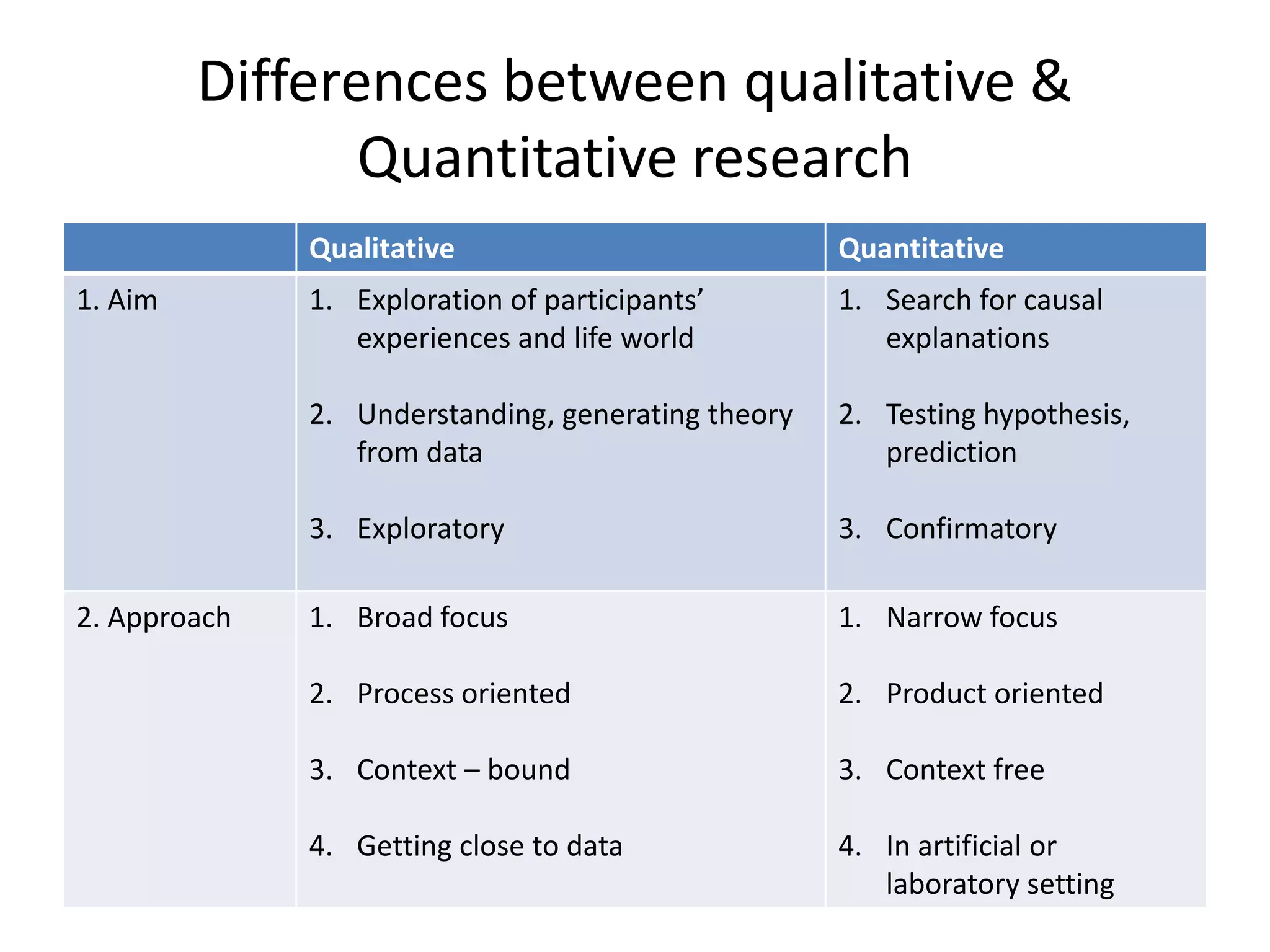
Differences between qualitative &
                Quantitative research
              Qualitative                           Quantitative
1. Aim        1. Exploration of participants’       1. Search for causal
                 experiences and life world            explanations

              2. Understanding, generating theory   2. Testing hypothesis,
                 from data                             prediction

              3. Exploratory                        3. Confirmatory

2. Approach   1. Broad focus                        1. Narrow focus

              2. Process oriented                   2. Product oriented

              3. Context – bound                    3. Context free

              4. Getting close to data              4. In artificial or
                                                       laboratory setting
Differences between qualitative &
            Quantitative research
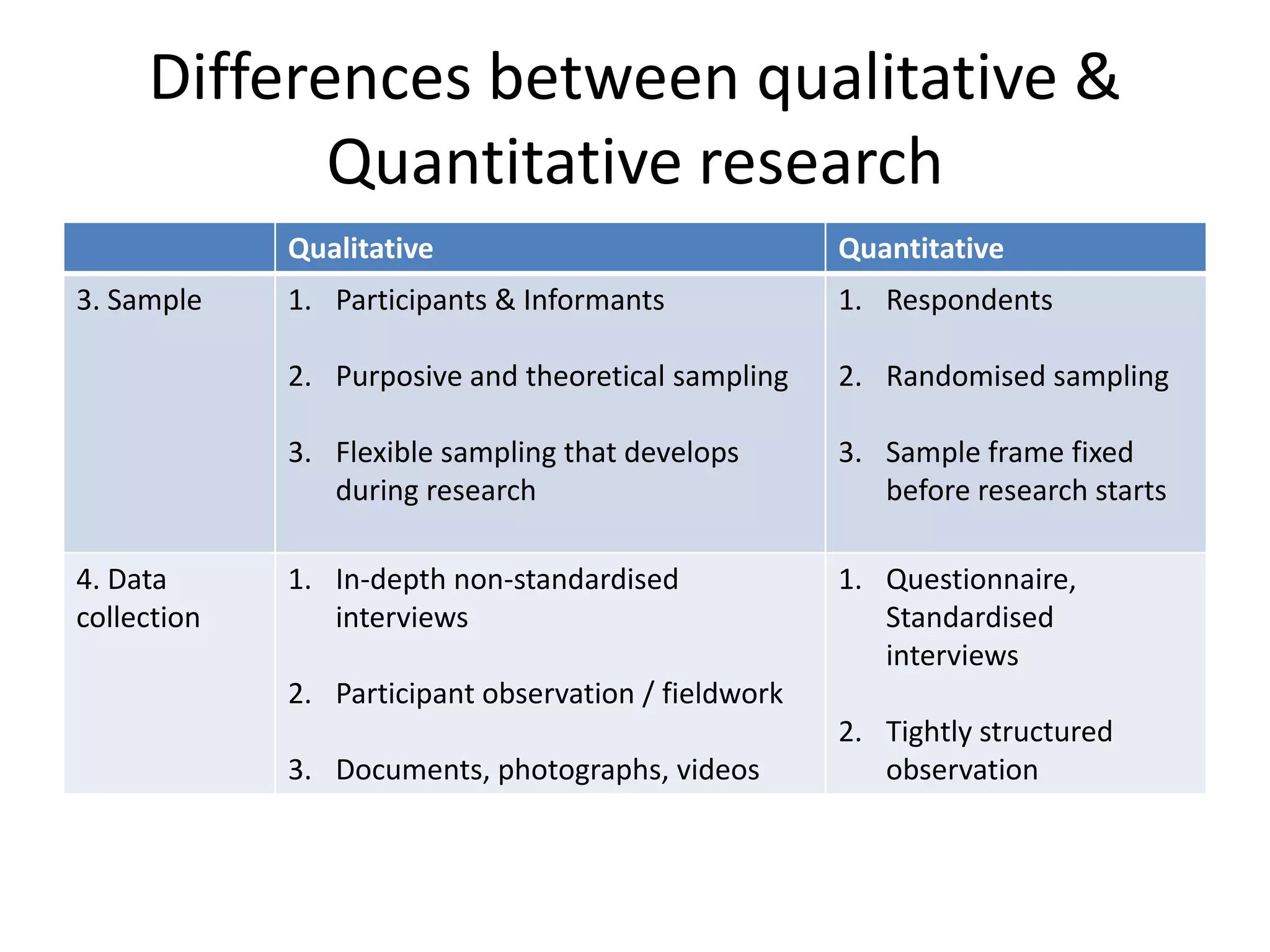
             Qualitative                              Quantitative
3. Sample    1. Participants & Informants             1. Respondents

             2. Purposive and theoretical sampling    2. Randomised sampling

             3. Flexible sampling that develops       3. Sample frame fixed
                during research                          before research starts

4. Data      1. In-depth non-standardised             1. Questionnaire,
collection      interviews                               Standardised
                                                         interviews
             2. Participant observation / fieldwork
                                                      2. Tightly structured
             3. Documents, photographs, videos           observation
Differences between qualitative &
            Quantitative research
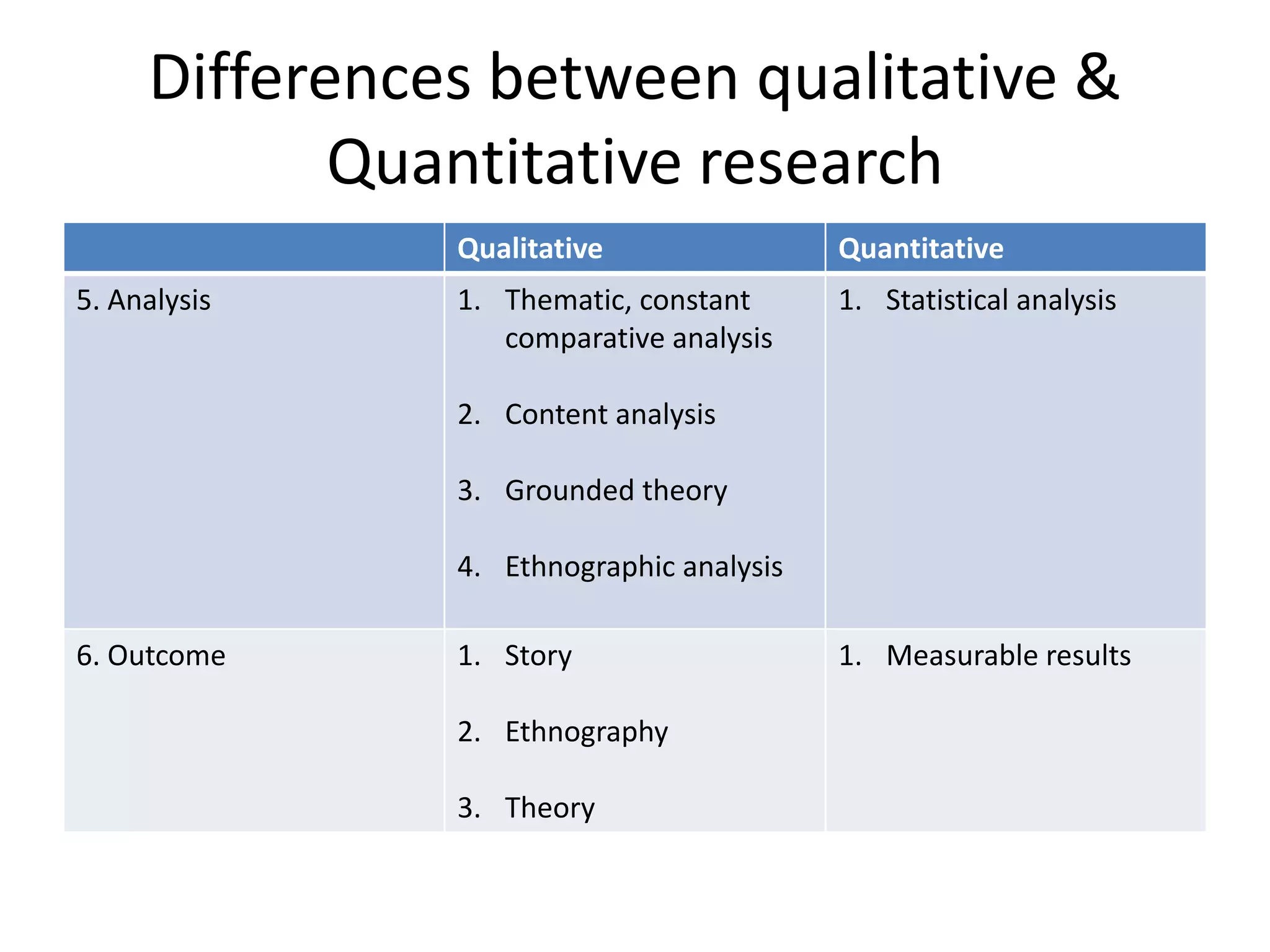
               Qualitative                Quantitative
5. Analysis    1. Thematic, constant      1. Statistical analysis
                  comparative analysis

               2. Content analysis

               3. Grounded theory

               4. Ethnographic analysis

6. Outcome     1. Story                   1. Measurable results

               2. Ethnography

               3. Theory
Differences between qualitative &
            Quantitative research
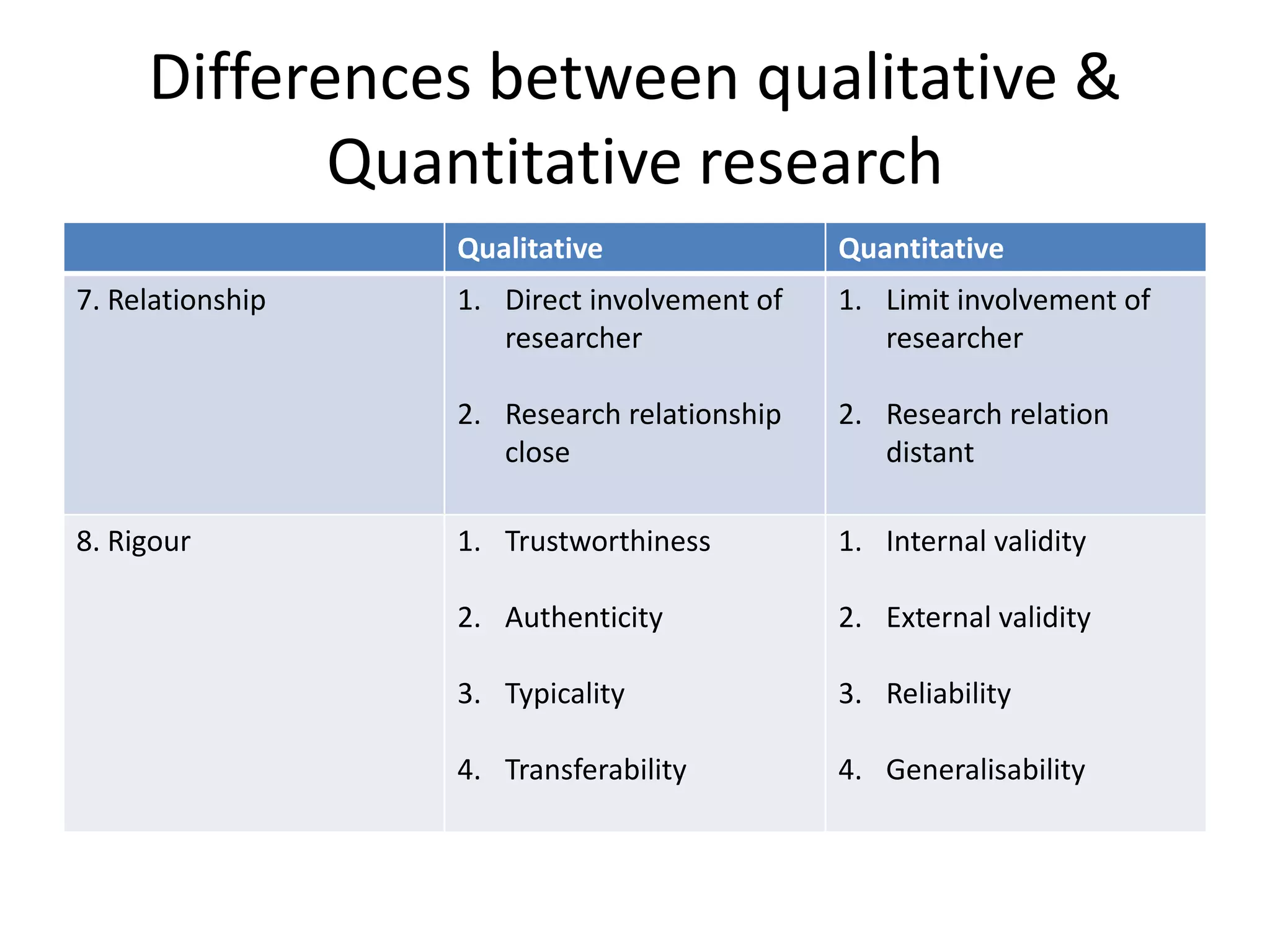
                  Qualitative                Quantitative
7. Relationship   1. Direct involvement of   1. Limit involvement of
                     researcher                 researcher

                  2. Research relationship   2. Research relation
                     close                      distant

8. Rigour         1. Trustworthiness         1. Internal validity

                  2. Authenticity            2. External validity

                  3. Typicality              3. Reliability

                  4. Transferability         4. Generalisability
Basic concepts of
Qualitative studies
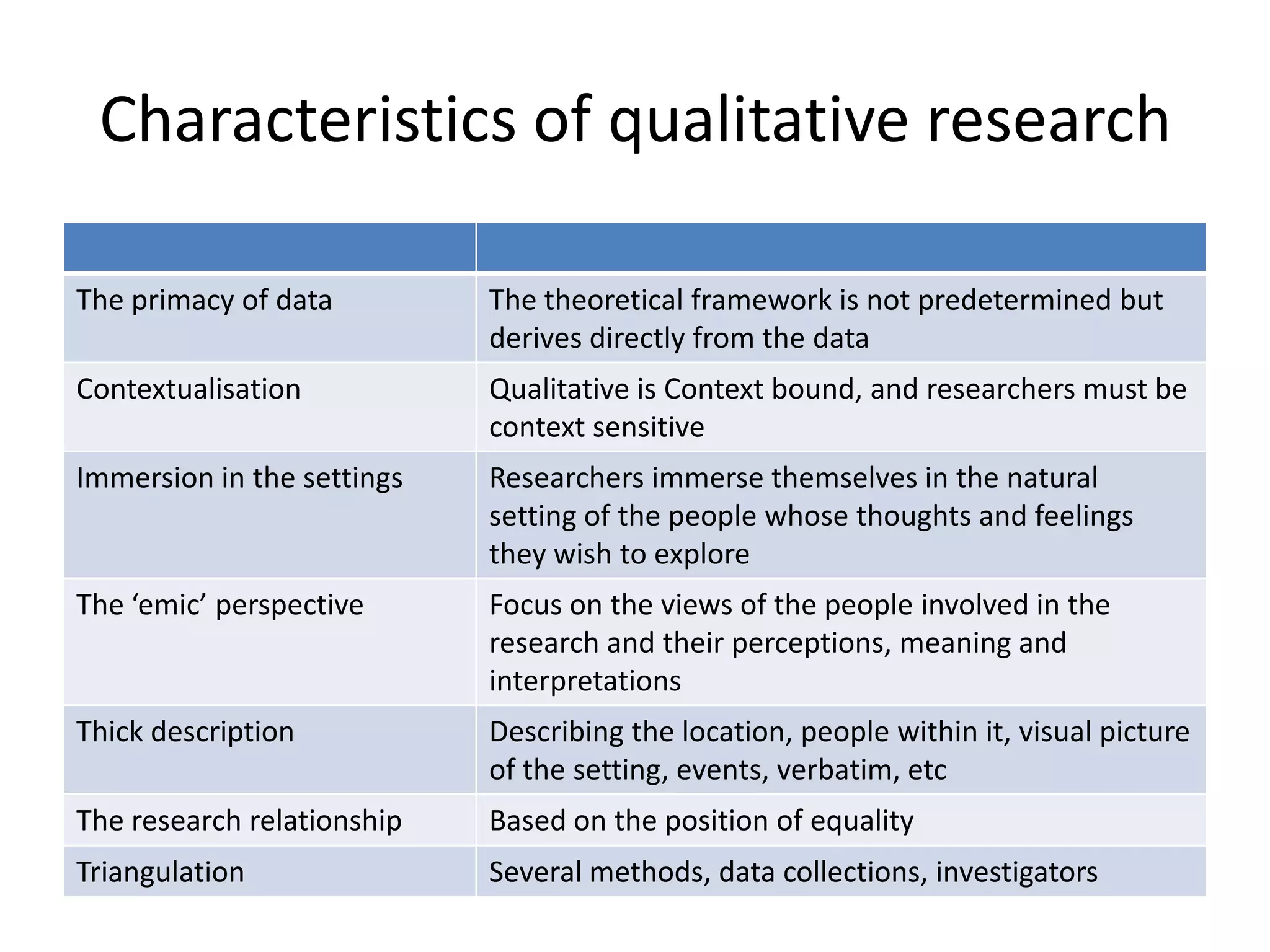
Characteristics of qualitative research

The primacy of data         The theoretical framework is not predetermined but
                            derives directly from the data
Contextualisation           Qualitative is Context bound, and researchers must be
                            context sensitive
Immersion in the settings   Researchers immerse themselves in the natural
                            setting of the people whose thoughts and feelings
                            they wish to explore
The ‘emic’ perspective      Focus on the views of the people involved in the
                            research and their perceptions, meaning and
                            interpretations
Thick description           Describing the location, people within it, visual picture
                            of the setting, events, verbatim, etc
The research relationship   Based on the position of equality
Triangulation               Several methods, data collections, investigators
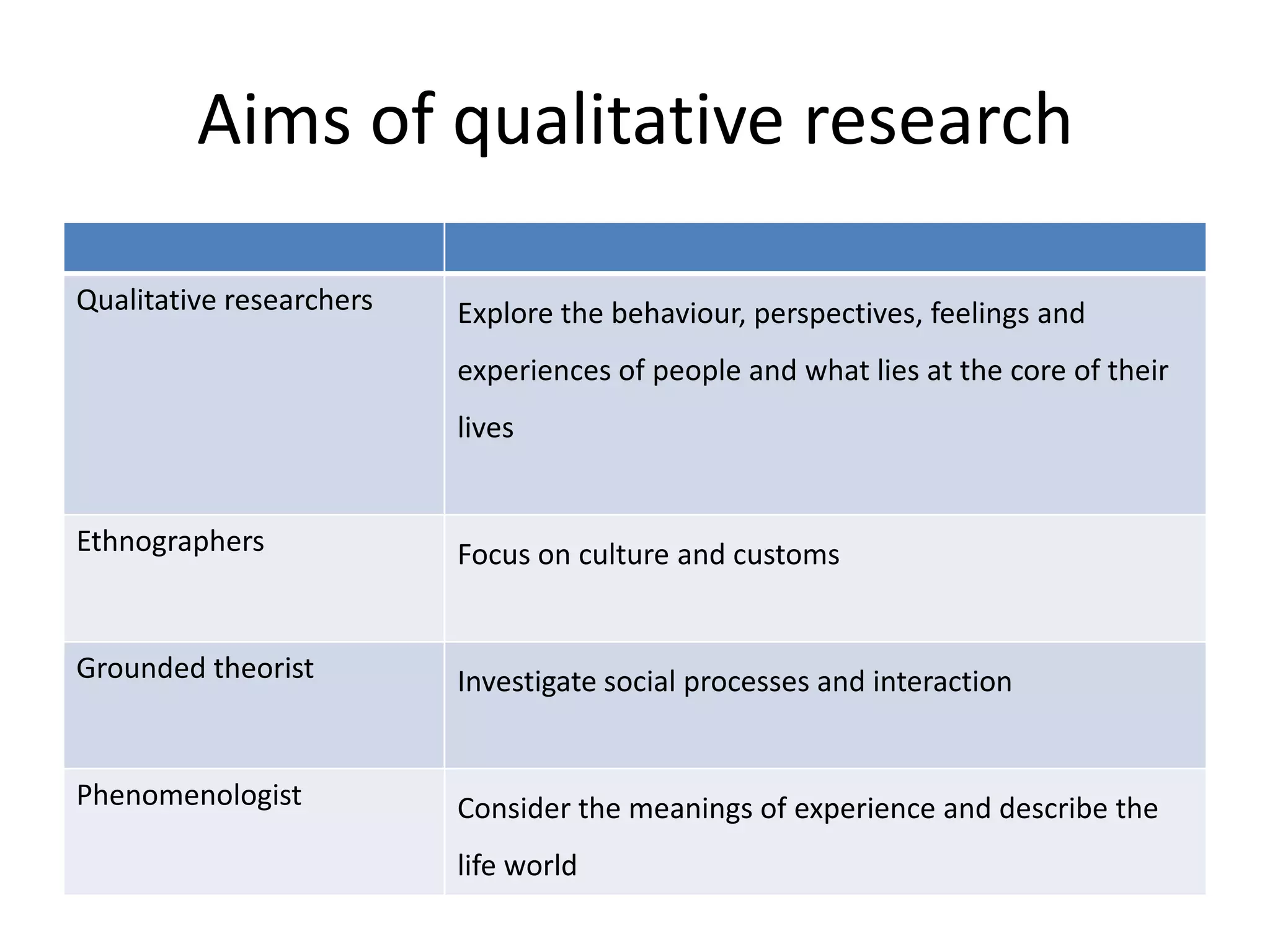
Aims of qualitative research

Qualitative researchers   Explore the behaviour, perspectives, feelings and
                          experiences of people and what lies at the core of their
                          lives


Ethnographers             Focus on culture and customs


Grounded theorist         Investigate social processes and interaction


Phenomenologist           Consider the meanings of experience and describe the
                          life world
Be Flexible
• We need to be FLEXIBLE when carrying out a qualitative study.

• There are many methods we can use to achieve the same learning
  objective.

• Also we can ask different kinds of questions to learn the same
  information.

• So, if we find that a method or question we are using isn’t being
  understood or isn’t working well, we can change methods or use a
  different question.

• This is unlike a household survey where methods and questions are fixed
  before we start collecting data.
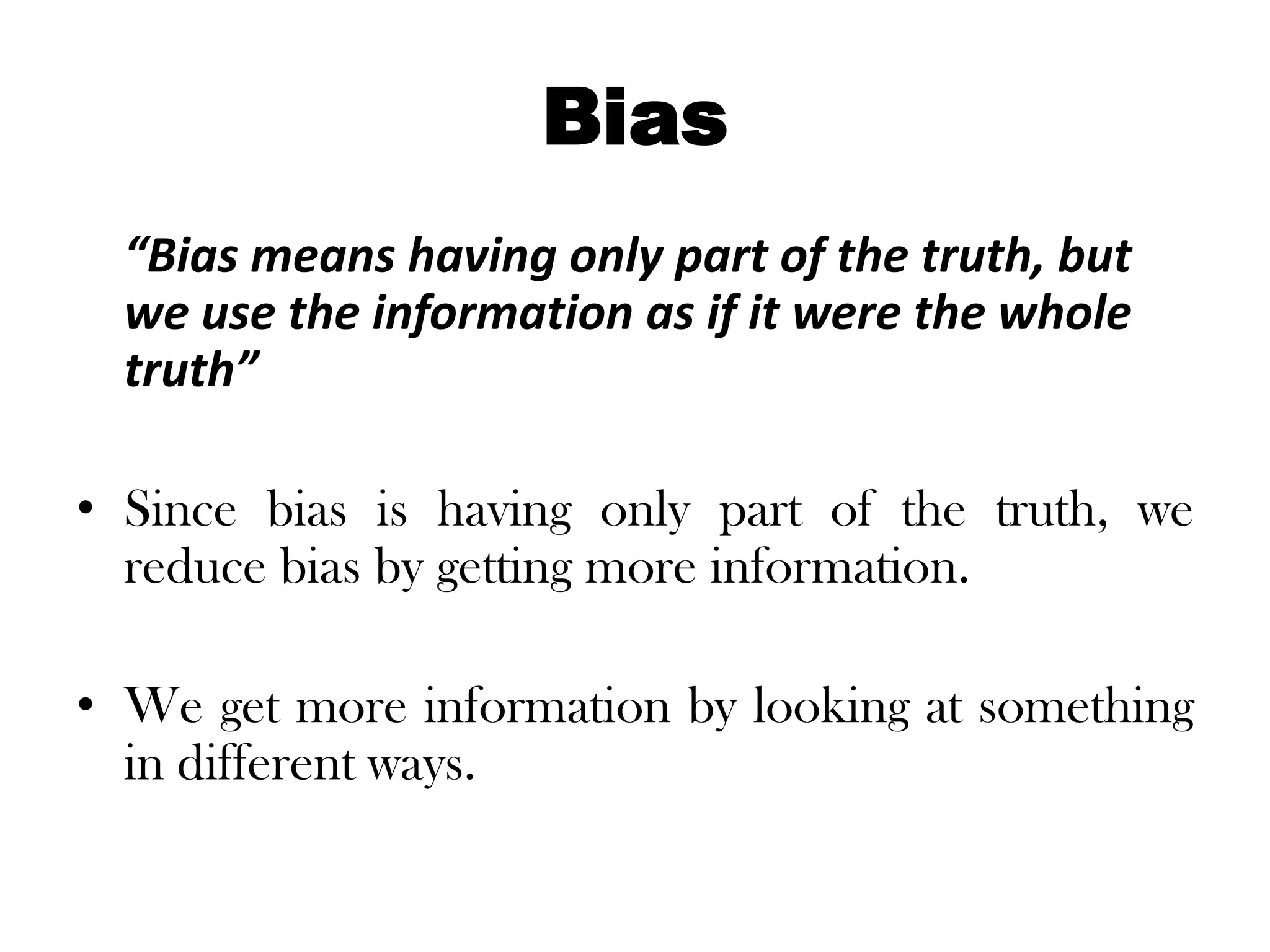
Bias
  “Bias means having only part of the truth, but
  we use the information as if it were the whole
  truth”

• Since bias is having only part of the truth, we
  reduce bias by getting more information.

• We get more information by looking at something
  in different ways.
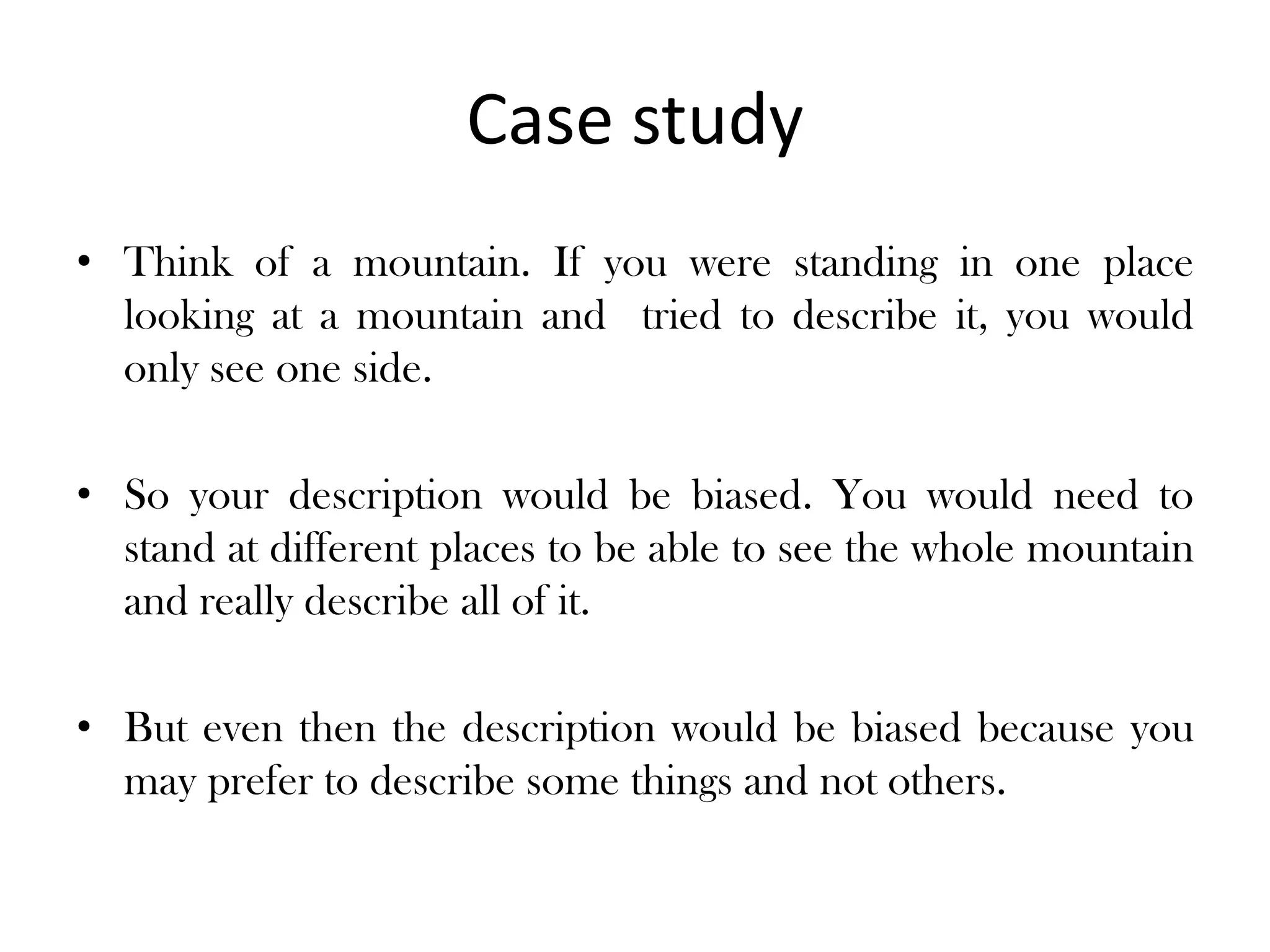
Case study
• Think of a mountain. If you were standing in one place
  looking at a mountain and tried to describe it, you would
  only see one side.

• So your description would be biased. You would need to
  stand at different places to be able to see the whole mountain
  and really describe all of it.

• But even then the description would be biased because you
  may prefer to describe some things and not others.
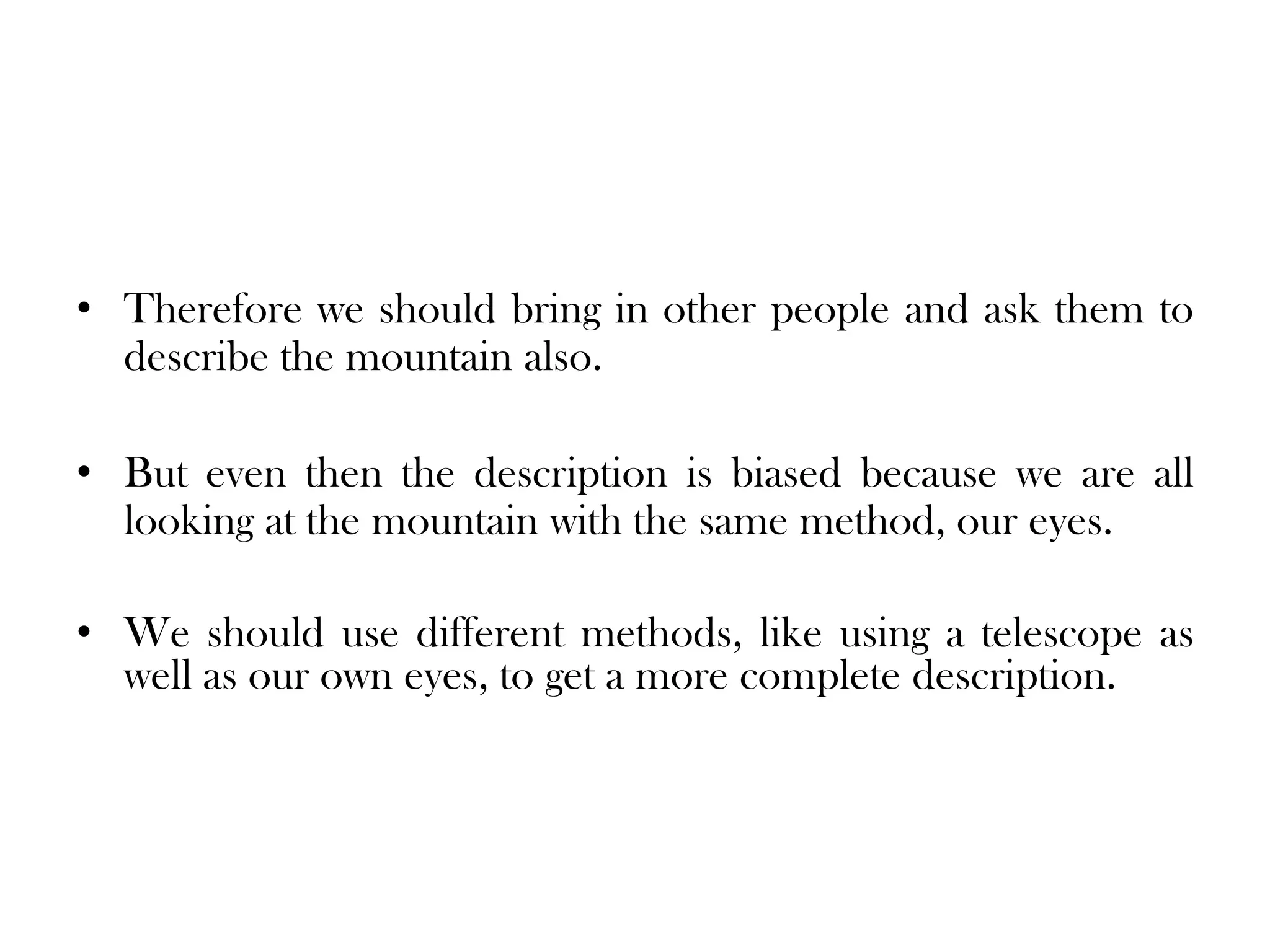
• Therefore we should bring in other people and ask them to
  describe the mountain also.

• But even then the description is biased because we are all
  looking at the mountain with the same method, our eyes.

• We should use different methods, like using a telescope as
  well as our own eyes, to get a more complete description.
• But the description is still biased because we are all looking at
  the mountain at the same time of year.

• Some months there may be snow on the mountain but not at
  other times, so we would want to look at different times of
  the year.

• There is a name for reducing bias by using different
  ways to study the same thing. It is called
  TRIANGULATION. We do this, triangulation, in
  qualitative studies to describe populations instead of
  mountains
Triangulation
Reduce bias by:

• Using team members with different
  experiences and perspectives

• Continuously cross-checking information using
  different methods and types of informants
  – Actively identify bias at the end of each day
  – Decide how to manage bias in days ahead
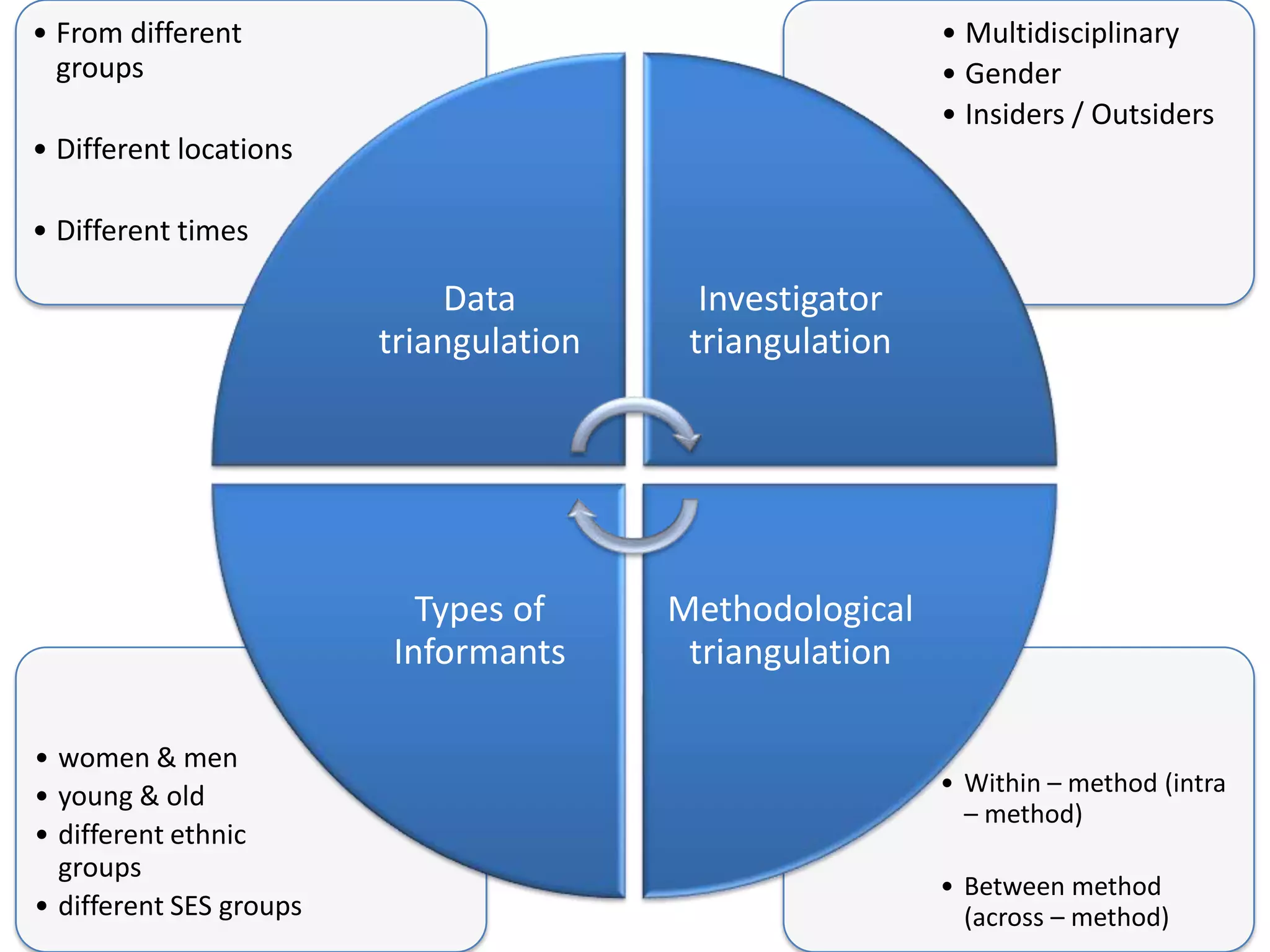
• From different                                          • Multidisciplinary
  groups                                                  • Gender
                                                          • Insiders / Outsiders
• Different locations

• Different times
                              Data         Investigator
                         triangulation    triangulation


                           Types of      Methodological
                         Informants       triangulation

• women & men
• young & old                                             • Within – method (intra
                                                            – method)
• different ethnic
  groups
                                                          • Between method
• different SES groups                                      (across – method)
Trustworthiness
• We sometimes say that we trust a person.
• With this we mean that his behaviour is predictable in that
  similar behaviour is expressed at different occasions and we
  believe that the person is not lying.

• A trustworthy person is someone who tells us the “truth” and
  dose so consistently.

• What then, is trustworthy research?

• How can we judge what findings are worth believing?
• Several criteria have been established within
  both quantitative and qualitative research to
  judge their trustworthiness or rigor.
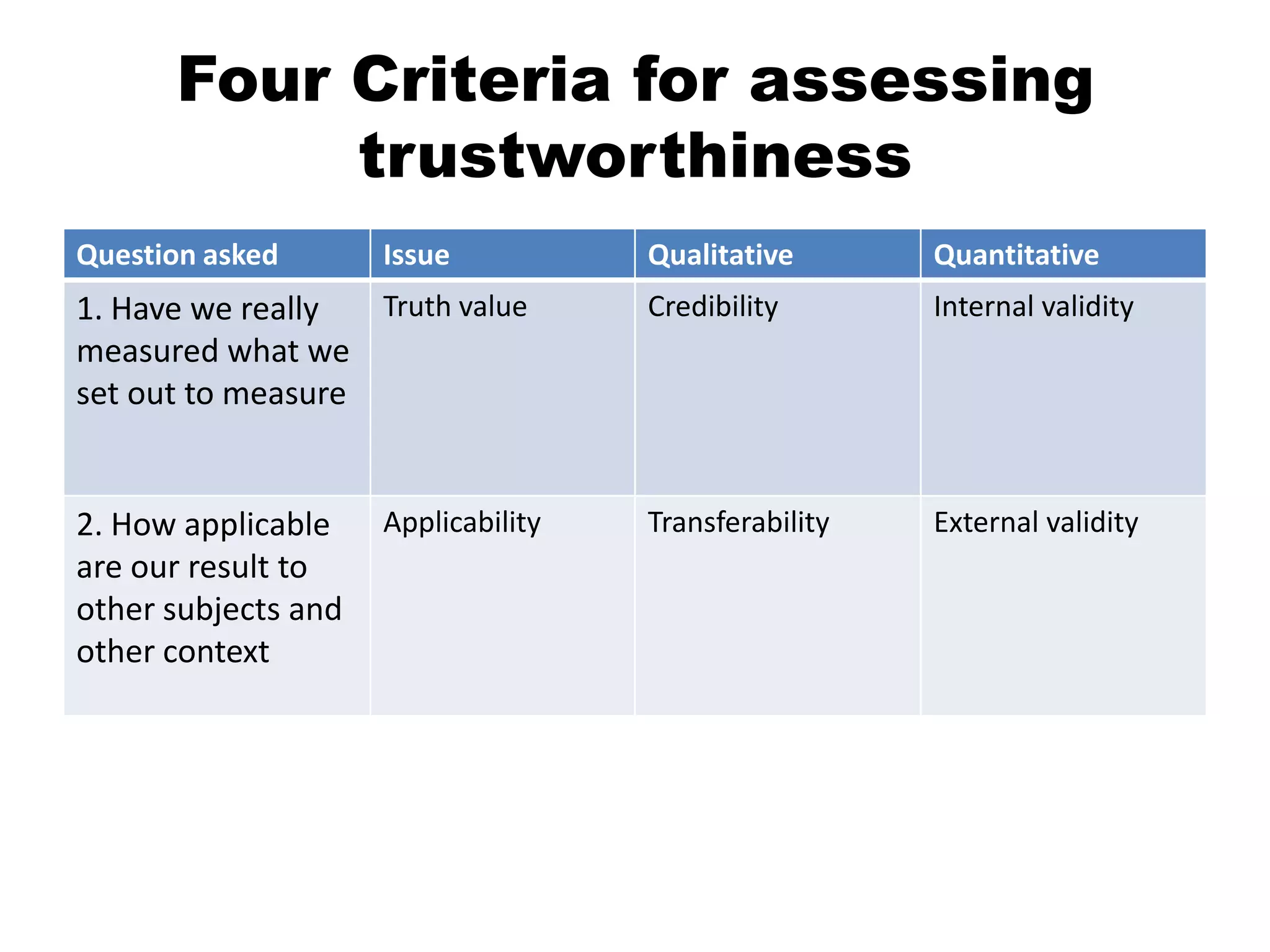
Four Criteria for assessing
           trustworthiness
Question asked       Issue           Qualitative       Quantitative
1. Have we really  Truth value       Credibility       Internal validity
measured what we
set out to measure


2. How applicable    Applicability   Transferability   External validity
are our result to
other subjects and
other context
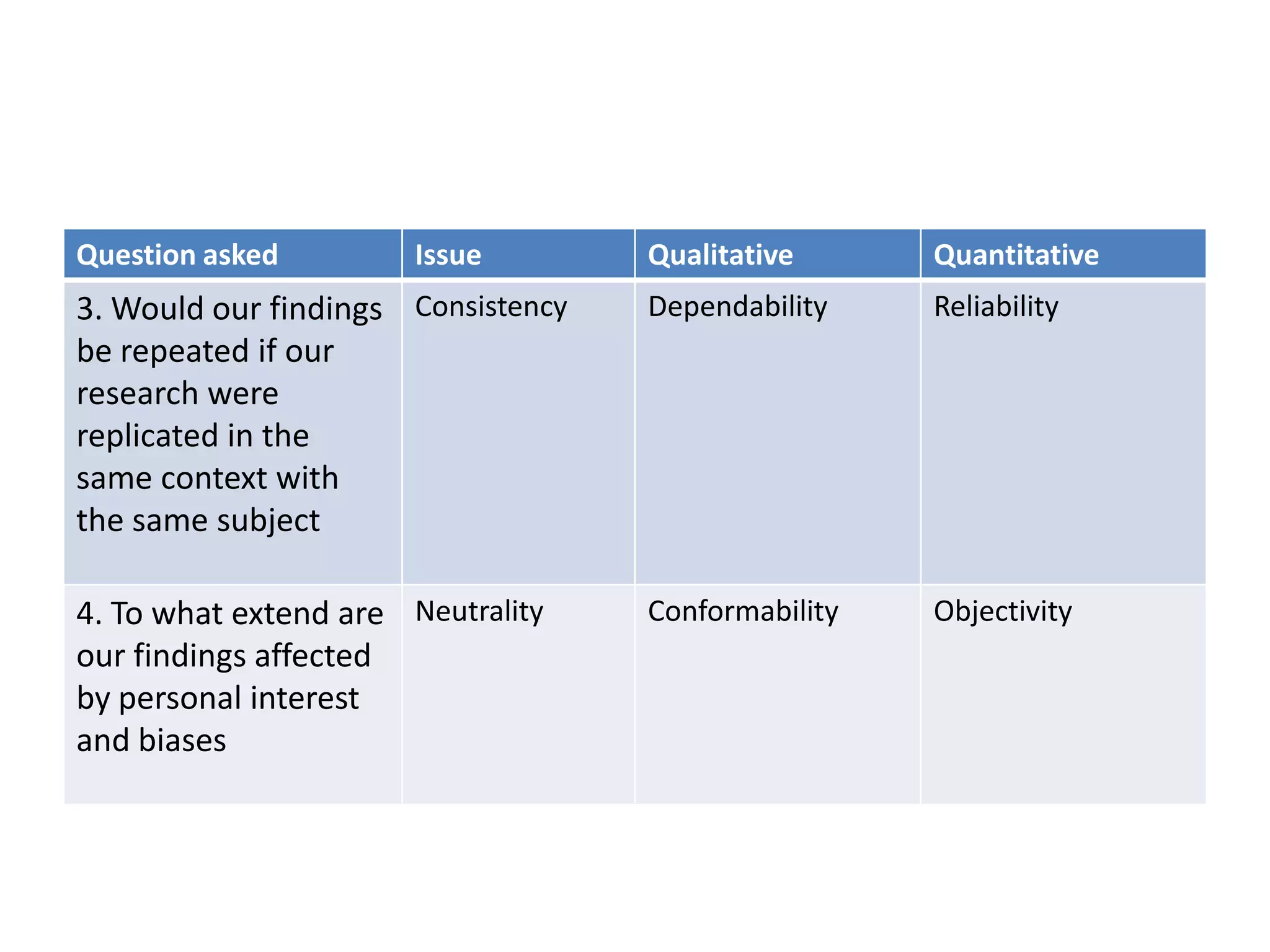
Question asked         Issue        Qualitative      Quantitative
3. Would our findings Consistency   Dependability    Reliability
be repeated if our
research were
replicated in the
same context with
the same subject

4. To what extend are Neutrality    Conformability   Objectivity
our findings affected
by personal interest
and biases
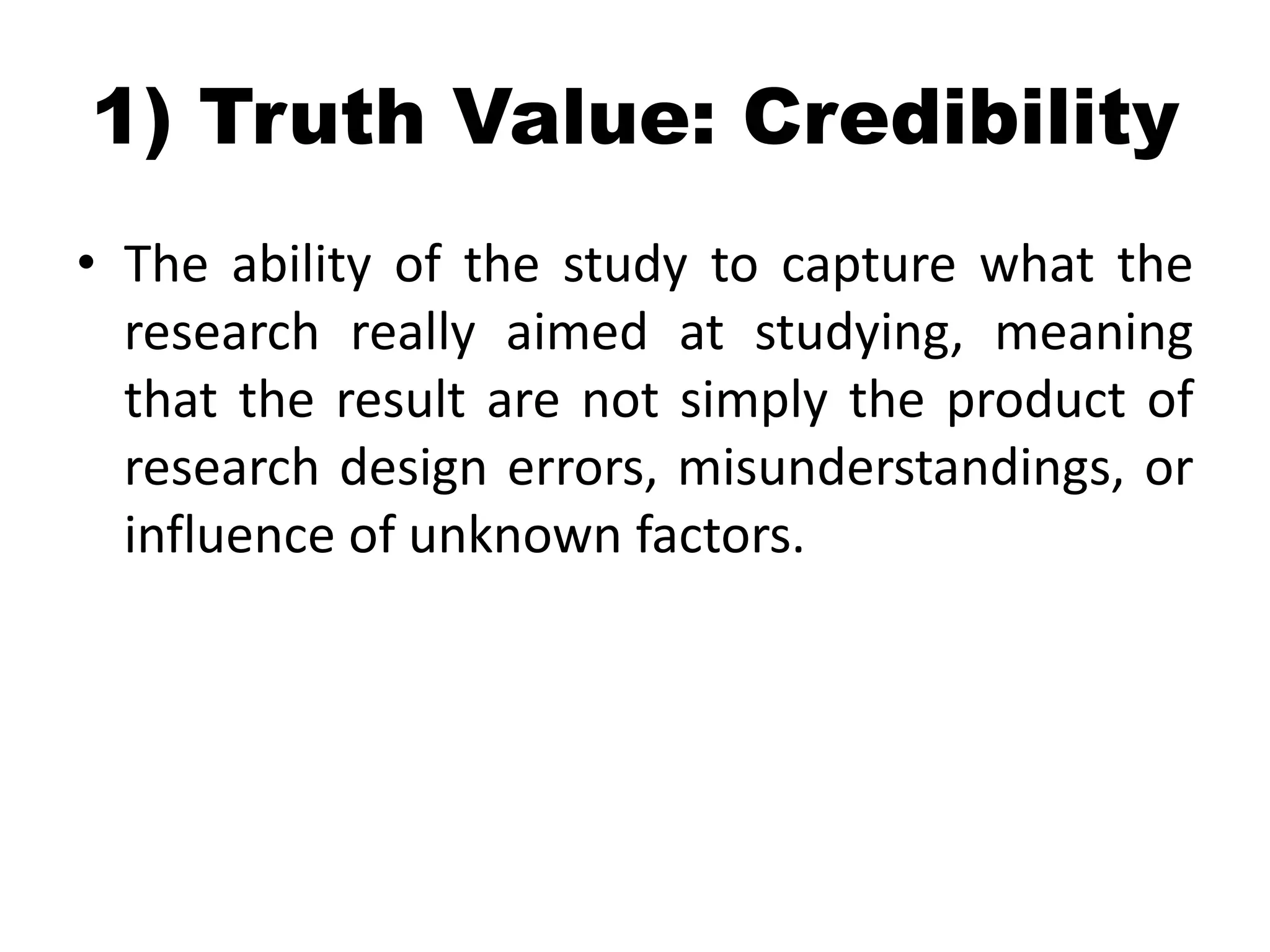
1) Truth Value: Credibility
• The ability of the study to capture what the
  research really aimed at studying, meaning
  that the result are not simply the product of
  research design errors, misunderstandings, or
  influence of unknown factors.


                             • = Internal validity in quant
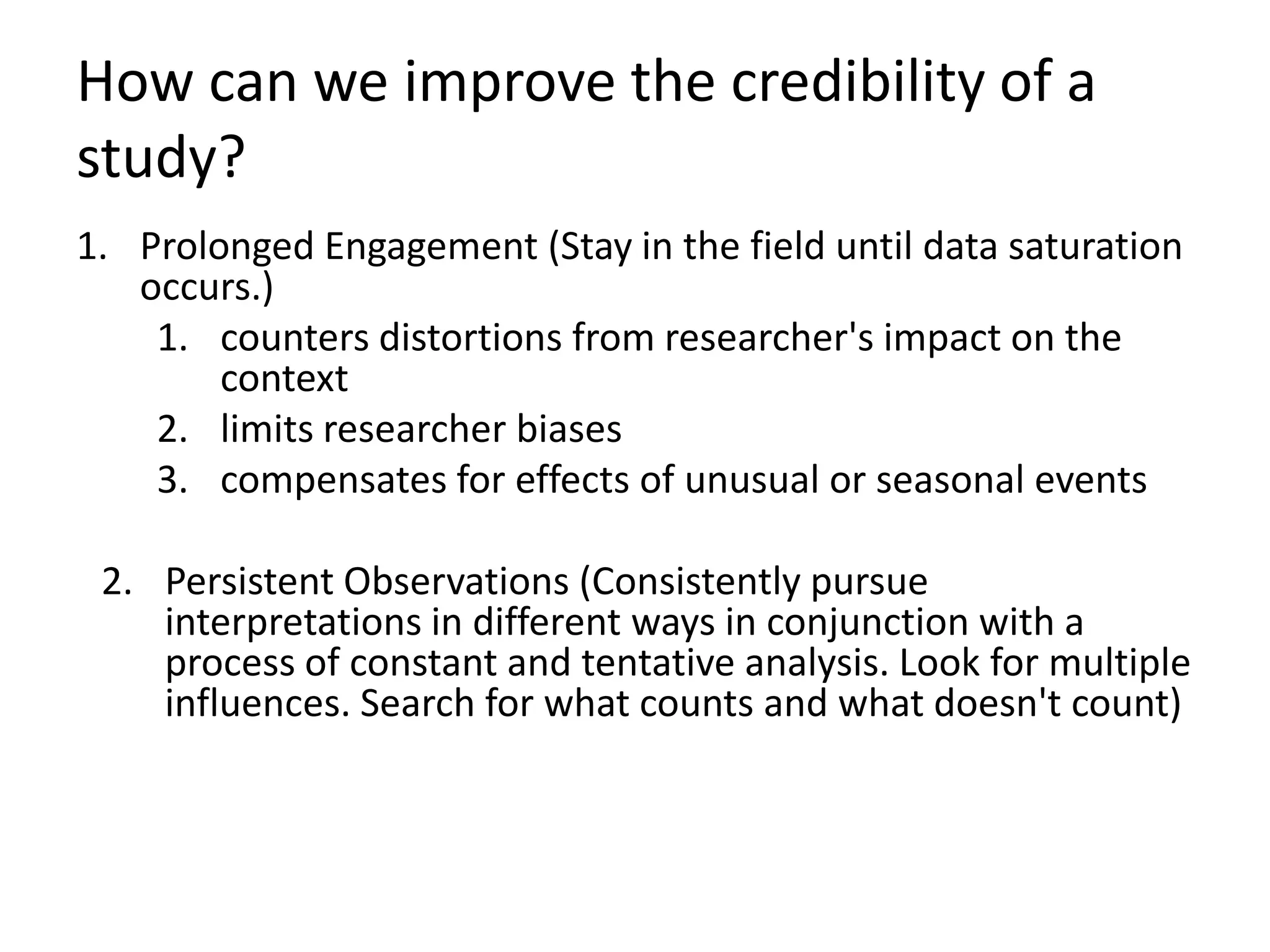
How can we improve the credibility of a
study?
1. Prolonged Engagement (Stay in the field until data saturation
   occurs.)
    1. counters distortions from researcher's impact on the
        context
    2. limits researcher biases
    3. compensates for effects of unusual or seasonal events

 2. Persistent Observations (Consistently pursue
    interpretations in different ways in conjunction with a
    process of constant and tentative analysis. Look for multiple
    influences. Search for what counts and what doesn't count)
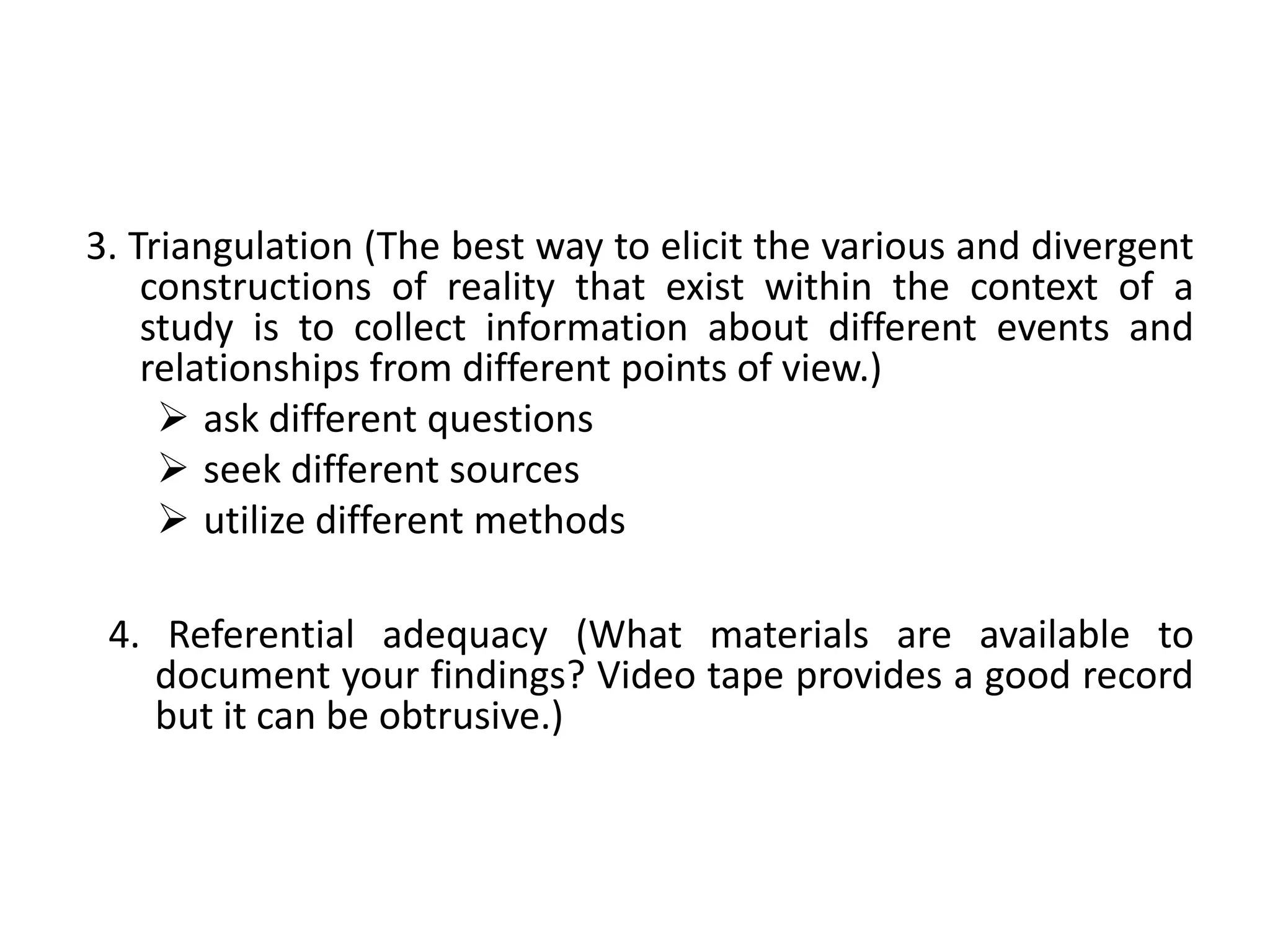
3. Triangulation (The best way to elicit the various and divergent
    constructions of reality that exist within the context of a
    study is to collect information about different events and
    relationships from different points of view.)
      ask different questions
      seek different sources
      utilize different methods

 4. Referential adequacy (What materials are available to
    document your findings? Video tape provides a good record
    but it can be obtrusive.)
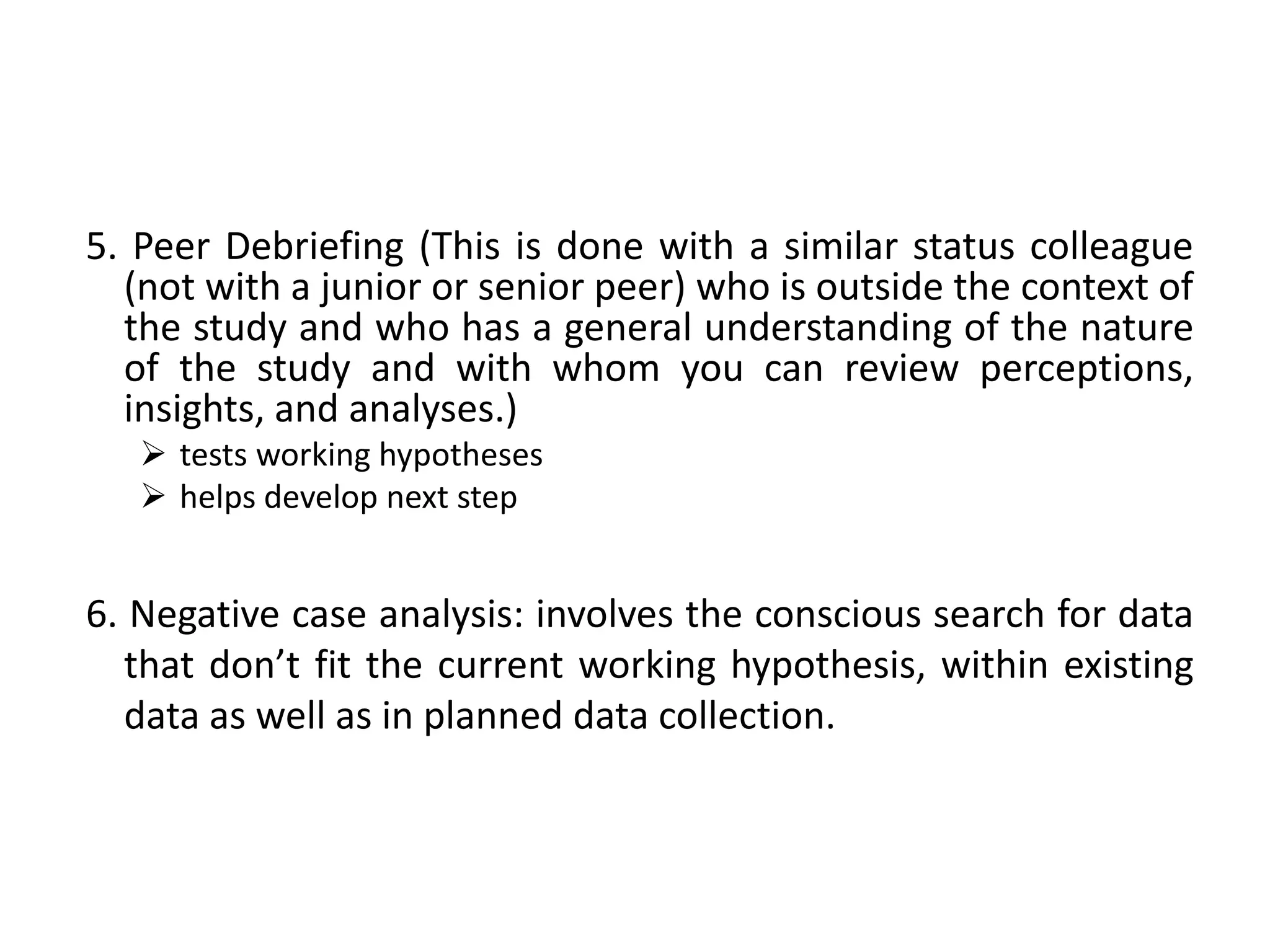
5. Peer Debriefing (This is done with a similar status colleague
  (not with a junior or senior peer) who is outside the context of
  the study and who has a general understanding of the nature
  of the study and with whom you can review perceptions,
  insights, and analyses.)
    tests working hypotheses
    helps develop next step


6. Negative case analysis: involves the conscious search for data
   that don’t fit the current working hypothesis, within existing
   data as well as in planned data collection.
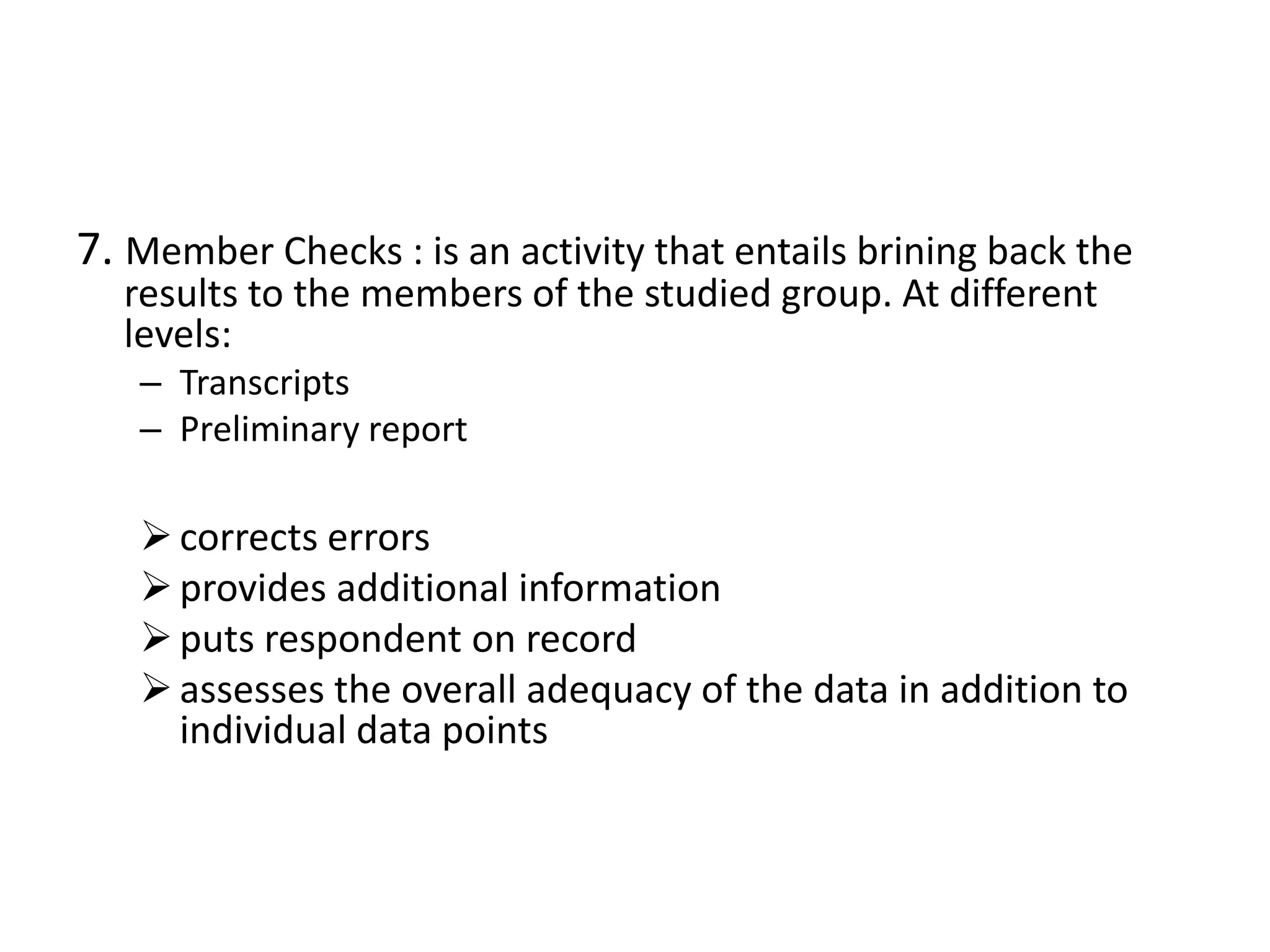
7. Member Checks : is an activity that entails brining back the
  results to the members of the studied group. At different
  levels:
   – Transcripts
   – Preliminary report

    corrects errors
    provides additional information
    puts respondent on record
    assesses the overall adequacy of the data in addition to
     individual data points
2) Applicability: Transferability
   Thick Description
    Because transferability is a naturalistic study depends on similarities
    between sending and receiving contexts, the researcher collects
    sufficiently detailed descriptions of data in context and reports
    them with sufficient detail and precision to allow judgments about
    transferability to be made by the reader.

   Purposive Sampling
    In contrast to random sampling that is usually done in a traditional
    study to gain a representative picture through aggregated qualities,
    naturalistic research seeks to maximize the range of specific
    information that can be obtained from and about that context by
    purposely selecting locations and informants that differ.
3) Consistency: Dependability
• An inquiry must also provide its audience with evidence that if
  it were replicated with the same or similar respondents
  (subjects) in the same (or a similar) context, its finding would
  be repeated

• Increasing Dependability
  To enable readers of the research report to develop a
  thorough understanding of the methods and their
  effectiveness, the text should include sections devoted to:
•   The research design and its implementation, describing what
    was planned and executed on a strategic level;

•   The operational detail of data gathering, addressing the
    minutiae of what was done in the field;

•   Reflective appraisal of the project, evaluating        the
    effectiveness of the process of inquiry undertaken.
4) Neutrality: Confirmability
• To what extend are our findings affected by personal interest
  and biases

• This is the degree to which the findings are the product of the
  focus of the inquiry and not of the biases of the researcher.)

Confirmability Audit Trail
• An adequate trail should be left to enable the auditor to
  determine if the conclusions, interpretations, and
  recommendations can be traced to their sources and if they
  are supported by the inquiry
END

1. Introduction to qualitative research by Elmusharaf

  • 1.
    1) Introduction to Qualitative Research Training Course in Sexual and Reproductive Health Research Geneva 2012 Dr. Khalifa Elmusharaf MBBS, PGDip, FRSPH, PhD researcher Health System & Policy RCRU / UMST Elmusharaf K. Introduction to qualitative research. Paper presented at: Training Course in Sexual and Reproductive Health Research; 2012 Jul 24; Geneva. Available from: http://www.gfmer.ch/SRH-Course-2012/research-methodology/Introduction-qualitative research-Elmusharaf-2012.htm
  • 2.
    Objective of Presentation By the end of this presentation you should be able to: • Describe what is qualitative research • Demonstrate the differences between Qualitative & Quantitative research • Understand the basic concepts of Qualitative studies: – Characteristics of qualitative research – Bias – Triangulation – Trustworthiness This presentation will be followed by presentations about 1. Qualitative Sampling Techniques 2. Qualitative Data collection techniques 3. Qualitative Research methods 4. Qualitative Data Analysis
  • 3.
  • 4.
    • When wework with any population we are working with people whose situation, background and often even their culture is are different from our own. • Qualitative methods will help you to better understand another people and avoid misunderstandings. • Lack of understanding and misunderstandings are frequent causes of program failures.
  • 5.
    Case study • Agroup of researchers from RCRU were working in a village in South Sudan. They did a survey of villagers and asked them what were the most serious problems. The villagers said that one of the most serious problems was malaria. • The researchers tested the blood of some of the villagers and found that malaria was very common. They gave people in the village bed- nets soaked in insecticide and told them that using the nets would decrease malaria. • The people started using the nets. The research team tested the blood of the people and found that there was a big reduction in malaria for those people that used the nets. So they felt the program was successful.
  • 6.
    • Later someother researchers came to the village. They found the people no longer used the nets. They said that they didn’t work. • The villagers were sceptical of outsiders and were less interested in cooperating in programs to reduce malaria. Question: • What are possible reasons that the people stopped using the nets?
  • 7.
    the real reason: •In this case the reason the villagers stopped using the nets was a misunderstanding. • By ‘malaria’ the researchers meant infection with the malaria parasite. But the villagers meant all fevers. • Therefore, although the number of ‘malaria infections’ decreased, the total number of ‘all fevers’ did not change much in the community’s eyes. • For this reason, they felt the nets did not work against what the community called ‘malaria’ and abandoned using the nets. Question: • Ask yourself: How could we have discovered the real reason?
  • 8.
    Qualitative Research • Theseare research methods which obtain a lot of in-depth information from people. • The aim is to understand WHY people think and behave the way they do. • Because we spend a lot of time with people to get this information we usually can only talk with a FEW people.
  • 9.
    • This isdifferent from quantitative methods like surveys. • In quantitative research we obtain relatively little detailed information from each person. • This is because with quantitative methods we are interested in describing WHAT people do (things like how many people have had vaccinations, how many people know about ORS) - without really wanting details about why the situation is like that. • Because we need less time with people to get this information, we can interview A LOT OF people.
  • 10.
    • Both qualitativeand quantitative methods are important, and whether we use one or the other depends on what we are trying to learn. • Quantitative approaches are important and solve many type of research problem. Qualitative research is appropriate for different type of questions.
  • 11.
    • Qualitative researchis a form of social inquiry that focuses on the way people interpret and make sense of their experiences and the world in which they live. • Understand the social reality of individuals, groups and cultures.
  • 12.
    Differences between Qualitative &Quantitative research
  • 13.
    Differences between qualitative& Quantitative research Qualitative Quantitative 1. Aim 1. Exploration of participants’ 1. Search for causal experiences and life world explanations 2. Understanding, generating theory 2. Testing hypothesis, from data prediction 3. Exploratory 3. Confirmatory 2. Approach 1. Broad focus 1. Narrow focus 2. Process oriented 2. Product oriented 3. Context – bound 3. Context free 4. Getting close to data 4. In artificial or laboratory setting
  • 14.
    Differences between qualitative& Quantitative research Qualitative Quantitative 3. Sample 1. Participants & Informants 1. Respondents 2. Purposive and theoretical sampling 2. Randomised sampling 3. Flexible sampling that develops 3. Sample frame fixed during research before research starts 4. Data 1. In-depth non-standardised 1. Questionnaire, collection interviews Standardised interviews 2. Participant observation / fieldwork 2. Tightly structured 3. Documents, photographs, videos observation
  • 15.
    Differences between qualitative& Quantitative research Qualitative Quantitative 5. Analysis 1. Thematic, constant 1. Statistical analysis comparative analysis 2. Content analysis 3. Grounded theory 4. Ethnographic analysis 6. Outcome 1. Story 1. Measurable results 2. Ethnography 3. Theory
  • 16.
    Differences between qualitative& Quantitative research Qualitative Quantitative 7. Relationship 1. Direct involvement of 1. Limit involvement of researcher researcher 2. Research relationship 2. Research relation close distant 8. Rigour 1. Trustworthiness 1. Internal validity 2. Authenticity 2. External validity 3. Typicality 3. Reliability 4. Transferability 4. Generalisability
  • 17.
  • 18.
    Characteristics of qualitativeresearch The primacy of data The theoretical framework is not predetermined but derives directly from the data Contextualisation Qualitative is Context bound, and researchers must be context sensitive Immersion in the settings Researchers immerse themselves in the natural setting of the people whose thoughts and feelings they wish to explore The ‘emic’ perspective Focus on the views of the people involved in the research and their perceptions, meaning and interpretations Thick description Describing the location, people within it, visual picture of the setting, events, verbatim, etc The research relationship Based on the position of equality Triangulation Several methods, data collections, investigators
  • 19.
    Aims of qualitativeresearch Qualitative researchers Explore the behaviour, perspectives, feelings and experiences of people and what lies at the core of their lives Ethnographers Focus on culture and customs Grounded theorist Investigate social processes and interaction Phenomenologist Consider the meanings of experience and describe the life world
  • 20.
    Be Flexible • Weneed to be FLEXIBLE when carrying out a qualitative study. • There are many methods we can use to achieve the same learning objective. • Also we can ask different kinds of questions to learn the same information. • So, if we find that a method or question we are using isn’t being understood or isn’t working well, we can change methods or use a different question. • This is unlike a household survey where methods and questions are fixed before we start collecting data.
  • 21.
    Bias “Biasmeans having only part of the truth, but we use the information as if it were the whole truth” • Since bias is having only part of the truth, we reduce bias by getting more information. • We get more information by looking at something in different ways.
  • 22.
    Case study • Thinkof a mountain. If you were standing in one place looking at a mountain and tried to describe it, you would only see one side. • So your description would be biased. You would need to stand at different places to be able to see the whole mountain and really describe all of it. • But even then the description would be biased because you may prefer to describe some things and not others.
  • 23.
    • Therefore weshould bring in other people and ask them to describe the mountain also. • But even then the description is biased because we are all looking at the mountain with the same method, our eyes. • We should use different methods, like using a telescope as well as our own eyes, to get a more complete description.
  • 24.
    • But thedescription is still biased because we are all looking at the mountain at the same time of year. • Some months there may be snow on the mountain but not at other times, so we would want to look at different times of the year. • There is a name for reducing bias by using different ways to study the same thing. It is called TRIANGULATION. We do this, triangulation, in qualitative studies to describe populations instead of mountains
  • 25.
    Triangulation Reduce bias by: •Using team members with different experiences and perspectives • Continuously cross-checking information using different methods and types of informants – Actively identify bias at the end of each day – Decide how to manage bias in days ahead
  • 26.
    • From different • Multidisciplinary groups • Gender • Insiders / Outsiders • Different locations • Different times Data Investigator triangulation triangulation Types of Methodological Informants triangulation • women & men • young & old • Within – method (intra – method) • different ethnic groups • Between method • different SES groups (across – method)
  • 27.
    Trustworthiness • We sometimessay that we trust a person. • With this we mean that his behaviour is predictable in that similar behaviour is expressed at different occasions and we believe that the person is not lying. • A trustworthy person is someone who tells us the “truth” and dose so consistently. • What then, is trustworthy research? • How can we judge what findings are worth believing?
  • 28.
    • Several criteriahave been established within both quantitative and qualitative research to judge their trustworthiness or rigor.
  • 29.
    Four Criteria forassessing trustworthiness Question asked Issue Qualitative Quantitative 1. Have we really Truth value Credibility Internal validity measured what we set out to measure 2. How applicable Applicability Transferability External validity are our result to other subjects and other context
  • 30.
    Question asked Issue Qualitative Quantitative 3. Would our findings Consistency Dependability Reliability be repeated if our research were replicated in the same context with the same subject 4. To what extend are Neutrality Conformability Objectivity our findings affected by personal interest and biases
  • 31.
    1) Truth Value:Credibility • The ability of the study to capture what the research really aimed at studying, meaning that the result are not simply the product of research design errors, misunderstandings, or influence of unknown factors. • = Internal validity in quant
  • 32.
    How can weimprove the credibility of a study? 1. Prolonged Engagement (Stay in the field until data saturation occurs.) 1. counters distortions from researcher's impact on the context 2. limits researcher biases 3. compensates for effects of unusual or seasonal events 2. Persistent Observations (Consistently pursue interpretations in different ways in conjunction with a process of constant and tentative analysis. Look for multiple influences. Search for what counts and what doesn't count)
  • 33.
    3. Triangulation (Thebest way to elicit the various and divergent constructions of reality that exist within the context of a study is to collect information about different events and relationships from different points of view.)  ask different questions  seek different sources  utilize different methods 4. Referential adequacy (What materials are available to document your findings? Video tape provides a good record but it can be obtrusive.)
  • 34.
    5. Peer Debriefing(This is done with a similar status colleague (not with a junior or senior peer) who is outside the context of the study and who has a general understanding of the nature of the study and with whom you can review perceptions, insights, and analyses.)  tests working hypotheses  helps develop next step 6. Negative case analysis: involves the conscious search for data that don’t fit the current working hypothesis, within existing data as well as in planned data collection.
  • 35.
    7. Member Checks: is an activity that entails brining back the results to the members of the studied group. At different levels: – Transcripts – Preliminary report  corrects errors  provides additional information  puts respondent on record  assesses the overall adequacy of the data in addition to individual data points
  • 36.
    2) Applicability: Transferability  Thick Description Because transferability is a naturalistic study depends on similarities between sending and receiving contexts, the researcher collects sufficiently detailed descriptions of data in context and reports them with sufficient detail and precision to allow judgments about transferability to be made by the reader.  Purposive Sampling In contrast to random sampling that is usually done in a traditional study to gain a representative picture through aggregated qualities, naturalistic research seeks to maximize the range of specific information that can be obtained from and about that context by purposely selecting locations and informants that differ.
  • 37.
    3) Consistency: Dependability •An inquiry must also provide its audience with evidence that if it were replicated with the same or similar respondents (subjects) in the same (or a similar) context, its finding would be repeated • Increasing Dependability To enable readers of the research report to develop a thorough understanding of the methods and their effectiveness, the text should include sections devoted to:
  • 38.
    The research design and its implementation, describing what was planned and executed on a strategic level; • The operational detail of data gathering, addressing the minutiae of what was done in the field; • Reflective appraisal of the project, evaluating the effectiveness of the process of inquiry undertaken.
  • 39.
    4) Neutrality: Confirmability •To what extend are our findings affected by personal interest and biases • This is the degree to which the findings are the product of the focus of the inquiry and not of the biases of the researcher.) Confirmability Audit Trail • An adequate trail should be left to enable the auditor to determine if the conclusions, interpretations, and recommendations can be traced to their sources and if they are supported by the inquiry
  • 40.