Downloaded 369 times


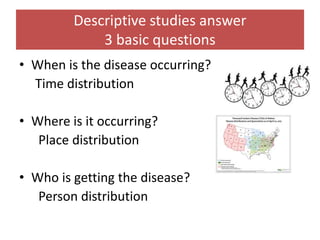
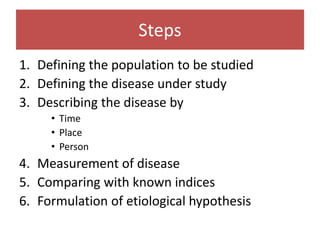








This document provides an overview of descriptive epidemiology. Descriptive epidemiology involves studying the distribution and determinants of health-related states or events in specified populations, without comparing groups. The main objectives are to describe the incidence, prevalence, and natural history of diseases and their distribution according to person, place and time. Descriptive studies make hypotheses about potential causes, but do not confirm them due to the lack of a comparison group. Key steps include defining the population and disease, describing disease distribution by time, place and person, measuring disease occurrence, comparing to known indices, and formulating etiological hypotheses.


