
Javed Iqbal and Keilah Kane
EDPY 559
Group Presentation
By the end of this session course participants could be
able to;
 Define case study,
 Differentiate among different types of case studies,
 Discuss the relationship between theory and case
study,
 Share issues pertinent to case study.
Questions
 What do you mean by Case
study?
 What kinds of research
questions are phrased for case
study?
 In what kind of situation should
you opt for case study?
 Have any of you conducted
research using case study? If so
please tell us about it!
Phenomenon
ContextInvestigation
Researcher
Stake (1995) Yin (2003), Creswell, J. (1998) Baxter, P. (2003)
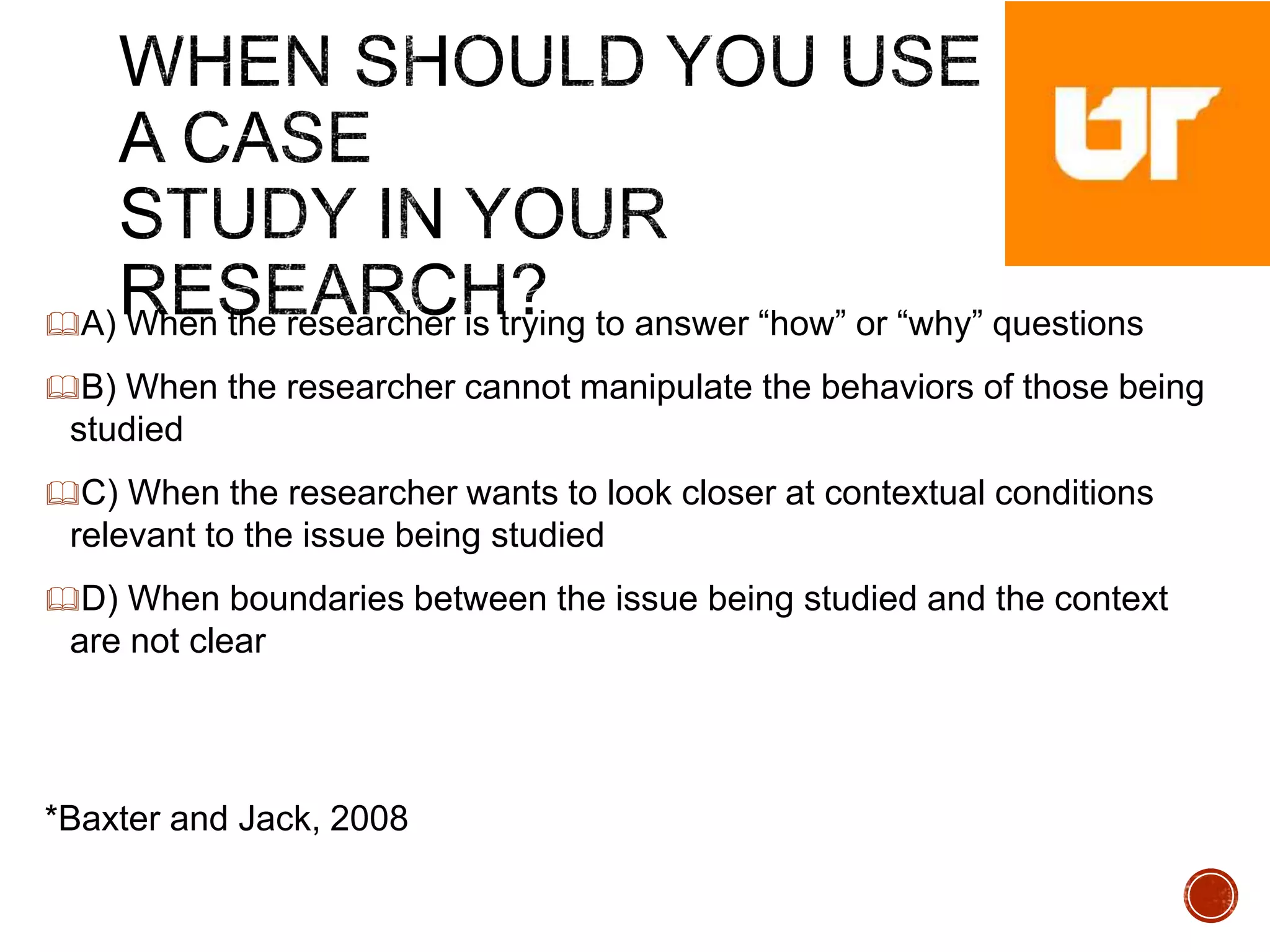
A) When the researcher is trying to answer “how” or “why” questions
B) When the researcher cannot manipulate the behaviors of those being
studied
C) When the researcher wants to look closer at contextual conditions
relevant to the issue being studied
D) When boundaries between the issue being studied and the context
are not clear
*Baxter and Jack, 2008
Miles and Huberman (1994) stated case study as, “a
phenomenon of some sort occurring in a bounded context.
The case is, “in effect, your unit of analysis” (p. 25).
Determine what your case study will NOT be
Individual, program, or process
Watch for some specifics!
What identifies this example as a case study?
What were the methods of data collection?
What did the researchers conclude?
 Groat Sleep Center - https://www.youtube.com/watch?v=-Ygvt7G1DLs
Theory-building approach vs. theory-testing approach
Theory of the case
Theory for the case (deductive)
Theory from the case (Inductive)
Theory and case (dialogic model)
(Rule & John, 2015)
Explanatory
Exploratory
Descriptive
Employed to study
Multiple-case studies
Intrinsic
Instrumental
Collective
Group No. 1
Explanatory
Descriptive
Instrumental
Group. No. 2
Exploratory
Intrinsic
Collective
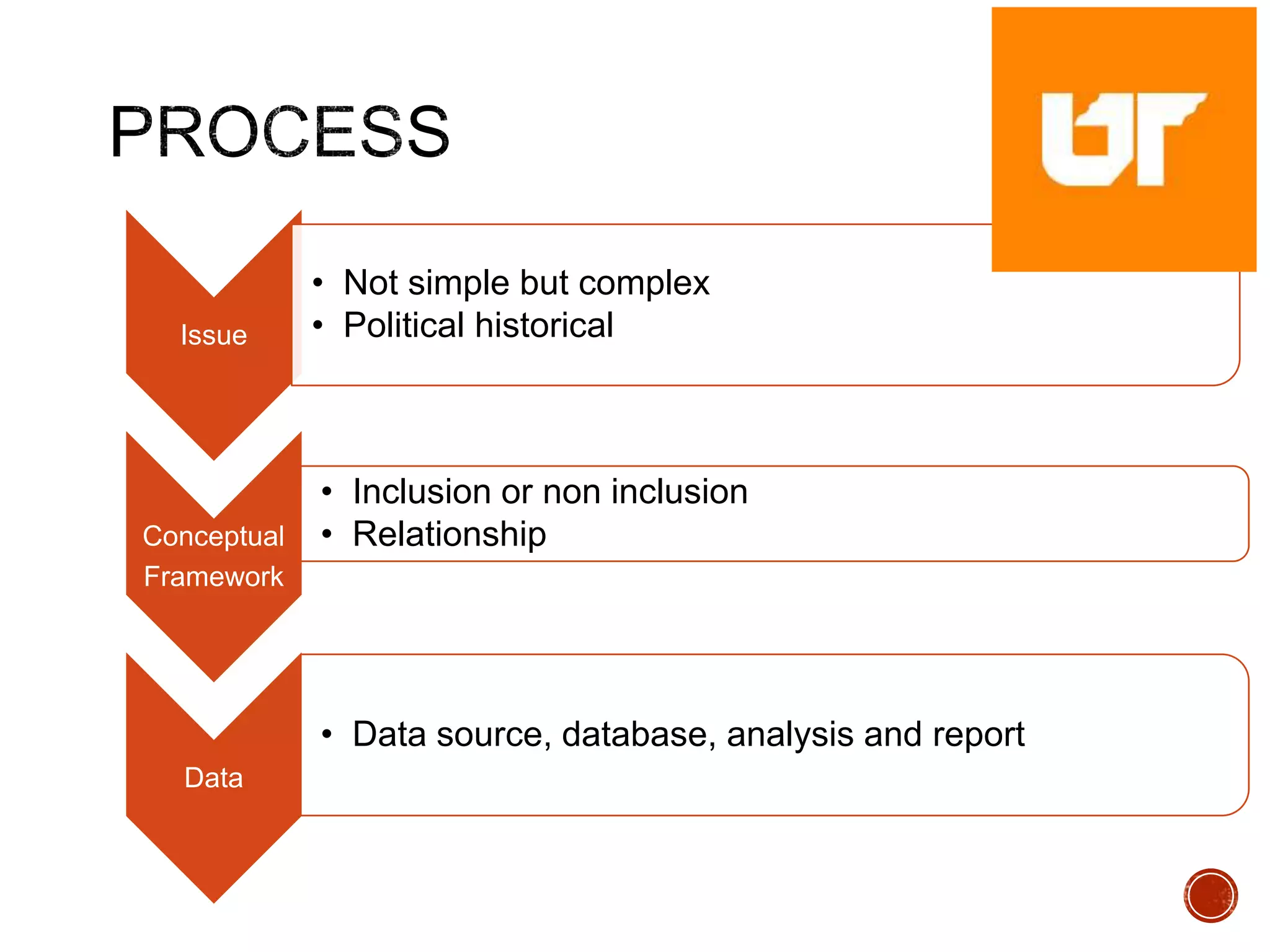
Issue
• Not simple but complex
• Political historical
Conceptual
Framework
• Inclusion or non inclusion
• Relationship
Data
• Data source, database, analysis and report
 “Teachers’ and Children’s Personal Epistemologies for Moral Education:
Case Studies in Early Years Elementary Education”
 https://www.youtube.com/watch?v=XjJQBjWYDTs
How to collect data?
What about external issues?
Poor and irregular definitions (Van Wynseberghe
& Khan, 2007)
Ambiguity and lack of clarity ( Verschuren, 2003)
Little theoretical depth (Rule & John, 2015)
• Unpublished
thesis
• Article
• Poster
• Presentation
• Hard copy
• Soft copies
• Hard drive
• One drive, google
drive
• Transcribing
• Coding
• Soft ware
• Verbal
• Data beyond
Talk
Data Source Data
Analysis
Reporting
Data
Management
Study of a phenomenon in real-life
context
Focuses more on the overall picture
If a group is studied, the behaviors of the
group as a whole are analyzed, not
individuals
 Baxter, P., & Jack, S. (2008). Qualitative case study methodology: Study
design and implementation for novice researchers. The qualitative
report,13(4), 544-559.
 Brownlee, J., Syu, J.-J., Mascadri, J., Cobb-Moore, C., Walker, S., Johansson,
E., … Ailwood, J. (2012). Teachers’ and children's personal
epistemologies for moral education: Case studies in early years
elementary education. Teaching and Teacher Education,28(3), 440–
450. doi:10.1016/j.tate.2011.11.012
 Rule, P., & John, V. M. (2015). A necessary dialogue: Theory in case study
research. International Journal of Qualitative Methods, 14(4).
 Van Wynsberghe, R., & Khan, S. (2007). Redefining case study.
International Journal of Qualitative Methods, 6, 80-94.
 Verschuren, P. (2003). Case study as a research strategy: Some ambiguities
and opportunities. International Journal of Social Research
Methodology, 6, 121-139.
 Images found at www.google.com
Qualitative Case Study

Qualitative Case Study

  • 1.
    Javed Iqbal andKeilah Kane EDPY 559 Group Presentation
  • 2.
    By the endof this session course participants could be able to;  Define case study,  Differentiate among different types of case studies,  Discuss the relationship between theory and case study,  Share issues pertinent to case study.
  • 3.
    Questions  What doyou mean by Case study?  What kinds of research questions are phrased for case study?  In what kind of situation should you opt for case study?  Have any of you conducted research using case study? If so please tell us about it!
  • 4.
    Phenomenon ContextInvestigation Researcher Stake (1995) Yin(2003), Creswell, J. (1998) Baxter, P. (2003)
  • 5.
    A) When theresearcher is trying to answer “how” or “why” questions B) When the researcher cannot manipulate the behaviors of those being studied C) When the researcher wants to look closer at contextual conditions relevant to the issue being studied D) When boundaries between the issue being studied and the context are not clear *Baxter and Jack, 2008
  • 6.
    Miles and Huberman(1994) stated case study as, “a phenomenon of some sort occurring in a bounded context. The case is, “in effect, your unit of analysis” (p. 25). Determine what your case study will NOT be Individual, program, or process
  • 7.
    Watch for somespecifics! What identifies this example as a case study? What were the methods of data collection? What did the researchers conclude?  Groat Sleep Center - https://www.youtube.com/watch?v=-Ygvt7G1DLs
  • 8.
    Theory-building approach vs.theory-testing approach Theory of the case Theory for the case (deductive) Theory from the case (Inductive) Theory and case (dialogic model) (Rule & John, 2015)
  • 9.
  • 10.
  • 11.
    Group No. 1 Explanatory Descriptive Instrumental Group.No. 2 Exploratory Intrinsic Collective
  • 12.
    Issue • Not simplebut complex • Political historical Conceptual Framework • Inclusion or non inclusion • Relationship Data • Data source, database, analysis and report
  • 13.
     “Teachers’ andChildren’s Personal Epistemologies for Moral Education: Case Studies in Early Years Elementary Education”  https://www.youtube.com/watch?v=XjJQBjWYDTs
  • 14.
    How to collectdata? What about external issues? Poor and irregular definitions (Van Wynseberghe & Khan, 2007) Ambiguity and lack of clarity ( Verschuren, 2003) Little theoretical depth (Rule & John, 2015)
  • 15.
    • Unpublished thesis • Article •Poster • Presentation • Hard copy • Soft copies • Hard drive • One drive, google drive • Transcribing • Coding • Soft ware • Verbal • Data beyond Talk Data Source Data Analysis Reporting Data Management
  • 16.
    Study of aphenomenon in real-life context Focuses more on the overall picture If a group is studied, the behaviors of the group as a whole are analyzed, not individuals
  • 19.
     Baxter, P.,& Jack, S. (2008). Qualitative case study methodology: Study design and implementation for novice researchers. The qualitative report,13(4), 544-559.  Brownlee, J., Syu, J.-J., Mascadri, J., Cobb-Moore, C., Walker, S., Johansson, E., … Ailwood, J. (2012). Teachers’ and children's personal epistemologies for moral education: Case studies in early years elementary education. Teaching and Teacher Education,28(3), 440– 450. doi:10.1016/j.tate.2011.11.012  Rule, P., & John, V. M. (2015). A necessary dialogue: Theory in case study research. International Journal of Qualitative Methods, 14(4).  Van Wynsberghe, R., & Khan, S. (2007). Redefining case study. International Journal of Qualitative Methods, 6, 80-94.  Verschuren, P. (2003). Case study as a research strategy: Some ambiguities and opportunities. International Journal of Social Research Methodology, 6, 121-139.  Images found at www.google.com

Editor's Notes

  • #4 Javed jot down and Keilah ask
  • #5 Javed Mentioned the big names related with case study and evey one has defiend in their own way but these are commons things in all defintion
  • #6 Keilah
  • #7 Javed
  • #8 Keilah Ask them to specifically watch for what the case study was, how it was conducted, what were the methods of data collection, and what did the researchers conclude at the end?
  • #9 Javed
  • #10 Keilah Explanatory – used to examine relationships, including causal relationships, that are too complex for simple surveys or experimental strategies to fully explain Exploratory – used in situations in which the intervention would have no clear cut set of outcomes Descriptive – used to describe the real-life action of the intervention as it unfolded. Employed to study- A single holistic case might be the decision making of one woman or a single group of 30 year old women facing breast reconstruction post-mastectomy Multiple-case studies – used to compare differences between cases (researcher must be sure that the cases will have commonalities to ensure they can compare cases)
  • #11 Keilah Intrinsic – used for a case in which the researcher has a deep personal interest Instrumental – used in supportive roles, to accomplish an overall goal instead of simply understanding a particular situation. Looked into more deeply and scrutinized more carefully Collective – similar to multiple-case studies, collective case studies focus on similarities in several cases, which may result in the same conclusions being drawn, rather than the multiple-case aspect which seeks to look at differences.
  • #13 Javed
  • #14 Keilah
  • #15 Keilah
  • #17 Grounded Theory – focuses more on the data, creating the theory once the data has been gathered and analyzed. Ethnography – a researcher could use ethnography as a case study, looking at one group of people or several different people to study certain phenomenon about their culture, but ethnography focuses more on studying the people and cultures specifically Phenomenology – Study of the structures of consciousness and that of what appears in the acts of consciousness. Narrative – uses the written or recorded to word as a means to analyze the way people create meaning in their lives as narratives.