Dr.MANOJ
PRABHAKAR
Resident , Dept. of
RENAL REPLACEMENT
THERAPY
DEFINITION
 Renal replacement therapy is a
therapy that replaces the normal
blood filtering functioning of the
kidneys.
 It is used when the kidneys are not
functioning well i.e in conditions like
Acute or Chronic Kidney Disease.
MODALITIES OF RRT
 HEMODIALYSIS
 PERITONEAL DIALYSIS
 RENAL TRANSPLANTATION
DIALYSIS
 All dialyses modalities can be used to ensure
equivalent solute clearence and ultrafiltration.
 Choice of procedure depends on
a) Age & size of the patient
b) Cardiovascular status
c) Availability of vascular status
d) Integrity of peritoneal membrane and abdominal
cavity.
e) Expertise available.
Indications of Dialysis in AKI
 Uremia
 Hyperkalemia
 Hyponatremia
 Fluid overload
 Metabolic Acidosis
 Hypercatabolic state
Indications in CKD
 GFR <15ml/min/1.73m2 BSA.
 Growth Failure
 Severe HTN
 Intractable intravascular volume overload
 Profound electrolyte abnormalities
{hyperkalemia , hyperphosphatemia etc.}
ACUTE PERITONEAL DIALYSIS
 ULTRAFILTRATION :
Exchange of solutes and movement of fluid across
the semipermeable peritoneal membrane.
 DIFFUSIVE TRANSPORT :
Solutes are exchanged across their concentration
gradient between the peritoneal capillaries and
the dialysis solution that is instilled into the
peritoneal cavity.
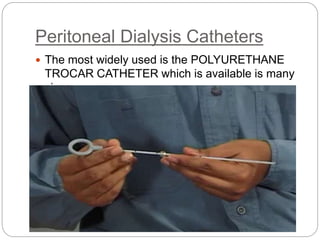
Peritoneal Dialysis Catheters
 The most widely used is the POLYURETHANE
TROCAR CATHETER which is available is many
sizes.
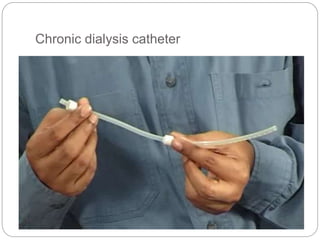
Chronic dialysis catheter
Peritoneal Dialysis Solutions
 Conventionally PD solutions contain dextrose as
the osmotic agent.
 Non – dextrose containing solutions : reduce risk
of hyperglycemia
 Other solutes comercially available : lactate,
sodium & calsium.
Complications
 Bleeding after catheter insertion
 Perforation of gut.
 Abdominal pain
 Leakage around catheter
 Difficult Drainage
 Exit site infections.
 Peritonitis
 Metabolic problems ( Hypo or hypernatremia,
hypokalemia,hyperglycemia, hypopsosphatemia
& metabolic alkalosis.
Chronic Peritoneal Dialysis
 Accepted mode of treatment for patients awaiting
renal transplantation.
 Two types :
1) CAPD ( Continuous Ambulatory Peritoneal
Dialysis )
Contains of
- Plastic bag containing dialysis fluid
- Transfer set
- Permanent Peritoneal Catheter
 This procedure is particularly suitable for infants and
for small children.
Complications:
- Peritonitis (most important complication of
CAPD)
- Catheter malfunction
- Abdominal wall hernia
- Back pain
- Hydrothorax
- Respiratory difficulty
 2) CCPD (Continuous Cycling Peritoneal
Dialysis):
Most common approach involves frequent
continuous ‘cycling’ of dialysate during the night,
while the child is asleep & then leaving in a small
volume of dialysate during the daytime.
The automated device minimizes the need for
extensive manual manipulation and hence
reduces the risk of peritonitis.
The patient can carry out day to day activities and
attend school.
Advantages
 Ability to perform dialysis at home.
 Technically easy than hemodialysis, especially in
infants
 Ability to live a greater distance from medical
center
 Freedom to attend school
 Less restrictive diet
 Less expensive than hemodialysis
Disadvantages
 Catheter malfunction
 Catheter related infections
 Impaired appetite
 Negative body image
- HEMODIALYSIS -
 Provides an excellent extracorporeal mode
for renal replacement.
 Advances in technical aspects and
availability of pediatric size dialyzers have
made it possible to offer hemodialysis to
children in end stage renal disease.
Principles
 The basic principles of HD are the same as
for PD :-
- A) Ultrafiltration
- B) Solute Removal ( by connective
transport and diffuse transport)
 What differentiates HD from PD is :
A) The driving force between the two
processes
B) Technical aspects of the procedure
C) Duration/Frequency of the treatments.
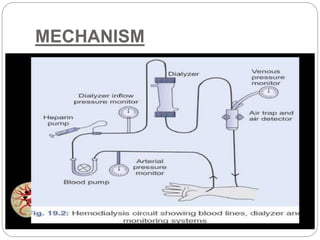
MECHANISM
 The rate of transfer of substances
depend upon :
- The surface area and the permeability of
the dialyzer membrane
- The solute concentration gadient
- Rates of blood flow and dialysate flow
- Composition of dialysate.
 Vascular Accesss:
A) Tunneled cuffed catheter
B) Arteriovenous (AV) fistula
C) AV graft.
1) Catheters
 Percutaneous temporary dual lumen catheter
 Cuffed central venous catheter (Permacath)
2) Fistulas include the Radiocephalic and
Brachiocephalic fistula.
3)AV Grafts
 Similar to fistulae except that an artifical graft made
of Teflon is used to join artery and vein.
Dialyzers and Blood Tubing
 Most dialyzers currently are hollow fiber
dialyzers.
 Most modern dialyzers are made of
modified cellulose or entirely made of
synthetic material.
(Advantage of being more permeable and
efficient solute removal.
 The choice of dialyzer is based on the size
of the dialyzer.
Length & Frequency of Dialysis
 The aim is for 30% reduction in BUN
during the 1s dialysis(1.5-2hrs).
 50% during the 2nd treatment. (3hrs)
 >70% reduction during subsequent
treatments (3.5-4hrs).
Complicaions during Hemodialysis
1.Dialysis disequilibrium syndrome:
Manifested as seizures
2.Muscle Cramps
3.Hypotension.
4. Nausea & Vomiting
5.Itching.
Advantages
 Maximum solute clearance
 Best tx for severe hyper- K+
 Ready availability
 Limited anti-coagulation time
 Bedside vascular access
Disadvantages
 Hemodynamic instability
 Hypoxemia
 Rapid fluid + solute shifts
 Complex equipment
 Specialized personnel
 Difficult in small infants
CONTINUOUS RENAL
REPLACEMENT THERAPY
 Variant of HD therapies that are continuous
and prolonged.(for days to weeks).
2 types :
a) CVVH (Continuous venovenous
Hemofiltration)
Only convective transport without adding
dialytic compound.
b) CVVHD (Continuous venovenous
hemofiltartion dialysis)
Dialytic compound added.
 The choice of CVVH or CVVHD is center
dependent and also on the need for
solute removal , which is usually greater
with CVVHD.
Indications for CRRT
 Modality of choice in patients who are critically ill
and hemodynamically unstable patients.
 Neonates and infants with cardiovascular or
abdominal surgery.
 Trauma
 Shock & multi-system failure.
 Children with inborn errors of metabolism such as
urea cycle disorders
Disadvantages of CRRT
 Same as seen in Hemodialysis.
 Continous nature – risk greatly multiplied.
 Continuous vascular access, very close
monitoring
– very expensive
Renal replacement therapy

Renal replacement therapy

  • 1.
    Dr.MANOJ PRABHAKAR Resident , Dept.of RENAL REPLACEMENT THERAPY
  • 2.
    DEFINITION  Renal replacementtherapy is a therapy that replaces the normal blood filtering functioning of the kidneys.  It is used when the kidneys are not functioning well i.e in conditions like Acute or Chronic Kidney Disease.
  • 3.
    MODALITIES OF RRT HEMODIALYSIS  PERITONEAL DIALYSIS  RENAL TRANSPLANTATION
  • 4.
    DIALYSIS  All dialysesmodalities can be used to ensure equivalent solute clearence and ultrafiltration.  Choice of procedure depends on a) Age & size of the patient b) Cardiovascular status c) Availability of vascular status d) Integrity of peritoneal membrane and abdominal cavity. e) Expertise available.
  • 5.
    Indications of Dialysisin AKI  Uremia  Hyperkalemia  Hyponatremia  Fluid overload  Metabolic Acidosis  Hypercatabolic state
  • 6.
    Indications in CKD GFR <15ml/min/1.73m2 BSA.  Growth Failure  Severe HTN  Intractable intravascular volume overload  Profound electrolyte abnormalities {hyperkalemia , hyperphosphatemia etc.}
  • 7.
    ACUTE PERITONEAL DIALYSIS ULTRAFILTRATION : Exchange of solutes and movement of fluid across the semipermeable peritoneal membrane.  DIFFUSIVE TRANSPORT : Solutes are exchanged across their concentration gradient between the peritoneal capillaries and the dialysis solution that is instilled into the peritoneal cavity.
  • 8.
    Peritoneal Dialysis Catheters The most widely used is the POLYURETHANE TROCAR CATHETER which is available is many sizes.
  • 9.
  • 10.
    Peritoneal Dialysis Solutions Conventionally PD solutions contain dextrose as the osmotic agent.  Non – dextrose containing solutions : reduce risk of hyperglycemia  Other solutes comercially available : lactate, sodium & calsium.
  • 11.
    Complications  Bleeding aftercatheter insertion  Perforation of gut.  Abdominal pain  Leakage around catheter  Difficult Drainage  Exit site infections.  Peritonitis  Metabolic problems ( Hypo or hypernatremia, hypokalemia,hyperglycemia, hypopsosphatemia & metabolic alkalosis.
  • 12.
    Chronic Peritoneal Dialysis Accepted mode of treatment for patients awaiting renal transplantation.  Two types : 1) CAPD ( Continuous Ambulatory Peritoneal Dialysis ) Contains of - Plastic bag containing dialysis fluid - Transfer set - Permanent Peritoneal Catheter
  • 13.
     This procedureis particularly suitable for infants and for small children. Complications: - Peritonitis (most important complication of CAPD) - Catheter malfunction - Abdominal wall hernia - Back pain - Hydrothorax - Respiratory difficulty
  • 14.
     2) CCPD(Continuous Cycling Peritoneal Dialysis): Most common approach involves frequent continuous ‘cycling’ of dialysate during the night, while the child is asleep & then leaving in a small volume of dialysate during the daytime. The automated device minimizes the need for extensive manual manipulation and hence reduces the risk of peritonitis. The patient can carry out day to day activities and attend school.
  • 15.
    Advantages  Ability toperform dialysis at home.  Technically easy than hemodialysis, especially in infants  Ability to live a greater distance from medical center  Freedom to attend school  Less restrictive diet  Less expensive than hemodialysis
  • 16.
    Disadvantages  Catheter malfunction Catheter related infections  Impaired appetite  Negative body image
  • 17.
    - HEMODIALYSIS - Provides an excellent extracorporeal mode for renal replacement.  Advances in technical aspects and availability of pediatric size dialyzers have made it possible to offer hemodialysis to children in end stage renal disease.
  • 18.
    Principles  The basicprinciples of HD are the same as for PD :- - A) Ultrafiltration - B) Solute Removal ( by connective transport and diffuse transport)
  • 19.
     What differentiatesHD from PD is : A) The driving force between the two processes B) Technical aspects of the procedure C) Duration/Frequency of the treatments.
  • 20.
  • 21.
     The rateof transfer of substances depend upon : - The surface area and the permeability of the dialyzer membrane - The solute concentration gadient - Rates of blood flow and dialysate flow - Composition of dialysate.
  • 22.
     Vascular Accesss: A)Tunneled cuffed catheter B) Arteriovenous (AV) fistula C) AV graft.
  • 23.
    1) Catheters  Percutaneoustemporary dual lumen catheter  Cuffed central venous catheter (Permacath) 2) Fistulas include the Radiocephalic and Brachiocephalic fistula. 3)AV Grafts  Similar to fistulae except that an artifical graft made of Teflon is used to join artery and vein.
  • 24.
    Dialyzers and BloodTubing  Most dialyzers currently are hollow fiber dialyzers.  Most modern dialyzers are made of modified cellulose or entirely made of synthetic material. (Advantage of being more permeable and efficient solute removal.  The choice of dialyzer is based on the size of the dialyzer.
  • 25.
    Length & Frequencyof Dialysis  The aim is for 30% reduction in BUN during the 1s dialysis(1.5-2hrs).  50% during the 2nd treatment. (3hrs)  >70% reduction during subsequent treatments (3.5-4hrs).
  • 26.
    Complicaions during Hemodialysis 1.Dialysisdisequilibrium syndrome: Manifested as seizures 2.Muscle Cramps 3.Hypotension. 4. Nausea & Vomiting 5.Itching.
  • 27.
    Advantages  Maximum soluteclearance  Best tx for severe hyper- K+  Ready availability  Limited anti-coagulation time  Bedside vascular access
  • 28.
    Disadvantages  Hemodynamic instability Hypoxemia  Rapid fluid + solute shifts  Complex equipment  Specialized personnel  Difficult in small infants
  • 29.
    CONTINUOUS RENAL REPLACEMENT THERAPY Variant of HD therapies that are continuous and prolonged.(for days to weeks). 2 types : a) CVVH (Continuous venovenous Hemofiltration) Only convective transport without adding dialytic compound.
  • 30.
    b) CVVHD (Continuousvenovenous hemofiltartion dialysis) Dialytic compound added.  The choice of CVVH or CVVHD is center dependent and also on the need for solute removal , which is usually greater with CVVHD.
  • 31.
    Indications for CRRT Modality of choice in patients who are critically ill and hemodynamically unstable patients.  Neonates and infants with cardiovascular or abdominal surgery.  Trauma  Shock & multi-system failure.  Children with inborn errors of metabolism such as urea cycle disorders
  • 32.
    Disadvantages of CRRT Same as seen in Hemodialysis.  Continous nature – risk greatly multiplied.  Continuous vascular access, very close monitoring – very expensive