ACUTE ENCEPHALITIS
SYNDROME- Case based
discussion
Dr.MANOJ PRABHAKAR
Resident , Dept. of Paediatrics
CASE
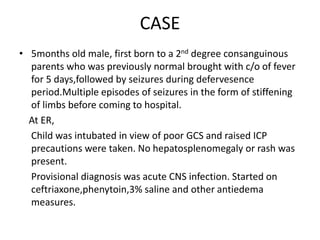
• 5months old male, first born to a 2nd degree consanguinous
parents who was previously normal brought with c/o of fever
for 5 days,followed by seizures during defervesence
period.Multiple episodes of seizures in the form of stiffening
of limbs before coming to hospital.
At ER,
Child was intubated in view of poor GCS and raised ICP
precautions were taken. No hepatosplenomegaly or rash was
present.
Provisional diagnosis was acute CNS infection. Started on
ceftriaxone,phenytoin,3% saline and other antiedema
measures.
Case contd…
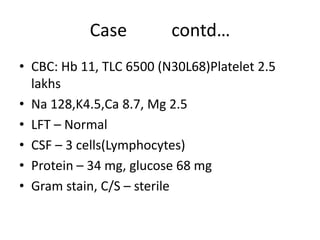
• CBC: Hb 11, TLC 6500 (N30L68)Platelet 2.5
lakhs
• Na 128,K4.5,Ca 8.7, Mg 2.5
• LFT – Normal
• CSF – 3 cells(Lymphocytes)
• Protein – 34 mg, glucose 68 mg
• Gram stain, C/S – sterile
Case cont….
• On day three of admission child had subtle
seizures and lid twitching hence was loaded
with phenobarbitone, leviteracetam and
midazolam infusion. Pyridoxine and folinic
acid was added for refractory seizures.
• Day 4: MRI Brain with contrast /MRA & MRS
Normal
CASE contd…
• Initial CSF study was normal.
• Dengue serology was sent on day 3 since
encephalopathy occurred during defervescence
period. Igm and Ig G reported as positive. But
classical features of dengue were not present
• EEG showed epileptiform activity for which
midazolam infusion was continued.
• S.Ammonia – Normal
• HIV- Non reactive
Contd..
• Since child was refractory to supportive
management and definite diagnosis could not
be achieved ,suspecting autoimmune
encephalitis- Methylprednisolone was added.
• Possibilities kept at this point were
• 1.Infection triggered Encephalopathy ? Viral
(FIRES)
• 2.Metabolic
• 3.Autoimmune encephalitis
CASE Contd…
• By day 8 – GCS dropped. Pupils SRL.Child had
refractory raised ICP and subsequently pupils
became dilated ,absent gag reflex and
spontaneous triggers .
• On 19.5.2017, baby went in for cardiac arrest.
Declared dead on 19.5.2017 at 11.30am
• Postmortem LP done
• CSF Dengue,HSV,JE and encephalitis panel –
Negative
• DNA has been separated for genetic studies(
Epileptic encephalopathy panel)
Final diagnosis:
• Refractory Raised intracranial pressure
• Epileptic encephalopathy
• ? Cause
What else could have been done
• Continuous EEG monitoring
• Continous ETCO2 monitoring
IMPORTANT DEFINITIONS
1) Encephalopathy : Encephalopathy describes a
clinical syndrome of altered mental status,
manifesting as reduced consciousness or
altered behavior.
2) Encephalitis : Encephalitis means
inflammation of the brain.
IMPORTANT DEFINITIONS
3) Acute Encephalitis Syndrome : A person of
any age, at any time of year with the acute
onset of fever and a change in mental status.
Etiological Agents
• Herpes simplex virus
• Dengue Virus
• Measles virus
• Mumps virus
• Chikungunya
• Varicella zoster virus
• Epstein-Barr virus
• Human immunodeficiency virus
• Rabies
Contd..
• Bacterial
• Malaria
2.Metabolic : Reye syndrome and ther IEM
3.Autoimmune encephalitis
4.Poisoning
EVALUATION AND MANAGEMENT
Step I: Rapid assessment and stabilization
Step II: Clinical evaluation: History and
Examination
Step III: Investigation/Samples to be collected
Step IV: Empirical Treatment
Step V: Supportive care and treatment
Step VI: Prevention/treatment of complications
and rehabilitation
Step I: Rapid assessment and
stabilization
• Establish and maintain airway
• Ventilation, Oxygenation
• Circulation
• Identify signs of cerebral herniation or raised
ICP.
• Temperature: treat fever and hypothermia
• Treat ongoing seizures- Benzodiazepine,
followed by phenytoin loading
Step II: Clinical evaluation: History
and Examination
• There may be a prodrome of upper respiratory
illness, flu-like illness or diarrhea.
• Altered behavior, cognition, personality
changes, altered consciousness.
• History of recurrent episodes of
encephalopathy.
• Family history of previous infant/child deaths.
• Recent history of travel
Etiological Clues
• Pallor : Cerebral malaria, or IC bleed
• Icterus : Leptospirosis, hepatic
encephalopathy, or cerebral malaria.
• Skin rashes : dengue, measles, varicella,
rickettsial diseases
• Petechiae : dengue and viral hemorrhagic
fevers
• Parotid swelling and orchitis : Mumps
Examination
• GCS
• Pupillary size, shape, symmetry and response
to light provide valuable clues to brainstem
and third nerve dysfunction.
• Special attention should be given to posturing
because it often signals a brainstem
herniation syndrome.
• Fundus examination must be performed to
look for papilledema and retinal hemorrhages.
Step III: Investigation
• Basic investigations :
CBC, RFT, Electrolytes, LFT, Blood Culture, CXR
• Lumbar puncture :
In Patients who are hemodynamically stable, and no
features of raised intracranial pressure.
 CSF analysis is an important investigation in children
with AES (Should include full viral panel)
• Neuroimaging:
May give valuable information such as presence of bleed,
cerebral edema etc
MRI should be obtained, as soon as the patient is stable.
Investigation
• Other microbiological investigations:
These samples include urine, throat swab,
nasopharyngeal aspirate, swab from vesicles or
rash, if present.
• Unexplained encephalopathy with fever and
rash : Weil- Felix test, rickettsial serology
• Unexplained encephalitis : HIV testing
Investigation
• Other tests
• EEG is not routinely needed .
It must be performed in children with
unexplained altered sensorium to look for
suspected non-convulsive status epilepticus.
Metabolic.
Autoimmune encephalitis panel.
Step IV: Empirical Treatment
Must be started if CSF cannot be done/report
will take time and patient sick.
• Ceftriaxone
{100mg/kg/day}
• Acyclovir (use in all suspected sporadic viral
encephalitis)
3mt – 12yr : 500mg/m2 Q8H
> 12yr : 100mg/kg Q8H
Step V: Supportive care and treatment
(a) Maintenance intravenous fluids :
• Isotonic fluids are preferred
(b) Management of raised intracranial pressure:
• Head elevation,
• Minimal disturbance,
• Normothermia,
• Hyperventilation,
Supportive care and treatment
(c) Maintain euglycemia
(d) Treatment and prevention of seizures:
(Lorazepam 0.1 mg/kg, diazepam 0.3 mg/kg, or
midazolam 0.1 mg/kg)
(e) Other drugs : Corticosteroids
(f) Other measures: Acid-base and electrolyte
abnormalities should be corrected.
Step VI: Prevention/treatment of
complications and rehabilitation
• Physiotherapy, posture change, Prevent bed
sores and exposure keratitis.
• Complications: aspiration pneumonia,
nosocomial infections, coagulation
disturbances
• Nutrition: early feeding
• Psychological support to patient and family
PREVENTIVE STRATEGIES
(i) Surveillance for cases of AES;
(ii) Vector control;
(iii) Reduction in man-vector contact;
(iv) Vaccination
ACUTE ENCEPHALOPATHY IN CHILDREN
WITH INBORN ERRORS OF METABOLISM
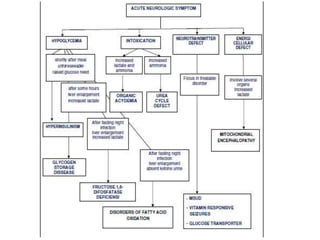
• Acute encephalopathy is a common and
potentially medical emergency in patients
with inborn errors of metabolism.
• In young children with unexplained altered
sensorium, especially with pre-morbid
developmental delay, investigations for inborn
errors of metabolism plasma must be carried
out.
Contd..
• Lactate, ketones.
• Serum ammonia,
• Blood tandem mass spectroscopy,
• Urine gas chromatography mass spectroscopy
Autoimmune Encephalitis
In older children, the possibility of autoimmune
disorders such as
SLE (anti-nuclear antibodies, anti-ds-DNA
antibodies),
Hashimoto encephalopathy (anti-TPO
antibodies), and
Anti-NMDA receptor and Anti-VKGC antibody-
mediated encephalitis may be considered.
• In this case infectious etiology has been
reasonably worked up and ruled out.
Metabolic & autoimmune encephalitis was
not completely worked up.
• Also there is a subgroup of disorders which
can have infantile epileptic encephalopathy
which can cause refractory raised ICP.
Take home message
• Early stabilization and institution of non-
specific supportive measures is the
cornerstone of management.
• Investigations are aimed at recognition of
etiological agent for specific therapeutic and
control measures.
THANKYOU

Acute encephalitis syndrome

  • 1.
    ACUTE ENCEPHALITIS SYNDROME- Casebased discussion Dr.MANOJ PRABHAKAR Resident , Dept. of Paediatrics
  • 2.
    CASE • 5months oldmale, first born to a 2nd degree consanguinous parents who was previously normal brought with c/o of fever for 5 days,followed by seizures during defervesence period.Multiple episodes of seizures in the form of stiffening of limbs before coming to hospital. At ER, Child was intubated in view of poor GCS and raised ICP precautions were taken. No hepatosplenomegaly or rash was present. Provisional diagnosis was acute CNS infection. Started on ceftriaxone,phenytoin,3% saline and other antiedema measures.
  • 3.
    Case contd… • CBC:Hb 11, TLC 6500 (N30L68)Platelet 2.5 lakhs • Na 128,K4.5,Ca 8.7, Mg 2.5 • LFT – Normal • CSF – 3 cells(Lymphocytes) • Protein – 34 mg, glucose 68 mg • Gram stain, C/S – sterile
  • 4.
    Case cont…. • Onday three of admission child had subtle seizures and lid twitching hence was loaded with phenobarbitone, leviteracetam and midazolam infusion. Pyridoxine and folinic acid was added for refractory seizures. • Day 4: MRI Brain with contrast /MRA & MRS Normal
  • 5.
    CASE contd… • InitialCSF study was normal. • Dengue serology was sent on day 3 since encephalopathy occurred during defervescence period. Igm and Ig G reported as positive. But classical features of dengue were not present • EEG showed epileptiform activity for which midazolam infusion was continued. • S.Ammonia – Normal • HIV- Non reactive
  • 6.
    Contd.. • Since childwas refractory to supportive management and definite diagnosis could not be achieved ,suspecting autoimmune encephalitis- Methylprednisolone was added. • Possibilities kept at this point were • 1.Infection triggered Encephalopathy ? Viral (FIRES) • 2.Metabolic • 3.Autoimmune encephalitis
  • 7.
    CASE Contd… • Byday 8 – GCS dropped. Pupils SRL.Child had refractory raised ICP and subsequently pupils became dilated ,absent gag reflex and spontaneous triggers . • On 19.5.2017, baby went in for cardiac arrest. Declared dead on 19.5.2017 at 11.30am • Postmortem LP done • CSF Dengue,HSV,JE and encephalitis panel – Negative • DNA has been separated for genetic studies( Epileptic encephalopathy panel)
  • 8.
    Final diagnosis: • RefractoryRaised intracranial pressure • Epileptic encephalopathy • ? Cause
  • 9.
    What else couldhave been done • Continuous EEG monitoring • Continous ETCO2 monitoring
  • 10.
    IMPORTANT DEFINITIONS 1) Encephalopathy: Encephalopathy describes a clinical syndrome of altered mental status, manifesting as reduced consciousness or altered behavior. 2) Encephalitis : Encephalitis means inflammation of the brain.
  • 11.
    IMPORTANT DEFINITIONS 3) AcuteEncephalitis Syndrome : A person of any age, at any time of year with the acute onset of fever and a change in mental status.
  • 12.
    Etiological Agents • Herpessimplex virus • Dengue Virus • Measles virus • Mumps virus • Chikungunya • Varicella zoster virus • Epstein-Barr virus • Human immunodeficiency virus • Rabies
  • 13.
    Contd.. • Bacterial • Malaria 2.Metabolic: Reye syndrome and ther IEM 3.Autoimmune encephalitis 4.Poisoning
  • 14.
    EVALUATION AND MANAGEMENT StepI: Rapid assessment and stabilization Step II: Clinical evaluation: History and Examination Step III: Investigation/Samples to be collected Step IV: Empirical Treatment Step V: Supportive care and treatment Step VI: Prevention/treatment of complications and rehabilitation
  • 15.
    Step I: Rapidassessment and stabilization • Establish and maintain airway • Ventilation, Oxygenation • Circulation • Identify signs of cerebral herniation or raised ICP. • Temperature: treat fever and hypothermia • Treat ongoing seizures- Benzodiazepine, followed by phenytoin loading
  • 16.
    Step II: Clinicalevaluation: History and Examination • There may be a prodrome of upper respiratory illness, flu-like illness or diarrhea. • Altered behavior, cognition, personality changes, altered consciousness. • History of recurrent episodes of encephalopathy. • Family history of previous infant/child deaths. • Recent history of travel
  • 17.
    Etiological Clues • Pallor: Cerebral malaria, or IC bleed • Icterus : Leptospirosis, hepatic encephalopathy, or cerebral malaria. • Skin rashes : dengue, measles, varicella, rickettsial diseases • Petechiae : dengue and viral hemorrhagic fevers • Parotid swelling and orchitis : Mumps
  • 18.
    Examination • GCS • Pupillarysize, shape, symmetry and response to light provide valuable clues to brainstem and third nerve dysfunction. • Special attention should be given to posturing because it often signals a brainstem herniation syndrome. • Fundus examination must be performed to look for papilledema and retinal hemorrhages.
  • 19.
    Step III: Investigation •Basic investigations : CBC, RFT, Electrolytes, LFT, Blood Culture, CXR • Lumbar puncture : In Patients who are hemodynamically stable, and no features of raised intracranial pressure.  CSF analysis is an important investigation in children with AES (Should include full viral panel) • Neuroimaging: May give valuable information such as presence of bleed, cerebral edema etc MRI should be obtained, as soon as the patient is stable.
  • 20.
    Investigation • Other microbiologicalinvestigations: These samples include urine, throat swab, nasopharyngeal aspirate, swab from vesicles or rash, if present. • Unexplained encephalopathy with fever and rash : Weil- Felix test, rickettsial serology • Unexplained encephalitis : HIV testing
  • 21.
    Investigation • Other tests •EEG is not routinely needed . It must be performed in children with unexplained altered sensorium to look for suspected non-convulsive status epilepticus. Metabolic. Autoimmune encephalitis panel.
  • 22.
    Step IV: EmpiricalTreatment Must be started if CSF cannot be done/report will take time and patient sick. • Ceftriaxone {100mg/kg/day} • Acyclovir (use in all suspected sporadic viral encephalitis) 3mt – 12yr : 500mg/m2 Q8H > 12yr : 100mg/kg Q8H
  • 23.
    Step V: Supportivecare and treatment (a) Maintenance intravenous fluids : • Isotonic fluids are preferred (b) Management of raised intracranial pressure: • Head elevation, • Minimal disturbance, • Normothermia, • Hyperventilation,
  • 24.
    Supportive care andtreatment (c) Maintain euglycemia (d) Treatment and prevention of seizures: (Lorazepam 0.1 mg/kg, diazepam 0.3 mg/kg, or midazolam 0.1 mg/kg) (e) Other drugs : Corticosteroids (f) Other measures: Acid-base and electrolyte abnormalities should be corrected.
  • 25.
    Step VI: Prevention/treatmentof complications and rehabilitation • Physiotherapy, posture change, Prevent bed sores and exposure keratitis. • Complications: aspiration pneumonia, nosocomial infections, coagulation disturbances • Nutrition: early feeding • Psychological support to patient and family
  • 26.
    PREVENTIVE STRATEGIES (i) Surveillancefor cases of AES; (ii) Vector control; (iii) Reduction in man-vector contact; (iv) Vaccination
  • 27.
    ACUTE ENCEPHALOPATHY INCHILDREN WITH INBORN ERRORS OF METABOLISM • Acute encephalopathy is a common and potentially medical emergency in patients with inborn errors of metabolism. • In young children with unexplained altered sensorium, especially with pre-morbid developmental delay, investigations for inborn errors of metabolism plasma must be carried out.
  • 28.
    Contd.. • Lactate, ketones. •Serum ammonia, • Blood tandem mass spectroscopy, • Urine gas chromatography mass spectroscopy
  • 30.
    Autoimmune Encephalitis In olderchildren, the possibility of autoimmune disorders such as SLE (anti-nuclear antibodies, anti-ds-DNA antibodies), Hashimoto encephalopathy (anti-TPO antibodies), and Anti-NMDA receptor and Anti-VKGC antibody- mediated encephalitis may be considered.
  • 31.
    • In thiscase infectious etiology has been reasonably worked up and ruled out. Metabolic & autoimmune encephalitis was not completely worked up. • Also there is a subgroup of disorders which can have infantile epileptic encephalopathy which can cause refractory raised ICP.
  • 32.
    Take home message •Early stabilization and institution of non- specific supportive measures is the cornerstone of management. • Investigations are aimed at recognition of etiological agent for specific therapeutic and control measures.
  • 33.