A 62 year man complains of swelling in feet for last 2 years. He consulted
a GP for same who prescribed him Tablet Lasix (Furosemide). The swelling
subsides on taking tablet. For the past 6 months, he has also developed
shortness of breath on regular walk, but there is no history of chest pain.
He is a chronic smoker, but doesn’t consume alcohol.
Examination
• BP is 106/74, Pulse 80 regular
• Pallor +nt, Icterus –nt, Clubbing –nt
• JVP raised, bilateral pitting edema +nt
• On auscultation, bilateral basal crepts +nt
Investigations
• Renal & liver functions are normal
• Urine routine/microscopy is normal
• Serum albumin 3.8 g/dl
• Chest x-ray is s/o cardiomegaly, ECG shows LVH
Which is the most likely diagnosis ???
1. Chronic liver disease
2. Congestive heart failure
3. Nephrotic syndrome
4. Hypothyroidism
ANS: Congestive heart failure
Approach to Pedal Edema
Dr Abdullah Ansari
Senior Resident
Department of Medicine
Aligarh Muslim University
Definition of Edema
The abnormal fluid accumulation in the interstitial space that exceeds
the capacity of physiological lymphatic drainage
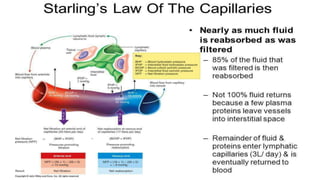
Mechanism
• Interstitial fluid space is dependent on the hydrostatic and oncotic
pressure gradient across the capillaries and also the lymphatic
drainage
• So they are dependent on four main factors, namely-
1. Capillary permeability
2. Capillary hydrostatic pressure
3. Capillary oncotic pressure
4. Lymphatic drainage
• Any derangement increases the interstitial fluid resulting in edema
Causes
• Increased capillary permeability
• Local Causes – cellulitis
• Systemic Causes – hypersensitivity reactions, sepsis
• Increased capillary hydrostatic pressure
• Local Causes – compartment syndrome, chronic venous insufficiency
• Systemic Causes – congestive cardiac failure, cor pulmonale, renal failure, anemia,
pregnancy
• Decreased capillary oncotic pressure
• Systemic Causes – Protein deficient states like chronic liver diseases, nephrotic
syndrome, protein losing enteropathy, malabsorption syndrome
• Lymphatic obstruction (lymphedema)
• Tumour, trauma, radiation and infections like filariasis
Anasarca
• There are two principal causes of generalised oedema
1. Fluid overload
2. Hypoproteinemia
• The effective arterial blood volume is reduced, and renal blood flow
decreases
• The renin-angiotensin-aldosterone system (RAAS) is activated, and
causes sodium and water retention
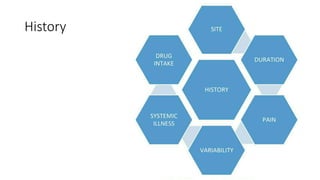
History
History
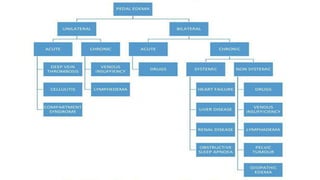
1. Site and distribution
• Unilateral pedal edema: local causes like deep vein thrombosis, cellulitis,
compartment syndrome and filariasis
• Bilateral pedal edema: systemic causes like congestive cardiac failure,
anemia, chronic kidney disease and chronic liver disease
2. Duration of illness
• Acute: Cellulitis, DVT, Compartment syndrome
• Chronic: Systemic diseases, hypoproteinemic states, chronic venous
insufficiency, lymphedema
History cont...
3. Association with pain
• Painful: Deep vein thrombosis and cellulitis
• Painless: Systemic diseases, hypoproteinemic states, venous insufficiency,
lymphedema
4. Variability of edema
• Congestive cardiac failure: Dependent edema aggravated by standing and
improves with overnight limb elevation
• Nephrotic syndrome: Edema is characteristically generalized, but especially
evident in the very soft tissues of the eyelids and face in the morning
• Chronic liver disease: Ascites is predominant
History cont...
5. History of systemic illness
• Cardiac: Exertional dyspnea, orthopnea, paroxysmal nocturnal dyspnea,
chest pain and palpitations
• Renal: Oliguria and puffiness of face
• Liver: Long term alcohol consumption, blood transfusion, tattooing,
yellowish discoloration of eyes and urine and abdominal distension
History cont...
6. History of other illness
• Hypothyroidism: Fatigue, weight gain, decreased appetite, sleepiness, cold
intolerance, constipation, decreased menses
• Obstructive sleep apnea: Snoring at night interrupted by episodes of apneas,
excessive daytime sleepiness, daytime fatigue/tiredness
7. History of drug intake
• Common drugs like calcium channel blockers, NSAIDs and steroids
• 50% of patients taking CCBs and 5% taking NSAIDs complain of pedal edema
Drugs associated with Edema
Direct arterial vasodilators (antihypertensive) Hydralazine
Clonidine
Methyldopa
α-blockers
Calcium channel blockers (antihypertensive) Amlodipine
Nonsteroidal anti-inflammatory drugs
(NSAIDs)
Ibuprofen
Diclofenac
Hormones Glucocorticoids
Anabolic steroids
Estrogens
Progestins
Growth hormone
Thiazolidinediones (oral hypoglycemics) Rosiglitazone
Pioglitazone
Anti–depressants MAO inhibitors
History cont...
8. History of trauma and radiation
• Trauma and radiation can cause cellulitis and compartment syndrome
• Long term radiation can also cause lymphedema
Local examination
1. Distribution - Identify whether it is unilateral (usually local causes)
or bilateral (predominantly systemic causes)
2. Site – Bony prominences like medial malleolus and anterior aspect
of tibia, sacrum in bedridden patients
3. Tenderness – Deep vein thrombosis, cellulitis and compartment
syndrome are generally tender. Lymphedema and edema due to
systemic diseases and hypoproteinemic states are painless
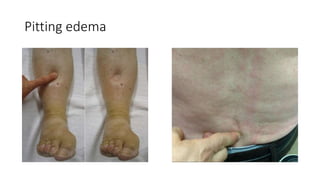
4. Pitting edema – Except lymphedema and myxedema, most other
diseases cause pitting pedal edema. Lymphedema is initially pitting
Hyaluronic acid deposition in hypothyroidism
Pitting edema
Local exam cont...
5. Skin changes
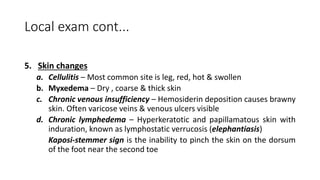
a. Cellulitis – Most common site is leg, red, hot & swollen
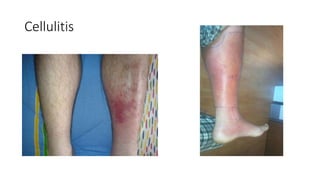
b. Myxedema – Dry , coarse & thick skin
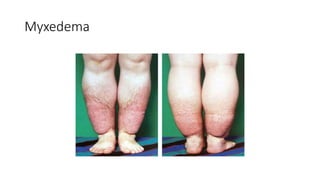
c. Chronic venous insufficiency – Hemosiderin deposition causes brawny
skin. Often varicose veins & venous ulcers visible
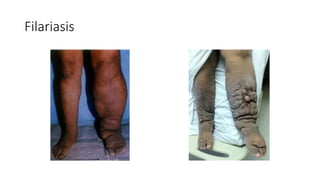
d. Chronic lymphedema – Hyperkeratotic and papillamatous skin with
induration, known as lymphostatic verrucosis (elephantiasis)
Kaposi-stemmer sign is the inability to pinch the skin on the dorsum
of the foot near the second toe
Cellulitis
Myxedema
Chronic venous
insufficiency
Filariasis
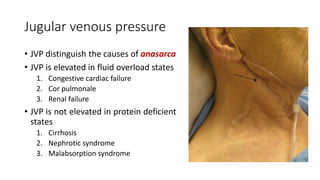
Jugular venous pressure
• JVP distinguish the causes of anasarca
• JVP is elevated in fluid overload states
1. Congestive cardiac failure
2. Cor pulmonale
3. Renal failure
• JVP is not elevated in protein deficient
states
1. Cirrhosis
2. Nephrotic syndrome
3. Malabsorption syndrome
Systemic examination
• Congestive cardiac failure – Elevated jugular venous pressure, third
heart sound and crepitations over the lung bases
• Chronic liver disease – Icterus, ascites, splenomegaly, gynaecomastia,
spider naevi
• Chronic kidney disease – Anemia, dry skin, uremic breath
• Hypothyroidism – Bradycardia, skin changes like dry skin and sparse
hair, hoarseness of voice
Lab Investigations
1. Complete blood count – Anemia and clue to the cause of anemia
2. Urine routine/microscopy and renal function test– Chronic kidney
disease & nephrotic syndrome
3. Liver function test – Chronic liver disease
4. Serum total protein and albumin – Chronic liver disease, nephrotic
syndrome, protein losing enteropathy and malnutrition
5. Serum lipid profile –Nephrotic syndrome, coronary heart disease
6. Chest X ray, ECG and Brain natriuretic peptide – Heart failure
7. Serum TSH – Hypothyroidism
8. D-dimer – elevated D-dimer is suggestive of DVT
Imaging
1. USG Abdomen and KUB – altered liver echo-texture and
shrunken liver in CLD, and bilateral shrunken kidneys in CKD
2. Doppler study – Deep vein thrombosis and chronic venous
insufficiency
3. Lympho-scintigraphy – a radio-nucleotide tracer is injected
into the first web space and flow of lymph is monitored using
a gamma camera
4. Echocardiography – assesses the left ventricular function in
CHF, measures pulmonary artery pressure and diagnoses
pulmonary hypertension in cor pulmonale and OSA
Management
• Chronic kidney disease – Fluid & salt restriction and loop diuretics
like frusemide or torsemide can be given
• Congestive heart failure – Salt restrictions, diuretics like frusemide &
spironolactone, and ventricular remodeling drugs like beta blockers &
ACE inhibitors
• Chronic liver disease – Fluid & salt restriction, and diuretics like
frusemide and spironolactone. Albumin infusion in refractory cases
Management cont...
• Obstructive sleep apnea – Weight reduction and CPAP (continuous
positive airway pressure)
• Hypothyroidism – Replace thyroxine 1.6 mcg/kg body weight
• Cellulitis – Limb elevation and empirical antibiotics against Staph
aureus
Management cont...
• Deep vein thrombosis – Anticoagulant therapy using LMWH followed
by oral anticoagulants like warfarin. In chronic bedridden patients,
bandages, stockings, compression devices & prophylactic heparin to
prevent DVT
• Venous insufficiency – Limb elevation, high knee compression
stockings & pneumatic compression devices. Skin care with topical
steroids & emollients to avoid excoriation & ulceration
• Lymphedema – Manual massaging, compressive stockings &
intermittent pneumatic compression. In refractory cases, surgical
procedures like bypass & debulking
Thank you

Approach to Pedal Edema (for undergraduates)

  • 1.
    A 62 yearman complains of swelling in feet for last 2 years. He consulted a GP for same who prescribed him Tablet Lasix (Furosemide). The swelling subsides on taking tablet. For the past 6 months, he has also developed shortness of breath on regular walk, but there is no history of chest pain. He is a chronic smoker, but doesn’t consume alcohol. Examination • BP is 106/74, Pulse 80 regular • Pallor +nt, Icterus –nt, Clubbing –nt • JVP raised, bilateral pitting edema +nt • On auscultation, bilateral basal crepts +nt Investigations • Renal & liver functions are normal • Urine routine/microscopy is normal • Serum albumin 3.8 g/dl • Chest x-ray is s/o cardiomegaly, ECG shows LVH
  • 2.
    Which is themost likely diagnosis ??? 1. Chronic liver disease 2. Congestive heart failure 3. Nephrotic syndrome 4. Hypothyroidism ANS: Congestive heart failure
  • 3.
    Approach to PedalEdema Dr Abdullah Ansari Senior Resident Department of Medicine Aligarh Muslim University
  • 4.
    Definition of Edema Theabnormal fluid accumulation in the interstitial space that exceeds the capacity of physiological lymphatic drainage
  • 5.
    Mechanism • Interstitial fluidspace is dependent on the hydrostatic and oncotic pressure gradient across the capillaries and also the lymphatic drainage • So they are dependent on four main factors, namely- 1. Capillary permeability 2. Capillary hydrostatic pressure 3. Capillary oncotic pressure 4. Lymphatic drainage • Any derangement increases the interstitial fluid resulting in edema
  • 7.
    Causes • Increased capillarypermeability • Local Causes – cellulitis • Systemic Causes – hypersensitivity reactions, sepsis • Increased capillary hydrostatic pressure • Local Causes – compartment syndrome, chronic venous insufficiency • Systemic Causes – congestive cardiac failure, cor pulmonale, renal failure, anemia, pregnancy • Decreased capillary oncotic pressure • Systemic Causes – Protein deficient states like chronic liver diseases, nephrotic syndrome, protein losing enteropathy, malabsorption syndrome • Lymphatic obstruction (lymphedema) • Tumour, trauma, radiation and infections like filariasis
  • 8.
    Anasarca • There aretwo principal causes of generalised oedema 1. Fluid overload 2. Hypoproteinemia • The effective arterial blood volume is reduced, and renal blood flow decreases • The renin-angiotensin-aldosterone system (RAAS) is activated, and causes sodium and water retention
  • 9.
  • 10.
    History 1. Site anddistribution • Unilateral pedal edema: local causes like deep vein thrombosis, cellulitis, compartment syndrome and filariasis • Bilateral pedal edema: systemic causes like congestive cardiac failure, anemia, chronic kidney disease and chronic liver disease 2. Duration of illness • Acute: Cellulitis, DVT, Compartment syndrome • Chronic: Systemic diseases, hypoproteinemic states, chronic venous insufficiency, lymphedema
  • 11.
    History cont... 3. Associationwith pain • Painful: Deep vein thrombosis and cellulitis • Painless: Systemic diseases, hypoproteinemic states, venous insufficiency, lymphedema 4. Variability of edema • Congestive cardiac failure: Dependent edema aggravated by standing and improves with overnight limb elevation • Nephrotic syndrome: Edema is characteristically generalized, but especially evident in the very soft tissues of the eyelids and face in the morning • Chronic liver disease: Ascites is predominant
  • 12.
    History cont... 5. Historyof systemic illness • Cardiac: Exertional dyspnea, orthopnea, paroxysmal nocturnal dyspnea, chest pain and palpitations • Renal: Oliguria and puffiness of face • Liver: Long term alcohol consumption, blood transfusion, tattooing, yellowish discoloration of eyes and urine and abdominal distension
  • 13.
    History cont... 6. Historyof other illness • Hypothyroidism: Fatigue, weight gain, decreased appetite, sleepiness, cold intolerance, constipation, decreased menses • Obstructive sleep apnea: Snoring at night interrupted by episodes of apneas, excessive daytime sleepiness, daytime fatigue/tiredness 7. History of drug intake • Common drugs like calcium channel blockers, NSAIDs and steroids • 50% of patients taking CCBs and 5% taking NSAIDs complain of pedal edema
  • 14.
    Drugs associated withEdema Direct arterial vasodilators (antihypertensive) Hydralazine Clonidine Methyldopa α-blockers Calcium channel blockers (antihypertensive) Amlodipine Nonsteroidal anti-inflammatory drugs (NSAIDs) Ibuprofen Diclofenac Hormones Glucocorticoids Anabolic steroids Estrogens Progestins Growth hormone Thiazolidinediones (oral hypoglycemics) Rosiglitazone Pioglitazone Anti–depressants MAO inhibitors
  • 15.
    History cont... 8. Historyof trauma and radiation • Trauma and radiation can cause cellulitis and compartment syndrome • Long term radiation can also cause lymphedema
  • 16.
    Local examination 1. Distribution- Identify whether it is unilateral (usually local causes) or bilateral (predominantly systemic causes) 2. Site – Bony prominences like medial malleolus and anterior aspect of tibia, sacrum in bedridden patients 3. Tenderness – Deep vein thrombosis, cellulitis and compartment syndrome are generally tender. Lymphedema and edema due to systemic diseases and hypoproteinemic states are painless 4. Pitting edema – Except lymphedema and myxedema, most other diseases cause pitting pedal edema. Lymphedema is initially pitting Hyaluronic acid deposition in hypothyroidism
  • 17.
  • 18.
    Local exam cont... 5.Skin changes a. Cellulitis – Most common site is leg, red, hot & swollen b. Myxedema – Dry , coarse & thick skin c. Chronic venous insufficiency – Hemosiderin deposition causes brawny skin. Often varicose veins & venous ulcers visible d. Chronic lymphedema – Hyperkeratotic and papillamatous skin with induration, known as lymphostatic verrucosis (elephantiasis) Kaposi-stemmer sign is the inability to pinch the skin on the dorsum of the foot near the second toe
  • 19.
  • 20.
  • 21.
  • 22.
  • 23.
    Jugular venous pressure •JVP distinguish the causes of anasarca • JVP is elevated in fluid overload states 1. Congestive cardiac failure 2. Cor pulmonale 3. Renal failure • JVP is not elevated in protein deficient states 1. Cirrhosis 2. Nephrotic syndrome 3. Malabsorption syndrome
  • 24.
    Systemic examination • Congestivecardiac failure – Elevated jugular venous pressure, third heart sound and crepitations over the lung bases • Chronic liver disease – Icterus, ascites, splenomegaly, gynaecomastia, spider naevi • Chronic kidney disease – Anemia, dry skin, uremic breath • Hypothyroidism – Bradycardia, skin changes like dry skin and sparse hair, hoarseness of voice
  • 26.
    Lab Investigations 1. Completeblood count – Anemia and clue to the cause of anemia 2. Urine routine/microscopy and renal function test– Chronic kidney disease & nephrotic syndrome 3. Liver function test – Chronic liver disease 4. Serum total protein and albumin – Chronic liver disease, nephrotic syndrome, protein losing enteropathy and malnutrition 5. Serum lipid profile –Nephrotic syndrome, coronary heart disease 6. Chest X ray, ECG and Brain natriuretic peptide – Heart failure 7. Serum TSH – Hypothyroidism 8. D-dimer – elevated D-dimer is suggestive of DVT
  • 27.
    Imaging 1. USG Abdomenand KUB – altered liver echo-texture and shrunken liver in CLD, and bilateral shrunken kidneys in CKD 2. Doppler study – Deep vein thrombosis and chronic venous insufficiency 3. Lympho-scintigraphy – a radio-nucleotide tracer is injected into the first web space and flow of lymph is monitored using a gamma camera 4. Echocardiography – assesses the left ventricular function in CHF, measures pulmonary artery pressure and diagnoses pulmonary hypertension in cor pulmonale and OSA
  • 28.
    Management • Chronic kidneydisease – Fluid & salt restriction and loop diuretics like frusemide or torsemide can be given • Congestive heart failure – Salt restrictions, diuretics like frusemide & spironolactone, and ventricular remodeling drugs like beta blockers & ACE inhibitors • Chronic liver disease – Fluid & salt restriction, and diuretics like frusemide and spironolactone. Albumin infusion in refractory cases
  • 29.
    Management cont... • Obstructivesleep apnea – Weight reduction and CPAP (continuous positive airway pressure) • Hypothyroidism – Replace thyroxine 1.6 mcg/kg body weight • Cellulitis – Limb elevation and empirical antibiotics against Staph aureus
  • 30.
    Management cont... • Deepvein thrombosis – Anticoagulant therapy using LMWH followed by oral anticoagulants like warfarin. In chronic bedridden patients, bandages, stockings, compression devices & prophylactic heparin to prevent DVT • Venous insufficiency – Limb elevation, high knee compression stockings & pneumatic compression devices. Skin care with topical steroids & emollients to avoid excoriation & ulceration • Lymphedema – Manual massaging, compressive stockings & intermittent pneumatic compression. In refractory cases, surgical procedures like bypass & debulking
  • 31.