CONTINUOUS RENAL
REPLACEMENT THERAPIES
(CRRT)
-MS. SAHELI CHAKRABORTY
INTRODUCTION
• CRRT is used to replace normal kidney function by
circulating the patient’s blood through the filter and
returning it to the patient.
• Continuous Renal Replacement Therapies are also a type of
Hemodialysis.
• Indicated for patients with acute or chronic renal failure
who are clinically unstable for traditional hemodialysis, for
patients with fluid overload secondary to oliguric renal
failure and for patients whose kidneys cannot handle their
acutely high metabolic or nutritional needs.
• CRRT does not produce rapid fluid shift , does not require
dialysis machine, or dialysis personnel to carry out the
procedure and can be initiated quickly.
• Normal IHD treatment consisted of 4 hours of
treatment every second day and due to haemodialysis
machines requiring specialised staff, that meant
patients would need transporting to a dialysis unit for
treatment. This increased risks to the critically ill
patient as well as delaying necessary treatment.
• HD was also shown to affect the condition of the
critically ill patient adversely in a couple of main
areas. These included the increased hemodynamic
instability, the fluctuations in uremic and fluid control
and decreased metabolic control.
Continuous Renal Replacement
Therapy
Defined as-
“Any extracorporeal blood purification therapy
intended to substitute for impaired renal function
over an extended period of time and being applied
for 24 hours /day.”
INDICATIONS OF CRRT
• Severe acid base disorder.
• Severe electrolyte abnormalities.
• Refractory volume overload
• Intoxication
• Severe septic shock
• Oliguria (200ml in 12 hours)
• Anuria (less than 50ml in 12 hours)
• Hyperkalaemia (Potassium >6.5 mmol/L)
• Severe acidemia (pH <7.1)
• Azotemia (urea >30 mmol/L)
• Uremia.
• Significant organ edema (lung or heart overload)
• Uremic encephalopathy
• Uremic pericarditis
• Uremic neuropathy/ myopathy
• Severe dysnatremia (Sodium >160 or <115 mmol/L)
• Hyperthermia
• Drug overdose with dialysable toxin.
PURPOSES OF CRRT
1. Reduces hemodynamic instability, preventing
secondary ischemia.
 Uremic toxic removal.
 Effective control of uremia, hypophosphatemia,
hyperkalemia.
 Precise volume control, immediately adaptable.
2. Acid base balance: rapid control of metabolic acidosis.
3. Electrolyte management: control of electrolyte
imbalances.
4.Managemnent of sepsis.
5. Plasma cytokine filter .
COMPLICATIONS OF CRRT
Patients who undergo CRRT are vulnerable to many
complications especially when they are critically ill.
1. Hypotension: In some cases inotropic support may be
required to maintain effective MAP.
2. Risk associated with anticoagulation therapy:
Bleeding and coagulopathy.
 Patient’s coagulation status is carefully monitored.
 Look for signs of bleeding such as a decrease in
haemoglobin levels or drop in blood pressure.
3. Introduction of infection :
• through poor aseptic technique when handling the CRRT
circuit, filter and vascath.
• It can also develop when a vascath has been in the
patient for an extended period of time, particularly in a
femoral site, as these vascath lines have a shorter life
span.
• Monitor for signs of infection like redness, swelling and
heat at the site, increased temperature and increased
white blood cells
4. CRRT can cause electrolyte and acid-base imbalances:
constantly monitor the patient for the signs and symptoms
and looking at blood results.
CONTRAINDICATION
• There are no known contraindication of
Continuous Renal Replacement Therapy.
• CRRT is intended for continuous operation.
PRINCIPLES OF CRRT
PRINCIPLES INVOLVED IN CRRT
1. CONVECTION: Convection refers to the movement
of dissolved solutes/molecules which are in the
plasma water ; across the semi permeable
membrane.
• Movement occurs from an area of high pressure to an
area of low pressure and the size of the molecules are
related to the size of the pores in the filter.
• The filtered fluid is discarded and replaced by
chemically similar replacement fluid ( prismasol).
2. ULTRA-FILTRATION:
• Movement of fluid volume from an area of high
pressure to an area of low pressure across a semi-
permeable membrane.
• The difference between ultra-filtration and
convection is the first is related to the movement of
fluids while the second is related to the movement
of dissolved molecules.
• As large amounts of fluid can be removed during
ultra-filtration, replacement fluids are essential;
reducing the risk of hypovolemia.
3. DIFFUSION :
• Movement of a substance from an area of high
concentration to an area of low concentration.
• In CRRT this is done by passing a dialysate fluid
reflecting normal blood chemistry (prismosol)
• This means that excess wastes in the blood will
diffuse out, and replacement electrolytes and
molecules will diffuse in.
DIFFERENT MODES OF CRRT
1. SCUF – Slow Continuous Ultra filtration
2. CVVH – Continuous Veno Venous Hemofiltration.
3. CVVHD – Continuous Veno Venous Hemodialysis
4. CVVHDF – Continuous Veno Venous
Hemodiafiltration
5. TPE – Therapeutic Plasma Exchange
1. SLOW CONTINUOUS ULTRA FILTRATION
(SCUF)
Principle: Ultra filtration; to remove excess fluid from
the body and therefore is used to treat fluid overload.
Process:
• It works by pumping the patient’s blood through a filter
which separates the fluid and molecules according to
the size of the filter pores.
• These are generally very small in this mode so as not to
lose different solutes.
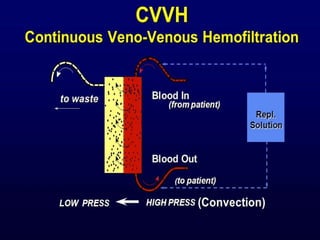
2. Continuous Veno Venous Hemofiltration
(CVVH)
Principles: Ultra-filtration and convection.
Process: The size of the pores in the filter is increased
thus allowing further molecules to pass into the ultra-
filtrate.
• The fluid that is filtered from the blood is then
replaced by a suitable fluid with chemistry similar to
normal blood which is applied in either pre or post
dilution.
3.Continuous Veno Venous Hemodialysis
(CVVHD)
Principle: Diffusion of molecules across a semi-
permeable membrane along a concentration gradient.
Process:
• A dialysate (prismasol) with similar chemistry to
normal blood is pumped counter-current to the blood
through the filter.
• Any molecules that are in greater concentration in the
blood are drawn across into the dialysate and
removed from the body.
• Molecules which are low in the blood are also
replaced by the normal levels in the dialysate.
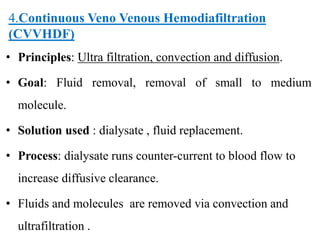
4.Continuous Veno Venous Hemodiafiltration
(CVVHDF)
• Principles: Ultra filtration, convection and diffusion.
• Goal: Fluid removal, removal of small to medium
molecule.
• Solution used : dialysate , fluid replacement.
• Process: dialysate runs counter-current to blood flow to
increase diffusive clearance.
• Fluids and molecules are removed via convection and
ultrafiltration .
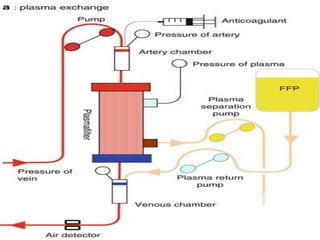
5. TPE – Therapeutic Plasma Exchange
• This mode is designed to separate the plasma from the
blood through a special filter membrane.
• The plasma is then replaced by a mixture of fresh
frozen plasma and albumin.
• Plasma exchange has shown good results in removing
harmful cytokines in conditions like myastenia gravis,
Guillian-Barre Syndrome, Good pasture syndrome and
thrombotic thrombocytopenic purpura
PROCEDURE
OF
CRRT
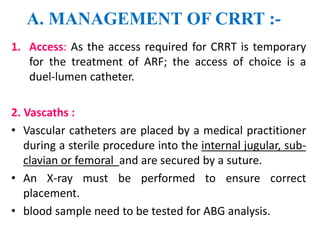
A. MANAGEMENT OF CRRT :-
1. Access: As the access required for CRRT is temporary
for the treatment of ARF; the access of choice is a
duel-lumen catheter.
2. Vascaths :
• Vascular catheters are placed by a medical practitioner
during a sterile procedure into the internal jugular, sub-
clavian or femoral and are secured by a suture.
• An X-ray must be performed to ensure correct
placement.
• blood sample need to be tested for ABG analysis.
• Vascaths usually have a lifespan of 7 – 10 days when they
are placed in the sub-clavian or internal jugular veins and
up to 5 days when placed in the femoral vein.
• The main complications of vascaths are the introduction of
infectious organisms and the clotting of the lumens.
3. AV fistulas:
• When renal replacement therapy will be required for
longer than a temporary treatment especially in chronic
renal failure patients then formation of an AV fistula in the
patients forearm will be considered.
B. The CRRT Order Form:-
1. The CRRT order: In intensive care units medical
staff will order continuous renal replacement
therapies.
2. Patient’s name, medical record number, address,
date of birth and sex for identification,purposes
need to write in the order form.
3. The patient’s pre treatment weight need to take.
4. The prescribed fluid balance for the patient which
will either be negative or neutral.
5. The type of replacement fluid (Dialysate): Lactate
or Bicarbonate based fluid.
6.Type of anticoagulation for the circuit: Heparin,
Regional heparinisation, citrate or no anticoagulant
related to the patients current coagulation blood
results and so should be checked prior to
commencing treatment)
7. If heparin is selected then the hourly rate in
units/kilogram/hour and a heparin bolus(usually
2500 units).
8. The Machine settings:
Effluent rate 25 ml/kg/hr or 40 ml/kg/hr, a Dialysate
rate in ml/hr and post dilution replacement rate in
ml/hr which will usually be set at the same speed.
9. The type of filter: Either a GAMBRO filter or an
EDWARDS filter which has two different sizes
according to surface area; the 1.2 or the 1.9.
10. The order form also has some standing orders
according to electrolyte replacement which are:
• If the patient’s serum potassium level drops below 4.0
mmol/L then add 15 mmol of Potassium Chloride to
each 5 litre bag of replacement fluid.
• If the patient’s serum phosphate level drops
below 1.0mmol/L then KH2PO4 will need to
be prescribed for replacement.
11. The order form finally requires a doctor’s
signature with a date and time.
C. EQUIPMENTS:
• 2 × 1000 ml 0.9% Sodium Chloride
• 45,000 units of heparin or citrate as ordered.
• 1 × 500mls of 0.9% Sodium Chloride
• 1 × standard IV giving set
• 1 × 50 ml BD syringe
• Dressing pack
• Sterile gloves
• 10ml syringes
• 19 gauge needles (sharp)
• additive labels
• Potassium Chloride poly ampoules (if ordered)
• Dialysate solution (Either Lactate or Bicarbonate 5
litre bags)
• The Aquarius haemodialysis circuit
• Dialysis filter (size and type as per order)
D. SET UP OF MACHINE
1. Bring CRRT machine to the bedside, plug into the wall
and switch on. The machine will do a brief self test.
2. Keep ready the solutions which will be the 1000ml (2
in number) bags of PRISMASOL BAG. Affix the
additive labels.
3. Prepare the heparin infusion (if ordered) in the 50ml
syringe by drawing up 25000 units of heparin(500
units per ml). Affix additive label
4. Once the Aquarius machine has finished its self-test:
Select the ordered therapy: (SCUF, CVVH, CVVHD,
CVVHDF, TPE)
5. Depending on the mode of treatment pre and post
dilution pumps are to be connected in the circuit.
6. Connect an empty effluent bag to the end of the yellow
effluent line and hang it on the left side of the balancing
scales (under the machine).
7. After the circuit is satisfactorily primed, connect the
access and return lines to two lumen spike.
8. Allow machine to perform the clamp and pressure test.
9. START and continue the procedure in the monitor
NURSING MANAGEMENT
1. Patient assessment:
• Assess for signs of infection, including redness,
swelling, increased tenderness, and drainage at access
site. Obtain temperature 4th hourly and note any
increase.
• Assess hemodynamic and fluid volume status by
monitoring-
 Hourly intake and output
 Vital signs, CVP, PA pressure at 15 min interval at the
onset of treatment until stable, every half hour during
treatment once stable and every 4th hourly when not
being dialyzed.
 Monitor breath sounds and heart sounds every 4th
hourly.
 Ultra filtration rate every 1 min until stable then every
hourly.
 Activated clotting time at 15 min interval until stable
then 4th hourly.
2. PATIENT MANAGEMENT:
• Prime filter and blood circuit with heparinized saline
and administer physician ordered heparin bolus to the
patient.
• For CVVHD , administer dialysate through the filter,
couter-current to blood flow.
• Set blood pump rate and apply air and venous pressure
detecting devices.
• If ordered infuse replacement solution usually hourly
via the arterial side or venous side. Replacement are
based on ultra filtration rate (UFR). If the UFR is high
then volume depletion will occur.
• If using a gravity drainage bag, keep the bag at least 16
inches below the filter. The UFR can be increased by
lowering the bag or can be decreased by raising the
collection bag.
• If collecting ultra-filtrate using vacuum suction, keep
suction set between 80 and 120 mmHg.
• If the SBP is less than 90 mmHg then place the patient in
flat or trendelenburg position. Administer normal saline,
replacement solution or vasoactive medications as
ordered.
• If the effluent appears pink tinged ; it suspect
a blood leak. Clamp the ultrafiltrate line.
• If the ultra-filtration rate decreases and the
blood in the circuit is darkened ; suspects
clotting in the filter. Adjust heparinization, be
prepared to replace the circuit.
CRITICAL OBSERVATION
Consult with the physician for the following:
• Cardiovascular collapse
• Blood in ultrafiltrate.
• Clotted filter
Continuous renal replacement therapy

Continuous renal replacement therapy

  • 1.
  • 5.
    INTRODUCTION • CRRT isused to replace normal kidney function by circulating the patient’s blood through the filter and returning it to the patient. • Continuous Renal Replacement Therapies are also a type of Hemodialysis. • Indicated for patients with acute or chronic renal failure who are clinically unstable for traditional hemodialysis, for patients with fluid overload secondary to oliguric renal failure and for patients whose kidneys cannot handle their acutely high metabolic or nutritional needs. • CRRT does not produce rapid fluid shift , does not require dialysis machine, or dialysis personnel to carry out the procedure and can be initiated quickly.
  • 6.
    • Normal IHDtreatment consisted of 4 hours of treatment every second day and due to haemodialysis machines requiring specialised staff, that meant patients would need transporting to a dialysis unit for treatment. This increased risks to the critically ill patient as well as delaying necessary treatment. • HD was also shown to affect the condition of the critically ill patient adversely in a couple of main areas. These included the increased hemodynamic instability, the fluctuations in uremic and fluid control and decreased metabolic control.
  • 7.
    Continuous Renal Replacement Therapy Definedas- “Any extracorporeal blood purification therapy intended to substitute for impaired renal function over an extended period of time and being applied for 24 hours /day.”
  • 10.
    INDICATIONS OF CRRT •Severe acid base disorder. • Severe electrolyte abnormalities. • Refractory volume overload • Intoxication • Severe septic shock • Oliguria (200ml in 12 hours) • Anuria (less than 50ml in 12 hours) • Hyperkalaemia (Potassium >6.5 mmol/L) • Severe acidemia (pH <7.1) • Azotemia (urea >30 mmol/L)
  • 11.
    • Uremia. • Significantorgan edema (lung or heart overload) • Uremic encephalopathy • Uremic pericarditis • Uremic neuropathy/ myopathy • Severe dysnatremia (Sodium >160 or <115 mmol/L) • Hyperthermia • Drug overdose with dialysable toxin.
  • 12.
    PURPOSES OF CRRT 1.Reduces hemodynamic instability, preventing secondary ischemia.  Uremic toxic removal.  Effective control of uremia, hypophosphatemia, hyperkalemia.  Precise volume control, immediately adaptable. 2. Acid base balance: rapid control of metabolic acidosis. 3. Electrolyte management: control of electrolyte imbalances. 4.Managemnent of sepsis. 5. Plasma cytokine filter .
  • 13.
    COMPLICATIONS OF CRRT Patientswho undergo CRRT are vulnerable to many complications especially when they are critically ill. 1. Hypotension: In some cases inotropic support may be required to maintain effective MAP. 2. Risk associated with anticoagulation therapy: Bleeding and coagulopathy.  Patient’s coagulation status is carefully monitored.  Look for signs of bleeding such as a decrease in haemoglobin levels or drop in blood pressure.
  • 14.
    3. Introduction ofinfection : • through poor aseptic technique when handling the CRRT circuit, filter and vascath. • It can also develop when a vascath has been in the patient for an extended period of time, particularly in a femoral site, as these vascath lines have a shorter life span. • Monitor for signs of infection like redness, swelling and heat at the site, increased temperature and increased white blood cells 4. CRRT can cause electrolyte and acid-base imbalances: constantly monitor the patient for the signs and symptoms and looking at blood results.
  • 15.
    CONTRAINDICATION • There areno known contraindication of Continuous Renal Replacement Therapy. • CRRT is intended for continuous operation.
  • 16.
  • 17.
    PRINCIPLES INVOLVED INCRRT 1. CONVECTION: Convection refers to the movement of dissolved solutes/molecules which are in the plasma water ; across the semi permeable membrane. • Movement occurs from an area of high pressure to an area of low pressure and the size of the molecules are related to the size of the pores in the filter. • The filtered fluid is discarded and replaced by chemically similar replacement fluid ( prismasol).
  • 19.
    2. ULTRA-FILTRATION: • Movementof fluid volume from an area of high pressure to an area of low pressure across a semi- permeable membrane. • The difference between ultra-filtration and convection is the first is related to the movement of fluids while the second is related to the movement of dissolved molecules. • As large amounts of fluid can be removed during ultra-filtration, replacement fluids are essential; reducing the risk of hypovolemia.
  • 20.
    3. DIFFUSION : •Movement of a substance from an area of high concentration to an area of low concentration. • In CRRT this is done by passing a dialysate fluid reflecting normal blood chemistry (prismosol) • This means that excess wastes in the blood will diffuse out, and replacement electrolytes and molecules will diffuse in.
  • 21.
    DIFFERENT MODES OFCRRT 1. SCUF – Slow Continuous Ultra filtration 2. CVVH – Continuous Veno Venous Hemofiltration. 3. CVVHD – Continuous Veno Venous Hemodialysis 4. CVVHDF – Continuous Veno Venous Hemodiafiltration 5. TPE – Therapeutic Plasma Exchange
  • 22.
    1. SLOW CONTINUOUSULTRA FILTRATION (SCUF) Principle: Ultra filtration; to remove excess fluid from the body and therefore is used to treat fluid overload. Process: • It works by pumping the patient’s blood through a filter which separates the fluid and molecules according to the size of the filter pores. • These are generally very small in this mode so as not to lose different solutes.
  • 24.
    2. Continuous VenoVenous Hemofiltration (CVVH) Principles: Ultra-filtration and convection. Process: The size of the pores in the filter is increased thus allowing further molecules to pass into the ultra- filtrate. • The fluid that is filtered from the blood is then replaced by a suitable fluid with chemistry similar to normal blood which is applied in either pre or post dilution.
  • 26.
    3.Continuous Veno VenousHemodialysis (CVVHD) Principle: Diffusion of molecules across a semi- permeable membrane along a concentration gradient. Process: • A dialysate (prismasol) with similar chemistry to normal blood is pumped counter-current to the blood through the filter. • Any molecules that are in greater concentration in the blood are drawn across into the dialysate and removed from the body. • Molecules which are low in the blood are also replaced by the normal levels in the dialysate.
  • 28.
    4.Continuous Veno VenousHemodiafiltration (CVVHDF) • Principles: Ultra filtration, convection and diffusion. • Goal: Fluid removal, removal of small to medium molecule. • Solution used : dialysate , fluid replacement. • Process: dialysate runs counter-current to blood flow to increase diffusive clearance. • Fluids and molecules are removed via convection and ultrafiltration .
  • 30.
    5. TPE –Therapeutic Plasma Exchange • This mode is designed to separate the plasma from the blood through a special filter membrane. • The plasma is then replaced by a mixture of fresh frozen plasma and albumin. • Plasma exchange has shown good results in removing harmful cytokines in conditions like myastenia gravis, Guillian-Barre Syndrome, Good pasture syndrome and thrombotic thrombocytopenic purpura
  • 32.
  • 33.
    A. MANAGEMENT OFCRRT :- 1. Access: As the access required for CRRT is temporary for the treatment of ARF; the access of choice is a duel-lumen catheter. 2. Vascaths : • Vascular catheters are placed by a medical practitioner during a sterile procedure into the internal jugular, sub- clavian or femoral and are secured by a suture. • An X-ray must be performed to ensure correct placement. • blood sample need to be tested for ABG analysis.
  • 34.
    • Vascaths usuallyhave a lifespan of 7 – 10 days when they are placed in the sub-clavian or internal jugular veins and up to 5 days when placed in the femoral vein. • The main complications of vascaths are the introduction of infectious organisms and the clotting of the lumens. 3. AV fistulas: • When renal replacement therapy will be required for longer than a temporary treatment especially in chronic renal failure patients then formation of an AV fistula in the patients forearm will be considered.
  • 35.
    B. The CRRTOrder Form:- 1. The CRRT order: In intensive care units medical staff will order continuous renal replacement therapies. 2. Patient’s name, medical record number, address, date of birth and sex for identification,purposes need to write in the order form. 3. The patient’s pre treatment weight need to take. 4. The prescribed fluid balance for the patient which will either be negative or neutral. 5. The type of replacement fluid (Dialysate): Lactate or Bicarbonate based fluid.
  • 36.
    6.Type of anticoagulationfor the circuit: Heparin, Regional heparinisation, citrate or no anticoagulant related to the patients current coagulation blood results and so should be checked prior to commencing treatment) 7. If heparin is selected then the hourly rate in units/kilogram/hour and a heparin bolus(usually 2500 units). 8. The Machine settings: Effluent rate 25 ml/kg/hr or 40 ml/kg/hr, a Dialysate rate in ml/hr and post dilution replacement rate in ml/hr which will usually be set at the same speed.
  • 37.
    9. The typeof filter: Either a GAMBRO filter or an EDWARDS filter which has two different sizes according to surface area; the 1.2 or the 1.9. 10. The order form also has some standing orders according to electrolyte replacement which are: • If the patient’s serum potassium level drops below 4.0 mmol/L then add 15 mmol of Potassium Chloride to each 5 litre bag of replacement fluid.
  • 38.
    • If thepatient’s serum phosphate level drops below 1.0mmol/L then KH2PO4 will need to be prescribed for replacement. 11. The order form finally requires a doctor’s signature with a date and time.
  • 39.
    C. EQUIPMENTS: • 2× 1000 ml 0.9% Sodium Chloride • 45,000 units of heparin or citrate as ordered. • 1 × 500mls of 0.9% Sodium Chloride • 1 × standard IV giving set • 1 × 50 ml BD syringe • Dressing pack • Sterile gloves
  • 40.
    • 10ml syringes •19 gauge needles (sharp) • additive labels • Potassium Chloride poly ampoules (if ordered) • Dialysate solution (Either Lactate or Bicarbonate 5 litre bags) • The Aquarius haemodialysis circuit • Dialysis filter (size and type as per order)
  • 41.
    D. SET UPOF MACHINE 1. Bring CRRT machine to the bedside, plug into the wall and switch on. The machine will do a brief self test. 2. Keep ready the solutions which will be the 1000ml (2 in number) bags of PRISMASOL BAG. Affix the additive labels. 3. Prepare the heparin infusion (if ordered) in the 50ml syringe by drawing up 25000 units of heparin(500 units per ml). Affix additive label 4. Once the Aquarius machine has finished its self-test: Select the ordered therapy: (SCUF, CVVH, CVVHD, CVVHDF, TPE)
  • 42.
    5. Depending onthe mode of treatment pre and post dilution pumps are to be connected in the circuit. 6. Connect an empty effluent bag to the end of the yellow effluent line and hang it on the left side of the balancing scales (under the machine). 7. After the circuit is satisfactorily primed, connect the access and return lines to two lumen spike. 8. Allow machine to perform the clamp and pressure test. 9. START and continue the procedure in the monitor
  • 43.
    NURSING MANAGEMENT 1. Patientassessment: • Assess for signs of infection, including redness, swelling, increased tenderness, and drainage at access site. Obtain temperature 4th hourly and note any increase. • Assess hemodynamic and fluid volume status by monitoring-  Hourly intake and output  Vital signs, CVP, PA pressure at 15 min interval at the onset of treatment until stable, every half hour during treatment once stable and every 4th hourly when not being dialyzed.
  • 44.
     Monitor breathsounds and heart sounds every 4th hourly.  Ultra filtration rate every 1 min until stable then every hourly.  Activated clotting time at 15 min interval until stable then 4th hourly.
  • 45.
    2. PATIENT MANAGEMENT: •Prime filter and blood circuit with heparinized saline and administer physician ordered heparin bolus to the patient. • For CVVHD , administer dialysate through the filter, couter-current to blood flow. • Set blood pump rate and apply air and venous pressure detecting devices. • If ordered infuse replacement solution usually hourly via the arterial side or venous side. Replacement are based on ultra filtration rate (UFR). If the UFR is high then volume depletion will occur.
  • 46.
    • If usinga gravity drainage bag, keep the bag at least 16 inches below the filter. The UFR can be increased by lowering the bag or can be decreased by raising the collection bag. • If collecting ultra-filtrate using vacuum suction, keep suction set between 80 and 120 mmHg. • If the SBP is less than 90 mmHg then place the patient in flat or trendelenburg position. Administer normal saline, replacement solution or vasoactive medications as ordered.
  • 47.
    • If theeffluent appears pink tinged ; it suspect a blood leak. Clamp the ultrafiltrate line. • If the ultra-filtration rate decreases and the blood in the circuit is darkened ; suspects clotting in the filter. Adjust heparinization, be prepared to replace the circuit.
  • 48.
    CRITICAL OBSERVATION Consult withthe physician for the following: • Cardiovascular collapse • Blood in ultrafiltrate. • Clotted filter