HYPOPITUITARISM
Dr. Rasikapriya
First year paediatrics
OBJECTIVES
• Introduction
• Classification
• Pathophysiology
• Clinical features
• Investigation
• Management
PITUITARY GLAND
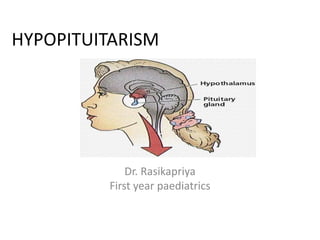
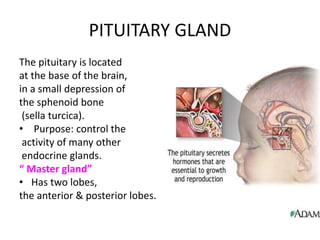
The pituitary is located
at the base of the brain,
in a small depression of
the sphenoid bone
(sella turcica).
• Purpose: control the
activity of many other
endocrine glands.
“ Master gland”
• Has two lobes,
the anterior & posterior lobes.
HYPOPITUITARISM
• Hypopituitarism- denotes
1. Underproduction of GH alone
2. In combination with deficiencies of other
pituitary hormones.
• Incidence – 1 in 4000- 1 in 10000 live births
( as per Nelson).
Contd…
• Hypopituitarism occurs when the anterior
(front) and posterior lobes of the pituitary
gland loses its ability to make hormones,
resulting in multiple pituitary hormone
deficiencies. Physical symptoms depend on
which hormones are no longer being
produced by the gland.
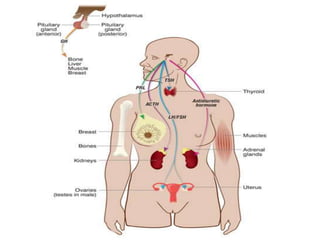
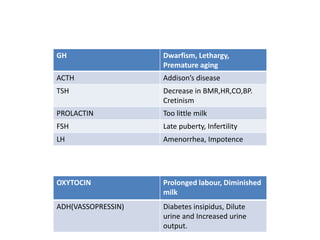
GH Dwarfism, Lethargy,
Premature aging
ACTH Addison’s disease
TSH Decrease in BMR,HR,CO,BP.
Cretinism
PROLACTIN Too little milk
FSH Late puberty, Infertility
LH Amenorrhea, Impotence
OXYTOCIN Prolonged labour, Diminished
milk
ADH(VASSOPRESSIN) Diabetes insipidus, Dilute
urine and Increased urine
output.
ETIOLOGY
HYPOPITUITARISM
1. CONGENITAL
2. ACQUIRED
CONGENITAL
• Perinatal insults (eg, traumatic delivery, birth
asphyxia)
• Interrupted pituitary stalk
• Absent or ectopic neurohypophysis
CONTD..
Genetic disorders:
• Isolated GH deficiency types IA, IB, II, III
• MPHD (eg, from PIT1 and PROP1 mutations)
• Septo-optic dysplasia
• Isolated gonadotropin deficiency (eg,
fromKAL and KISS1R mutations)
CONTD..
Developmental central nervous system (CNS)
defects:
• Anencephaly
• Holoprosencephaly
• Pituitary aplasia or hypoplasia
IDIOPATHIC
ACQUIRED CAUSES
• Any lesion that damages hypothalamus,
pituitary stalk or anterior pituitary hormone
deficiency .
• Most common lesion- craniopharyngioma
• Diabetes insipidus- most frequently seen.
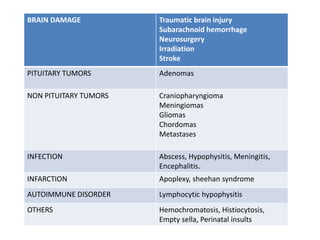
BRAIN DAMAGE Traumatic brain injury
Subarachnoid hemorrhage
Neurosurgery
Irradiation
Stroke
PITUITARY TUMORS Adenomas
NON PITUITARY TUMORS Craniopharyngioma
Meningiomas
Gliomas
Chordomas
Metastases
INFECTION Abscess, Hypophysitis, Meningitis,
Encephalitis.
INFARCTION Apoplexy, sheehan syndrome
AUTOIMMUNE DISORDER Lymphocytic hypophysitis
OTHERS Hemochromatosis, Histiocytosis,
Empty sella, Perinatal insults
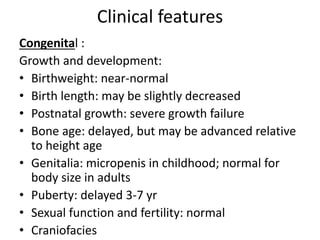
Clinical features
Congenital :
Growth and development:
• Birthweight: near-normal
• Birth length: may be slightly decreased
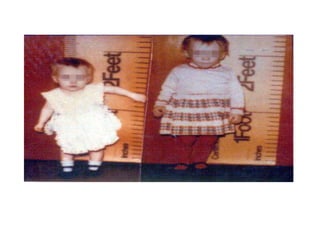
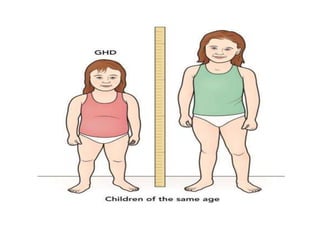
• Postnatal growth: severe growth failure
• Bone age: delayed, but may be advanced relative
to height age
• Genitalia: micropenis in childhood; normal for
body size in adults
• Puberty: delayed 3-7 yr
• Sexual function and fertility: normal
• Craniofacies
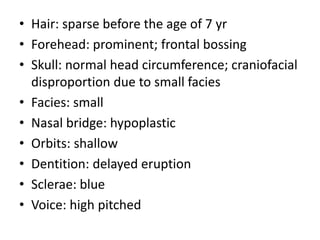
• Hair: sparse before the age of 7 yr
• Forehead: prominent; frontal bossing
• Skull: normal head circumference; craniofacial
disproportion due to small facies
• Facies: small
• Nasal bridge: hypoplastic
• Orbits: shallow
• Dentition: delayed eruption
• Sclerae: blue
• Voice: high pitched
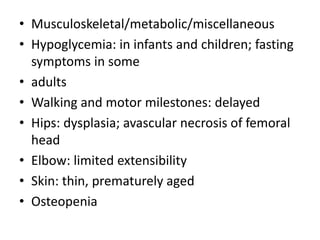
• Musculoskeletal/metabolic/miscellaneous
• Hypoglycemia: in infants and children; fasting
symptoms in some
• adults
• Walking and motor milestones: delayed
• Hips: dysplasia; avascular necrosis of femoral
head
• Elbow: limited extensibility
• Skin: thin, prematurely aged
• Osteopenia
• Common presentation- Hypoglycemia.
• Jaundice
• Electrolyte disturbances
ACQUIRED
• TUMORS- headache, vomiting, visual
disturbance, pathologic sleep patterns,
decreased school performance, seizures,
polyuria and growth failure.
• Craniopharyngioma- visual field defects, optic
atrophy, papilledema and cranial nerve palsy.
• Loss of weight, asthenia, sensitivity to cold,
mental torpor and absence of sweating.
Contd..
• Sexual maturation fails or regression
• Atropy of gonads with amenorrhea and loss of
pubic hair.
• Growth slows dramatically.
INVESTIGATION
• CRITERIA FOR GROWTH FAILURE:
1. Height < 1 percentile for age and sex
2. Height > 2 SD below sex adjusted mid parent
height.
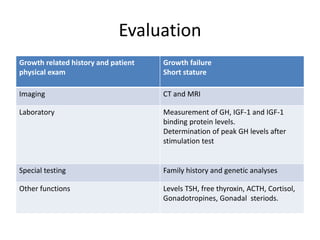
Evaluation
Growth related history and patient
physical exam
Growth failure
Short stature
Imaging CT and MRI
Laboratory Measurement of GH, IGF-1 and IGF-1
binding protein levels.
Determination of peak GH levels after
stimulation test
Special testing Family history and genetic analyses
Other functions Levels TSH, free thyroxin, ACTH, Cortisol,
Gonadotropines, Gonadal steriods.
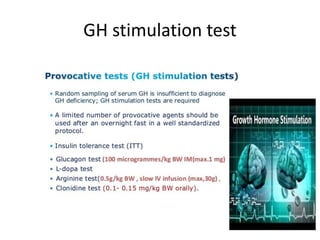
GH stimulation test
Contd..
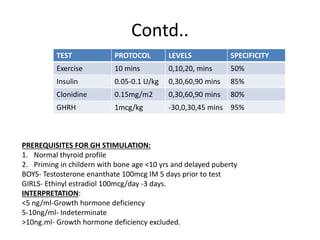
TEST PROTOCOL LEVELS SPECIFICITY
Exercise 10 mins 0,10,20, mins 50%
Insulin 0.05-0.1 U/kg 0,30,60,90 mins 85%
Clonidine 0.15mg/m2 0,30,60,90 mins 80%
GHRH 1mcg/kg -30,0,30,45 mins 95%
PREREQUISITES FOR GH STIMULATION:
1. Normal thyroid profile
2. Priming in childern with bone age <10 yrs and delayed puberty
BOYS- Testosterone enanthate 100mcg IM 5 days prior to test
GIRLS- Ethinyl estradiol 100mcg/day -3 days.
INTERPRETATION:
<5 ng/ml-Growth hormone deficiency
5-10ng/ml- Indeterminate
>10ng.ml- Growth hormone deficiency excluded.
MRI
MPHD
Triad- small anterior
pituitary, missing or
attenuated pituitary stalk
and ectopic posterior
pituitary bright spot at base
of hypothalamus
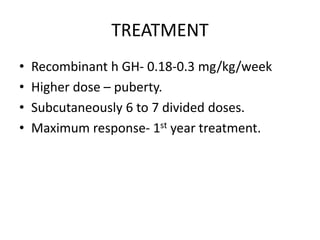
TREATMENT
• Recombinant h GH- 0.18-0.3 mg/kg/week
• Higher dose – puberty.
• Subcutaneously 6 to 7 divided doses.
• Maximum response- 1st year treatment.
Contd..
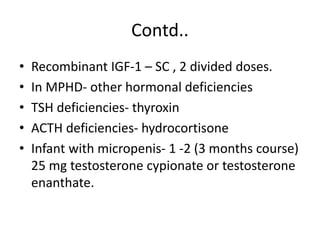
• Recombinant IGF-1 – SC , 2 divided doses.
• In MPHD- other hormonal deficiencies
• TSH deficiencies- thyroxin
• ACTH deficiencies- hydrocortisone
• Infant with micropenis- 1 -2 (3 months course)
25 mg testosterone cypionate or testosterone
enanthate.
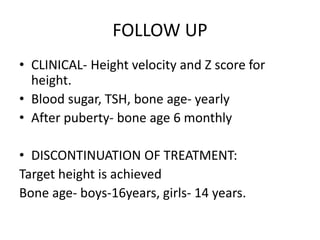
FOLLOW UP
• CLINICAL- Height velocity and Z score for
height.
• Blood sugar, TSH, bone age- yearly
• After puberty- bone age 6 monthly
• DISCONTINUATION OF TREATMENT:
Target height is achieved
Bone age- boys-16years, girls- 14 years.
Diabetes Insipitus
• DI is usually insidious but can occur with
damage to the hypothalamus or the pituitary.
(neurogenic DI)
• May be a result of defect in renal tubules, do
not respond to ADH (nephrogenic DI)
• Decreased production or release of ADH
results in massive water loss
• Leads to hypovolemic & dehydration
CLINICAL FEATURES
Polyuria
Urine specific gravity low
Polydipsia (excessive drinking)
Weight loss
Dry skin & mucous membranes
Possible hypervolemia, hypotension,
electrolyte imbalance
DIAGNOSTIC TESTS
• Serum sodium
• Urine specific gravity
• Serum osmolality
• Urine osmolality
• Serum ADH levels
• Vasopressin test and water deprivation test:
increased hyperosmolality is diagnostic for DI.
TREATMENT
Medical management includes
• Rehydration IV fluids (hypotonic)
• Symptom management
• ADH replacement (vasopressin)
• For nephrogenic DI: thiazide diuretics,
mild salt depletion, prostaglandin
inhibitors (i.e. ibuprophen)
THANK YOU

Hypopituitarism

  • 1.
  • 2.
    OBJECTIVES • Introduction • Classification •Pathophysiology • Clinical features • Investigation • Management
  • 3.
    PITUITARY GLAND The pituitaryis located at the base of the brain, in a small depression of the sphenoid bone (sella turcica). • Purpose: control the activity of many other endocrine glands. “ Master gland” • Has two lobes, the anterior & posterior lobes.
  • 5.
    HYPOPITUITARISM • Hypopituitarism- denotes 1.Underproduction of GH alone 2. In combination with deficiencies of other pituitary hormones. • Incidence – 1 in 4000- 1 in 10000 live births ( as per Nelson).
  • 6.
    Contd… • Hypopituitarism occurswhen the anterior (front) and posterior lobes of the pituitary gland loses its ability to make hormones, resulting in multiple pituitary hormone deficiencies. Physical symptoms depend on which hormones are no longer being produced by the gland.
  • 7.
    GH Dwarfism, Lethargy, Prematureaging ACTH Addison’s disease TSH Decrease in BMR,HR,CO,BP. Cretinism PROLACTIN Too little milk FSH Late puberty, Infertility LH Amenorrhea, Impotence OXYTOCIN Prolonged labour, Diminished milk ADH(VASSOPRESSIN) Diabetes insipidus, Dilute urine and Increased urine output.
  • 8.
  • 9.
    CONGENITAL • Perinatal insults(eg, traumatic delivery, birth asphyxia) • Interrupted pituitary stalk • Absent or ectopic neurohypophysis
  • 10.
    CONTD.. Genetic disorders: • IsolatedGH deficiency types IA, IB, II, III • MPHD (eg, from PIT1 and PROP1 mutations) • Septo-optic dysplasia • Isolated gonadotropin deficiency (eg, fromKAL and KISS1R mutations)
  • 11.
    CONTD.. Developmental central nervoussystem (CNS) defects: • Anencephaly • Holoprosencephaly • Pituitary aplasia or hypoplasia IDIOPATHIC
  • 12.
    ACQUIRED CAUSES • Anylesion that damages hypothalamus, pituitary stalk or anterior pituitary hormone deficiency . • Most common lesion- craniopharyngioma • Diabetes insipidus- most frequently seen.
  • 13.
    BRAIN DAMAGE Traumaticbrain injury Subarachnoid hemorrhage Neurosurgery Irradiation Stroke PITUITARY TUMORS Adenomas NON PITUITARY TUMORS Craniopharyngioma Meningiomas Gliomas Chordomas Metastases INFECTION Abscess, Hypophysitis, Meningitis, Encephalitis. INFARCTION Apoplexy, sheehan syndrome AUTOIMMUNE DISORDER Lymphocytic hypophysitis OTHERS Hemochromatosis, Histiocytosis, Empty sella, Perinatal insults
  • 14.
    Clinical features Congenital : Growthand development: • Birthweight: near-normal • Birth length: may be slightly decreased • Postnatal growth: severe growth failure • Bone age: delayed, but may be advanced relative to height age • Genitalia: micropenis in childhood; normal for body size in adults • Puberty: delayed 3-7 yr • Sexual function and fertility: normal • Craniofacies
  • 15.
    • Hair: sparsebefore the age of 7 yr • Forehead: prominent; frontal bossing • Skull: normal head circumference; craniofacial disproportion due to small facies • Facies: small • Nasal bridge: hypoplastic • Orbits: shallow • Dentition: delayed eruption • Sclerae: blue • Voice: high pitched
  • 16.
    • Musculoskeletal/metabolic/miscellaneous • Hypoglycemia:in infants and children; fasting symptoms in some • adults • Walking and motor milestones: delayed • Hips: dysplasia; avascular necrosis of femoral head • Elbow: limited extensibility • Skin: thin, prematurely aged • Osteopenia
  • 17.
    • Common presentation-Hypoglycemia. • Jaundice • Electrolyte disturbances
  • 20.
    ACQUIRED • TUMORS- headache,vomiting, visual disturbance, pathologic sleep patterns, decreased school performance, seizures, polyuria and growth failure. • Craniopharyngioma- visual field defects, optic atrophy, papilledema and cranial nerve palsy. • Loss of weight, asthenia, sensitivity to cold, mental torpor and absence of sweating.
  • 21.
    Contd.. • Sexual maturationfails or regression • Atropy of gonads with amenorrhea and loss of pubic hair. • Growth slows dramatically.
  • 22.
    INVESTIGATION • CRITERIA FORGROWTH FAILURE: 1. Height < 1 percentile for age and sex 2. Height > 2 SD below sex adjusted mid parent height.
  • 23.
    Evaluation Growth related historyand patient physical exam Growth failure Short stature Imaging CT and MRI Laboratory Measurement of GH, IGF-1 and IGF-1 binding protein levels. Determination of peak GH levels after stimulation test Special testing Family history and genetic analyses Other functions Levels TSH, free thyroxin, ACTH, Cortisol, Gonadotropines, Gonadal steriods.
  • 24.
  • 25.
    Contd.. TEST PROTOCOL LEVELSSPECIFICITY Exercise 10 mins 0,10,20, mins 50% Insulin 0.05-0.1 U/kg 0,30,60,90 mins 85% Clonidine 0.15mg/m2 0,30,60,90 mins 80% GHRH 1mcg/kg -30,0,30,45 mins 95% PREREQUISITES FOR GH STIMULATION: 1. Normal thyroid profile 2. Priming in childern with bone age <10 yrs and delayed puberty BOYS- Testosterone enanthate 100mcg IM 5 days prior to test GIRLS- Ethinyl estradiol 100mcg/day -3 days. INTERPRETATION: <5 ng/ml-Growth hormone deficiency 5-10ng/ml- Indeterminate >10ng.ml- Growth hormone deficiency excluded.
  • 26.
    MRI MPHD Triad- small anterior pituitary,missing or attenuated pituitary stalk and ectopic posterior pituitary bright spot at base of hypothalamus
  • 27.
    TREATMENT • Recombinant hGH- 0.18-0.3 mg/kg/week • Higher dose – puberty. • Subcutaneously 6 to 7 divided doses. • Maximum response- 1st year treatment.
  • 28.
    Contd.. • Recombinant IGF-1– SC , 2 divided doses. • In MPHD- other hormonal deficiencies • TSH deficiencies- thyroxin • ACTH deficiencies- hydrocortisone • Infant with micropenis- 1 -2 (3 months course) 25 mg testosterone cypionate or testosterone enanthate.
  • 29.
    FOLLOW UP • CLINICAL-Height velocity and Z score for height. • Blood sugar, TSH, bone age- yearly • After puberty- bone age 6 monthly • DISCONTINUATION OF TREATMENT: Target height is achieved Bone age- boys-16years, girls- 14 years.
  • 30.
    Diabetes Insipitus • DIis usually insidious but can occur with damage to the hypothalamus or the pituitary. (neurogenic DI) • May be a result of defect in renal tubules, do not respond to ADH (nephrogenic DI) • Decreased production or release of ADH results in massive water loss • Leads to hypovolemic & dehydration
  • 31.
    CLINICAL FEATURES Polyuria Urine specificgravity low Polydipsia (excessive drinking) Weight loss Dry skin & mucous membranes Possible hypervolemia, hypotension, electrolyte imbalance
  • 32.
    DIAGNOSTIC TESTS • Serumsodium • Urine specific gravity • Serum osmolality • Urine osmolality • Serum ADH levels • Vasopressin test and water deprivation test: increased hyperosmolality is diagnostic for DI.
  • 33.
    TREATMENT Medical management includes •Rehydration IV fluids (hypotonic) • Symptom management • ADH replacement (vasopressin) • For nephrogenic DI: thiazide diuretics, mild salt depletion, prostaglandin inhibitors (i.e. ibuprophen)
  • 34.