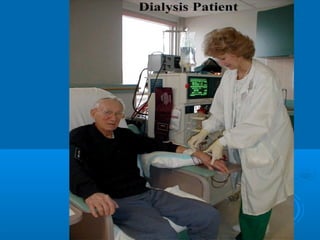
Renal ReplacementRenal Replacement
TherapyTherapy
(RRT)(RRT)
PRESENTED BY
DR SHASHANK
AGRAWAL
MEDICINE
ObjectivesObjectives
At the end of this presentation the learner will beAt the end of this presentation the learner will be
familiar with:familiar with:
• The stages of progressive renal failureThe stages of progressive renal failure
• The renal replacement therapies available toThe renal replacement therapies available to
patients in North Bay and surrounding district whopatients in North Bay and surrounding district who
have either acute or chronic kidney failurehave either acute or chronic kidney failure
• The types of accesses required for peritoneal andThe types of accesses required for peritoneal and
hemodialysishemodialysis
Primary Functions of the KidneyPrimary Functions of the Kidney
• Removal of metabolic wastes, drugs andRemoval of metabolic wastes, drugs and
other toxinsother toxins
• Fluid BalanceFluid Balance
• Electrolyte BalanceElectrolyte Balance
• Acid-Base RegulationAcid-Base Regulation
• Blood Pressure ControlBlood Pressure Control
• Hormone Production ~ Erythropoietin,Hormone Production ~ Erythropoietin,
Vitamin D (Calcitriol), ReninVitamin D (Calcitriol), Renin
““Master Chemists of the Body”Master Chemists of the Body”
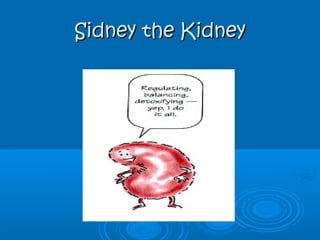
Sidney the KidneySidney the Kidney
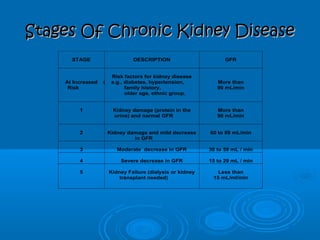
Stages Of Chronic Kidney DiseaseStages Of Chronic Kidney Disease
STAGE DESCRIPTION GFR
At Increased
Risk
Risk factors for kidney disease
( e.g., diabetes, hypertension,
family history,
older age, ethnic group.
More than
90 mL/min
1 Kidney damage (protein in the
urine) and normal GFR
More than
90 mL/min
2 Kidney damage and mild decrease
in GFR
60 to 89 mL/min
3 Moderate decrease in GFR 30 to 59 mL / min
4 Severe decrease in GFR 15 to 29 mL / min
5 Kidney Failure (dialysis or kidney
transplant needed)
Less than
15 mL/ml/min
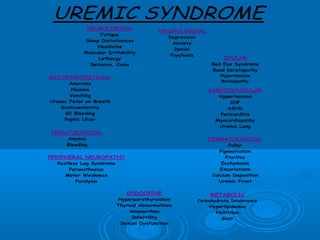
UREMIC SYNDROME
NEUROLOGICAL
Fatigue
Sleep Disturbances
Headache
Muscular Irritability
Lethargy
Seizures, Coma
PSYCHOLOGICAL
Depression
Anxiety
Denial
Psychosis
OCULAR
Red Eye Syndrome
Band Keratopathy
Hypertensive
Retinopathy
CARDIOVASCULAR
Hypertension
CHF
ASHD
Pericarditis
Myocardiopathy
Uremic Lung
DERMATOLOGICAL
Pallor
Pigmentation
Pruritus
Ecchymosis
Excoriations
Calcium Deposition
Uremic Frost
METABOLIC
Carbohydrate Intolerance
Hyperlipidemia
Nutrition
Gout
ENDOCRINE
Hyperparathyroidism
Thyroid Abnormalities
Amenorrhea
Infertility
Sexual Dysfunction
PERIPHERAL NEUROPATHY
Restless Leg Syndrome
Paraesthesias
Motor Weakness
Paralysis
HEMATOLOGICAL
Anemia
Bleeding
GASTROINTESTINAL
Anorexia
Nausea
Vomiting
Uremic Fetor on Breath
Gastroenteritis
GI Bleeding
Peptic Ulcer
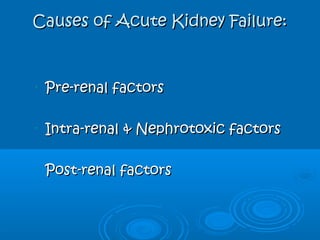
Causes of Acute Kidney Failure:Causes of Acute Kidney Failure:
•
Pre-renal factorsPre-renal factors
•
Intra-renal & Nephrotoxic factorsIntra-renal & Nephrotoxic factors
•
Post-renal factorsPost-renal factors
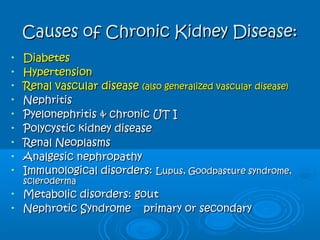
Causes of Chronic Kidney Disease:Causes of Chronic Kidney Disease:
• DiabetesDiabetes
• HypertensionHypertension
• Renal vascular diseaseRenal vascular disease (also generalized vascular disease)(also generalized vascular disease)
• NephritisNephritis
• Pyelonephritis & chronic UT IPyelonephritis & chronic UT I
• Polycystic kidney diseasePolycystic kidney disease
• Renal NeoplasmsRenal Neoplasms
• Analgesic nephropathyAnalgesic nephropathy
• Immunological disorders:Immunological disorders: Lupus, Goodpasture syndrome,Lupus, Goodpasture syndrome,
sclerodermascleroderma
• Metabolic disorders: goutMetabolic disorders: gout
• Nephrotic SyndromeNephrotic Syndrome primary or secondaryprimary or secondary
Does everyone understand howDoes everyone understand how
important we are?important we are?
Kidneys UrineKidneys Urine
Types of DialysisTypes of Dialysis
Dialysis is a way to clean blood of wastes, fluids andDialysis is a way to clean blood of wastes, fluids and
salts that build up in the body when the kidneys fail.salts that build up in the body when the kidneys fail.
There are 2 kinds of Dialysis:There are 2 kinds of Dialysis:
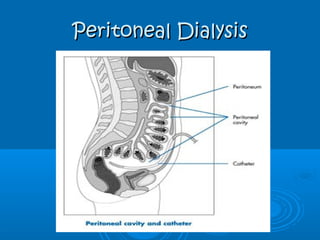
• Peritoneal Dialysis:Peritoneal Dialysis:
•
Uses the peritoneal membrane as the filter. The membraneUses the peritoneal membrane as the filter. The membrane
covers the abdominal organs and lines the abdominal wall.covers the abdominal organs and lines the abdominal wall.
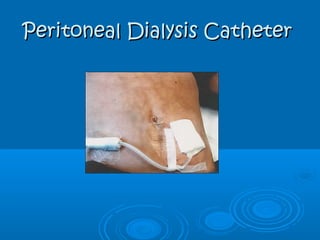
This takes placeThis takes place insideinside the body and requires placementthe body and requires placement
of a catheter in the peritoneal cavity to allow fluid to beof a catheter in the peritoneal cavity to allow fluid to be
instilled and drained out.instilled and drained out.
• Hemodialysis:Hemodialysis:
•
Uses a dialyzer or artificial kidney to filter the blood. ThisUses a dialyzer or artificial kidney to filter the blood. This
takes placetakes place outsideoutside the body and requires some form ofthe body and requires some form of
access to the circulatory system. Accomplished with theaccess to the circulatory system. Accomplished with the
use of a sophisticated computerized control unit (dialysisuse of a sophisticated computerized control unit (dialysis
machinemachine ))
Other choicesOther choices
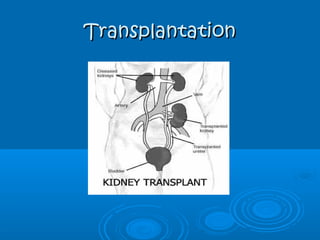
• kidney transplantation:kidney transplantation:
•
To be placed on a transplant list the patientTo be placed on a transplant list the patient
must be on some form of renal replacementmust be on some form of renal replacement
therapy, whether it is peritoneal dialysis ortherapy, whether it is peritoneal dialysis or
hemodialysishemodialysis
•
Once a patient is accepted for transplant, theOnce a patient is accepted for transplant, the
date of start of dialysis is the date they aredate of start of dialysis is the date they are
active on the listactive on the list
•
If the patient has a living donor who has beenIf the patient has a living donor who has been
accepted as healthy donor, it is possible to haveaccepted as healthy donor, it is possible to have
a pre-emptive transplant, bypassing dialysis.a pre-emptive transplant, bypassing dialysis.
• No treatment or palliative careNo treatment or palliative care
Peritoneal DialysisPeritoneal Dialysis
•
Uses the peritoneal membrane as the filter. The membraneUses the peritoneal membrane as the filter. The membrane
covers the abdominal organs and lines the abdominal wall.covers the abdominal organs and lines the abdominal wall.
The membrane size is 1 – 2 mThe membrane size is 1 – 2 m22
and approximates the bodyand approximates the body
surface area. Uses the following principles:surface area. Uses the following principles:
•
DiffusionDiffusion: movement of solutes across the peritoneal: movement of solutes across the peritoneal
membrane from an area of higher concentration to anmembrane from an area of higher concentration to an
area of lower concentrationarea of lower concentration
•
OsmosisOsmosis:: movement of water across the peritonealmovement of water across the peritoneal
membrane from an area of lower solute concentration tomembrane from an area of lower solute concentration to
an area of higher solute concentration.an area of higher solute concentration.
•
Ultrafiltration:Ultrafiltration: water removal related to an osmoticwater removal related to an osmotic
pressure gradient with the use of various concentrationspressure gradient with the use of various concentrations
of dialysate fluidof dialysate fluid
How does PD work?How does PD work?
• Fluid called DIALYSATE is put into theFluid called DIALYSATE is put into the
abdomen through a PD catheter. This fluidabdomen through a PD catheter. This fluid
is left to dwell in the peritoneum for severalis left to dwell in the peritoneum for several
hours.hours.
• While in the abdomen, the fluid collectsWhile in the abdomen, the fluid collects
wastes that have been filtered through thewastes that have been filtered through the
peritoneal membrane. These wastes passperitoneal membrane. These wastes pass
from the body when the fluid is drained.from the body when the fluid is drained.
Peritoneal DialysisPeritoneal Dialysis
• Performed daily, by the patient at home,Performed daily, by the patient at home,
more physiologicalmore physiological
• Allows for independence, patients can workAllows for independence, patients can work
or travelor travel
• Fewer fluid and dietary restrictionsFewer fluid and dietary restrictions
• Often fewer medications or lower dosesOften fewer medications or lower doses
requiredrequired
• Residual renal function preservedResidual renal function preserved
• Ministry of Health funded home therapyMinistry of Health funded home therapy
Peritoneal DialysisPeritoneal Dialysis
PatientsPatients
•
must have a clean room to performmust have a clean room to perform
exchanges and a large enough area toexchanges and a large enough area to
store all suppliesstore all supplies
•
no pets allowed in the roomno pets allowed in the room
•
must learn to monitor their own weightmust learn to monitor their own weight
and blood pressuresand blood pressures
•
must be able to follow importantmust be able to follow important
instructions to prevent infection in theinstructions to prevent infection in the
peritoneumperitoneum
•
must also be able to determine the choicemust also be able to determine the choice
of dialysate fluid and when to use itof dialysate fluid and when to use it
Peritoneal DialysisPeritoneal Dialysis
Peritoneal Dialysis CatheterPeritoneal Dialysis Catheter
Types of PeritonealTypes of Peritoneal
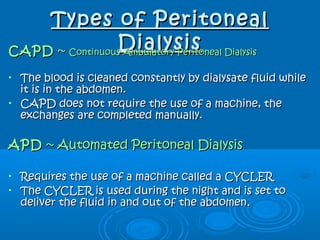
DialysisDialysisCAPDCAPD ~~ Continuous Ambulatory Peritoneal DialysisContinuous Ambulatory Peritoneal Dialysis
• The blood is cleaned constantly by dialysate fluid whileThe blood is cleaned constantly by dialysate fluid while
it is in the abdomen.it is in the abdomen.
• CAPD does not require the use of a machine, theCAPD does not require the use of a machine, the
exchanges are completed manually.exchanges are completed manually.
APDAPD ~ Automated Peritoneal Dialysis~ Automated Peritoneal Dialysis
• Requires the use of a machine called a CYCLERRequires the use of a machine called a CYCLER
• The CYCLER is used during the night and is set toThe CYCLER is used during the night and is set to
deliver the fluid in and out of the abdomendeliver the fluid in and out of the abdomen..
HemodialysisHemodialysis
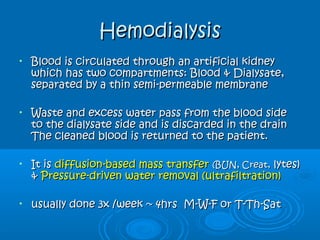
• Blood is circulated through an artificial kidneyBlood is circulated through an artificial kidney
which has two compartments: Blood & Dialysate,which has two compartments: Blood & Dialysate,
separated by a thin semi-permeable membraneseparated by a thin semi-permeable membrane
• Waste and excess water pass from the blood sideWaste and excess water pass from the blood side
to the dialysate side and is discarded in the drainto the dialysate side and is discarded in the drain
The cleaned blood is returned to the patient.The cleaned blood is returned to the patient.
• It isIt is diffusion-based mass transferdiffusion-based mass transfer (BUN, Creat,(BUN, Creat, lytes)lytes)
&& Pressure-driven water removal (ultrafiltration)Pressure-driven water removal (ultrafiltration)
• usually done 3x /week ~ 4hrs M-W-F or T-Th-Satusually done 3x /week ~ 4hrs M-W-F or T-Th-Sat
HemodialysisHemodialysis
• Hemodialysis treatments every other day are not asHemodialysis treatments every other day are not as
physiological as peritoneal dialysisphysiological as peritoneal dialysis
• Requires a trip to the hospital up to 3 times weeklyRequires a trip to the hospital up to 3 times weekly
• Patients can travel to other units but must be pre-Patients can travel to other units but must be pre-
arranged and space is not always availablearranged and space is not always available
• Patients are more restricted in dietary and fluidPatients are more restricted in dietary and fluid
intake between treatmentsintake between treatments
• Medication requirements different than for thoseMedication requirements different than for those
on peritoneal dialysis e.g. require moreon peritoneal dialysis e.g. require more
antihypertensive meds, higher doses ofantihypertensive meds, higher doses of
ErythropoietinErythropoietin
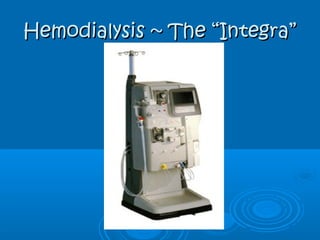
Hemodialysis ~ The “Integra”Hemodialysis ~ The “Integra”
HemodialysisHemodialysis
• Requires access to the blood streamRequires access to the blood stream
•
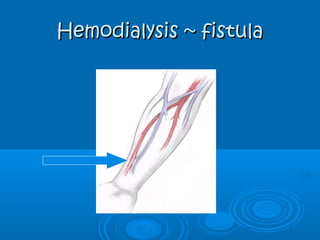
Arterio – venous fistulaArterio – venous fistula
•
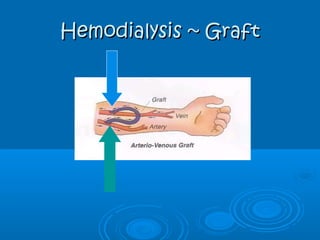
Arterio – venous graftArterio – venous graft
•
Temporary catheterTemporary catheter
•
Long – term catheterLong – term catheter
Hemodialysis ~ fistulaHemodialysis ~ fistula
Hemodialysis ~ GraftHemodialysis ~ Graft
Temporary Hemodialysis CatheterTemporary Hemodialysis Catheter
Exit site atExit site at
surface ofsurface of
the skinthe skin
Tip locatedTip located
at junctionat junction
of SVC andof SVC and
right Atriumright Atrium
InsertedInserted
in thein the
jugularjugular
veinvein
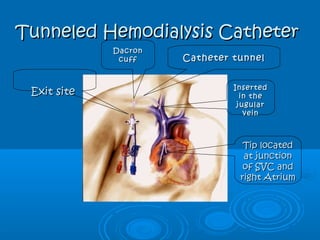
Tunneled Hemodialysis CatheterTunneled Hemodialysis Catheter
Exit siteExit site
Catheter tunnelCatheter tunnel
Tip locatedTip located
at junctionat junction
of SVC andof SVC and
right Atriumright Atrium
InsertedInserted
in thein the
jugularjugular
veinvein
DacronDacron
cuffcuff
TransplantationTransplantation
Thank youThank you

Renal replacement therapy_

  • 1.
  • 2.
    ObjectivesObjectives At the endof this presentation the learner will beAt the end of this presentation the learner will be familiar with:familiar with: • The stages of progressive renal failureThe stages of progressive renal failure • The renal replacement therapies available toThe renal replacement therapies available to patients in North Bay and surrounding district whopatients in North Bay and surrounding district who have either acute or chronic kidney failurehave either acute or chronic kidney failure • The types of accesses required for peritoneal andThe types of accesses required for peritoneal and hemodialysishemodialysis
  • 3.
    Primary Functions ofthe KidneyPrimary Functions of the Kidney • Removal of metabolic wastes, drugs andRemoval of metabolic wastes, drugs and other toxinsother toxins • Fluid BalanceFluid Balance • Electrolyte BalanceElectrolyte Balance • Acid-Base RegulationAcid-Base Regulation • Blood Pressure ControlBlood Pressure Control • Hormone Production ~ Erythropoietin,Hormone Production ~ Erythropoietin, Vitamin D (Calcitriol), ReninVitamin D (Calcitriol), Renin ““Master Chemists of the Body”Master Chemists of the Body”
  • 4.
  • 5.
    Stages Of ChronicKidney DiseaseStages Of Chronic Kidney Disease STAGE DESCRIPTION GFR At Increased Risk Risk factors for kidney disease ( e.g., diabetes, hypertension, family history, older age, ethnic group. More than 90 mL/min 1 Kidney damage (protein in the urine) and normal GFR More than 90 mL/min 2 Kidney damage and mild decrease in GFR 60 to 89 mL/min 3 Moderate decrease in GFR 30 to 59 mL / min 4 Severe decrease in GFR 15 to 29 mL / min 5 Kidney Failure (dialysis or kidney transplant needed) Less than 15 mL/ml/min
  • 6.
    UREMIC SYNDROME NEUROLOGICAL Fatigue Sleep Disturbances Headache MuscularIrritability Lethargy Seizures, Coma PSYCHOLOGICAL Depression Anxiety Denial Psychosis OCULAR Red Eye Syndrome Band Keratopathy Hypertensive Retinopathy CARDIOVASCULAR Hypertension CHF ASHD Pericarditis Myocardiopathy Uremic Lung DERMATOLOGICAL Pallor Pigmentation Pruritus Ecchymosis Excoriations Calcium Deposition Uremic Frost METABOLIC Carbohydrate Intolerance Hyperlipidemia Nutrition Gout ENDOCRINE Hyperparathyroidism Thyroid Abnormalities Amenorrhea Infertility Sexual Dysfunction PERIPHERAL NEUROPATHY Restless Leg Syndrome Paraesthesias Motor Weakness Paralysis HEMATOLOGICAL Anemia Bleeding GASTROINTESTINAL Anorexia Nausea Vomiting Uremic Fetor on Breath Gastroenteritis GI Bleeding Peptic Ulcer
  • 7.
    Causes of AcuteKidney Failure:Causes of Acute Kidney Failure: • Pre-renal factorsPre-renal factors • Intra-renal & Nephrotoxic factorsIntra-renal & Nephrotoxic factors • Post-renal factorsPost-renal factors
  • 8.
    Causes of ChronicKidney Disease:Causes of Chronic Kidney Disease: • DiabetesDiabetes • HypertensionHypertension • Renal vascular diseaseRenal vascular disease (also generalized vascular disease)(also generalized vascular disease) • NephritisNephritis • Pyelonephritis & chronic UT IPyelonephritis & chronic UT I • Polycystic kidney diseasePolycystic kidney disease • Renal NeoplasmsRenal Neoplasms • Analgesic nephropathyAnalgesic nephropathy • Immunological disorders:Immunological disorders: Lupus, Goodpasture syndrome,Lupus, Goodpasture syndrome, sclerodermascleroderma • Metabolic disorders: goutMetabolic disorders: gout • Nephrotic SyndromeNephrotic Syndrome primary or secondaryprimary or secondary
  • 9.
    Does everyone understandhowDoes everyone understand how important we are?important we are? Kidneys UrineKidneys Urine
  • 10.
    Types of DialysisTypesof Dialysis Dialysis is a way to clean blood of wastes, fluids andDialysis is a way to clean blood of wastes, fluids and salts that build up in the body when the kidneys fail.salts that build up in the body when the kidneys fail. There are 2 kinds of Dialysis:There are 2 kinds of Dialysis: • Peritoneal Dialysis:Peritoneal Dialysis: • Uses the peritoneal membrane as the filter. The membraneUses the peritoneal membrane as the filter. The membrane covers the abdominal organs and lines the abdominal wall.covers the abdominal organs and lines the abdominal wall. This takes placeThis takes place insideinside the body and requires placementthe body and requires placement of a catheter in the peritoneal cavity to allow fluid to beof a catheter in the peritoneal cavity to allow fluid to be instilled and drained out.instilled and drained out. • Hemodialysis:Hemodialysis: • Uses a dialyzer or artificial kidney to filter the blood. ThisUses a dialyzer or artificial kidney to filter the blood. This takes placetakes place outsideoutside the body and requires some form ofthe body and requires some form of access to the circulatory system. Accomplished with theaccess to the circulatory system. Accomplished with the use of a sophisticated computerized control unit (dialysisuse of a sophisticated computerized control unit (dialysis machinemachine ))
  • 11.
    Other choicesOther choices •kidney transplantation:kidney transplantation: • To be placed on a transplant list the patientTo be placed on a transplant list the patient must be on some form of renal replacementmust be on some form of renal replacement therapy, whether it is peritoneal dialysis ortherapy, whether it is peritoneal dialysis or hemodialysishemodialysis • Once a patient is accepted for transplant, theOnce a patient is accepted for transplant, the date of start of dialysis is the date they aredate of start of dialysis is the date they are active on the listactive on the list • If the patient has a living donor who has beenIf the patient has a living donor who has been accepted as healthy donor, it is possible to haveaccepted as healthy donor, it is possible to have a pre-emptive transplant, bypassing dialysis.a pre-emptive transplant, bypassing dialysis. • No treatment or palliative careNo treatment or palliative care
  • 12.
    Peritoneal DialysisPeritoneal Dialysis • Usesthe peritoneal membrane as the filter. The membraneUses the peritoneal membrane as the filter. The membrane covers the abdominal organs and lines the abdominal wall.covers the abdominal organs and lines the abdominal wall. The membrane size is 1 – 2 mThe membrane size is 1 – 2 m22 and approximates the bodyand approximates the body surface area. Uses the following principles:surface area. Uses the following principles: • DiffusionDiffusion: movement of solutes across the peritoneal: movement of solutes across the peritoneal membrane from an area of higher concentration to anmembrane from an area of higher concentration to an area of lower concentrationarea of lower concentration • OsmosisOsmosis:: movement of water across the peritonealmovement of water across the peritoneal membrane from an area of lower solute concentration tomembrane from an area of lower solute concentration to an area of higher solute concentration.an area of higher solute concentration. • Ultrafiltration:Ultrafiltration: water removal related to an osmoticwater removal related to an osmotic pressure gradient with the use of various concentrationspressure gradient with the use of various concentrations of dialysate fluidof dialysate fluid
  • 13.
    How does PDwork?How does PD work? • Fluid called DIALYSATE is put into theFluid called DIALYSATE is put into the abdomen through a PD catheter. This fluidabdomen through a PD catheter. This fluid is left to dwell in the peritoneum for severalis left to dwell in the peritoneum for several hours.hours. • While in the abdomen, the fluid collectsWhile in the abdomen, the fluid collects wastes that have been filtered through thewastes that have been filtered through the peritoneal membrane. These wastes passperitoneal membrane. These wastes pass from the body when the fluid is drained.from the body when the fluid is drained.
  • 14.
    Peritoneal DialysisPeritoneal Dialysis •Performed daily, by the patient at home,Performed daily, by the patient at home, more physiologicalmore physiological • Allows for independence, patients can workAllows for independence, patients can work or travelor travel • Fewer fluid and dietary restrictionsFewer fluid and dietary restrictions • Often fewer medications or lower dosesOften fewer medications or lower doses requiredrequired • Residual renal function preservedResidual renal function preserved • Ministry of Health funded home therapyMinistry of Health funded home therapy
  • 15.
    Peritoneal DialysisPeritoneal Dialysis PatientsPatients • musthave a clean room to performmust have a clean room to perform exchanges and a large enough area toexchanges and a large enough area to store all suppliesstore all supplies • no pets allowed in the roomno pets allowed in the room • must learn to monitor their own weightmust learn to monitor their own weight and blood pressuresand blood pressures • must be able to follow importantmust be able to follow important instructions to prevent infection in theinstructions to prevent infection in the peritoneumperitoneum • must also be able to determine the choicemust also be able to determine the choice of dialysate fluid and when to use itof dialysate fluid and when to use it
  • 16.
  • 17.
  • 18.
    Types of PeritonealTypesof Peritoneal DialysisDialysisCAPDCAPD ~~ Continuous Ambulatory Peritoneal DialysisContinuous Ambulatory Peritoneal Dialysis • The blood is cleaned constantly by dialysate fluid whileThe blood is cleaned constantly by dialysate fluid while it is in the abdomen.it is in the abdomen. • CAPD does not require the use of a machine, theCAPD does not require the use of a machine, the exchanges are completed manually.exchanges are completed manually. APDAPD ~ Automated Peritoneal Dialysis~ Automated Peritoneal Dialysis • Requires the use of a machine called a CYCLERRequires the use of a machine called a CYCLER • The CYCLER is used during the night and is set toThe CYCLER is used during the night and is set to deliver the fluid in and out of the abdomendeliver the fluid in and out of the abdomen..
  • 19.
    HemodialysisHemodialysis • Blood iscirculated through an artificial kidneyBlood is circulated through an artificial kidney which has two compartments: Blood & Dialysate,which has two compartments: Blood & Dialysate, separated by a thin semi-permeable membraneseparated by a thin semi-permeable membrane • Waste and excess water pass from the blood sideWaste and excess water pass from the blood side to the dialysate side and is discarded in the drainto the dialysate side and is discarded in the drain The cleaned blood is returned to the patient.The cleaned blood is returned to the patient. • It isIt is diffusion-based mass transferdiffusion-based mass transfer (BUN, Creat,(BUN, Creat, lytes)lytes) && Pressure-driven water removal (ultrafiltration)Pressure-driven water removal (ultrafiltration) • usually done 3x /week ~ 4hrs M-W-F or T-Th-Satusually done 3x /week ~ 4hrs M-W-F or T-Th-Sat
  • 20.
    HemodialysisHemodialysis • Hemodialysis treatmentsevery other day are not asHemodialysis treatments every other day are not as physiological as peritoneal dialysisphysiological as peritoneal dialysis • Requires a trip to the hospital up to 3 times weeklyRequires a trip to the hospital up to 3 times weekly • Patients can travel to other units but must be pre-Patients can travel to other units but must be pre- arranged and space is not always availablearranged and space is not always available • Patients are more restricted in dietary and fluidPatients are more restricted in dietary and fluid intake between treatmentsintake between treatments • Medication requirements different than for thoseMedication requirements different than for those on peritoneal dialysis e.g. require moreon peritoneal dialysis e.g. require more antihypertensive meds, higher doses ofantihypertensive meds, higher doses of ErythropoietinErythropoietin
  • 21.
    Hemodialysis ~ The“Integra”Hemodialysis ~ The “Integra”
  • 22.
    HemodialysisHemodialysis • Requires accessto the blood streamRequires access to the blood stream • Arterio – venous fistulaArterio – venous fistula • Arterio – venous graftArterio – venous graft • Temporary catheterTemporary catheter • Long – term catheterLong – term catheter
  • 23.
  • 24.
  • 25.
    Temporary Hemodialysis CatheterTemporaryHemodialysis Catheter Exit site atExit site at surface ofsurface of the skinthe skin Tip locatedTip located at junctionat junction of SVC andof SVC and right Atriumright Atrium InsertedInserted in thein the jugularjugular veinvein
  • 26.
    Tunneled Hemodialysis CatheterTunneledHemodialysis Catheter Exit siteExit site Catheter tunnelCatheter tunnel Tip locatedTip located at junctionat junction of SVC andof SVC and right Atriumright Atrium InsertedInserted in thein the jugularjugular veinvein DacronDacron cuffcuff
  • 28.
  • 29.

Editor's Notes

  • #4 Metabolic wastes ~ urea, creatinine, uric acid, beta-2microglobulin and many other waste products. Urea is from the breakdown of dietary protein intake. Creatinine>an end product of phosphocreatine, high energy substance used to form ATP to be used as energy by muscles Fluid Balance ~ Regulate body fld. volume and osmolality by regulating urine volume and osmolality Electrolyte Balance ~ regulates sodium, potassium, chloride, calcium, phosphate, magnesium. Regulate acid-base balance of body fluids in conjunction with body buffer systems and respiratory system Regulate BP by controlling vascular volume and by secreting renin, which causes synthesis of angiotensin II and secretion of aldosterone. Regulate bone marrow production of RBCs by secreting erythropoetin. Synthesize vitamin D to its physiologically active form which helps regulate calcium and phosphorus balance and bone formation Excrete drugs and toxins from the body fluids.
  • #8 PRE RENAL FACTORS ~any conditions that result in hypotension & shock, burns Cardiac disorders: MI,CHF, cardiac tamponade, arrhythmias. Altered Peripheral Vascular resistance: sepsis, post-op hypovolemia, antihypertensive meds, drug overdose, anaphylactic reactions, neurogenic shock. Renal Artery Disorders: renal artery occlusion, emboli, thrombi, stenosis, aneruysm, occlusion, trauma. Any condition that results in reduced blood flow to the kidneys INTRA RENAL FACTORS ~ trauma, radiation to the kidney, injury to renal tissue associated with intra-renal ischemia, toxins or both. The condition results in Acute Tubular Necrosis ~ATN NEPHROTOXINS ~ antineoplastics, anaesthetics, antimicrobes(Gentamicin), immunosuppressants, X-Ray contrast, pesticides, organic solvents, heavy metals (lead, mercury, gold). Plant and animal substances ~ mushrooms, snake venom POST RENAL FACTORS ~ Interference with the flow of urine from the kidneys to the exterior of the body. Associated with obstruction or disruption of the urinary tract such as: Calculi, Neoplasms, Strictures (ureters or urethra), Blood Clots, Prostate Hypertrophy, Abdominal or Pelvic Neoplasms, and inadvertent surgical ligation. In the case of Methanol poisoning, the need for acute hemodialysis is related to the need for correction of metabolic acidosis caused by the poisoning as well as to hasten the elimination of the methyl alcohol and the toxic metabolites like formaldehyde, formic acid and lactic acid.