Dr.Manoj Prabhakar,
Resident,
Dept of Paediatrics.
Article to be discussed
 Bifi dobacterium breve BBG-001 in very preterm
infants: a randomised controlled phase 3 trial
 Kate Costeloe, Pollyanna Hardy, Edmund
Juszczak, Mark Wilks, Michael R Millar, on
behalf of The Probiotics in Preterm Infants Study
Collaborative Group
 Published Online November 25, 2015 in
www.thelancet.com
Background –What is known?
 Probiotics may reduce necrotising enterocolitis and
late-onset sepsis after preterm birth.
 However, there has been concern about the rigour
and generalisability of some trials and there is no
agreement about whether or not they should be
used routinely.
Lacunae in previous studies
 A small number of trials of probiotic in preterm
infants have been performed and the analysis
suggested reduced necrotising enterocolitis and
death, but with no effect on sepsis.
NEC in a Glance.
 Most serious GI disease of the preterm infant.
 Prematurity is the single greatest risk factor.
 Approx 10% infants with NEC term.
 Pathogenesis is Multifactorial.
 Formula feed increases the risk of NEC.
 Pneumatosis Coli : Rare & more benign form of NEC
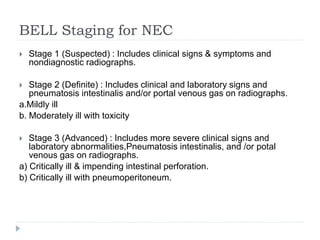
BELL Staging for NEC
 Stage 1 (Suspected) : Includes clinical signs & symptoms and
nondiagnostic radiographs.
 Stage 2 (Definite) : Includes clinical and laboratory signs and
pneumatosis intestinalis and/or portal venous gas on radiographs.
a.Mildly ill
b. Moderately ill with toxicity
 Stage 3 (Advanced) : Includes more severe clinical signs and
laboratory abnormalities,Pneumatosis intestinalis, and /or potal
venous gas on radiographs.
a) Critically ill & impending intestinal perforation.
b) Critically ill with pneumoperitoneum.
Objective
To test the effectiveness of the probiotic
Bifi dobacterium breve BBG-001 to reduce
necrotising enterocolitis, late-onset sepsis, and
death in preterm infants.
Setting
 Multicentre randomised controlled phase 3 study,
recruiting infants born between 23 and 30 weeks’
gestational age within 48 h of birth from 24 hospitals
within 60 miles of London in Southeast England.
 Between July 1, 2010, and July 31, 2013.
Sample Size
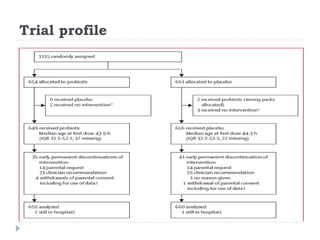
 A total of 1315 infants were recruited.
 Of the total infants selected, 654 were allocated to
probiotic and 661 to placebo.
 Five infants had consent withdrawn after
randomisation, thus 650 were analysed in the
probiotic group and 660 in the placebo group
Trial profile
Randomisation & Masking
 Procedure completed within 48hrs of birth.
 Randomly assigned.
 Parents, clinicians and outcome assessors were
masked to the treatment allocation.
Research in context
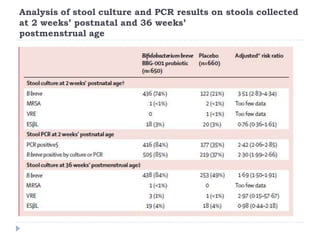
 This is the first trial systematically to study stool
colonisation in both groups of the trial and to
emphasise both the incomplete colonisation in the
active and the high cross colonisation in the placebo
group.
Treatment For
 The hypothesis supporting the use of probiotic
bacteria to prevent necrotising enterocolitis and
sepsis is that their administration to the preterm
infant will encourage gut microbiota resembling that
of the term infant, strengthen intestinal barrier
function, and, thereby, protect the infant.
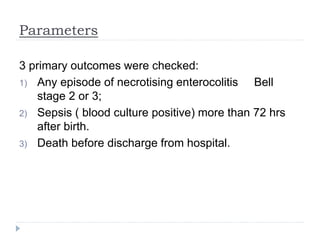
Parameters
3 primary outcomes were checked:
1) Any episode of necrotising enterocolitis Bell
stage 2 or 3;
2) Sepsis ( blood culture positive) more than 72 hrs
after birth.
3) Death before discharge from hospital.
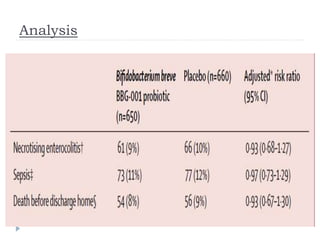
Analysis
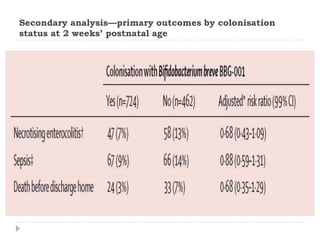
Secondary analysis—primary outcomes by colonisation
status at 2 weeks’ postnatal age
Analysis of stool culture and PCR results on stools collected
at 2 weeks’ postnatal and 36 weeks’
postmenstrual age
Conclusion
There is no evidence of benefit for this intervention
in this population; this result does not support
the routine use of B breve BBG-001 for
prevention of necrotising enterocolitis and late-
onset sepis in very preterm infants.
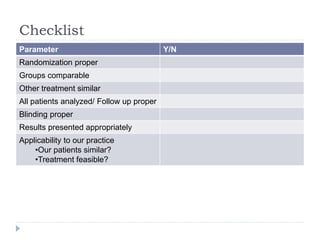
Checklist
Parameter Y/N
Randomization proper
Groups comparable
Other treatment similar
All patients analyzed/ Follow up proper
Blinding proper
Results presented appropriately
Applicability to our practice
•Our patients similar?
•Treatment feasible?
Strength
 The strengths of this trial are three-fold:
1) First, its size, which combined with the reported
rates of necrotising enterocolitis and sepsis, provide
it with statistical power to give clear answers;
2) The combination of early recruitment, broad
eligibility criteria, and early commencement of the
intervention.
3) Reporting of probiotic stool colonisation rates that
inform the interpretation of the findings.
Implication to Practice
 The importance of the microbiome in the complex
pathogenesis of necrotising enterocolitis is widely
accepted.
 As understanding progresses so the rationale for the
choice of probiotics that might have a therapeutic
role either alone or in combination, and of which
infants might benefit, should strengthen.
 The evidence from this trial does not support the
routine administration of probiotics to the preterm
infant.
Thank You

Journal Presentation 23/03/17

  • 1.
  • 2.
    Article to bediscussed  Bifi dobacterium breve BBG-001 in very preterm infants: a randomised controlled phase 3 trial  Kate Costeloe, Pollyanna Hardy, Edmund Juszczak, Mark Wilks, Michael R Millar, on behalf of The Probiotics in Preterm Infants Study Collaborative Group  Published Online November 25, 2015 in www.thelancet.com
  • 3.
    Background –What isknown?  Probiotics may reduce necrotising enterocolitis and late-onset sepsis after preterm birth.  However, there has been concern about the rigour and generalisability of some trials and there is no agreement about whether or not they should be used routinely.
  • 4.
    Lacunae in previousstudies  A small number of trials of probiotic in preterm infants have been performed and the analysis suggested reduced necrotising enterocolitis and death, but with no effect on sepsis.
  • 5.
    NEC in aGlance.  Most serious GI disease of the preterm infant.  Prematurity is the single greatest risk factor.  Approx 10% infants with NEC term.  Pathogenesis is Multifactorial.  Formula feed increases the risk of NEC.  Pneumatosis Coli : Rare & more benign form of NEC
  • 6.
    BELL Staging forNEC  Stage 1 (Suspected) : Includes clinical signs & symptoms and nondiagnostic radiographs.  Stage 2 (Definite) : Includes clinical and laboratory signs and pneumatosis intestinalis and/or portal venous gas on radiographs. a.Mildly ill b. Moderately ill with toxicity  Stage 3 (Advanced) : Includes more severe clinical signs and laboratory abnormalities,Pneumatosis intestinalis, and /or potal venous gas on radiographs. a) Critically ill & impending intestinal perforation. b) Critically ill with pneumoperitoneum.
  • 7.
    Objective To test theeffectiveness of the probiotic Bifi dobacterium breve BBG-001 to reduce necrotising enterocolitis, late-onset sepsis, and death in preterm infants.
  • 8.
    Setting  Multicentre randomisedcontrolled phase 3 study, recruiting infants born between 23 and 30 weeks’ gestational age within 48 h of birth from 24 hospitals within 60 miles of London in Southeast England.  Between July 1, 2010, and July 31, 2013.
  • 9.
    Sample Size  Atotal of 1315 infants were recruited.  Of the total infants selected, 654 were allocated to probiotic and 661 to placebo.  Five infants had consent withdrawn after randomisation, thus 650 were analysed in the probiotic group and 660 in the placebo group
  • 10.
  • 11.
    Randomisation & Masking Procedure completed within 48hrs of birth.  Randomly assigned.  Parents, clinicians and outcome assessors were masked to the treatment allocation.
  • 12.
    Research in context This is the first trial systematically to study stool colonisation in both groups of the trial and to emphasise both the incomplete colonisation in the active and the high cross colonisation in the placebo group.
  • 13.
    Treatment For  Thehypothesis supporting the use of probiotic bacteria to prevent necrotising enterocolitis and sepsis is that their administration to the preterm infant will encourage gut microbiota resembling that of the term infant, strengthen intestinal barrier function, and, thereby, protect the infant.
  • 14.
    Parameters 3 primary outcomeswere checked: 1) Any episode of necrotising enterocolitis Bell stage 2 or 3; 2) Sepsis ( blood culture positive) more than 72 hrs after birth. 3) Death before discharge from hospital.
  • 15.
  • 16.
    Secondary analysis—primary outcomesby colonisation status at 2 weeks’ postnatal age
  • 17.
    Analysis of stoolculture and PCR results on stools collected at 2 weeks’ postnatal and 36 weeks’ postmenstrual age
  • 18.
    Conclusion There is noevidence of benefit for this intervention in this population; this result does not support the routine use of B breve BBG-001 for prevention of necrotising enterocolitis and late- onset sepis in very preterm infants.
  • 19.
    Checklist Parameter Y/N Randomization proper Groupscomparable Other treatment similar All patients analyzed/ Follow up proper Blinding proper Results presented appropriately Applicability to our practice •Our patients similar? •Treatment feasible?
  • 20.
    Strength  The strengthsof this trial are three-fold: 1) First, its size, which combined with the reported rates of necrotising enterocolitis and sepsis, provide it with statistical power to give clear answers; 2) The combination of early recruitment, broad eligibility criteria, and early commencement of the intervention. 3) Reporting of probiotic stool colonisation rates that inform the interpretation of the findings.
  • 21.
    Implication to Practice The importance of the microbiome in the complex pathogenesis of necrotising enterocolitis is widely accepted.  As understanding progresses so the rationale for the choice of probiotics that might have a therapeutic role either alone or in combination, and of which infants might benefit, should strengthen.  The evidence from this trial does not support the routine administration of probiotics to the preterm infant.
  • 22.