FEBRILE SEIZURE
DR.RAVI KUMAR.S
DEPT OF PEDIATRICS
MGMCRI
INTRODUCTION
DEFINITION:
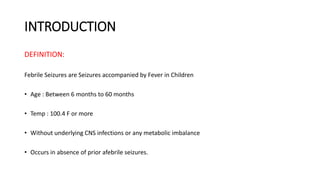
Febrile Seizures are Seizures accompanied by Fever in Children
• Age : Between 6 months to 60 months
• Temp : 100.4 F or more
• Without underlying CNS infections or any metabolic imbalance
• Occurs in absence of prior afebrile seizures.
CLASSIFICATION
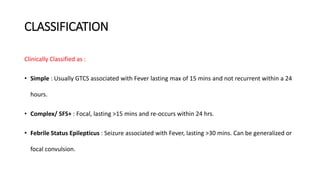
Clinically Classified as :
• Simple : Usually GTCS associated with Fever lasting max of 15 mins and not recurrent within a 24
hours.
• Complex/ SFS+ : Focal, lasting >15 mins and re-occurs within 24 hrs.
• Febrile Status Epilepticus : Seizure associated with Fever, lasting >30 mins. Can be generalized or
focal convulsion.
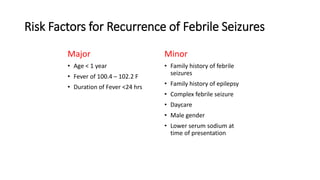
Risk Factors for Recurrence of Febrile Seizures
Major
• Age < 1 year
• Fever of 100.4 – 102.2 F
• Duration of Fever <24 hrs
Minor
• Family history of febrile
seizures
• Family history of epilepsy
• Complex febrile seizure
• Daycare
• Male gender
• Lower serum sodium at
time of presentation
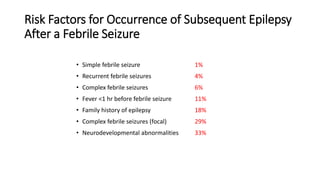
Risk Factors for Occurrence of Subsequent Epilepsy
After a Febrile Seizure
• Simple febrile seizure
• Recurrent febrile seizures
• Complex febrile seizures
• Fever <1 hr before febrile seizure
• Family history of epilepsy
• Complex febrile seizures (focal)
• Neurodevelopmental abnormalities
1%
4%
6%
11%
18%
29%
33%
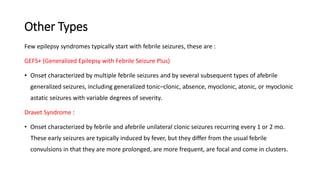
Other Types
Few epilepsy syndromes typically start with febrile seizures, these are :
GEFS+ (Generalized Epilepsy with Febrile Seizure Plus)
• Onset characterized by multiple febrile seizures and by several subsequent types of afebrile
generalized seizures, including generalized tonic–clonic, absence, myoclonic, atonic, or myoclonic
astatic seizures with variable degrees of severity.
Dravet Syndrome :
• Onset characterized by febrile and afebrile unilateral clonic seizures recurring every 1 or 2 mo.
These early seizures are typically induced by fever, but they differ from the usual febrile
convulsions in that they are more prolonged, are more frequent, are focal and come in clusters.
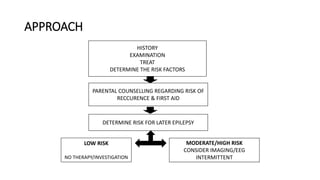
APPROACH
HISTORY
EXAMINATION
TREAT
DETERMINE THE RISK FACTORS
PARENTAL COUNSELLING REGARDING RISK OF
RECCURENCE & FIRST AID
DETERMINE RISK FOR LATER EPILEPSY
LOW RISK
NO THERAPY/INVESTIGATION
MODERATE/HIGH RISK
CONSIDER IMAGING/EEG
INTERMITTENT
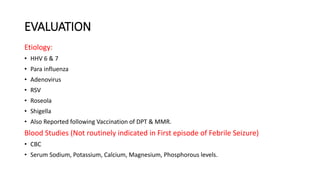
EVALUATION
Etiology:
• HHV 6 & 7
• Para influenza
• Adenovirus
• RSV
• Roseola
• Shigella
• Also Reported following Vaccination of DPT & MMR.
Blood Studies (Not routinely indicated in First episode of Febrile Seizure)
• CBC
• Serum Sodium, Potassium, Calcium, Magnesium, Phosphorous levels.
EVALUATION
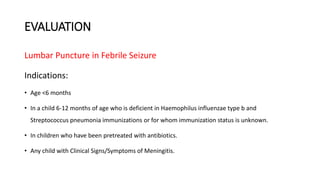
Lumbar Puncture in Febrile Seizure
Indications:
• Age <6 months
• In a child 6-12 months of age who is deficient in Haemophilus influenzae type b and
Streptococcus pneumonia immunizations or for whom immunization status is unknown.
• In children who have been pretreated with antibiotics.
• Any child with Clinical Signs/Symptoms of Meningitis.
EVALUATION
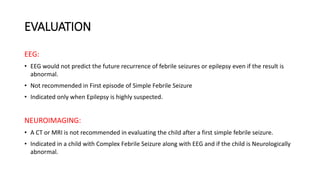
EEG:
• EEG would not predict the future recurrence of febrile seizures or epilepsy even if the result is
abnormal.
• Not recommended in First episode of Simple Febrile Seizure
• Indicated only when Epilepsy is highly suspected.
NEUROIMAGING:
• A CT or MRI is not recommended in evaluating the child after a first simple febrile seizure.
• Indicated in a child with Complex Febrile Seizure along with EEG and if the child is Neurologically
abnormal.
ACUTE MANAGEMENT
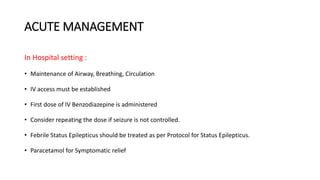
In Hospital setting :
• Maintenance of Airway, Breathing, Circulation
• IV access must be established
• First dose of IV Benzodiazepine is administered
• Consider repeating the dose if seizure is not controlled.
• Febrile Status Epilepticus should be treated as per Protocol for Status Epilepticus.
• Paracetamol for Symptomatic relief
LIST OF DRUGS USED
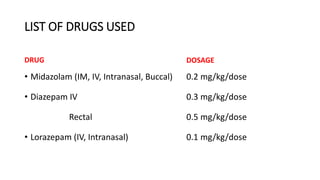
DRUG
• Midazolam (IM, IV, Intranasal, Buccal)
• Diazepam IV
Rectal
• Lorazepam (IV, Intranasal)
DOSAGE
0.2 mg/kg/dose
0.3 mg/kg/dose
0.5 mg/kg/dose
0.1 mg/kg/dose
ACUTE MANAGEMENT
In Home Setting:
Parents should be instructed
• To stay calm and avoid panic
• Advised to observe the semiology and duration of seizure
• Childs clothing should be loosened
• Placement of the child to Left lateral position
• Can administer rectal diazepam or intranasal midazolam if seizure lasting for longer duration
• Inform doctor/shift to hospital if >5 min.
PROPHYLAXIS
INTERMITTENT PROPHYLAXIS:
Clobazam (Frisium) is used at 1 mg/kg/day in 2 divided doses for first 48 hours after onset of fever.
Indication:
• Frequent seizures within a short period (3 or more in 6 months/ 4 or more in 1 year)
• Prolonged seizures requiring AED.
CONTINOUS PROPHYLAXIS:
• Studies have shown AED preferably Sodium Valproate would reduce the risk of recurrences in
child
• THANK YOU

Febrile seizure update

  • 1.
  • 2.
    INTRODUCTION DEFINITION: Febrile Seizures areSeizures accompanied by Fever in Children • Age : Between 6 months to 60 months • Temp : 100.4 F or more • Without underlying CNS infections or any metabolic imbalance • Occurs in absence of prior afebrile seizures.
  • 3.
    CLASSIFICATION Clinically Classified as: • Simple : Usually GTCS associated with Fever lasting max of 15 mins and not recurrent within a 24 hours. • Complex/ SFS+ : Focal, lasting >15 mins and re-occurs within 24 hrs. • Febrile Status Epilepticus : Seizure associated with Fever, lasting >30 mins. Can be generalized or focal convulsion.
  • 4.
    Risk Factors forRecurrence of Febrile Seizures Major • Age < 1 year • Fever of 100.4 – 102.2 F • Duration of Fever <24 hrs Minor • Family history of febrile seizures • Family history of epilepsy • Complex febrile seizure • Daycare • Male gender • Lower serum sodium at time of presentation
  • 5.
    Risk Factors forOccurrence of Subsequent Epilepsy After a Febrile Seizure • Simple febrile seizure • Recurrent febrile seizures • Complex febrile seizures • Fever <1 hr before febrile seizure • Family history of epilepsy • Complex febrile seizures (focal) • Neurodevelopmental abnormalities 1% 4% 6% 11% 18% 29% 33%
  • 6.
    Other Types Few epilepsysyndromes typically start with febrile seizures, these are : GEFS+ (Generalized Epilepsy with Febrile Seizure Plus) • Onset characterized by multiple febrile seizures and by several subsequent types of afebrile generalized seizures, including generalized tonic–clonic, absence, myoclonic, atonic, or myoclonic astatic seizures with variable degrees of severity. Dravet Syndrome : • Onset characterized by febrile and afebrile unilateral clonic seizures recurring every 1 or 2 mo. These early seizures are typically induced by fever, but they differ from the usual febrile convulsions in that they are more prolonged, are more frequent, are focal and come in clusters.
  • 7.
    APPROACH HISTORY EXAMINATION TREAT DETERMINE THE RISKFACTORS PARENTAL COUNSELLING REGARDING RISK OF RECCURENCE & FIRST AID DETERMINE RISK FOR LATER EPILEPSY LOW RISK NO THERAPY/INVESTIGATION MODERATE/HIGH RISK CONSIDER IMAGING/EEG INTERMITTENT
  • 8.
    EVALUATION Etiology: • HHV 6& 7 • Para influenza • Adenovirus • RSV • Roseola • Shigella • Also Reported following Vaccination of DPT & MMR. Blood Studies (Not routinely indicated in First episode of Febrile Seizure) • CBC • Serum Sodium, Potassium, Calcium, Magnesium, Phosphorous levels.
  • 9.
    EVALUATION Lumbar Puncture inFebrile Seizure Indications: • Age <6 months • In a child 6-12 months of age who is deficient in Haemophilus influenzae type b and Streptococcus pneumonia immunizations or for whom immunization status is unknown. • In children who have been pretreated with antibiotics. • Any child with Clinical Signs/Symptoms of Meningitis.
  • 10.
    EVALUATION EEG: • EEG wouldnot predict the future recurrence of febrile seizures or epilepsy even if the result is abnormal. • Not recommended in First episode of Simple Febrile Seizure • Indicated only when Epilepsy is highly suspected. NEUROIMAGING: • A CT or MRI is not recommended in evaluating the child after a first simple febrile seizure. • Indicated in a child with Complex Febrile Seizure along with EEG and if the child is Neurologically abnormal.
  • 11.
    ACUTE MANAGEMENT In Hospitalsetting : • Maintenance of Airway, Breathing, Circulation • IV access must be established • First dose of IV Benzodiazepine is administered • Consider repeating the dose if seizure is not controlled. • Febrile Status Epilepticus should be treated as per Protocol for Status Epilepticus. • Paracetamol for Symptomatic relief
  • 12.
    LIST OF DRUGSUSED DRUG • Midazolam (IM, IV, Intranasal, Buccal) • Diazepam IV Rectal • Lorazepam (IV, Intranasal) DOSAGE 0.2 mg/kg/dose 0.3 mg/kg/dose 0.5 mg/kg/dose 0.1 mg/kg/dose
  • 13.
    ACUTE MANAGEMENT In HomeSetting: Parents should be instructed • To stay calm and avoid panic • Advised to observe the semiology and duration of seizure • Childs clothing should be loosened • Placement of the child to Left lateral position • Can administer rectal diazepam or intranasal midazolam if seizure lasting for longer duration • Inform doctor/shift to hospital if >5 min.
  • 14.
    PROPHYLAXIS INTERMITTENT PROPHYLAXIS: Clobazam (Frisium)is used at 1 mg/kg/day in 2 divided doses for first 48 hours after onset of fever. Indication: • Frequent seizures within a short period (3 or more in 6 months/ 4 or more in 1 year) • Prolonged seizures requiring AED. CONTINOUS PROPHYLAXIS: • Studies have shown AED preferably Sodium Valproate would reduce the risk of recurrences in child
  • 15.