Renal Replacement Therapy
(RRT) in Critical Care
DR. NIDA
What is Renal Replacement Therapy
(RRT)?
 • Replaces kidney function to remove waste,
balance fluids and electrolytes
 • Used in ICU patients with acute kidney injury
(AKI)
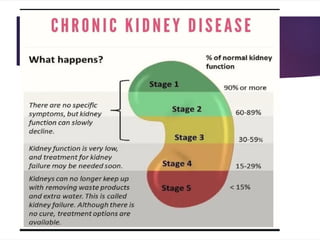
Understanding Kidneys and Nephron
 • Kidneys filter ~180 liters of blood daily
 • Each kidney contains ~1 million nephrons
 • Nephrons include a glomerulus and renal
tubules
 • Functions: waste removal, fluid &
electrolyte balance, acid-base regulation
Indications of RRT
 1. Acute kidney injury (AKI) with:
 • Fluid overload (refractory to diuretics)
 • Hyperkalemia (K+ > 6.5)
 • Severe metabolic acidosis (pH < 7.1)
 • Rapidly climbing urea/creatinine (or urea >
30mmol.l-1)
 • Symptomatic uraemia: encephalopathy,
pericarditis, bleeding, nausea, pruritus
 • Oliguria/anuria.
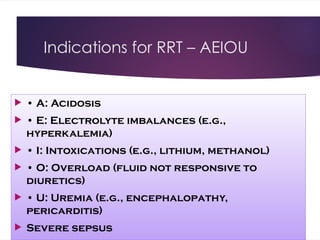
Indications for RRT – AEIOU
 • A: Acidosis
 • E: Electrolyte imbalances (e.g.,
hyperkalemia)
 • I: Intoxications (e.g., lithium, methanol)
 • O: Overload (fluid not responsive to
diuretics)
 • U: Uremia (e.g., encephalopathy,
pericarditis)
 Severe sepsus
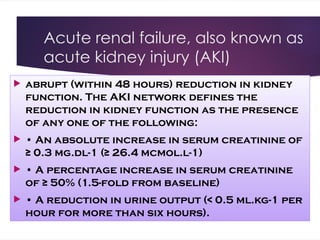
Acute renal failure, also known as
acute kidney injury (AKI)
 abrupt (within 48 hours) reduction in kidney
function. The AKI network defines the
reduction in kidney function as the presence
of any one of the following:
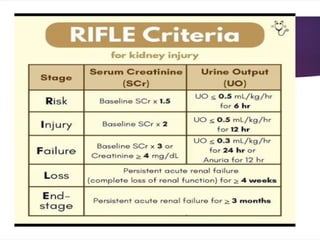
 • An absolute increase in serum creatinine of
≥ 0.3 mg.dl-1 (≥ 26.4 mcmol.l-1)
 • A percentage increase in serum creatinine
of ≥ 50% (1.5-fold from baseline)
 • A reduction in urine output (< 0.5 ml.kg-1 per
hour for more than six hours).
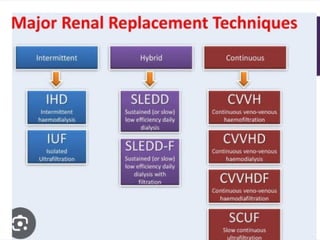
Modalities of RRT in ICU
 • Intermittent Hemodialysis (IHD)
 • Sustained Low-Efficiency Daily Dialysis
(SLEDD)
 • Continuous Renal Replacement Therapy
(CRRT): SCUF, CVVH, CVVHD, CVVHDF
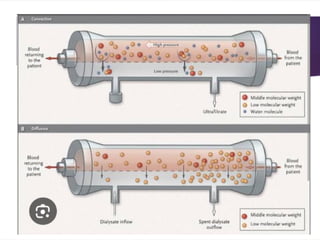
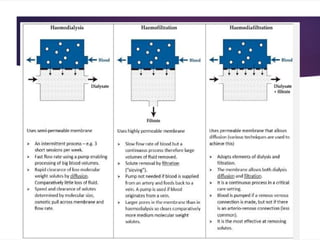
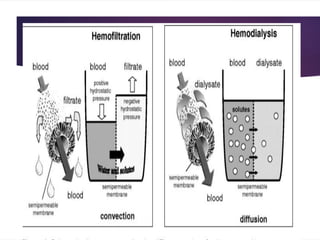
HemoFiltration ( convection )
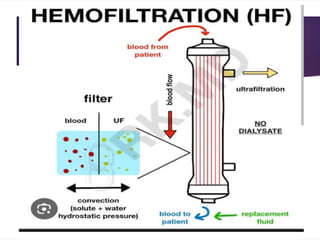
 Haemofiltration= blood being pumped through an extracorporeal
system
 semi-permeable membrane
 hydrostatic pressure created on the blood-side of the filter
 drives plasma water across the filter
 This process is referred to as ultrafiltration
 Molecules that are small enough to pass through the membrane
(<50,000 Daltons) are dragged across the membrane with
 the water by the process of convection.
 The filtered fluid (ultrafiltrate) is discarded
 replacement fluid is added in an adjustable fashion according to the
desired fluid balance.
Haemodialysis (diffusion)
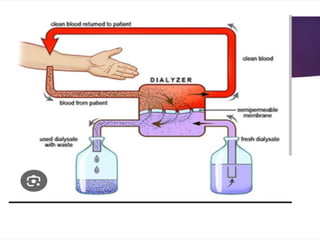
 Haemodialysis involves blood being pumped through an extracorporeal
system that incorporates a dialyzer.
 In the dialyzer, blood is separated from a crystalloid solution (dialysate) by
a semi-permeable membrane.
 Solutes move across the membrane along their concentration gradient
from one compartment to the other obeying Fick`s laws of diffusion.
 For example, bicarbonate moves from dialysate to blood whereas urea and
potassium move from blood to dialysate.
 dialysate flows countercurrent to the flow of blood.
 When removal of water is required the pressure on the blood-side of the
membrane has to be increased forcing water molecules to pass into the
dialysate.
Haemodiafiltration
 a combination of filtration and dialysis.
 It has the benefits of both techniques
SCUF
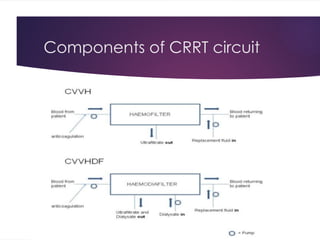
 Slow continuous ultrafiltration is used when the only
requirement is water removal.
 Effectively, it is CVVH with a low filtration rate.
 It can remove up to 6 litres of fluid a day but solute
removal is minimal.
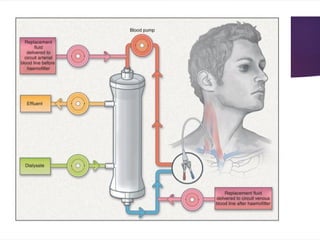
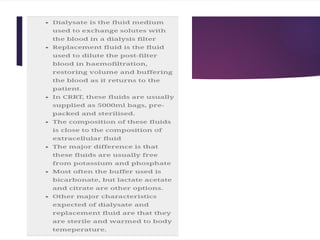
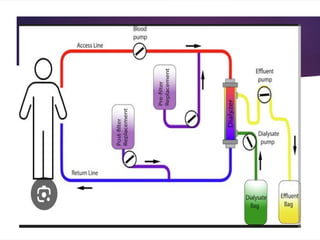
Replacement fluid
 It is a substitution fluid:
 A solution of variable composition
 physiologic
 used to replace large volumes of ultrafiltrate during hemofiltration or
hemodiafiltration.
 Replacement fluid may be given as predilution or postdilution."
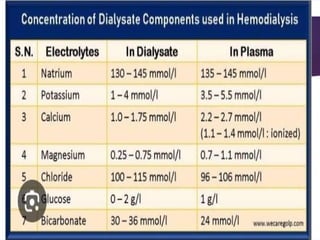
Dilaysate
 A solution of variable composition designed to facilitate diffusion of solutes into
the ultrafiltrate-dialysate compartment of the hemofilter or hemodialyzer.“
 Dialysate is the fluid which is infused into the filter
 by convention everything that comes out of the filter is called effluent
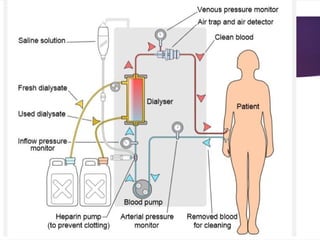
Components of CRRT circuit
Intetmittent vs Continuous
 Dialysing with higher flow rates than CRRT.
 A typical regime is 3-5 hours of dialysis 3 times
a week.
 The high flow rates and rapid fall in plasma
osmolality mean that it is only suitable for
patients who are cardiovascularly stable.
Continuous mode of hemodialysis
 CRRT involves filtering and/or dialysing on a
continuous basis.
 It allows better fluid managemen.
 creates less haemodynamic disturbance
 more expensive than IHD and requires continuous
rather than intermittent coagulation.
 There is some evidence to suggest that CRRT is
superior to IHD in
 patients with sepsis, cardiovascular instability or with
a head injury.
SLED
 Sustained low efficiency dialysis is an
example of a hybrid therapy which aims to
combine the logistic and cost advantages of
IHD with the relative cardiovascular stability
of CRRT.
 Treatments are intermittent but usually daily
and with longer session durations than
conventional IHD
 Solute and fluid removal are slower than
IHD, but faster than CRRT
WHICH FORM OF RRT SHOULD WE US
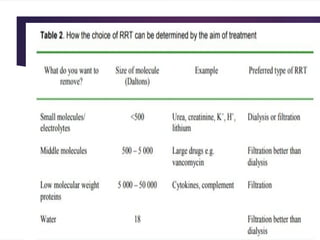
 What we want to remove from the plasma
 The patient`s cardiovascular status
 The availability of resources
 The clinician`s experience
 Convective modes of RRT may be beneficial if the patient
has septic shock
 • CRRT can aid feeding regimes by improving fluid
management
 • CRRT may be associated with better cerebral perfusion
in patients with an acute brain injury
 or fulminant hepatic failure
Modality Comparison: IHD vs SLEDD
CRRT
 Duration: IHD (3–5 hrs)
 SLEDD (~12 hrs)
 CRRT (24 hrs)
 • Clearance: IHD > SLEDD > CRRT
 • Hemodynamic stability: CRRT > SLEDD > IHD
Continuous Renal Replacement
Therapy (CRRT)
 • Used for unstable ICU patients needing
slow, continuous therapy
 • SCUF: fluid removal only
 • CVVH: convection-based clearance with
replacement fluid
 • CVVHD: diffusion-based clearance with
dialysate
 • CVVHDF: combines convection and diffusion
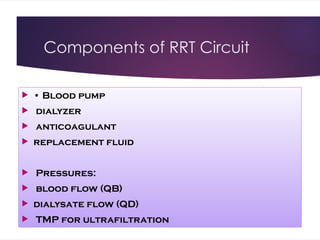
Components of RRT Circuit
 • Blood pump
 dialyzer
 anticoagulant
 replacement fluid
 Pressures:
 blood flow (QB)
 dialysate flow (QD)
 TMP for ultrafiltration
Dialyzer Membranes and Performan
 • Synthetic membranes preferred over
cellulose for better biocompatibility
 • Factors: flux, permeability, surface area
 • Clears solutes based on size and
transport mechanism
Vascular Access for RRT
 • Preferred sites: Right IJV > Femoral >
Left IJV > Subclavian
 • Types:
 AV fistula
 tunneled catheter
 temporary catheter
Anticoagulation During RRT
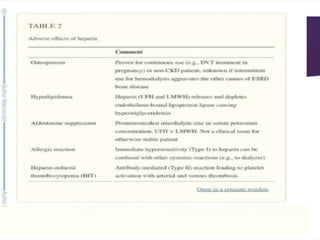
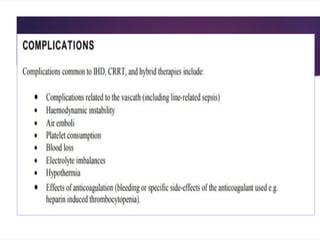
 • Systemic: Heparin (risk of HIT, bleeding)
 • Regional: Citrate (preferred for
circuit longevity)
 • Citrate chelates calcium – monitor for
electrolyte shifts
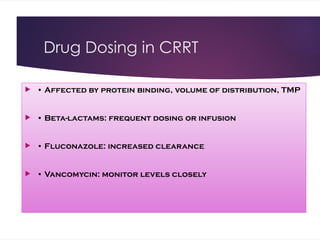
Drug Dosing in CRRT
 • Affected by protein binding, volume of distribution, TMP
 • Beta-lactams: frequent dosing or infusion
 • Fluconazole: increased clearance
 • Vancomycin: monitor levels closely
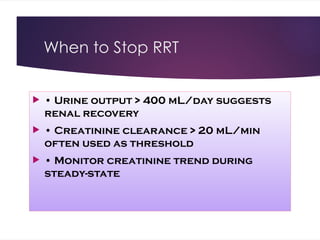
When to Stop RRT
 • Urine output > 400 mL/day suggests
renal recovery
 • Creatinine clearance > 20 mL/min
often used as threshold
 • Monitor creatinine trend during
steady-state
Chronic Kidney Risk Post-AKI
 • 40% of ICU AKI survivors develop CKD
 • Some remain dialysis dependent
 • Follow-up nephrology care is essential
Research & Controversies in RRT
 • Timing of RRT initiation: early vs
delayed
 • High-volume haemofiltration in
sepsis: unclear benefit
 • Need for validated AKI biomarkers
Summary: Key Points in RRT
 • CRRT preferred in unstable patients
 • Know AEIOU indications
 • Tailor modality, dosing, and
anticoagulation to the patient
 • Watch for complications and long-term
kidney outcomes
rrt1.pptx pptx pptx renal replacemnt therapy

  • 1.
    Renal Replacement Therapy (RRT)in Critical Care DR. NIDA
  • 2.
    What is RenalReplacement Therapy (RRT)?  • Replaces kidney function to remove waste, balance fluids and electrolytes  • Used in ICU patients with acute kidney injury (AKI)
  • 4.
    Understanding Kidneys andNephron  • Kidneys filter ~180 liters of blood daily  • Each kidney contains ~1 million nephrons  • Nephrons include a glomerulus and renal tubules  • Functions: waste removal, fluid & electrolyte balance, acid-base regulation
  • 5.
    Indications of RRT 1. Acute kidney injury (AKI) with:  • Fluid overload (refractory to diuretics)  • Hyperkalemia (K+ > 6.5)  • Severe metabolic acidosis (pH < 7.1)  • Rapidly climbing urea/creatinine (or urea > 30mmol.l-1)  • Symptomatic uraemia: encephalopathy, pericarditis, bleeding, nausea, pruritus  • Oliguria/anuria.
  • 6.
    Indications for RRT– AEIOU  • A: Acidosis  • E: Electrolyte imbalances (e.g., hyperkalemia)  • I: Intoxications (e.g., lithium, methanol)  • O: Overload (fluid not responsive to diuretics)  • U: Uremia (e.g., encephalopathy, pericarditis)  Severe sepsus
  • 9.
    Acute renal failure,also known as acute kidney injury (AKI)  abrupt (within 48 hours) reduction in kidney function. The AKI network defines the reduction in kidney function as the presence of any one of the following:  • An absolute increase in serum creatinine of ≥ 0.3 mg.dl-1 (≥ 26.4 mcmol.l-1)  • A percentage increase in serum creatinine of ≥ 50% (1.5-fold from baseline)  • A reduction in urine output (< 0.5 ml.kg-1 per hour for more than six hours).
  • 10.
    Modalities of RRTin ICU  • Intermittent Hemodialysis (IHD)  • Sustained Low-Efficiency Daily Dialysis (SLEDD)  • Continuous Renal Replacement Therapy (CRRT): SCUF, CVVH, CVVHD, CVVHDF
  • 13.
    HemoFiltration ( convection)  Haemofiltration= blood being pumped through an extracorporeal system  semi-permeable membrane  hydrostatic pressure created on the blood-side of the filter  drives plasma water across the filter  This process is referred to as ultrafiltration  Molecules that are small enough to pass through the membrane (<50,000 Daltons) are dragged across the membrane with  the water by the process of convection.  The filtered fluid (ultrafiltrate) is discarded  replacement fluid is added in an adjustable fashion according to the desired fluid balance.
  • 14.
    Haemodialysis (diffusion)  Haemodialysisinvolves blood being pumped through an extracorporeal system that incorporates a dialyzer.  In the dialyzer, blood is separated from a crystalloid solution (dialysate) by a semi-permeable membrane.  Solutes move across the membrane along their concentration gradient from one compartment to the other obeying Fick`s laws of diffusion.  For example, bicarbonate moves from dialysate to blood whereas urea and potassium move from blood to dialysate.  dialysate flows countercurrent to the flow of blood.  When removal of water is required the pressure on the blood-side of the membrane has to be increased forcing water molecules to pass into the dialysate.
  • 15.
    Haemodiafiltration  a combinationof filtration and dialysis.  It has the benefits of both techniques
  • 16.
    SCUF  Slow continuousultrafiltration is used when the only requirement is water removal.  Effectively, it is CVVH with a low filtration rate.  It can remove up to 6 litres of fluid a day but solute removal is minimal.
  • 24.
    Replacement fluid  Itis a substitution fluid:  A solution of variable composition  physiologic  used to replace large volumes of ultrafiltrate during hemofiltration or hemodiafiltration.  Replacement fluid may be given as predilution or postdilution."
  • 25.
    Dilaysate  A solutionof variable composition designed to facilitate diffusion of solutes into the ultrafiltrate-dialysate compartment of the hemofilter or hemodialyzer.“  Dialysate is the fluid which is infused into the filter  by convention everything that comes out of the filter is called effluent
  • 27.
  • 29.
    Intetmittent vs Continuous Dialysing with higher flow rates than CRRT.  A typical regime is 3-5 hours of dialysis 3 times a week.  The high flow rates and rapid fall in plasma osmolality mean that it is only suitable for patients who are cardiovascularly stable.
  • 30.
    Continuous mode ofhemodialysis  CRRT involves filtering and/or dialysing on a continuous basis.  It allows better fluid managemen.  creates less haemodynamic disturbance  more expensive than IHD and requires continuous rather than intermittent coagulation.  There is some evidence to suggest that CRRT is superior to IHD in  patients with sepsis, cardiovascular instability or with a head injury.
  • 31.
    SLED  Sustained lowefficiency dialysis is an example of a hybrid therapy which aims to combine the logistic and cost advantages of IHD with the relative cardiovascular stability of CRRT.  Treatments are intermittent but usually daily and with longer session durations than conventional IHD  Solute and fluid removal are slower than IHD, but faster than CRRT
  • 32.
    WHICH FORM OFRRT SHOULD WE US  What we want to remove from the plasma  The patient`s cardiovascular status  The availability of resources  The clinician`s experience  Convective modes of RRT may be beneficial if the patient has septic shock  • CRRT can aid feeding regimes by improving fluid management  • CRRT may be associated with better cerebral perfusion in patients with an acute brain injury  or fulminant hepatic failure
  • 34.
    Modality Comparison: IHDvs SLEDD CRRT  Duration: IHD (3–5 hrs)  SLEDD (~12 hrs)  CRRT (24 hrs)  • Clearance: IHD > SLEDD > CRRT  • Hemodynamic stability: CRRT > SLEDD > IHD
  • 36.
    Continuous Renal Replacement Therapy(CRRT)  • Used for unstable ICU patients needing slow, continuous therapy  • SCUF: fluid removal only  • CVVH: convection-based clearance with replacement fluid  • CVVHD: diffusion-based clearance with dialysate  • CVVHDF: combines convection and diffusion
  • 37.
    Components of RRTCircuit  • Blood pump  dialyzer  anticoagulant  replacement fluid  Pressures:  blood flow (QB)  dialysate flow (QD)  TMP for ultrafiltration
  • 38.
    Dialyzer Membranes andPerforman  • Synthetic membranes preferred over cellulose for better biocompatibility  • Factors: flux, permeability, surface area  • Clears solutes based on size and transport mechanism
  • 39.
    Vascular Access forRRT  • Preferred sites: Right IJV > Femoral > Left IJV > Subclavian  • Types:  AV fistula  tunneled catheter  temporary catheter
  • 40.
    Anticoagulation During RRT • Systemic: Heparin (risk of HIT, bleeding)  • Regional: Citrate (preferred for circuit longevity)  • Citrate chelates calcium – monitor for electrolyte shifts
  • 45.
    Drug Dosing inCRRT  • Affected by protein binding, volume of distribution, TMP  • Beta-lactams: frequent dosing or infusion  • Fluconazole: increased clearance  • Vancomycin: monitor levels closely
  • 47.
    When to StopRRT  • Urine output > 400 mL/day suggests renal recovery  • Creatinine clearance > 20 mL/min often used as threshold  • Monitor creatinine trend during steady-state
  • 48.
    Chronic Kidney RiskPost-AKI  • 40% of ICU AKI survivors develop CKD  • Some remain dialysis dependent  • Follow-up nephrology care is essential
  • 49.
    Research & Controversiesin RRT  • Timing of RRT initiation: early vs delayed  • High-volume haemofiltration in sepsis: unclear benefit  • Need for validated AKI biomarkers
  • 50.
    Summary: Key Pointsin RRT  • CRRT preferred in unstable patients  • Know AEIOU indications  • Tailor modality, dosing, and anticoagulation to the patient  • Watch for complications and long-term kidney outcomes