INOTROPES
&
VASOACTIVE AGENTS
Dr.MANOJ PRABHAKAR
Resident , Dept. of Paediatrics
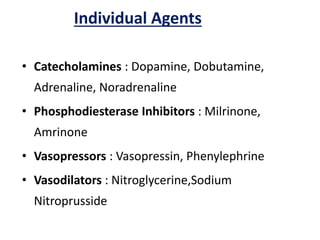
• Catecholamines : Dopamine, Dobutamine,
Adrenaline, Noradrenaline
• Phosphodiesterase Inhibitors : Milrinone,
Amrinone
• Vasopressors : Vasopressin, Phenylephrine
• Vasodilators : Nitroglycerine,Sodium
Nitroprusside
Individual Agents
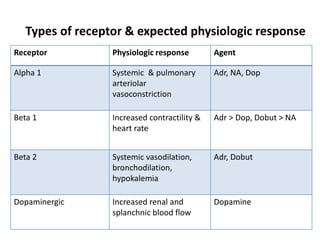
Types of receptor & expected physiologic response
Receptor Physiologic response Agent
Alpha 1 Systemic & pulmonary
arteriolar
vasoconstriction
Adr, NA, Dop
Beta 1 Increased contractility &
heart rate
Adr > Dop, Dobut > NA
Beta 2 Systemic vasodilation,
bronchodilation,
hypokalemia
Adr, Dobut
Dopaminergic Increased renal and
splanchnic blood flow
Dopamine
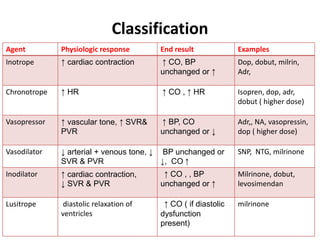
Classification
Agent Physiologic response End result Examples
Inotrope ↑ cardiac contraction ↑ CO, BP
unchanged or ↑
Dop, dobut, milrin,
Adr,
Chronotrope ↑ HR ↑ CO , ↑ HR Isopren, dop, adr,
dobut ( higher dose)
Vasopressor ↑ vascular tone, ↑ SVR&
PVR
↑ BP, CO
unchanged or ↓
Adr,, NA, vasopressin,
dop ( higher dose)
Vasodilator ↓ arterial + venous tone, ↓
SVR & PVR
BP unchanged or
↓, CO ↑
SNP, NTG, milrinone
Inodilator ↑ cardiac contraction,
↓ SVR & PVR
↑ CO , , BP
unchanged or ↑
Milrinone, dobut,
levosimendan
Lusitrope diastolic relaxation of
ventricles
↑ CO ( if diastolic
dysfunction
present)
milrinone
Dopamine
• Hemodynamic effects:
Dose dependent
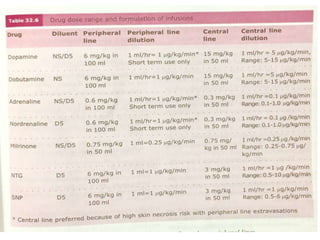
- Low dose : 2-5mcg/kg/min
- Mod dose : 5-10mcg/kg/min
- High dose : >10mcg/kg/min
• Indication :
Fluid refractory septic shock
Cardiogenic shock with moderate hypotension
Side effects
• Vasoconstriction
• Arryhthmias
• Extravasation
• Tachyphyllaxis
Dobutamine
• Hemodynamic effects:
Improves cardiac output by improving stroke volume &
decreasing afterload with minimal tachycardia.
• Indications :
- Cardiogenic shock with normal BP
- Fluid refractory septic shock with normal BP and
impaired extremity perfusion
Side effects
• Increases myocardial oxygen consumption
leading to supply-demand mismatch.
• Tachycardia & arrhythmias.
Adrenaline /Epinephrine
• Hemodynamic effects:
0.05 – 0.3 mics/kg/min – inotropy, chronotropy
0.3- 1 mics/kg/min – pressor
• ↑ myocardial O2 consumption can worsen
supply demand mismatch
NOTE
• At rates > 0.5, bp can ↑ but CO and organ
perfusion can worsen with a potential for
vulnerable organ ( gut, kidneys) iscemia
and failure. ( Numbers look better but
patients perfusion may be worse)
Indication
• Cardiogenic shock with decompensated shock
{ Improves diastolic BP, resulting in better coronary
perfusion & improved myocardial function }
• Myocardial dysfunction after cardiac arrest
• Cold septic shock refractory to fluids &
dobutamine/dopamine.
• Severe shock of any etiology
How to start and titrate
• Start infusion @0.1-0.3 mcg/kg/min.
• If BP improves but perfusion worsens add
inodilators
• Doses > 0.6 mics/kg/min are rarely useful as
ensuing organ ischemia may lead to MODS
Side effects
• Cvs : ↑ afterload, tachycardia,
subendocardial ischemia & arrythmias
• Metabolic: hyperglycemia, hypokalemia,
↑ lactate
• CNS : Excitability, tremors.
• Blunting beta effect
Noradrenaline (NA)
• Hemodynamic effects:
Increases BP by vasoconstriction.
• Indications :
- Vasodilatory shock
- Warm septic shock
- Raised ICP
Side effects
• ↑ Afterload { not appropriate in cardiogenic
shock}
• Worsens perfusion leading to multi organ
failure.
Vasopressin
• Potent pressor.
• Indication :
- Catecolamine resistant , vasodilatory
septic shock - after maximum NA(0.5-
1mcg/kg/min)
- Central DI
PDE inhibitors
• Results in increased cellular concentrations of
cAMP by inhibiting its destruction.
• Inotropy, lusitropy, vasodilatory with no
chronotropy resulting in improved
contractility,decreased preload & afterload.
• Synergestic effects with catecholamines
Indication
• Catecholamine refractory cold shock with
normal BP..
• Cardiogenic shock with normal BP.
• Pulmonary hypertension
Side effects
• Hypotension
• Toxicity in renal failure
• Long half life
• Thrombocytopenia
Nitroglycerin (NTG)
• Hemodynamics : Venodilator
Indications
• Acute pulmonary edema & pulmonary HTN.
• Cardiogenic shock with precarious hemodynamics
Side effects:
• Hypotension & tolerance
Sodium Nitroprusside(SNP)
• Produces arterial vasodilation resulting in
preload and afterload.
• Hemodynamics:
↓ SVR, ↓ PVR
Rapid half life of 2 mins
Indications :
Severe HTN.
Side effects:
Hypotension
Cyanide toxicity
Levosimendan
• Calcium Sensitizer : New class of agent that
increases sensitivity of cardiac myofilament to
calcium .
• Inotropic and vasodilatory properties.
• Most extensively studied in acute heart
failure, but given the potential role for
abnormal calcium handling in sepsis-induced
myocardial depression, its use also has been
proposed in sepsis.
Care & Monitoring
• Tailored to desired hemodynamics response
• Cardiorespiratory monitoring in ICU
• Sideeffects if patient is hypovolumic or normal
cardiac function
• Rapid purge
• Freshly prepared solution
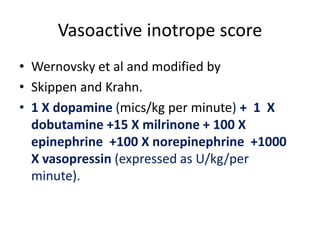
Vasoactive inotrope score
• Wernovsky et al and modified by
• Skippen and Krahn.
• 1 X dopamine (mics/kg per minute) + 1 X
dobutamine +15 X milrinone + 100 X
epinephrine +100 X norepinephrine +1000
X vasopressin (expressed as U/kg/per
minute).
Thankyou

Inotropes & vasoactive agents

  • 1.
  • 2.
    • Catecholamines :Dopamine, Dobutamine, Adrenaline, Noradrenaline • Phosphodiesterase Inhibitors : Milrinone, Amrinone • Vasopressors : Vasopressin, Phenylephrine • Vasodilators : Nitroglycerine,Sodium Nitroprusside Individual Agents
  • 3.
    Types of receptor& expected physiologic response Receptor Physiologic response Agent Alpha 1 Systemic & pulmonary arteriolar vasoconstriction Adr, NA, Dop Beta 1 Increased contractility & heart rate Adr > Dop, Dobut > NA Beta 2 Systemic vasodilation, bronchodilation, hypokalemia Adr, Dobut Dopaminergic Increased renal and splanchnic blood flow Dopamine
  • 4.
    Classification Agent Physiologic responseEnd result Examples Inotrope ↑ cardiac contraction ↑ CO, BP unchanged or ↑ Dop, dobut, milrin, Adr, Chronotrope ↑ HR ↑ CO , ↑ HR Isopren, dop, adr, dobut ( higher dose) Vasopressor ↑ vascular tone, ↑ SVR& PVR ↑ BP, CO unchanged or ↓ Adr,, NA, vasopressin, dop ( higher dose) Vasodilator ↓ arterial + venous tone, ↓ SVR & PVR BP unchanged or ↓, CO ↑ SNP, NTG, milrinone Inodilator ↑ cardiac contraction, ↓ SVR & PVR ↑ CO , , BP unchanged or ↑ Milrinone, dobut, levosimendan Lusitrope diastolic relaxation of ventricles ↑ CO ( if diastolic dysfunction present) milrinone
  • 5.
    Dopamine • Hemodynamic effects: Dosedependent - Low dose : 2-5mcg/kg/min - Mod dose : 5-10mcg/kg/min - High dose : >10mcg/kg/min • Indication : Fluid refractory septic shock Cardiogenic shock with moderate hypotension
  • 6.
    Side effects • Vasoconstriction •Arryhthmias • Extravasation • Tachyphyllaxis
  • 7.
    Dobutamine • Hemodynamic effects: Improvescardiac output by improving stroke volume & decreasing afterload with minimal tachycardia. • Indications : - Cardiogenic shock with normal BP - Fluid refractory septic shock with normal BP and impaired extremity perfusion
  • 8.
    Side effects • Increasesmyocardial oxygen consumption leading to supply-demand mismatch. • Tachycardia & arrhythmias.
  • 9.
    Adrenaline /Epinephrine • Hemodynamiceffects: 0.05 – 0.3 mics/kg/min – inotropy, chronotropy 0.3- 1 mics/kg/min – pressor • ↑ myocardial O2 consumption can worsen supply demand mismatch
  • 10.
    NOTE • At rates> 0.5, bp can ↑ but CO and organ perfusion can worsen with a potential for vulnerable organ ( gut, kidneys) iscemia and failure. ( Numbers look better but patients perfusion may be worse)
  • 11.
    Indication • Cardiogenic shockwith decompensated shock { Improves diastolic BP, resulting in better coronary perfusion & improved myocardial function } • Myocardial dysfunction after cardiac arrest • Cold septic shock refractory to fluids & dobutamine/dopamine. • Severe shock of any etiology
  • 12.
    How to startand titrate • Start infusion @0.1-0.3 mcg/kg/min. • If BP improves but perfusion worsens add inodilators • Doses > 0.6 mics/kg/min are rarely useful as ensuing organ ischemia may lead to MODS
  • 13.
    Side effects • Cvs: ↑ afterload, tachycardia, subendocardial ischemia & arrythmias • Metabolic: hyperglycemia, hypokalemia, ↑ lactate • CNS : Excitability, tremors. • Blunting beta effect
  • 14.
    Noradrenaline (NA) • Hemodynamiceffects: Increases BP by vasoconstriction. • Indications : - Vasodilatory shock - Warm septic shock - Raised ICP
  • 15.
    Side effects • ↑Afterload { not appropriate in cardiogenic shock} • Worsens perfusion leading to multi organ failure.
  • 16.
    Vasopressin • Potent pressor. •Indication : - Catecolamine resistant , vasodilatory septic shock - after maximum NA(0.5- 1mcg/kg/min) - Central DI
  • 17.
    PDE inhibitors • Resultsin increased cellular concentrations of cAMP by inhibiting its destruction. • Inotropy, lusitropy, vasodilatory with no chronotropy resulting in improved contractility,decreased preload & afterload. • Synergestic effects with catecholamines
  • 18.
    Indication • Catecholamine refractorycold shock with normal BP.. • Cardiogenic shock with normal BP. • Pulmonary hypertension
  • 19.
    Side effects • Hypotension •Toxicity in renal failure • Long half life • Thrombocytopenia
  • 20.
    Nitroglycerin (NTG) • Hemodynamics: Venodilator Indications • Acute pulmonary edema & pulmonary HTN. • Cardiogenic shock with precarious hemodynamics Side effects: • Hypotension & tolerance
  • 21.
    Sodium Nitroprusside(SNP) • Producesarterial vasodilation resulting in preload and afterload. • Hemodynamics: ↓ SVR, ↓ PVR Rapid half life of 2 mins
  • 22.
    Indications : Severe HTN. Sideeffects: Hypotension Cyanide toxicity
  • 23.
    Levosimendan • Calcium Sensitizer: New class of agent that increases sensitivity of cardiac myofilament to calcium . • Inotropic and vasodilatory properties. • Most extensively studied in acute heart failure, but given the potential role for abnormal calcium handling in sepsis-induced myocardial depression, its use also has been proposed in sepsis.
  • 25.
    Care & Monitoring •Tailored to desired hemodynamics response • Cardiorespiratory monitoring in ICU • Sideeffects if patient is hypovolumic or normal cardiac function • Rapid purge • Freshly prepared solution
  • 26.
    Vasoactive inotrope score •Wernovsky et al and modified by • Skippen and Krahn. • 1 X dopamine (mics/kg per minute) + 1 X dobutamine +15 X milrinone + 100 X epinephrine +100 X norepinephrine +1000 X vasopressin (expressed as U/kg/per minute).
  • 28.