Prepared by: 
Dr. Muhammad Asim Fazal 
MEEQAT GENERAL HOSPITAL 
ALMADINAH ALMUNAWARAH
 Definition 
 Brief review of potassium regulation 
processes 
 Causes 
 Clinical Manifestations 
 Therapy
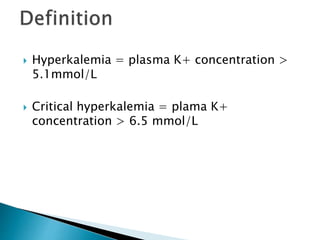
 Hyperkalemia = plasma K+ concentration > 
5.1mmol/L 
 Critical hyperkalemia = plama K+ 
concentration > 6.5 mmol/L
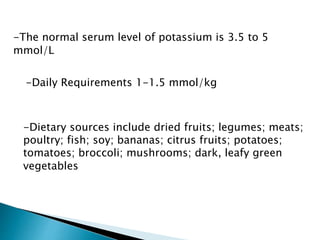
-The normal serum level of potassium is 3.5 to 5 
mmol/L 
-Daily Requirements 1-1.5 mmol/kg 
-Dietary sources include dried fruits; legumes; meats; 
poultry; fish; soy; bananas; citrus fruits; potatoes; 
tomatoes; broccoli; mushrooms; dark, leafy green 
vegetables
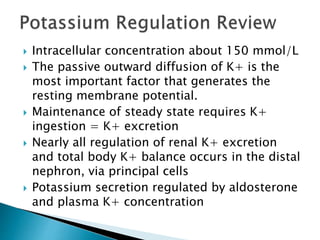
 Intracellular concentration about 150 mmol/L 
 The passive outward diffusion of K+ is the 
most important factor that generates the 
resting membrane potential. 
 Maintenance of steady state requires K+ 
ingestion = K+ excretion 
 Nearly all regulation of renal K+ excretion 
and total body K+ balance occurs in the distal 
nephron, via principal cells 
 Potassium secretion regulated by aldosterone 
and plasma K+ concentration
Potassium homeostasis 
-Gastrointestinal absorption is complete, resulting in daily excess 
intake of about 1 mmol/kg/d 
This excess is 
(10%) excreted through the gut 
(90%) excreted through the kidneys 
- The most important site of regulation is the distal nephron, 
including the distal convoluted tubule, the connecting tubule, 
and the cortical collecting tubule
I. Potassium release from cells 
II. Excessive Intake 
III. Decreased renal loss 
IV. Iatrogenic 
(Consider pseudohyperkalemia)
 Intravascular hemolysis 
 Tumor Lysis Syndrome 
 Rhabdomyolysis 
 Metabolic acidosis 
 Hyperglycemia 
 Severe Digitalis toxicity 
 Hyperkalemic periodic paralysis 
 Beta-blockers 
 Succinylcholine; especially in case massive 
trauma, burns or neuromuscular disease
Excessive intake 
- Uncommon cause of hyperkalemia. 
-The mechanisms for shifting potassium intracellularly and for 
renal excretion allow a person with normal potassium homeostatic 
mechanisms to ingest virtually unlimited quantities of potassium in 
healthy individuals. 
-Most often, it is caused in a patient with impaired mechanisms 
for the intracellular shift of potassium or for renal potassium 
excretion
-Is the most common cause 
--The causes of decreased renal potassium excretion include: 
-renal failure 
diabetes mellitus 
sickle cell disease 
Decreased excretion 
Medications (eg, potassium-sparing diuretics, 
NSAID,angiotensin-convening enzyme inhibitors)
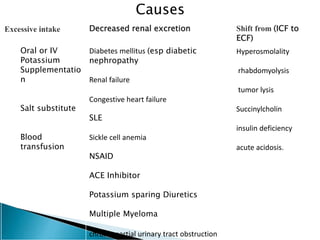
Causes 
Shift from (ICF to 
ECF) 
Excessive intake Decreased renal excretion 
Hyperosmolality 
rhabdomyolysis 
tumor lysis 
Succinylcholin 
insulin deficiency 
acute acidosis. 
Diabetes mellitus (esp diabetic 
nephropathy 
Renal failure 
Congestive heart failure 
SLE 
Sickle cell anemia 
NSAID 
ACE Inhibitor 
Potassium sparing Diuretics 
Multiple Myeloma 
chronic partial urinary tract obstruction 
Oral or IV 
Potassium 
Supplementatio 
n 
Salt substitute 
Blood 
transfusion
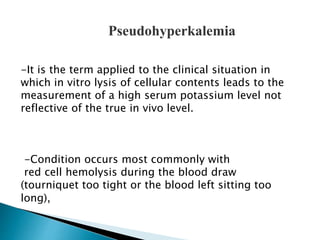
Pseudohyperkalemia 
-It is the term applied to the clinical situation in 
which in vitro lysis of cellular contents leads to the 
measurement of a high serum potassium level not 
reflective of the true in vivo level. 
-Condition occurs most commonly with 
red cell hemolysis during the blood draw 
(tourniquet too tight or the blood left sitting too 
long),
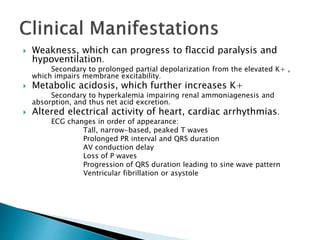
 Weakness, which can progress to flaccid paralysis and 
hypoventilation. 
Secondary to prolonged partial depolarization from the elevated K+ , 
which impairs membrane excitability. 
 Metabolic acidosis, which further increases K+ 
Secondary to hyperkalemia impairing renal ammoniagenesis and 
absorption, and thus net acid excretion. 
 Altered electrical activity of heart, cardiac arrhythmias. 
ECG changes in order of appearance: 
Tall, narrow-based, peaked T waves 
Prolonged PR interval and QRS duration 
AV conduction delay 
Loss of P waves 
Progression of QRS duration leading to sine wave pattern 
Ventricular fibrillation or asystole
Weakness and fatigue(most common) 
fFank muscle paralysis 
Shortness of breath 
Palpitations 
Symptoms
Physical 
-Vital signs generally are normal 
Except 
bradycardia due to heart block 
or tachypnea due to respiratory muscle 
weakness.
Lab 
Assess renal function. 
Check serum BUN and creatinine levels to 
determine whether renal insufficiency is present 
Check 24-hour urine for creatinine 
clearance 
Estimate the glomerular filtration rate (GFR)
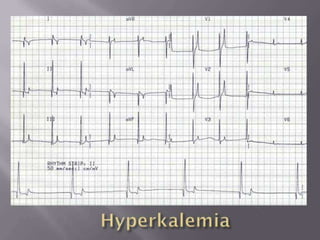
ECG 
Changes occur when Serum Potassium >6.0 mmol 
/L 
A-Initial 
T Waves peaked or Tented 
B-Next 
ST depression 
loss of P Wave 
QRS widening 
C-Final 
Biphasic wave (sine wave) QRS and T fusion
Measure complete metabolic profile 
-Low bicarbonate may suggest hyperkalemia due 
to metabolic acidosis. 
-Hyperglycemia suggests diabetes mellitus.
Treatment 
The first step 
-determine life-threatening toxicity. 
By Perform an ECG to look for cardiotoxicity. 
- if present 
Administer Iv Calcium Gluconate to ameliorate 
cardiac toxicity. 
-Initial dose: 10 ml over 2-5 minutes 
Second dose after 5 minutes if no response 
-Effect occurs in minutes and lasts for 30-60 
minutes 
Anticipate EKG improvement within 3 minutes
The second step 
-Is to identify and remove sources of potassium 
intake 
-Change the diet to a low-potassium diet.
The third step 
-Potassium shift from intravascular to 
intracellular 
-Glucose and Insulin Infusion 
Insulin Regular 10 units IV 
50 ml 50% of dextrose 
-Measure glucose and potassium every 2 
hours 
-Correct metabolic acidosis with sodium 
bicarbonate. 50ml I/V bolus 
-Ventolin Nebulization
The fourth step 
-Is to increase potassium excretion from the body 
-in normal kidney function by the administration of 
parenteral saline accompanied by a loop diuretic, 
such as furosemide Dose: 20-40 mg IV.
-Discontinue potassium-sparing diuretics, 
angiotensin-converting enzyme inhibitors, 
angiotensin receptor blockers, and other drugs that 
inhibit renal potassium 
excretion. 
Monitor volume status and aim to maintain 
euvolemia. 
-In patients with hyporeninemia or hypoaldosteronism 
Renal excretion can be enhanced by administration of 
an aldosterone analogue, such as 9-alpha 
fluorohydrocortisone acetate (Florinef).
Emergency dialysis 
Is a final recourse for unresponsive 
hyperkalemia with renal failure.
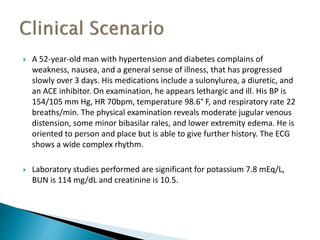
 A 52-year-old man with hypertension and diabetes complains of 
weakness, nausea, and a general sense of illness, that has progressed 
slowly over 3 days. His medications include a sulonylurea, a diuretic, and 
an ACE inhibitor. On examination, he appears lethargic and ill. His BP is 
154/105 mm Hg, HR 70bpm, temperature 98.6° F, and respiratory rate 22 
breaths/min. The physical examination reveals moderate jugular venous 
distension, some minor bibasilar rales, and lower extremity edema. He is 
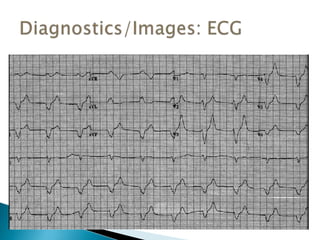
oriented to person and place but is able to give further history. The ECG 
shows a wide complex rhythm. 
 Laboratory studies performed are significant for potassium 7.8 mEq/L, 
BUN is 114 mg/dL and creatinine is 10.5.
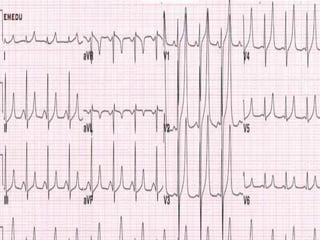
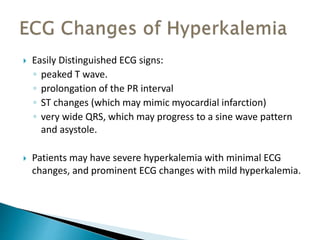
 Easily Distinguished ECG signs: 
◦ peaked T wave. 
◦ prolongation of the PR interval 
◦ ST changes (which may mimic myocardial infarction) 
◦ very wide QRS, which may progress to a sine wave pattern 
and asystole. 
 Patients may have severe hyperkalemia with minimal ECG 
changes, and prominent ECG changes with mild hyperkalemia.
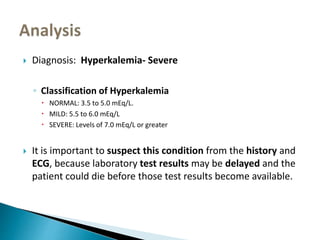
 Diagnosis: Hyperkalemia- Severe 
◦ Classification of Hyperkalemia 
 NORMAL: 3.5 to 5.0 mEq/L. 
 MILD: 5.5 to 6.0 mEq/L 
 SEVERE: Levels of 7.0 mEq/L or greater 
 It is important to suspect this condition from the history and 
ECG, because laboratory test results may be delayed and the 
patient could die before those test results become available.
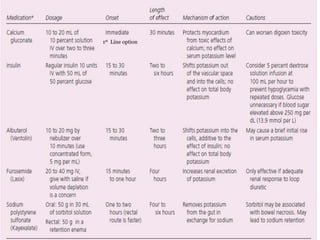
1st Line option
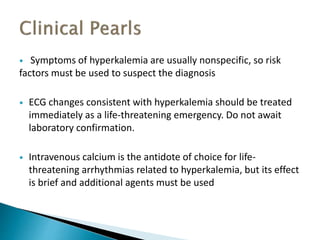
 Symptoms of hyperkalemia are usually nonspecific, so risk 
factors must be used to suspect the diagnosis 
 ECG changes consistent with hyperkalemia should be treated 
immediately as a life-threatening emergency. Do not await 
laboratory confirmation. 
 Intravenous calcium is the antidote of choice for life-threatening 
arrhythmias related to hyperkalemia, but its effect 
is brief and additional agents must be used
Hyperkalemia and its management

Hyperkalemia and its management

  • 2.
    Prepared by: Dr.Muhammad Asim Fazal MEEQAT GENERAL HOSPITAL ALMADINAH ALMUNAWARAH
  • 3.
     Definition Brief review of potassium regulation processes  Causes  Clinical Manifestations  Therapy
  • 4.
     Hyperkalemia =plasma K+ concentration > 5.1mmol/L  Critical hyperkalemia = plama K+ concentration > 6.5 mmol/L
  • 5.
    -The normal serumlevel of potassium is 3.5 to 5 mmol/L -Daily Requirements 1-1.5 mmol/kg -Dietary sources include dried fruits; legumes; meats; poultry; fish; soy; bananas; citrus fruits; potatoes; tomatoes; broccoli; mushrooms; dark, leafy green vegetables
  • 6.
     Intracellular concentrationabout 150 mmol/L  The passive outward diffusion of K+ is the most important factor that generates the resting membrane potential.  Maintenance of steady state requires K+ ingestion = K+ excretion  Nearly all regulation of renal K+ excretion and total body K+ balance occurs in the distal nephron, via principal cells  Potassium secretion regulated by aldosterone and plasma K+ concentration
  • 7.
    Potassium homeostasis -Gastrointestinalabsorption is complete, resulting in daily excess intake of about 1 mmol/kg/d This excess is (10%) excreted through the gut (90%) excreted through the kidneys - The most important site of regulation is the distal nephron, including the distal convoluted tubule, the connecting tubule, and the cortical collecting tubule
  • 8.
    I. Potassium releasefrom cells II. Excessive Intake III. Decreased renal loss IV. Iatrogenic (Consider pseudohyperkalemia)
  • 9.
     Intravascular hemolysis  Tumor Lysis Syndrome  Rhabdomyolysis  Metabolic acidosis  Hyperglycemia  Severe Digitalis toxicity  Hyperkalemic periodic paralysis  Beta-blockers  Succinylcholine; especially in case massive trauma, burns or neuromuscular disease
  • 10.
    Excessive intake -Uncommon cause of hyperkalemia. -The mechanisms for shifting potassium intracellularly and for renal excretion allow a person with normal potassium homeostatic mechanisms to ingest virtually unlimited quantities of potassium in healthy individuals. -Most often, it is caused in a patient with impaired mechanisms for the intracellular shift of potassium or for renal potassium excretion
  • 11.
    -Is the mostcommon cause --The causes of decreased renal potassium excretion include: -renal failure diabetes mellitus sickle cell disease Decreased excretion Medications (eg, potassium-sparing diuretics, NSAID,angiotensin-convening enzyme inhibitors)
  • 12.
    Causes Shift from(ICF to ECF) Excessive intake Decreased renal excretion Hyperosmolality rhabdomyolysis tumor lysis Succinylcholin insulin deficiency acute acidosis. Diabetes mellitus (esp diabetic nephropathy Renal failure Congestive heart failure SLE Sickle cell anemia NSAID ACE Inhibitor Potassium sparing Diuretics Multiple Myeloma chronic partial urinary tract obstruction Oral or IV Potassium Supplementatio n Salt substitute Blood transfusion
  • 13.
    Pseudohyperkalemia -It isthe term applied to the clinical situation in which in vitro lysis of cellular contents leads to the measurement of a high serum potassium level not reflective of the true in vivo level. -Condition occurs most commonly with red cell hemolysis during the blood draw (tourniquet too tight or the blood left sitting too long),
  • 14.
     Weakness, whichcan progress to flaccid paralysis and hypoventilation. Secondary to prolonged partial depolarization from the elevated K+ , which impairs membrane excitability.  Metabolic acidosis, which further increases K+ Secondary to hyperkalemia impairing renal ammoniagenesis and absorption, and thus net acid excretion.  Altered electrical activity of heart, cardiac arrhythmias. ECG changes in order of appearance: Tall, narrow-based, peaked T waves Prolonged PR interval and QRS duration AV conduction delay Loss of P waves Progression of QRS duration leading to sine wave pattern Ventricular fibrillation or asystole
  • 15.
    Weakness and fatigue(mostcommon) fFank muscle paralysis Shortness of breath Palpitations Symptoms
  • 16.
    Physical -Vital signsgenerally are normal Except bradycardia due to heart block or tachypnea due to respiratory muscle weakness.
  • 17.
    Lab Assess renalfunction. Check serum BUN and creatinine levels to determine whether renal insufficiency is present Check 24-hour urine for creatinine clearance Estimate the glomerular filtration rate (GFR)
  • 18.
    ECG Changes occurwhen Serum Potassium >6.0 mmol /L A-Initial T Waves peaked or Tented B-Next ST depression loss of P Wave QRS widening C-Final Biphasic wave (sine wave) QRS and T fusion
  • 22.
    Measure complete metabolicprofile -Low bicarbonate may suggest hyperkalemia due to metabolic acidosis. -Hyperglycemia suggests diabetes mellitus.
  • 23.
    Treatment The firststep -determine life-threatening toxicity. By Perform an ECG to look for cardiotoxicity. - if present Administer Iv Calcium Gluconate to ameliorate cardiac toxicity. -Initial dose: 10 ml over 2-5 minutes Second dose after 5 minutes if no response -Effect occurs in minutes and lasts for 30-60 minutes Anticipate EKG improvement within 3 minutes
  • 24.
    The second step -Is to identify and remove sources of potassium intake -Change the diet to a low-potassium diet.
  • 25.
    The third step -Potassium shift from intravascular to intracellular -Glucose and Insulin Infusion Insulin Regular 10 units IV 50 ml 50% of dextrose -Measure glucose and potassium every 2 hours -Correct metabolic acidosis with sodium bicarbonate. 50ml I/V bolus -Ventolin Nebulization
  • 26.
    The fourth step -Is to increase potassium excretion from the body -in normal kidney function by the administration of parenteral saline accompanied by a loop diuretic, such as furosemide Dose: 20-40 mg IV.
  • 27.
    -Discontinue potassium-sparing diuretics, angiotensin-converting enzyme inhibitors, angiotensin receptor blockers, and other drugs that inhibit renal potassium excretion. Monitor volume status and aim to maintain euvolemia. -In patients with hyporeninemia or hypoaldosteronism Renal excretion can be enhanced by administration of an aldosterone analogue, such as 9-alpha fluorohydrocortisone acetate (Florinef).
  • 28.
    Emergency dialysis Isa final recourse for unresponsive hyperkalemia with renal failure.
  • 29.
     A 52-year-oldman with hypertension and diabetes complains of weakness, nausea, and a general sense of illness, that has progressed slowly over 3 days. His medications include a sulonylurea, a diuretic, and an ACE inhibitor. On examination, he appears lethargic and ill. His BP is 154/105 mm Hg, HR 70bpm, temperature 98.6° F, and respiratory rate 22 breaths/min. The physical examination reveals moderate jugular venous distension, some minor bibasilar rales, and lower extremity edema. He is oriented to person and place but is able to give further history. The ECG shows a wide complex rhythm.  Laboratory studies performed are significant for potassium 7.8 mEq/L, BUN is 114 mg/dL and creatinine is 10.5.
  • 31.
     Easily DistinguishedECG signs: ◦ peaked T wave. ◦ prolongation of the PR interval ◦ ST changes (which may mimic myocardial infarction) ◦ very wide QRS, which may progress to a sine wave pattern and asystole.  Patients may have severe hyperkalemia with minimal ECG changes, and prominent ECG changes with mild hyperkalemia.
  • 32.
     Diagnosis: Hyperkalemia-Severe ◦ Classification of Hyperkalemia  NORMAL: 3.5 to 5.0 mEq/L.  MILD: 5.5 to 6.0 mEq/L  SEVERE: Levels of 7.0 mEq/L or greater  It is important to suspect this condition from the history and ECG, because laboratory test results may be delayed and the patient could die before those test results become available.
  • 33.
  • 34.
     Symptoms ofhyperkalemia are usually nonspecific, so risk factors must be used to suspect the diagnosis  ECG changes consistent with hyperkalemia should be treated immediately as a life-threatening emergency. Do not await laboratory confirmation.  Intravenous calcium is the antidote of choice for life-threatening arrhythmias related to hyperkalemia, but its effect is brief and additional agents must be used

Editor's Notes

  • #7 Amount of K+ lost in stool typically 10% of dietary intake. This can increase to 60% of intake in CKD.
  • #9 Pseudohyperkalemia: exit of K+ from cells at time of venipuncture; tourniquet left too long, hemolysis, marked leucocytosis or thrombocytosis (latter two secondary to release of intracellular K+ after clot formation). Mention blood transfusions with iatrogenic.
  • #10 Exer. Induced proportionate to degree exertion. BB mild degree. HyperKalemic PP: autosomal dominant d/o; episodic weakness/paralysis precipitated by stimuli that cause mild hyperkalemia; mutated skeletal musc. Na+ channel. Digitalis secondary inhibition Na/K/ATPase pump.
  • #15 Impaired net acid excretion occurs in the TALH.
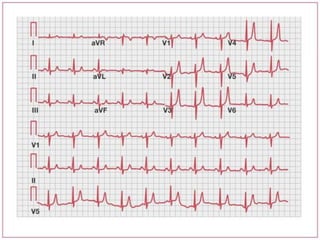
  • #31 Review: Peaked T-waves (V2-V5), widened QRS and prolonged PR interval resulting in (Sine-wave)- I, AvR, V1-V2 .
  • #32 Review: ECG changes of Hyperkalemia, may review back to ECG example in slide 5
  • #34 Table of Pharmacological interventions summarized
  • #35 Highlight Points: Do not wait for laboratory values to initiate treatment for patient with suspected Hyperkalemia based on ECG or PE