MANAGEMENT OF CKD-5 (ESRD)
DIALYSIS AND TRANSPLANTATION
Dr Muzafar Maqsood Wani
Consultant Nephrologist
SKIMS, SOURA
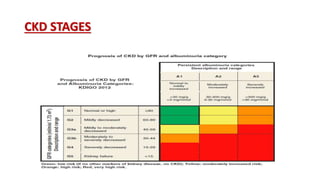
CKD STAGES
CKD STAGES
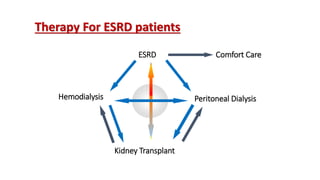
Therapy For ESRD patients
ESRD
Hemodialysis
Kidney Transplant
Peritoneal Dialysis
Comfort Care
Modality Selection
• Most patients (>80%) can do either modality and the decision is not a primarily
medical one although some factors may favor one modality over the other
• Modality selection should take into account medical issues, patient’s social
circumstances, wishes of patient but also overall economic circumstances in
which the dialysis program operates
DIALYSIS
• Dialysis is used to remove fluid & uremic waste products from the body
when kidneys are unable to do so
• Need for dialysis may be acute or chronic
• It is also be used to remove certain medications or other toxins from the
blood (poisoning, medication overdose)
TYPES OF DIALYSIS
1.HEMODIALYSIS (HD) (Intermittent Haemodialysis - IHD)
-in centre-2 or 3/week
-home-nocturnal, daily small sessions
Special forms – Continuous - CAVHD, CVVHD, CVVHDF, SCUF, SLED
2.PERITONEAL DIALYSIS (PD)-
- IPD- intermittent
- CAPD – Continuous Ambulatory
- CCPD – Continuous Cyclic
- APD – Ambulatory
HEMODIALYSIS (HD)
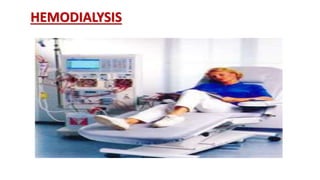
• HD is the most common method of dialysis.
• It is the process of purifying the blood & removing the waste products from the
blood & re-infusing the purified blood.
• For patients with CKD, HD prevents death, it does not cure renal disease & does
not compensate for the loss of endocrine or metabolic activity of kidneys
• Done usually 3 times a week for 3 to 4 hrs/treatment – (9-12 hrs /week)

• The anticoagulant heparin is administered to keep blood from clotting in dialysis
circuit.
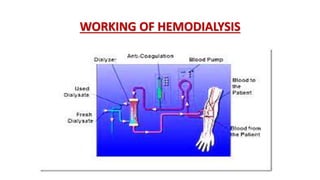
HEMODIALYSIS
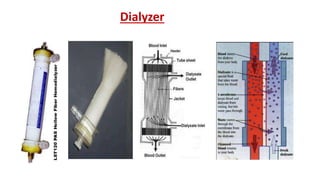
Dialyzer
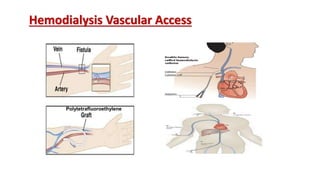
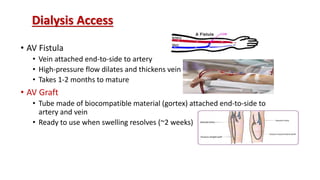
Hemodialysis Vascular Access
Polytetrafluoroethylene
Dialysis Access
• AV Fistula
• Vein attached end-to-side to artery
• High-pressure flow dilates and thickens vein
• Takes 1-2 months to mature
• AV Graft
• Tube made of biocompatible material (gortex) attached end-to-side to
artery and vein
• Ready to use when swelling resolves (~2 weeks)
WORKING OF HEMODIALYSIS
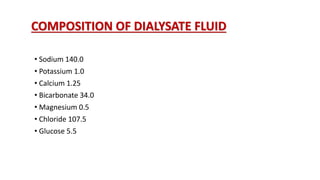
COMPOSITION OF DIALYSATE FLUID
• Sodium 140.0
• Potassium 1.0
• Calcium 1.25
• Bicarbonate 34.0
• Magnesium 0.5
• Chloride 107.5
• Glucose 5.5
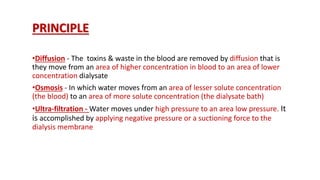
PRINCIPLE
•Diffusion - The toxins & waste in the blood are removed by diffusion that is
they move from an area of higher concentration in blood to an area of lower
concentration dialysate
•Osmosis - In which water moves from an area of lesser solute concentration
(the blood) to an area of more solute concentration (the dialysate bath)
•Ultra-filtration - Water moves under high pressure to an area low pressure. It
is accomplished by applying negative pressure or a suctioning force to the
dialysis membrane
COMPLICATIONS
• FEBRILE REACTIONS
• DIALYSIS DISEQUILIBRIUM SYNDROMES
• HYPOVOLEMIA
• HYPERNATREMIA
• HYPERGLYCEMIA
• HYPOTENSION
• ARRYTHIMIAS
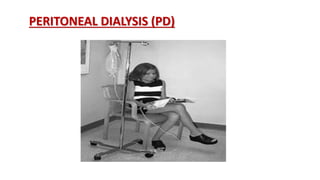
PERITONEAL DIALYSIS (PD)
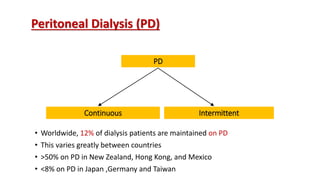
Peritoneal Dialysis (PD)
PD
Continuous Intermittent
• Worldwide, 12% of dialysis patients are maintained on PD
• This varies greatly between countries
• >50% on PD in New Zealand, Hong Kong, and Mexico
• <8% on PD in Japan ,Germany and Taiwan
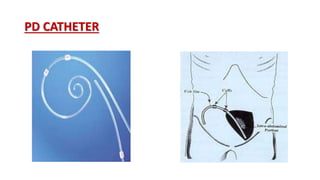
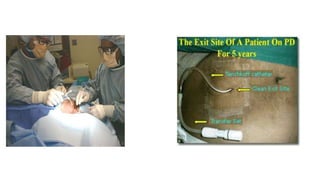
PD CATHETER
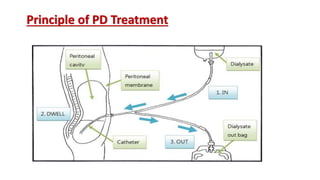
Principle of PD Treatment
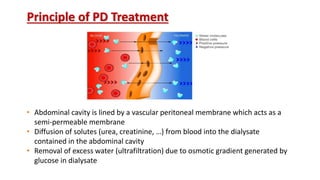
• Abdominal cavity is lined by a vascular peritoneal membrane which acts as a
semi-permeable membrane
• Diffusion of solutes (urea, creatinine, …) from blood into the dialysate
contained in the abdominal cavity
• Removal of excess water (ultrafiltration) due to osmotic gradient generated by
glucose in dialysate
Principle of PD Treatment
Indications for PD
Absolute indications
• Poor cardiac function
• Peripheral vascular disease (not able to make vascular access)
Relative indications
• Free life style
• Want to take care themselves
• Long distance to hemodialysis center
Contraindications to PD
• Inability to make connections and lack of family member or other person
willing or able to help
(dementia ,stroke ,arthritis , blindness, debilitation etc)
• Previous complicated abdominal surgery with adhesions, ostomies etc
• Lack of space to store PD solutions
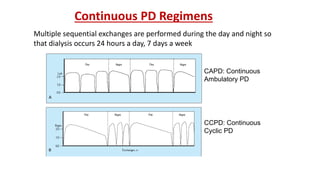
Continuous PD Regimens
Multiple sequential exchanges are performed during the day and night so
that dialysis occurs 24 hours a day, 7 days a week
CAPD: Continuous
Ambulatory PD
CCPD: Continuous
Cyclic PD
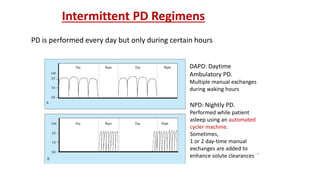
Intermittent PD Regimens
PD is performed every day but only during certain hours
DAPD: Daytime
Ambulatory PD.
Multiple manual exchanges
during waking hours
NPD: Nightly PD.
Performed while patient
asleep using an automated
cycler machine.
Sometimes,
1 or 2 day-time manual
exchanges are added to
enhance solute clearances `
Complications
IMMEDIATE
• Technical failure
• Bowel/viscera/vascular perforation
LATE
• Peritonitis- Bacterial, fungal, tubercular, sclerosizing
• Tunnel or exit site infection
• Catheter migration/malfunction
• Ultra filtration failure
• Hernia/s
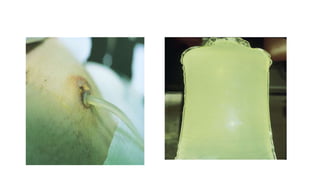
PERITONITIS
• Remains the biggest cause of PD technique failure in most countries
• Also causes hospitalization, catheter loss and even death
• Rates have fallen over past 2 decades , mainly due to improved connectology
• Abdominal pain, cloudy effluent, high PD fluid cell count,
gram stain positive, culture positive
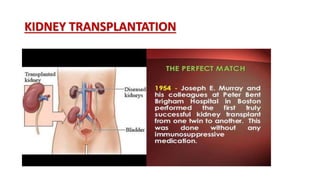
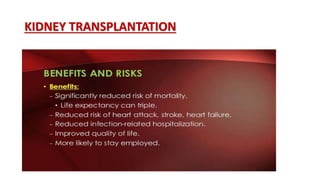
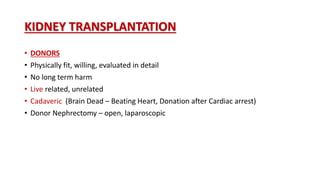
KIDNEY TRANSPLANTATION
• DONORS
• Physically fit, willing, evaluated in detail
• No long term harm
• Live related, unrelated
• Cadaveric (Brain Dead – Beating Heart, Donation after Cardiac arrest)
• Donor Nephrectomy – open, laparoscopic
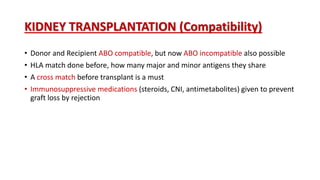
KIDNEY TRANSPLANTATION (Compatibility)
• Donor and Recipient ABO compatible, but now ABO incompatible also possible
• HLA match done before, how many major and minor antigens they share
• A cross match before transplant is a must
• Immunosuppressive medications (steroids, CNI, antimetabolites) given to prevent
graft loss by rejection
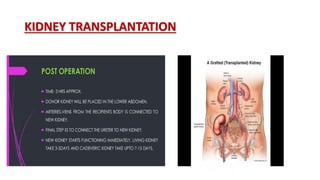
KIDNEY TRANSPLANTATION
KIDNEY TRANSPLANTATION (Complications)
• Rejection (Hyperacute, Acute, Chronic)
• Infections (Viral, Bacterial, Fungal) and sepsis
• Drug related complications( steroid, cyclosporine, tacrolimus, azathioprine,
mycophenolate, induction agents)
• Post transplant malignancies
• Electrolyte and metabolic complications
Thank you

Management of Chronic Kidney disease Dialysis & Transplantation

  • 1.
    MANAGEMENT OF CKD-5(ESRD) DIALYSIS AND TRANSPLANTATION Dr Muzafar Maqsood Wani Consultant Nephrologist SKIMS, SOURA
  • 2.
  • 3.
  • 4.
    Therapy For ESRDpatients ESRD Hemodialysis Kidney Transplant Peritoneal Dialysis Comfort Care
  • 5.
    Modality Selection • Mostpatients (>80%) can do either modality and the decision is not a primarily medical one although some factors may favor one modality over the other • Modality selection should take into account medical issues, patient’s social circumstances, wishes of patient but also overall economic circumstances in which the dialysis program operates
  • 6.
    DIALYSIS • Dialysis isused to remove fluid & uremic waste products from the body when kidneys are unable to do so • Need for dialysis may be acute or chronic • It is also be used to remove certain medications or other toxins from the blood (poisoning, medication overdose)
  • 7.
    TYPES OF DIALYSIS 1.HEMODIALYSIS(HD) (Intermittent Haemodialysis - IHD) -in centre-2 or 3/week -home-nocturnal, daily small sessions Special forms – Continuous - CAVHD, CVVHD, CVVHDF, SCUF, SLED 2.PERITONEAL DIALYSIS (PD)- - IPD- intermittent - CAPD – Continuous Ambulatory - CCPD – Continuous Cyclic - APD – Ambulatory
  • 8.
    HEMODIALYSIS (HD) • HDis the most common method of dialysis. • It is the process of purifying the blood & removing the waste products from the blood & re-infusing the purified blood. • For patients with CKD, HD prevents death, it does not cure renal disease & does not compensate for the loss of endocrine or metabolic activity of kidneys • Done usually 3 times a week for 3 to 4 hrs/treatment – (9-12 hrs /week) • The anticoagulant heparin is administered to keep blood from clotting in dialysis circuit.
  • 9.
  • 10.
  • 11.
  • 12.
    Dialysis Access • AVFistula • Vein attached end-to-side to artery • High-pressure flow dilates and thickens vein • Takes 1-2 months to mature • AV Graft • Tube made of biocompatible material (gortex) attached end-to-side to artery and vein • Ready to use when swelling resolves (~2 weeks)
  • 13.
  • 14.
    COMPOSITION OF DIALYSATEFLUID • Sodium 140.0 • Potassium 1.0 • Calcium 1.25 • Bicarbonate 34.0 • Magnesium 0.5 • Chloride 107.5 • Glucose 5.5
  • 15.
    PRINCIPLE •Diffusion - Thetoxins & waste in the blood are removed by diffusion that is they move from an area of higher concentration in blood to an area of lower concentration dialysate •Osmosis - In which water moves from an area of lesser solute concentration (the blood) to an area of more solute concentration (the dialysate bath) •Ultra-filtration - Water moves under high pressure to an area low pressure. It is accomplished by applying negative pressure or a suctioning force to the dialysis membrane
  • 16.
    COMPLICATIONS • FEBRILE REACTIONS •DIALYSIS DISEQUILIBRIUM SYNDROMES • HYPOVOLEMIA • HYPERNATREMIA • HYPERGLYCEMIA • HYPOTENSION • ARRYTHIMIAS
  • 17.
  • 18.
    Peritoneal Dialysis (PD) PD ContinuousIntermittent • Worldwide, 12% of dialysis patients are maintained on PD • This varies greatly between countries • >50% on PD in New Zealand, Hong Kong, and Mexico • <8% on PD in Japan ,Germany and Taiwan
  • 19.
  • 21.
    Principle of PDTreatment
  • 22.
    • Abdominal cavityis lined by a vascular peritoneal membrane which acts as a semi-permeable membrane • Diffusion of solutes (urea, creatinine, …) from blood into the dialysate contained in the abdominal cavity • Removal of excess water (ultrafiltration) due to osmotic gradient generated by glucose in dialysate Principle of PD Treatment
  • 23.
    Indications for PD Absoluteindications • Poor cardiac function • Peripheral vascular disease (not able to make vascular access) Relative indications • Free life style • Want to take care themselves • Long distance to hemodialysis center
  • 24.
    Contraindications to PD •Inability to make connections and lack of family member or other person willing or able to help (dementia ,stroke ,arthritis , blindness, debilitation etc) • Previous complicated abdominal surgery with adhesions, ostomies etc • Lack of space to store PD solutions
  • 25.
    Continuous PD Regimens Multiplesequential exchanges are performed during the day and night so that dialysis occurs 24 hours a day, 7 days a week CAPD: Continuous Ambulatory PD CCPD: Continuous Cyclic PD
  • 26.
    Intermittent PD Regimens PDis performed every day but only during certain hours DAPD: Daytime Ambulatory PD. Multiple manual exchanges during waking hours NPD: Nightly PD. Performed while patient asleep using an automated cycler machine. Sometimes, 1 or 2 day-time manual exchanges are added to enhance solute clearances `
  • 27.
    Complications IMMEDIATE • Technical failure •Bowel/viscera/vascular perforation LATE • Peritonitis- Bacterial, fungal, tubercular, sclerosizing • Tunnel or exit site infection • Catheter migration/malfunction • Ultra filtration failure • Hernia/s
  • 29.
    PERITONITIS • Remains thebiggest cause of PD technique failure in most countries • Also causes hospitalization, catheter loss and even death • Rates have fallen over past 2 decades , mainly due to improved connectology • Abdominal pain, cloudy effluent, high PD fluid cell count, gram stain positive, culture positive
  • 30.
  • 31.
  • 32.
  • 33.
    KIDNEY TRANSPLANTATION • DONORS •Physically fit, willing, evaluated in detail • No long term harm • Live related, unrelated • Cadaveric (Brain Dead – Beating Heart, Donation after Cardiac arrest) • Donor Nephrectomy – open, laparoscopic
  • 34.
    KIDNEY TRANSPLANTATION (Compatibility) •Donor and Recipient ABO compatible, but now ABO incompatible also possible • HLA match done before, how many major and minor antigens they share • A cross match before transplant is a must • Immunosuppressive medications (steroids, CNI, antimetabolites) given to prevent graft loss by rejection
  • 35.
  • 36.
    KIDNEY TRANSPLANTATION (Complications) •Rejection (Hyperacute, Acute, Chronic) • Infections (Viral, Bacterial, Fungal) and sepsis • Drug related complications( steroid, cyclosporine, tacrolimus, azathioprine, mycophenolate, induction agents) • Post transplant malignancies • Electrolyte and metabolic complications
  • 37.