NEONATAL DIABETES MELLITUS
Dr. C. Kannan
Postgraduate
Pediatrics
MGMCRI
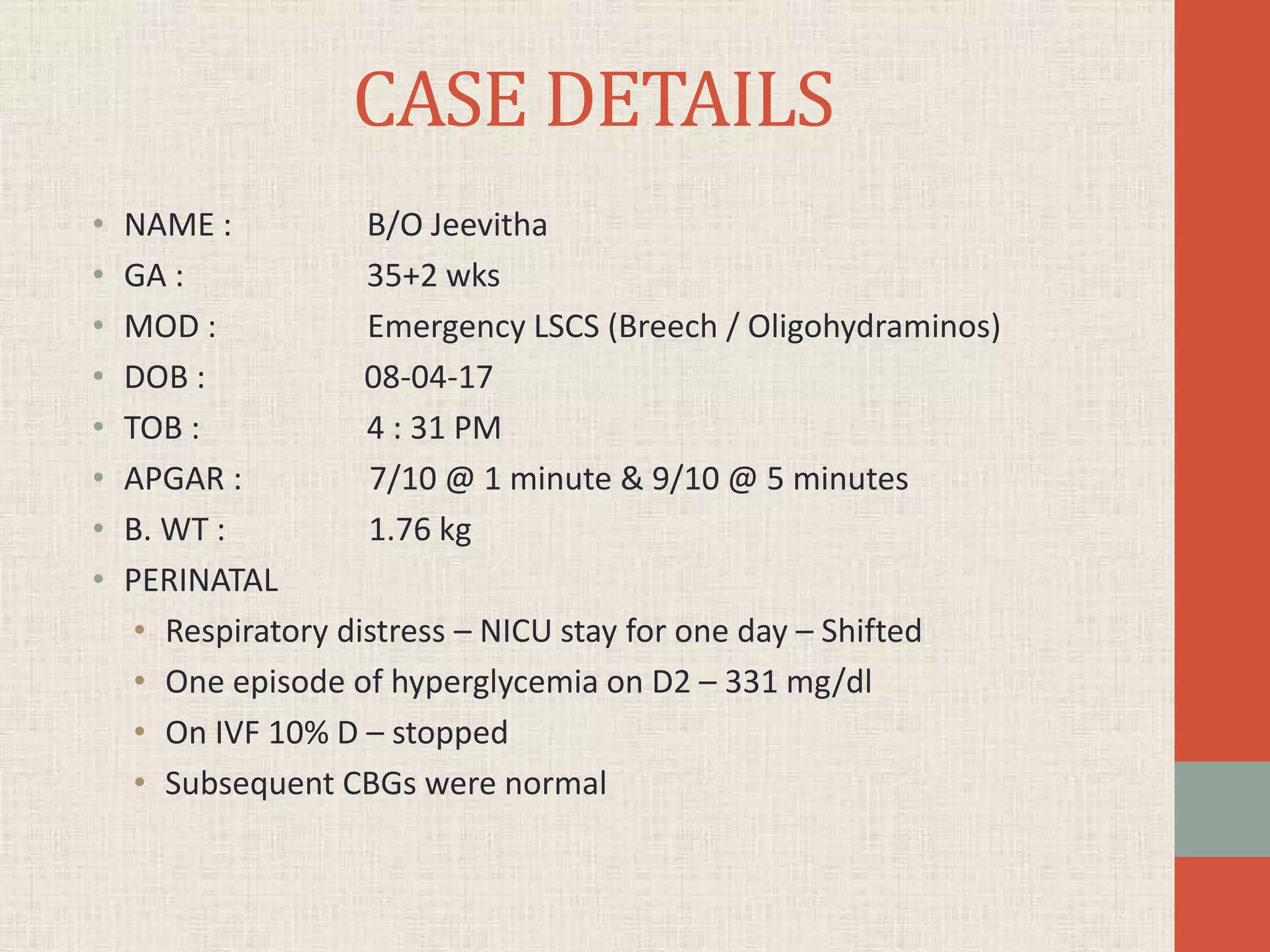
CASE DETAILS
• NAME : B/O Jeevitha
• GA : 35+2 wks
• MOD : Emergency LSCS (Breech / Oligohydraminos)
• DOB : 08-04-17
• TOB : 4 : 31 PM
• APGAR : 7/10 @ 1 minute & 9/10 @ 5 minutes
• B. WT : 1.76 kg
• PERINATAL
• Respiratory distress – NICU stay for one day – Shifted
• One episode of hyperglycemia on D2 – 331 mg/dl
• On IVF 10% D – stopped
• Subsequent CBGs were normal
POSTNATAL HISTORY
On D2
• Shifted to ward / doing well
On D6
• USG – KUB – Mild B/L HUN
• USG – Sacrum – Normal (In V/O Sacral dimple)
• RFT / Electrolytes – Normal
• Weight loss 55 gms
• Shifted to stepdown NICU for supportive care
HYPERGLYCEMIA
On D9
• CBG @ 7 pm – 353 mg/dl
• CBG @ 8 pm – 364 mg/dl
• Biochemical value @ 8 pm – 424 mg/dl
• CBC done – counts were not S/O sepsis
• Stopped supplements ( HMF / MCT oil )
• Continued DBF
• CBG @ 11: 30 pm – 436 mg/dl
• CBG @ 6 am – 417 mg/dl
• U/O/P - > 4.7 ml/kg/hr
NICU
On D-10
• Shifted to NICU
• No family H/O diabetes mellitus in 2 generations
• Blood gas & urine ketones done showed normal
• Started on insulin bolus 0.1 U/kg Q4H
• Hyperglycemia (>200 mg/dl ) persisting despite of 3 boluses
• Insulin infusion started @ 0.8 ml/hr (0.05 U/kg/hr)
INSULIN INFUSION
On D-11
• CBG @ 7 am – 74 mg/dl
• Infusion stopped
• CBG @ 12.30 am – 300 mg/dl
• Infusion restarted
• CBG @ 4.30 am – 88 mg/dl
• Infusion stopped
• Sepsis screen sent & started on IV Cefotaxim / amikacin
FLUCTUATING SUGARS
On D12
• Infusion restarted in V/O hyperglycemia
• Still fluctuation of sugars persisting
• Endocrinology opinion sought
• Suggested intermediate insulin NPH 0.5 – 1 U/kg/day OD
• Genetic testing
• Email sent to UK for approval for sending sample
• USG – Abdomen – Normal study (To R/O pancreatic defect)
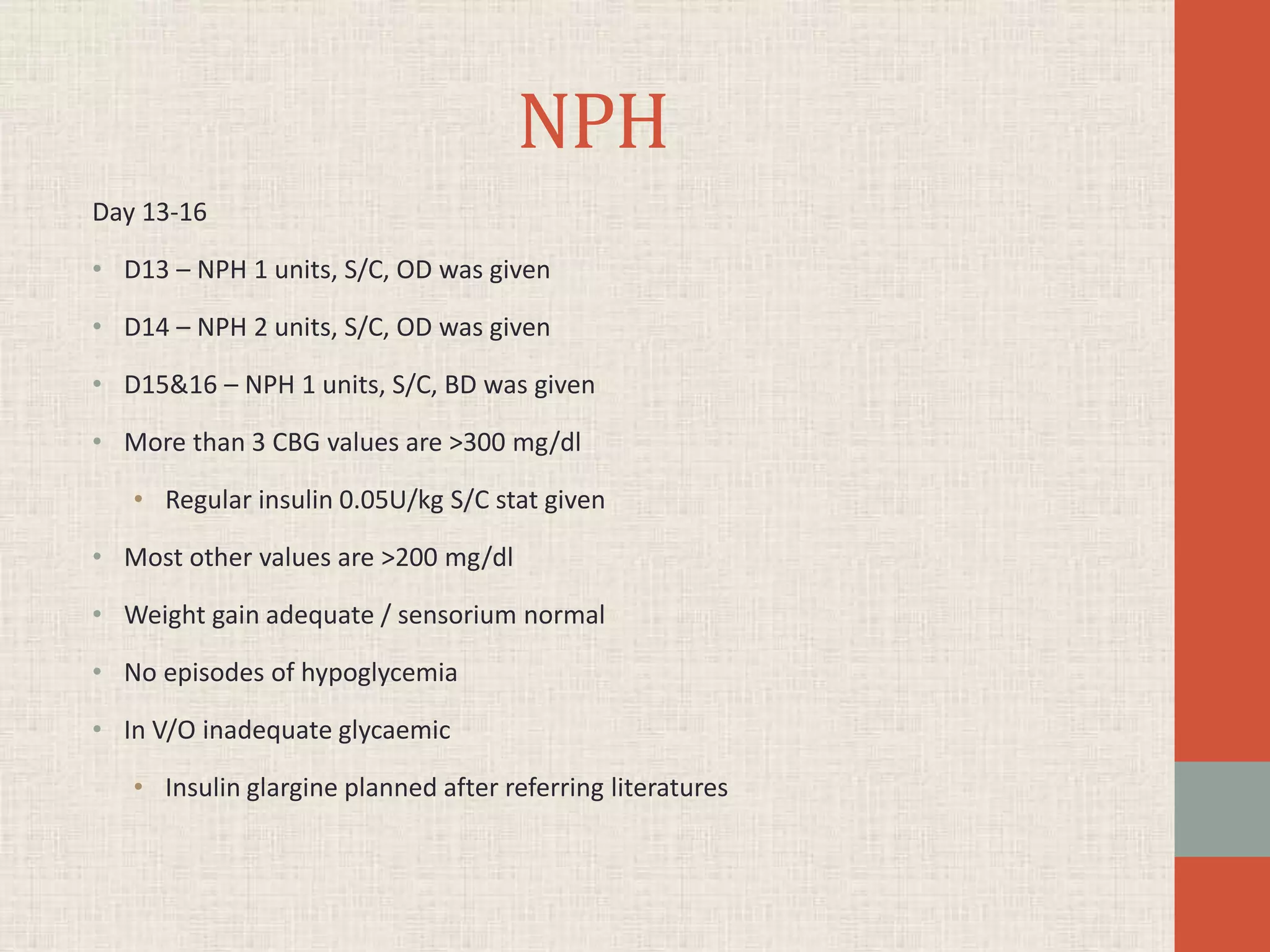
NPH
Day 13-16
• D13 – NPH 1 units, S/C, OD was given
• D14 – NPH 2 units, S/C, OD was given
• D15&16 – NPH 1 units, S/C, BD was given
• More than 3 CBG values are >300 mg/dl
• Regular insulin 0.05U/kg S/C stat given
• Most other values are >200 mg/dl
• Weight gain adequate / sensorium normal
• No episodes of hypoglycemia
• In V/O inadequate glycaemic
• Insulin glargine planned after referring literatures
GLARGINE – DAY - 1
On day 17
• Inj. Glargine insulin was given 2 units, S/C, OD
• 2 CBG values crossed 200 mg/dl
• Most other values are less than 200 mg/dl
• No CBG values crossed >300 mg/dl
• Weight gain 50 gms
• Inj. Cefotaxim + Amikacin restarted in V/O Reduced activity
• Sepsis screen sent/CRP –Ve/blood C/S awaited
• Urine O/P adequate
GLARGINE-DAY-2
On day 18
• Inj. Glargine insulin was given 2 units, S/C, OD
• one CBG values crossed 200 mg/dl
• Most other values are less than 110-120 mg/dl
• No CBG values crossed >300 mg/dl
• Weight gain 20 gms
• Excellent glycaemic control, hence shifted to step down NICU
HYPERGLYCEMIA
Common causes in neonates are
• ELBW
• Lipid infusion
• Metabolic stress
• Infection
• Medications
• Exogenous parenteral glucose
• Neonatal DM
• Pancreatic defect
• Hepatic immaturity
• Hypoxia
• Surgical procedures
Contd.,
VLBW (<1500 gms)
• Incidence as high as 20% to 86%
ELBW <1000 gms) associated with
• Development of IVH
• Necrotizing enterocolitis
• Retinopathy of prematurity
• Infection
• Late mortality
DIAGNOSIS
• Once we rule out other causes of hyperglycemia
• We can start doing work up for NDM
• Diagnostic modalities
• Sr. Insulin/C-peptide levels
• Molecular genetic testing
MOLECULAR GENETIC TESTING
• More than a dozen genes/loci associated with NDM
• Mutations can vary from one region to another worldwide
• Following mutations are commonly reported
• Glucokinase (GCK)
• Potassium channel J11 (KCNJ11)
• ATP–binding cassette transporter subfamily C member 8 (ABCC8)
• Insulin promoter factor 1 (IPF1)
Contd.,
• Mutations in the pancreatic ATP sensitive K+ channel proteins
• Sulfonylurea receptor 1 (SUR1)
• Inward rectifier K+ channel Kir 6.2 (Kir 6.2)
• May respond well to sulfonylurea therapy instead of insulin.
NEONATALDIABETESMELLITUS(NDM)
• NDM
• Persistent hyperglycemia
• Occurs within the first month of life
• Lasting at least 2 weeks
• Requiring management with insulin.
• Caused by defects in
• Insulin secretion
• Beta-cell development
NDM
Presents with
• Intrauterine growth retardation
• Volume depletion
• Profound hyperglycemia
• Glycosuria
• Polyuria
• Ketonuria
• Ketoacidosis
NDM
• NDM is subclassified into
• Transient neonatal diabetes mellitus (TNDM)
• Permanent neonatal diabetes mellitus (PNDM)
• Similar presenting symptoms in both
• Often requires further workup
• Incidence
• Very rare
• 1:300,000 to 500,000 live births.
PNDM
PNDM
• Accounts for 50% of all cases of NDM
• Mutations in K+ channels on pancreatic β cells
• Leads to decreased insulin secretion
TNDM
TNDM
• Accounts for remaining half of NDM cases.
• Between 60% and 80% of patients with TNDM
• Display genetic mutations
• Mostly chromosome-6 abnormalities
• Course of TNDM is highly variable
• Permanent resolution within the first several weeks or
• Months of life to recurrence later in childhood
LONG-TERM SEQUELAE
Long-term sequelae of either type
• Developmental delay
• Cardiac anomalies
• Seizures
• Poor weight gain
• Recurrence of diabetes at an older age.
CHALLENGES IN MANAGEMENT
• Compromise of calories, if glucose is withheld
• Lack of a pharmacokinetic profile for
• S/C administration of insulin in neonates
• Use of small doses that are highly error-prone
• Limited data for dilution of Insulins
• lack of subcutaneous fat deposits in a preterm/IUGR
S/C ROUTE & ABSORBTION
Absorption of drugs depends on
• Blood flow to the injection site
• Muscle mass
• Quantity of adipose tissue and muscle
Absorption may also be affected by
• pH of drug
• Ease of diffusion through capillary membranes
• Surface area over which the volume of injection spreads
S/C drug absorption in preterm are reduced
• Lower regional perfusion and reservoir mass
INSULIN
Rapid Acting Insulins
• Lispro
• Aspart
Short acting
• Insulin Glulisine
• Regular Insulin
Intermediate acting
• NPH- Neutral Protamine
• Hagedorn
• Pre mixed Insulins
Long Acting
• Glargine
• Detemir
INSULIN
NPH
• As per endocrinologist opinion
• NPH insulin started 1 units - OD – S/C
• On D2 changed to 2 units - OD – S/C
• On D3 changed to 1 units – BD – S/C
• Over 3 days
• In 24 hours 2-3 values were >300 mg/dl
• No hypoglycemia occurred
• No ketosis
• Weight gain +
• In V/O inadequate glycaemic control
• Unit team planned to start on glargine
• After referring from several literatures
GLARGINE
After S/C injection
• Onset 1-2 hrs
• Duration 2-22 hrs
• Disappearance 24 hrs
• Glargine forms microprecipitates at neutral pH
• Which gradually release active insulin monomers
• Over a 24-hour period
• Without a peak typically observed with insulin NPH/Detemir
Contd.,
• “The rarity of TNDM has limited the evidence available with which
to validate the use of subcutaneous insulin in neonates”
• “The experience with our patient indicates that the release pattern
of Glargine, as a truly “peak-less” insulin, may be most ideal for
TNDM management during the neonatal period and early infancy,
when patients are frequently or continuously fed”
www.ncbi.nlm.nih.gov/pmc/articles/PMC3385044/
THANK YOU

Neonatal Diabetes Mellitus

  • 1.
    NEONATAL DIABETES MELLITUS Dr.C. Kannan Postgraduate Pediatrics MGMCRI
  • 2.
    CASE DETAILS • NAME: B/O Jeevitha • GA : 35+2 wks • MOD : Emergency LSCS (Breech / Oligohydraminos) • DOB : 08-04-17 • TOB : 4 : 31 PM • APGAR : 7/10 @ 1 minute & 9/10 @ 5 minutes • B. WT : 1.76 kg • PERINATAL • Respiratory distress – NICU stay for one day – Shifted • One episode of hyperglycemia on D2 – 331 mg/dl • On IVF 10% D – stopped • Subsequent CBGs were normal
  • 3.
    POSTNATAL HISTORY On D2 •Shifted to ward / doing well On D6 • USG – KUB – Mild B/L HUN • USG – Sacrum – Normal (In V/O Sacral dimple) • RFT / Electrolytes – Normal • Weight loss 55 gms • Shifted to stepdown NICU for supportive care
  • 4.
    HYPERGLYCEMIA On D9 • CBG@ 7 pm – 353 mg/dl • CBG @ 8 pm – 364 mg/dl • Biochemical value @ 8 pm – 424 mg/dl • CBC done – counts were not S/O sepsis • Stopped supplements ( HMF / MCT oil ) • Continued DBF • CBG @ 11: 30 pm – 436 mg/dl • CBG @ 6 am – 417 mg/dl • U/O/P - > 4.7 ml/kg/hr
  • 5.
    NICU On D-10 • Shiftedto NICU • No family H/O diabetes mellitus in 2 generations • Blood gas & urine ketones done showed normal • Started on insulin bolus 0.1 U/kg Q4H • Hyperglycemia (>200 mg/dl ) persisting despite of 3 boluses • Insulin infusion started @ 0.8 ml/hr (0.05 U/kg/hr)
  • 6.
    INSULIN INFUSION On D-11 •CBG @ 7 am – 74 mg/dl • Infusion stopped • CBG @ 12.30 am – 300 mg/dl • Infusion restarted • CBG @ 4.30 am – 88 mg/dl • Infusion stopped • Sepsis screen sent & started on IV Cefotaxim / amikacin
  • 7.
    FLUCTUATING SUGARS On D12 •Infusion restarted in V/O hyperglycemia • Still fluctuation of sugars persisting • Endocrinology opinion sought • Suggested intermediate insulin NPH 0.5 – 1 U/kg/day OD • Genetic testing • Email sent to UK for approval for sending sample • USG – Abdomen – Normal study (To R/O pancreatic defect)
  • 8.
    NPH Day 13-16 • D13– NPH 1 units, S/C, OD was given • D14 – NPH 2 units, S/C, OD was given • D15&16 – NPH 1 units, S/C, BD was given • More than 3 CBG values are >300 mg/dl • Regular insulin 0.05U/kg S/C stat given • Most other values are >200 mg/dl • Weight gain adequate / sensorium normal • No episodes of hypoglycemia • In V/O inadequate glycaemic • Insulin glargine planned after referring literatures
  • 9.
    GLARGINE – DAY- 1 On day 17 • Inj. Glargine insulin was given 2 units, S/C, OD • 2 CBG values crossed 200 mg/dl • Most other values are less than 200 mg/dl • No CBG values crossed >300 mg/dl • Weight gain 50 gms • Inj. Cefotaxim + Amikacin restarted in V/O Reduced activity • Sepsis screen sent/CRP –Ve/blood C/S awaited • Urine O/P adequate
  • 10.
    GLARGINE-DAY-2 On day 18 •Inj. Glargine insulin was given 2 units, S/C, OD • one CBG values crossed 200 mg/dl • Most other values are less than 110-120 mg/dl • No CBG values crossed >300 mg/dl • Weight gain 20 gms • Excellent glycaemic control, hence shifted to step down NICU
  • 11.
    HYPERGLYCEMIA Common causes inneonates are • ELBW • Lipid infusion • Metabolic stress • Infection • Medications • Exogenous parenteral glucose • Neonatal DM • Pancreatic defect • Hepatic immaturity • Hypoxia • Surgical procedures
  • 12.
    Contd., VLBW (<1500 gms) •Incidence as high as 20% to 86% ELBW <1000 gms) associated with • Development of IVH • Necrotizing enterocolitis • Retinopathy of prematurity • Infection • Late mortality
  • 13.
    DIAGNOSIS • Once werule out other causes of hyperglycemia • We can start doing work up for NDM • Diagnostic modalities • Sr. Insulin/C-peptide levels • Molecular genetic testing
  • 14.
    MOLECULAR GENETIC TESTING •More than a dozen genes/loci associated with NDM • Mutations can vary from one region to another worldwide • Following mutations are commonly reported • Glucokinase (GCK) • Potassium channel J11 (KCNJ11) • ATP–binding cassette transporter subfamily C member 8 (ABCC8) • Insulin promoter factor 1 (IPF1)
  • 15.
    Contd., • Mutations inthe pancreatic ATP sensitive K+ channel proteins • Sulfonylurea receptor 1 (SUR1) • Inward rectifier K+ channel Kir 6.2 (Kir 6.2) • May respond well to sulfonylurea therapy instead of insulin.
  • 16.
    NEONATALDIABETESMELLITUS(NDM) • NDM • Persistenthyperglycemia • Occurs within the first month of life • Lasting at least 2 weeks • Requiring management with insulin. • Caused by defects in • Insulin secretion • Beta-cell development
  • 17.
    NDM Presents with • Intrauterinegrowth retardation • Volume depletion • Profound hyperglycemia • Glycosuria • Polyuria • Ketonuria • Ketoacidosis
  • 18.
    NDM • NDM issubclassified into • Transient neonatal diabetes mellitus (TNDM) • Permanent neonatal diabetes mellitus (PNDM) • Similar presenting symptoms in both • Often requires further workup • Incidence • Very rare • 1:300,000 to 500,000 live births.
  • 19.
    PNDM PNDM • Accounts for50% of all cases of NDM • Mutations in K+ channels on pancreatic β cells • Leads to decreased insulin secretion
  • 20.
    TNDM TNDM • Accounts forremaining half of NDM cases. • Between 60% and 80% of patients with TNDM • Display genetic mutations • Mostly chromosome-6 abnormalities • Course of TNDM is highly variable • Permanent resolution within the first several weeks or • Months of life to recurrence later in childhood
  • 21.
    LONG-TERM SEQUELAE Long-term sequelaeof either type • Developmental delay • Cardiac anomalies • Seizures • Poor weight gain • Recurrence of diabetes at an older age.
  • 22.
    CHALLENGES IN MANAGEMENT •Compromise of calories, if glucose is withheld • Lack of a pharmacokinetic profile for • S/C administration of insulin in neonates • Use of small doses that are highly error-prone • Limited data for dilution of Insulins • lack of subcutaneous fat deposits in a preterm/IUGR
  • 23.
    S/C ROUTE &ABSORBTION Absorption of drugs depends on • Blood flow to the injection site • Muscle mass • Quantity of adipose tissue and muscle Absorption may also be affected by • pH of drug • Ease of diffusion through capillary membranes • Surface area over which the volume of injection spreads S/C drug absorption in preterm are reduced • Lower regional perfusion and reservoir mass
  • 24.
    INSULIN Rapid Acting Insulins •Lispro • Aspart Short acting • Insulin Glulisine • Regular Insulin Intermediate acting • NPH- Neutral Protamine • Hagedorn • Pre mixed Insulins Long Acting • Glargine • Detemir
  • 25.
  • 26.
    NPH • As perendocrinologist opinion • NPH insulin started 1 units - OD – S/C • On D2 changed to 2 units - OD – S/C • On D3 changed to 1 units – BD – S/C • Over 3 days • In 24 hours 2-3 values were >300 mg/dl • No hypoglycemia occurred • No ketosis • Weight gain + • In V/O inadequate glycaemic control • Unit team planned to start on glargine • After referring from several literatures
  • 27.
    GLARGINE After S/C injection •Onset 1-2 hrs • Duration 2-22 hrs • Disappearance 24 hrs • Glargine forms microprecipitates at neutral pH • Which gradually release active insulin monomers • Over a 24-hour period • Without a peak typically observed with insulin NPH/Detemir
  • 28.
    Contd., • “The rarityof TNDM has limited the evidence available with which to validate the use of subcutaneous insulin in neonates” • “The experience with our patient indicates that the release pattern of Glargine, as a truly “peak-less” insulin, may be most ideal for TNDM management during the neonatal period and early infancy, when patients are frequently or continuously fed” www.ncbi.nlm.nih.gov/pmc/articles/PMC3385044/
  • 29.