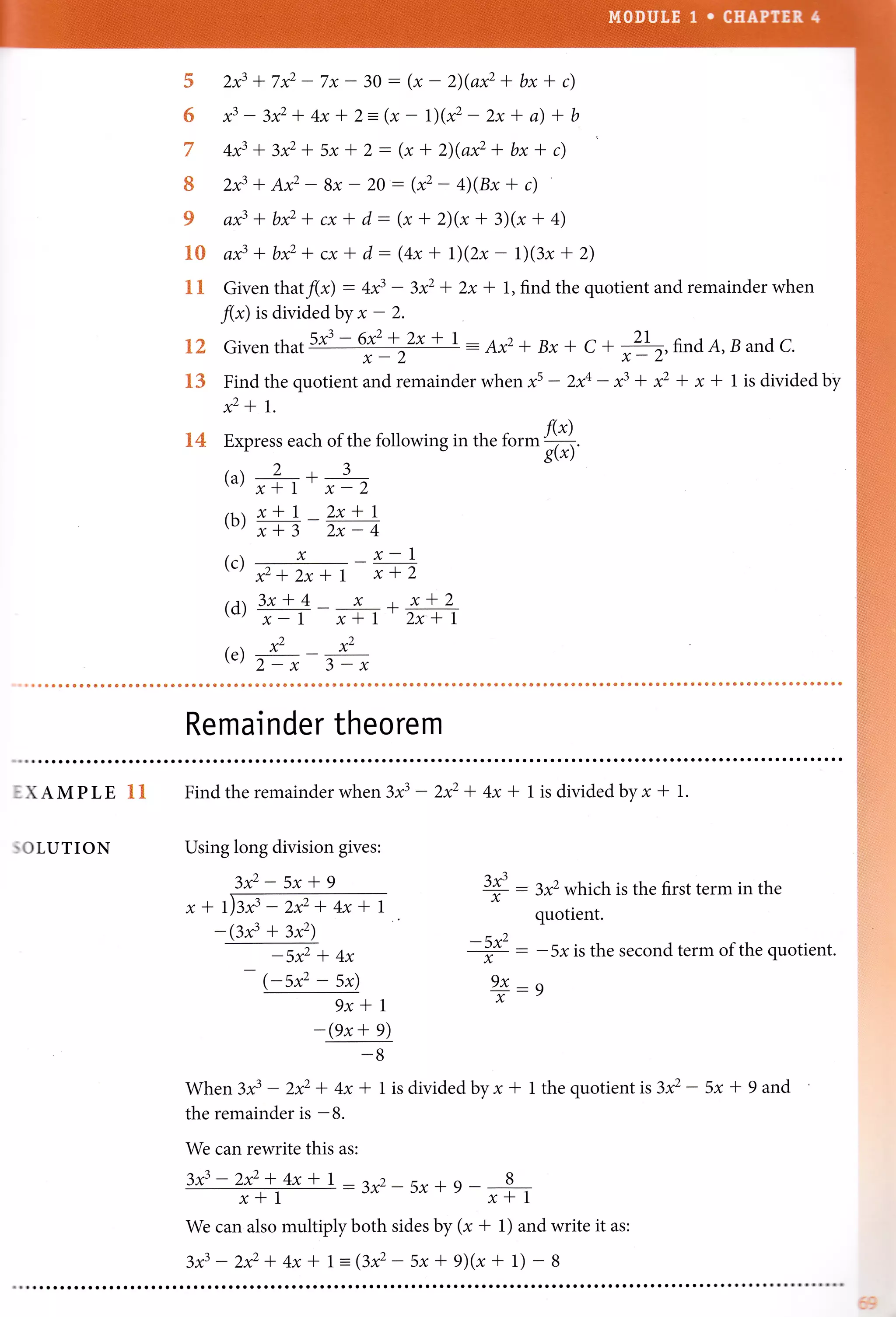
5 2x3+Z*-7x- 30: (x-2)(a** bx* c)
6 f -z*-t 4x*2:(x- r)(xz-2x* a)+ b
7 4f +3e* 5x*2: (x+2)(a*-t bx* c)
g zf + A* _ 8x_ zo:(*_ a)(Bx + c)
9 ax3+ b** cx* d: (x+Z)(x + 3)(r+ a)
l0 ax3 + b* * cx-r d: (4x + t)(Zx - t)(3x + 2)
11 Given thatflx) : 4f - Z* + Zx * 1, find the quotient and remainder when
f(x) is divided by x - 2.
13
13
Given that 5x3 - 6,* +_2x + L
x-2 = A* * Bx * c + #,find A,Band c.
Findthe quotient andremainderwhen xs - 2# - x3 + * + x * 1 is dividedby
*+t.
Ed Express each of the following in the form
#
(a)h+*
(b)#_ffi
1
+2
, x+2+-
'2x* 1
Remainder theorem
TXAMPLE }$
iOLUTION
Find the remainder when 3x3 - Zxz * 4x * 1 is divided by x * 1.
Using long division gives:
3x2-5x*9
x*t)zf-2x2*4x*1
-O* + tA
-5x2 * 4x
(- sxz - 5x)
9x*1
- (e. + e)_
-B
3xz which is the first term in the
quotient.
-5x is the second term of the quotient.
9
3x3
x-
')
- 5x'
x
9x-
x-
When 3x3 - 2xz * 4x * 1 is divided by x *
the remainder is - B.
We can rewrite this as:
3x3 - 2x2 +_4x + 1 : 3x2 _ 5x + g
x*1
We can also multiply both sides by (x + 1) and write it as:
3x3 - 2* * 4x t r=(3xz - 5x t 9)(x+ 1) B
1 the quotient is 3xz - 5x * 9 and
B
xll
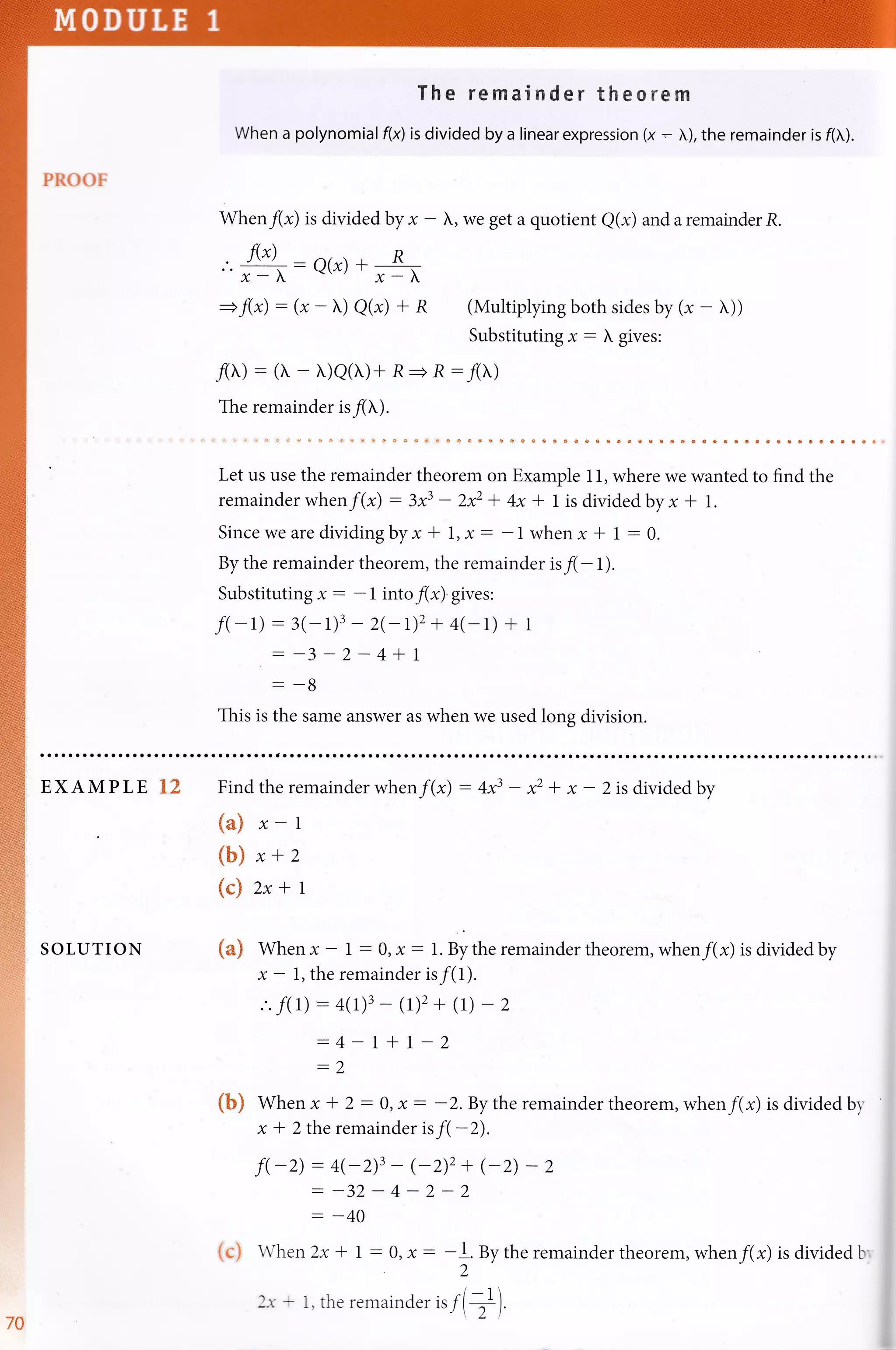
The remainder theorem
When a polynomial f(x) is divided by a linear expression (x - I), the remainder is ().
PROOF
When f(*) is divided by * -
. f(*) /1/ ^- , R
"';q: Q(x) +t-
+f(x) - (x - ) Q(x) + R
, we get a quotient Q(x) and a remainder R.
,()-(-)Q(}')+R+R
The remainder is/(}').
(Multiplying both sides by (* - ))
Substituting x -  gives:
-.,()
Let us use the remainder theorem on Example 11, where we wanted to find the
remainder when/(x) : 3x3 - Z* + +x * 1 is divided byx + 1.
Sincewe are dividingby x * I, y : -1 whenx * 1 : 0.
By the remainder theorem, the remainder isl- 1).
Substituting x: - 1 into/(x) gives:
f(-r): 3(- r)3 - 2(- t12 + +1-t; + t
- -3-2*4+t
-
_oo
This is the same answer as when we used long dMsion.
EXAMPLE 13
SOLUTION
Find the remainder when/(x) : 4x3 - x2 + x - 2 is divided by
(a) x-r
(b) x+z
(c) zx+t
(a) When x - | :0, .tr : 1. By the remainder theorem, when/(x) is divided by
x - 1, the remainder is/(t).
:.f(1): 4(t)3- (1)2+ (1)
-4-I+t-2
-1
(b) When x I 2 : 0, x : -2.8y the remainder theorem, when/(x) is divided by
x -f 2 the remainder isf(-2).
f(-2) : 4(-2)3 - (-2)'+ (-2) - 2
:-32-4-2-2
: -40
(c) When 2x -l | : 0, x : -+. By the remainder theorem, when/(r) is divided br
2.t -.,- l, the remaind.r rr/(+)
l'
ll
ll
ti
ii
i;
il
ii
fr
d,
7A
f(-+): ^(+)'- (+)'* (+)-z
-1 - 1- I _ ')
2 - 4- 1- z
-, 1
-14
.XAMPLE 13
:OLUTION
The remainderwhenflx) : 4f + a* + 2x* 1 is dividedby 3x- 1 is 4. Findthe
val:ue of a.
When3x-1:0,x-
Since f(*) : 4x3 * axz
f(+): n(+)' * ,(+)'*
:+*io*?*
-|o+fi
Sincef(+)-+
i,*ffi - +
|o:+-fi
1- 59
9"- 27
a- #*,
o:!
*.
u, the remainder theore m f(+) : 4.
* 2x * 1, substitutin g x - ] Sir.rt
4+)
+1
1
: IAMPLE 34
:'JLUTION
The expression 6f - +* + ax * bleaves a remainder of 5 when divided by x - |
and a remainder of 1 when divided by x * 1. Find the values of a and b.
Letf(x) : 6x3 - 4x2 * ax * b.
When dividing by x - 1 the remainder is 5.
Now/(l)
I :,:,n_*
-2*a*
.'.2+a*b-5
a*b:3
When dividing by x I 1 the remainder is 1.
=f(-1) - 1
f(-L):1,;,1
;:,;L)z
+ a(-t) + b
.'.-10-a*b-1
-a * b - 11 l2l
4(t)2+ a(t) + b
a*b
b
tll
T1
Solving the equations simultaneously gives:
2b:L4 tll + l2l
Substituting b - 7 rnto [1] gives:
a*7-3,a:-4
Hence, a: -4 and b - 7.
EXAMPLE 15
SOLUTION
Theexpression4x3 - * + ax -lZleavesaremainderof bwhendividedbyx * l ani
when the same expression is divided by * - 2 the remain der is 2b. Find the values o:
a andb.
Letf(x): 4x3 - * * ax -t 2.
v4ren x: -L,fl* 1) : 4(-1)3 - (- t)2 + a(-t) + z
--4-l-a-12
--u-J
By the remainder theorem,fl -l) : b.
=-a-3:b
a*b:-3 tll
,Vhen x: 2,f(2) : 4(2)3 - (2)2 + ae) + 2
:32 * 4'f 2a -12
:2a -l 30
By the remainder theorem,f(2) : 2b.
.'.2a * 30: 2b
:.a*15:b
-a-lb:I5 12)
a-tb-atb:-3+15 [1]+[2]
+2b: 12
b:6
Substituting into [1] gives:
a*6:-3
A: -9
Hence, a: -9 andb : 6.
v2
Try these 4.2 (a) Find the remainder when 6f - 3x2 + x - 2 is divided by the following.
(i) x-z
(ii) r+ 1
(iii) 2x - L
(b) whentheexpression#+ axz - 2x * l isdivided,byx- l theremainderis-l
Find the value of a.
(c) Whentheexpressionf - 4* + ax * bisdividedby2x - l theremainderisl.
when the same expression is divided by (, - 1) the remainder is 2. Find the
values of a andb.
r+land
values of
ing.
?k
,b
s
ffiKffiffiflXSffi &ffi
1#
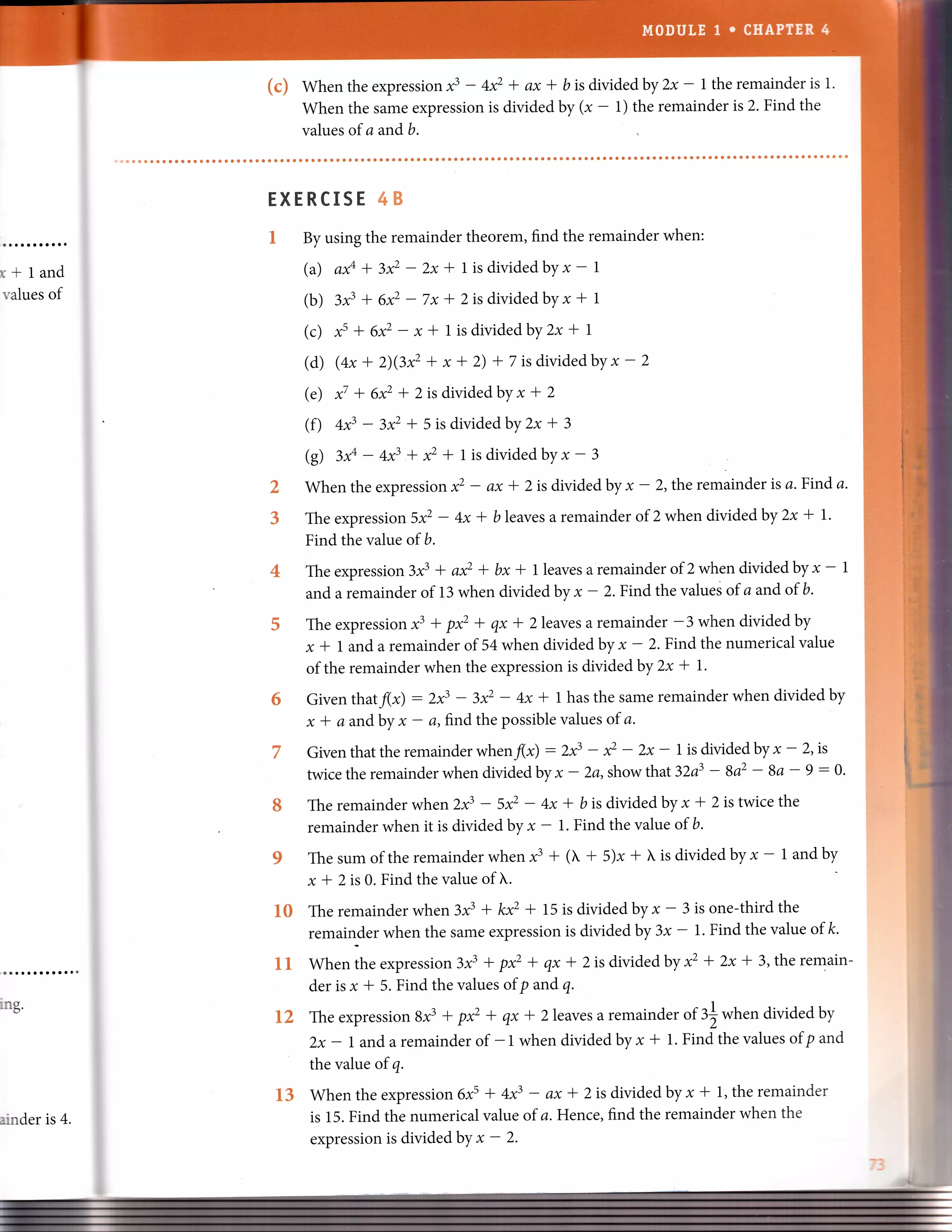
By using the remainder theorem, find the remainder when:
(a) a# + l* - 2x* l isdividedbyx - |
(b) 3t' + e* - 7x * 2 is divided byx * 1
(c) t' + A* -x * 1 isdividedby2x -t I
(d) (ax + 2)QP -t x * 2) + 7 is dividedby x - 2
(e) { * 6xz * 2 is divided by x -t 2
(f) +f - z* * 5 is dividedby2x + 3
@) 3# - 4* + * + tisdividedby * - 3
When the expression * - ax * 2is divided by * - 2, the remainder is a.Find a.
The expressi on 5* - 4x * b leaves a remainder of 2 when divided by 2x * l.
Find the value of b.
Theexpression3.C * a* + bxl- lleavesaremainderof 2whendividedbyx - 1
and a remainder of 13 when divided by * - 2. Find the values of a and of b.
The expression x3 + p* + qx * 2 leaves a remainder -3 when divided by
x * 1 and a remainder of 54 when divided by * - 2. Find the numerical value
of the remainder when the expression is divided by 2x * l.
Given thatf(x) : 2x3 - 3x2 - 4x * t has the same remainder when divided by
x * a andby * - a, frnd the possible values of a.
Giventhattheremainderwhenfx) :2f - * - zx - l isdMdedbyx - 2'is
twicetheremainderwhendividedby x- 2a,showthat 32a3 - 8az - 8a - 9:0.
The remainder when zx3 - 5* - 4x -l b is divided byx * 2 is twice the
remainder when it is divided by, - 1. Find the value of b.
The sum ofthe remainder when x3 + ( + 5)x + L is divided by *' 1 and by
x -l 2is 0. Find the value of I'.
The remainder when 3x3 + kxz * 15 is divided by * - 3 is one-third the
remainder when the same expression is divided by 3x - 1. Find the value of k.
when the expression 3x3 + p* + qx -f 2is divided by x2 + 2x * 3,the remain-
der is x * 5. Find the values of p and q.
The expression 8x3 + p* + qx * 2leaves a remainder of 3| when divided by
2x - land a remainder of -1 when divided by x * 1. Find the values ofp and
the value of 4.
When the expression6xs I 4x3 - ax * 2 is dMded byx * 1, the remainder
is 15. Find the numerical value of a.Hence, find the remainder when the
expression is dMded by x - 2.
E2
1&
ainder is 4.
E3
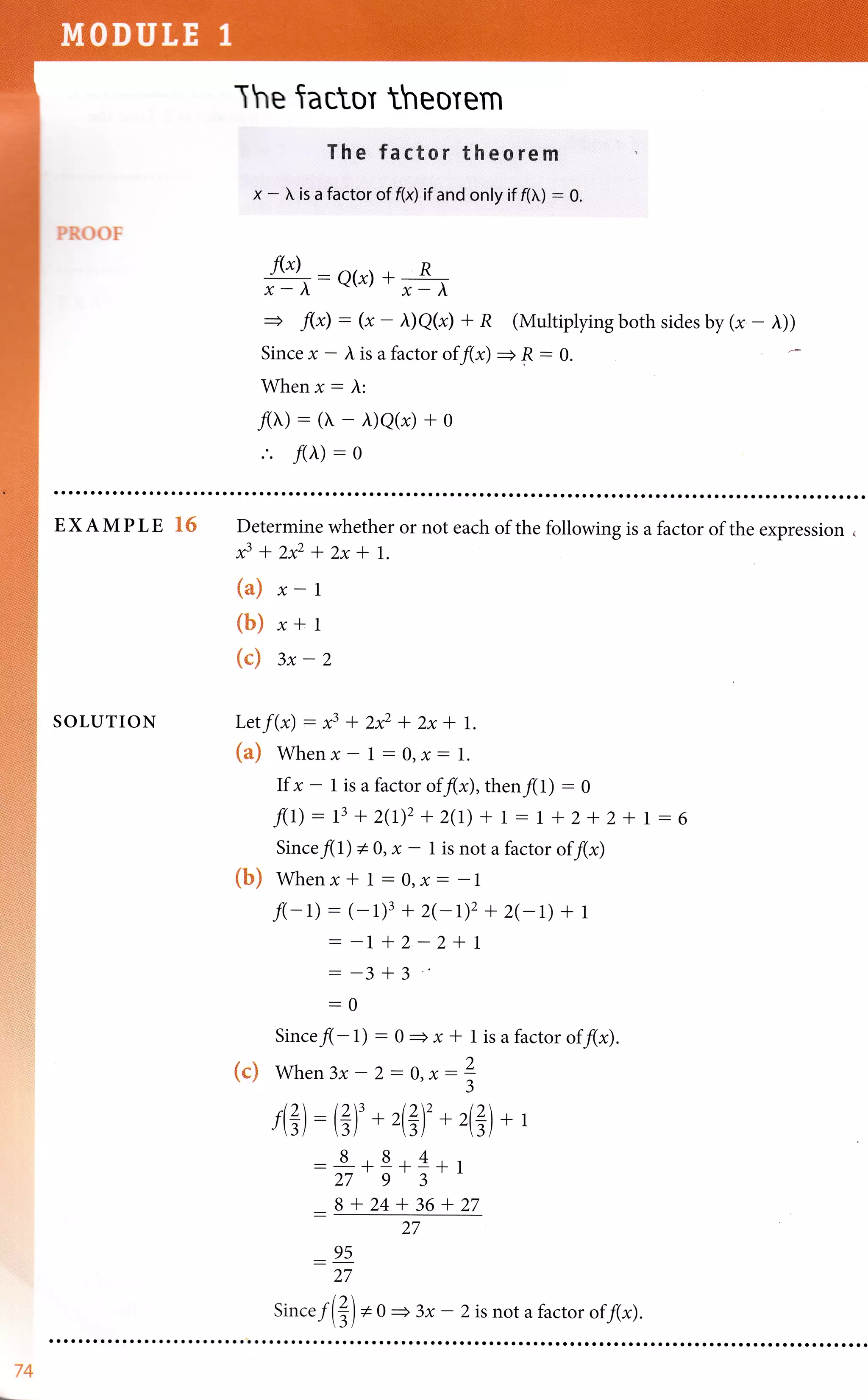
PROOF
The tactor theorem
Th'e f'ac,tor theorern ,
x -  is a factor of f(8 if and only if f(}.,) - 0.
f(x) ,  . R
g:Q(x)*p
=+ f(x) - (x - I)Q(x) + R (Multiplying both sides by (* - i))
Since x - ), is a factor of f(x) =+ F : 0.
When x: l:
.'. f(i) - o
EXAMPLE 1S
SOLUTION
Determine whether or not each of the following is a factor of the expression ,
f+z**2x*t.
(a) x-1
(b) r+t
(c) 3x-2
Letf(x)- x3+2**zx* 1.
{m} Whenx- 1:0,x- 1.
If x - 1 is a factor of f(x), then f(L) - 0
f(L):t3+Z(L),+z(L) +1-I +Z+z+ 1-6
Sincefll) * 0, x - 1 is not a factor of f(x)
{b} Whenx* 1:o,x- -l
f(-L) - (- 1)3 + 2(-r)2 + 2eD + 1
: -1 + 2 - 2 + 1
- -3 +3
-0
Sincefl - 1) - 0
= x * 1 is a factor of f(x).
{e} When3x-2-0,x:
f(?) : (?f *,(tr)' *
884
-vI-IrII
2793
B+24+36+27
?
3
4?
__ 95
27
Since f(?) *o
)+l
27
+ 3x - 2 is not a factor of f(x).
74
I. A}tPLE E7
-UTION
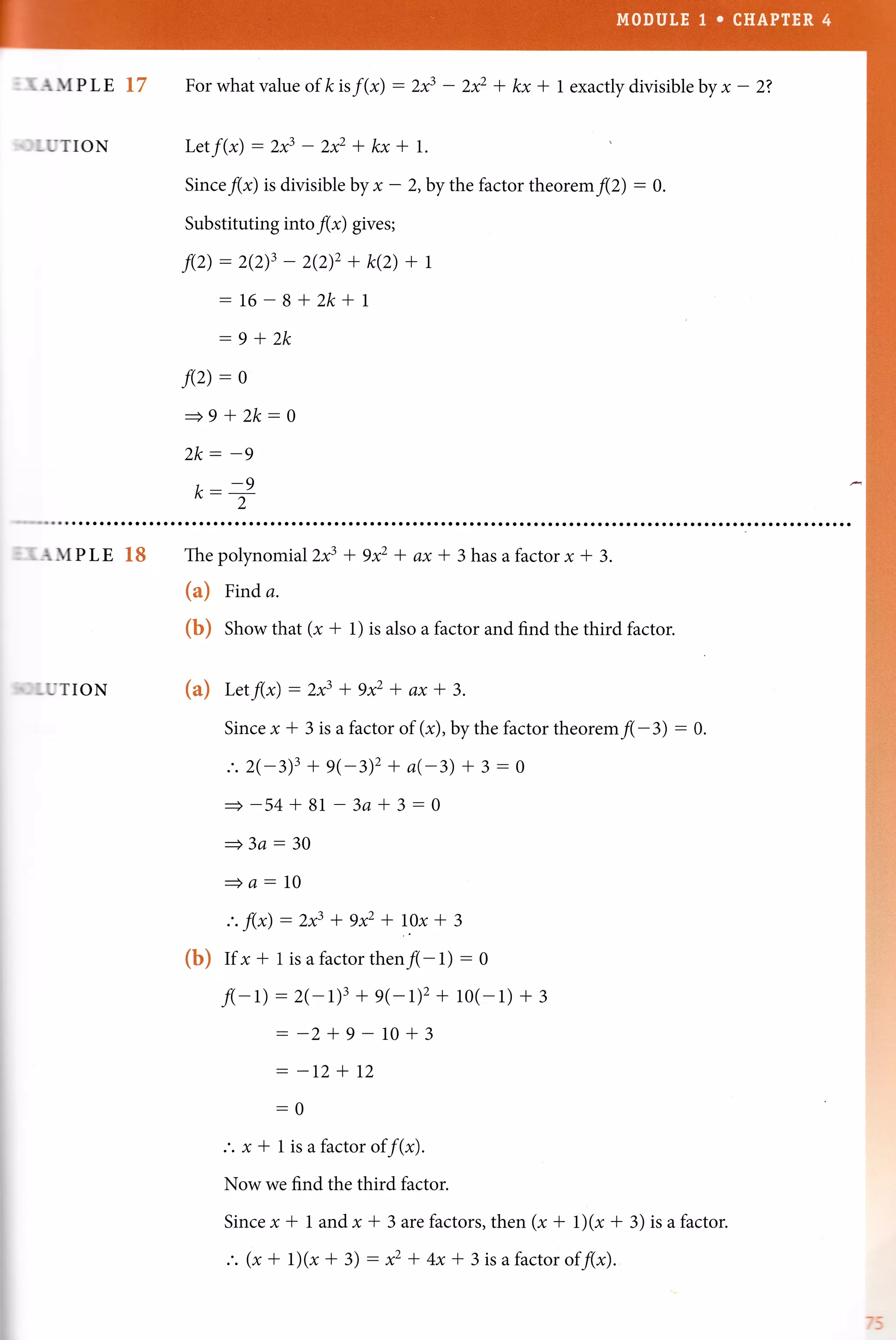
Forwhatvalueofkis/(r) :2f - 2* + kx * l exactlydivisiblebyx- 2?
Letf(x) :2f - 2* + kx + l.
Sinceflr) is divisible by * - 2, by the factor theoremflZ) : g.
Substituting intoflr) gives;
f(z) :2(2)3 - 2(2)2 + k(2) + t
:16-8+2k+1
:9*2k
f(z): o
+9+2k:0
2k: -9
,---9n- 2
_ {}[PLE affi
-UTION
The polynomial 2x3 l gxz * ax * 3 has a factor x + 3.
{a} Frnd a.
{h} Show that (x + 1) is also a factor and find the third factor.
{m} Letf(x) - 2x3 * 9x2 * ax + 3.
Since x + 3 is a factor of (x),bythe factor theore^f(-3) : 0.
.'. 2(-3)3 + g(-3)2 + a(-3) + 3 - 0
+-54+81 3a*3-0
=3a - 30
+a-10
:. f(x) - 2x3 * 9xz * l.ox + 3
{h} If x t 1 is a factor then f(- L) - 0
f(-L) - 2(- 1)3 + e(-r)z + 1o(- 1) + 3
- -2+9 10+3
- -12+L2
-0
.'. x + 1 is a factor of f(x).
Now we find the third factor.
Since x + 1 and x + 3 arefactors, then (x + 1)(x + 3) is a factor.
.'. (x+ 1)(r+3) -)et4x* 3isafactoroff(x).
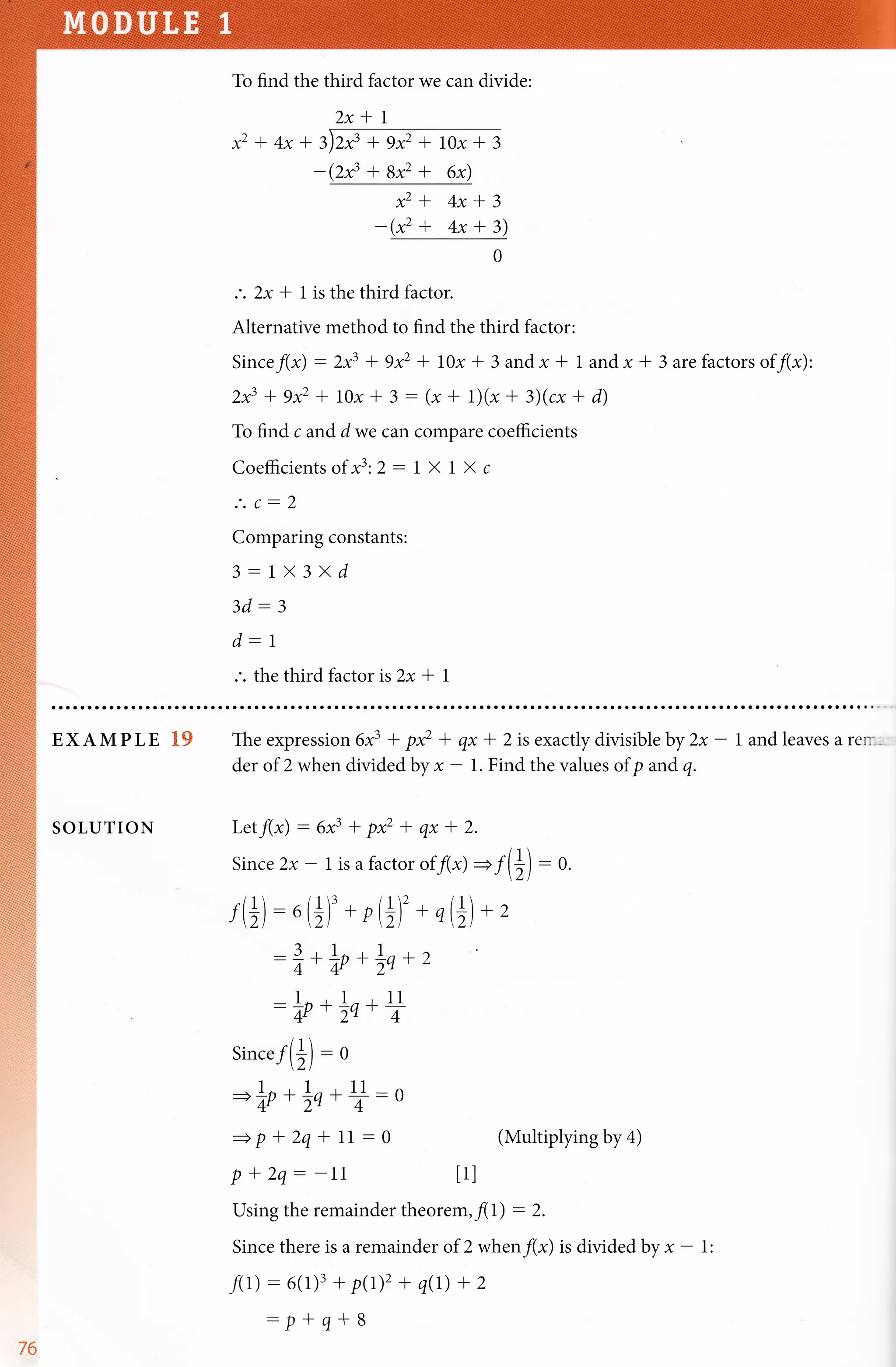
To find the third factor we can divide:
2x*1
x2 + 4x t z)zf * 9x2 * tox + 3
- (2x3 + Bx2 + 6x)
x2+ 4x*3
-(*' + 4x + 3)
.'. 2x *1 is the third factor.
o
Alternative method to find the third factor:
Since f(*) - 2x3 + 9xz + 10x + 3 and x * 1 and x * 3 arcfactors of f(x):
2x3 + 9x2 + 10x * 3 - (x + 1)(x + 3)(cx + d)
To find c and d we can compare coefficients
Coefficients of x3:2 - 1 X 1 X c
.'. c-2
Comparing constants:
3-1X 3 X d
3d:3
d-1
.'. the third factor ts 2x * 1
EXAMPLE XS
SOLUTION
The expression 6x3 + px2 * qx
der of 2 when divided by x - 1.
+ 2 is exactly divisible by 2x - 1 and leaves a ren--
Find the values of p and q.
Letf(x) - 6x3 * pxz *
Since2x-lisafactor
f(+) - ,(+)'* o(+)'
-1+L{+la+
-LnP**q++
Since f(+) - o
=L{**q+)-o
=pr2qr11 -0
P + 2q: -11
Using the remainder theorem,fll) - 2.
Since there is a remainder of 2 when f(*) is divided by * - 1:
f(r) - 6(1)3 + p(1)2 + q(r) + 2
- p + q+ B
qxl2.
of f(x)=f(+)
+ ,(+) + 2
2
:0.
(Multiplying by 4)
tll
v6
Since/(l) - 2
+p*q*B:2
P + q: 6
Solving simultaneously, and subtracting l2l from [1] gives:
p+2q-p-q--11 (-6)
=q--5
Substituting q: -5 into l2l gives:
p--6+s
p - -1
Hence,p: -l andq: -5.
121
'^! thesm 4.$ (a) Oetermine whether or not each of the following is a factor of the expression
zf-*-3x*t.
(i) x- |
(ii) 2x + I
(iii) 3x - 1
(b) fne expression +f + p* - qx - 6 is exactly divisible by 4x * 1 and leaves a
remainder of -20 when divided byx - 1. Find the values of p and q.
Factorising poLynomials and solving equations
A combination of the factor theorem and long division can be used to factorise
polynomials. Descartes' rule of signs can assist in determining whether a polyno-
mial has positive or negative roots and can give an idea of how many of each typ.
of roots.
(a) fo find the number of positive roots in a polynomial, we count the number
of times the consecutive terms of the function changes sign and then sub-
tract multiples of 2. For example,if f(x) : 4x3 - 3x2 + 2x * 1, then/(x)
changes sign two times consecfiively. f(x) has either 2 positive roots or 0
positive roots.
(b) to identiff the number of negative roots, count the number of sign changes in
fl-*).The number of sign changes or an even number fewer than this repre-
sents the number of negative roots of the function.
Ifflx) : +f - l* * 2x * l,thenfl-x) : 4(-x)3 - 3(-2s12 + 2(-x) + r
=f(*x): -4f - z* * 2x * t
Since there is 1 sign change, there is 1 negative root to the equation.

Remainder and factor theorem

  • 1.
    5 2x3+Z*-7x- 30:(x-2)(a** bx* c) 6 f -z*-t 4x*2:(x- r)(xz-2x* a)+ b 7 4f +3e* 5x*2: (x+2)(a*-t bx* c) g zf + A* _ 8x_ zo:(*_ a)(Bx + c) 9 ax3+ b** cx* d: (x+Z)(x + 3)(r+ a) l0 ax3 + b* * cx-r d: (4x + t)(Zx - t)(3x + 2) 11 Given thatflx) : 4f - Z* + Zx * 1, find the quotient and remainder when f(x) is divided by x - 2. 13 13 Given that 5x3 - 6,* +_2x + L x-2 = A* * Bx * c + #,find A,Band c. Findthe quotient andremainderwhen xs - 2# - x3 + * + x * 1 is dividedby *+t. Ed Express each of the following in the form # (a)h+* (b)#_ffi 1 +2 , x+2+- '2x* 1 Remainder theorem TXAMPLE }$ iOLUTION Find the remainder when 3x3 - Zxz * 4x * 1 is divided by x * 1. Using long division gives: 3x2-5x*9 x*t)zf-2x2*4x*1 -O* + tA -5x2 * 4x (- sxz - 5x) 9x*1 - (e. + e)_ -B 3xz which is the first term in the quotient. -5x is the second term of the quotient. 9 3x3 x- ') - 5x' x 9x- x- When 3x3 - 2xz * 4x * 1 is divided by x * the remainder is - B. We can rewrite this as: 3x3 - 2x2 +_4x + 1 : 3x2 _ 5x + g x*1 We can also multiply both sides by (x + 1) and write it as: 3x3 - 2* * 4x t r=(3xz - 5x t 9)(x+ 1) B 1 the quotient is 3xz - 5x * 9 and B xll
  • 2.
    The remainder theorem Whena polynomial f(x) is divided by a linear expression (x - I), the remainder is (). PROOF When f(*) is divided by * - . f(*) /1/ ^- , R "';q: Q(x) +t- +f(x) - (x - ) Q(x) + R , we get a quotient Q(x) and a remainder R. ,()-(-)Q(}')+R+R The remainder is/(}'). (Multiplying both sides by (* - )) Substituting x - gives: -.,() Let us use the remainder theorem on Example 11, where we wanted to find the remainder when/(x) : 3x3 - Z* + +x * 1 is divided byx + 1. Sincewe are dividingby x * I, y : -1 whenx * 1 : 0. By the remainder theorem, the remainder isl- 1). Substituting x: - 1 into/(x) gives: f(-r): 3(- r)3 - 2(- t12 + +1-t; + t - -3-2*4+t - _oo This is the same answer as when we used long dMsion. EXAMPLE 13 SOLUTION Find the remainder when/(x) : 4x3 - x2 + x - 2 is divided by (a) x-r (b) x+z (c) zx+t (a) When x - | :0, .tr : 1. By the remainder theorem, when/(x) is divided by x - 1, the remainder is/(t). :.f(1): 4(t)3- (1)2+ (1) -4-I+t-2 -1 (b) When x I 2 : 0, x : -2.8y the remainder theorem, when/(x) is divided by x -f 2 the remainder isf(-2). f(-2) : 4(-2)3 - (-2)'+ (-2) - 2 :-32-4-2-2 : -40 (c) When 2x -l | : 0, x : -+. By the remainder theorem, when/(r) is divided br 2.t -.,- l, the remaind.r rr/(+) l' ll ll ti ii i; il ii fr d, 7A
  • 3.
    f(-+): ^(+)'- (+)'*(+)-z -1 - 1- I _ ') 2 - 4- 1- z -, 1 -14 .XAMPLE 13 :OLUTION The remainderwhenflx) : 4f + a* + 2x* 1 is dividedby 3x- 1 is 4. Findthe val:ue of a. When3x-1:0,x- Since f(*) : 4x3 * axz f(+): n(+)' * ,(+)'* :+*io*?* -|o+fi Sincef(+)-+ i,*ffi - + |o:+-fi 1- 59 9"- 27 a- #*, o:! *. u, the remainder theore m f(+) : 4. * 2x * 1, substitutin g x - ] Sir.rt 4+) +1 1 : IAMPLE 34 :'JLUTION The expression 6f - +* + ax * bleaves a remainder of 5 when divided by x - | and a remainder of 1 when divided by x * 1. Find the values of a and b. Letf(x) : 6x3 - 4x2 * ax * b. When dividing by x - 1 the remainder is 5. Now/(l) I :,:,n_* -2*a* .'.2+a*b-5 a*b:3 When dividing by x I 1 the remainder is 1. =f(-1) - 1 f(-L):1,;,1 ;:,;L)z + a(-t) + b .'.-10-a*b-1 -a * b - 11 l2l 4(t)2+ a(t) + b a*b b tll T1
  • 4.
    Solving the equationssimultaneously gives: 2b:L4 tll + l2l Substituting b - 7 rnto [1] gives: a*7-3,a:-4 Hence, a: -4 and b - 7. EXAMPLE 15 SOLUTION Theexpression4x3 - * + ax -lZleavesaremainderof bwhendividedbyx * l ani when the same expression is divided by * - 2 the remain der is 2b. Find the values o: a andb. Letf(x): 4x3 - * * ax -t 2. v4ren x: -L,fl* 1) : 4(-1)3 - (- t)2 + a(-t) + z --4-l-a-12 --u-J By the remainder theorem,fl -l) : b. =-a-3:b a*b:-3 tll ,Vhen x: 2,f(2) : 4(2)3 - (2)2 + ae) + 2 :32 * 4'f 2a -12 :2a -l 30 By the remainder theorem,f(2) : 2b. .'.2a * 30: 2b :.a*15:b -a-lb:I5 12) a-tb-atb:-3+15 [1]+[2] +2b: 12 b:6 Substituting into [1] gives: a*6:-3 A: -9 Hence, a: -9 andb : 6. v2 Try these 4.2 (a) Find the remainder when 6f - 3x2 + x - 2 is divided by the following. (i) x-z (ii) r+ 1 (iii) 2x - L (b) whentheexpression#+ axz - 2x * l isdivided,byx- l theremainderis-l Find the value of a.
  • 5.
    (c) Whentheexpressionf -4* + ax * bisdividedby2x - l theremainderisl. when the same expression is divided by (, - 1) the remainder is 2. Find the values of a andb. r+land values of ing. ?k ,b s ffiKffiffiflXSffi &ffi 1# By using the remainder theorem, find the remainder when: (a) a# + l* - 2x* l isdividedbyx - | (b) 3t' + e* - 7x * 2 is divided byx * 1 (c) t' + A* -x * 1 isdividedby2x -t I (d) (ax + 2)QP -t x * 2) + 7 is dividedby x - 2 (e) { * 6xz * 2 is divided by x -t 2 (f) +f - z* * 5 is dividedby2x + 3 @) 3# - 4* + * + tisdividedby * - 3 When the expression * - ax * 2is divided by * - 2, the remainder is a.Find a. The expressi on 5* - 4x * b leaves a remainder of 2 when divided by 2x * l. Find the value of b. Theexpression3.C * a* + bxl- lleavesaremainderof 2whendividedbyx - 1 and a remainder of 13 when divided by * - 2. Find the values of a and of b. The expression x3 + p* + qx * 2 leaves a remainder -3 when divided by x * 1 and a remainder of 54 when divided by * - 2. Find the numerical value of the remainder when the expression is divided by 2x * l. Given thatf(x) : 2x3 - 3x2 - 4x * t has the same remainder when divided by x * a andby * - a, frnd the possible values of a. Giventhattheremainderwhenfx) :2f - * - zx - l isdMdedbyx - 2'is twicetheremainderwhendividedby x- 2a,showthat 32a3 - 8az - 8a - 9:0. The remainder when zx3 - 5* - 4x -l b is divided byx * 2 is twice the remainder when it is divided by, - 1. Find the value of b. The sum ofthe remainder when x3 + ( + 5)x + L is divided by *' 1 and by x -l 2is 0. Find the value of I'. The remainder when 3x3 + kxz * 15 is divided by * - 3 is one-third the remainder when the same expression is divided by 3x - 1. Find the value of k. when the expression 3x3 + p* + qx -f 2is divided by x2 + 2x * 3,the remain- der is x * 5. Find the values of p and q. The expression 8x3 + p* + qx * 2leaves a remainder of 3| when divided by 2x - land a remainder of -1 when divided by x * 1. Find the values ofp and the value of 4. When the expression6xs I 4x3 - ax * 2 is dMded byx * 1, the remainder is 15. Find the numerical value of a.Hence, find the remainder when the expression is dMded by x - 2. E2 1& ainder is 4. E3
  • 6.
    PROOF The tactor theorem Th'ef'ac,tor theorern , x - is a factor of f(8 if and only if f(}.,) - 0. f(x) , . R g:Q(x)*p =+ f(x) - (x - I)Q(x) + R (Multiplying both sides by (* - i)) Since x - ), is a factor of f(x) =+ F : 0. When x: l: .'. f(i) - o EXAMPLE 1S SOLUTION Determine whether or not each of the following is a factor of the expression , f+z**2x*t. (a) x-1 (b) r+t (c) 3x-2 Letf(x)- x3+2**zx* 1. {m} Whenx- 1:0,x- 1. If x - 1 is a factor of f(x), then f(L) - 0 f(L):t3+Z(L),+z(L) +1-I +Z+z+ 1-6 Sincefll) * 0, x - 1 is not a factor of f(x) {b} Whenx* 1:o,x- -l f(-L) - (- 1)3 + 2(-r)2 + 2eD + 1 : -1 + 2 - 2 + 1 - -3 +3 -0 Sincefl - 1) - 0 = x * 1 is a factor of f(x). {e} When3x-2-0,x: f(?) : (?f *,(tr)' * 884 -vI-IrII 2793 B+24+36+27 ? 3 4? __ 95 27 Since f(?) *o )+l 27 + 3x - 2 is not a factor of f(x). 74
  • 7.
    I. A}tPLE E7 -UTION Forwhatvalueofkis/(r):2f - 2* + kx * l exactlydivisiblebyx- 2? Letf(x) :2f - 2* + kx + l. Sinceflr) is divisible by * - 2, by the factor theoremflZ) : g. Substituting intoflr) gives; f(z) :2(2)3 - 2(2)2 + k(2) + t :16-8+2k+1 :9*2k f(z): o +9+2k:0 2k: -9 ,---9n- 2 _ {}[PLE affi -UTION The polynomial 2x3 l gxz * ax * 3 has a factor x + 3. {a} Frnd a. {h} Show that (x + 1) is also a factor and find the third factor. {m} Letf(x) - 2x3 * 9x2 * ax + 3. Since x + 3 is a factor of (x),bythe factor theore^f(-3) : 0. .'. 2(-3)3 + g(-3)2 + a(-3) + 3 - 0 +-54+81 3a*3-0 =3a - 30 +a-10 :. f(x) - 2x3 * 9xz * l.ox + 3 {h} If x t 1 is a factor then f(- L) - 0 f(-L) - 2(- 1)3 + e(-r)z + 1o(- 1) + 3 - -2+9 10+3 - -12+L2 -0 .'. x + 1 is a factor of f(x). Now we find the third factor. Since x + 1 and x + 3 arefactors, then (x + 1)(x + 3) is a factor. .'. (x+ 1)(r+3) -)et4x* 3isafactoroff(x).
  • 8.
    To find thethird factor we can divide: 2x*1 x2 + 4x t z)zf * 9x2 * tox + 3 - (2x3 + Bx2 + 6x) x2+ 4x*3 -(*' + 4x + 3) .'. 2x *1 is the third factor. o Alternative method to find the third factor: Since f(*) - 2x3 + 9xz + 10x + 3 and x * 1 and x * 3 arcfactors of f(x): 2x3 + 9x2 + 10x * 3 - (x + 1)(x + 3)(cx + d) To find c and d we can compare coefficients Coefficients of x3:2 - 1 X 1 X c .'. c-2 Comparing constants: 3-1X 3 X d 3d:3 d-1 .'. the third factor ts 2x * 1 EXAMPLE XS SOLUTION The expression 6x3 + px2 * qx der of 2 when divided by x - 1. + 2 is exactly divisible by 2x - 1 and leaves a ren-- Find the values of p and q. Letf(x) - 6x3 * pxz * Since2x-lisafactor f(+) - ,(+)'* o(+)' -1+L{+la+ -LnP**q++ Since f(+) - o =L{**q+)-o =pr2qr11 -0 P + 2q: -11 Using the remainder theorem,fll) - 2. Since there is a remainder of 2 when f(*) is divided by * - 1: f(r) - 6(1)3 + p(1)2 + q(r) + 2 - p + q+ B qxl2. of f(x)=f(+) + ,(+) + 2 2 :0. (Multiplying by 4) tll v6
  • 9.
    Since/(l) - 2 +p*q*B:2 P+ q: 6 Solving simultaneously, and subtracting l2l from [1] gives: p+2q-p-q--11 (-6) =q--5 Substituting q: -5 into l2l gives: p--6+s p - -1 Hence,p: -l andq: -5. 121 '^! thesm 4.$ (a) Oetermine whether or not each of the following is a factor of the expression zf-*-3x*t. (i) x- | (ii) 2x + I (iii) 3x - 1 (b) fne expression +f + p* - qx - 6 is exactly divisible by 4x * 1 and leaves a remainder of -20 when divided byx - 1. Find the values of p and q. Factorising poLynomials and solving equations A combination of the factor theorem and long division can be used to factorise polynomials. Descartes' rule of signs can assist in determining whether a polyno- mial has positive or negative roots and can give an idea of how many of each typ. of roots. (a) fo find the number of positive roots in a polynomial, we count the number of times the consecutive terms of the function changes sign and then sub- tract multiples of 2. For example,if f(x) : 4x3 - 3x2 + 2x * 1, then/(x) changes sign two times consecfiively. f(x) has either 2 positive roots or 0 positive roots. (b) to identiff the number of negative roots, count the number of sign changes in fl-*).The number of sign changes or an even number fewer than this repre- sents the number of negative roots of the function. Ifflx) : +f - l* * 2x * l,thenfl-x) : 4(-x)3 - 3(-2s12 + 2(-x) + r =f(*x): -4f - z* * 2x * t Since there is 1 sign change, there is 1 negative root to the equation.