What is the solar system?
The solar system is the sun and all of the bodies that orbit the
sun. Our current model of the solar system is the sun-centered or
heliocentric (hee.leeooh.SEN.trik) model. In the heliocentric model,
Earth and the other planets orbit the sun. The earliest models for
the solar system assumed that the Earth was at the center of the
solar system, with the sun, moon, and planets circling it. These
models, which used Earth as the center, are called Earth-centered
or geocentric (je..oh.SEN.trik) models. The heliocentric model
was not generally accepted until the work of Copernicus and
Kepler in the late 16th to early 17th centuries.
Who proposed some earty models of
the solar system?
Until Galileo improved on the telescope in 1609, people observed
the heavens with the naked eye. To observers, it appeared that
the sun, the moon, the planets, and the stars moved around
Earth each duy. This caused them to conclude that Earth was not
moving. If Earth was not moving, then Earth must be the center
of the solar system and all other bodies revolved around it.
This geocentric model of the solar system became part of
ancient Greek thought beginning in the 6th century BCE. Aristotle
was among'the first thinkers to propose this model.
5 ldentify As you read the text,
underline the definitions of
geocentric and hetiocentric.
Research Use different sources
to research a geocentric modet ,
of thq solar syst.em from either
ancient Greece, dflcient China, or
Babyton. Write a short description
of the modet you choose.
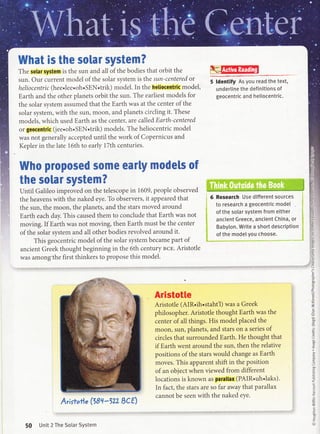
Aristotle
Aristotle (AlR.ih.staht'1) was a Greek
philosopher. Aristotle thought Earth was the
center of uU things. His model placed the
moon, sun, planets, and stars on a series of
circles that surrounded Earth. He thought that
if Earth went around the sun, then the relative
positions of the stars would change as Earth
moves. This apparent shift in the position
of an object when viewed from different
locations is known as parattax (PAlR.uh.laks).
In fact, the stars are so far away that parallax
cannot be seen with the naked eye.
:iO
(J
rn
L
o)
!
o-
ro
L
bJ)
oP
o
o-
o)
C
C
=t-,
=E
rO
o
E
b,)
-o
u',
=E
G.,
(J
C)
b,)
(o
E
a
L
ro
a
E
o(J
bl)
.c
VI
-oJ
L
P
L
J
o(J
L
(o
-L
i=
=t-
o#
bJ)
=o
-o
Arirtofle $Aq*aL BCE)
50 Unit 2The Sotar System
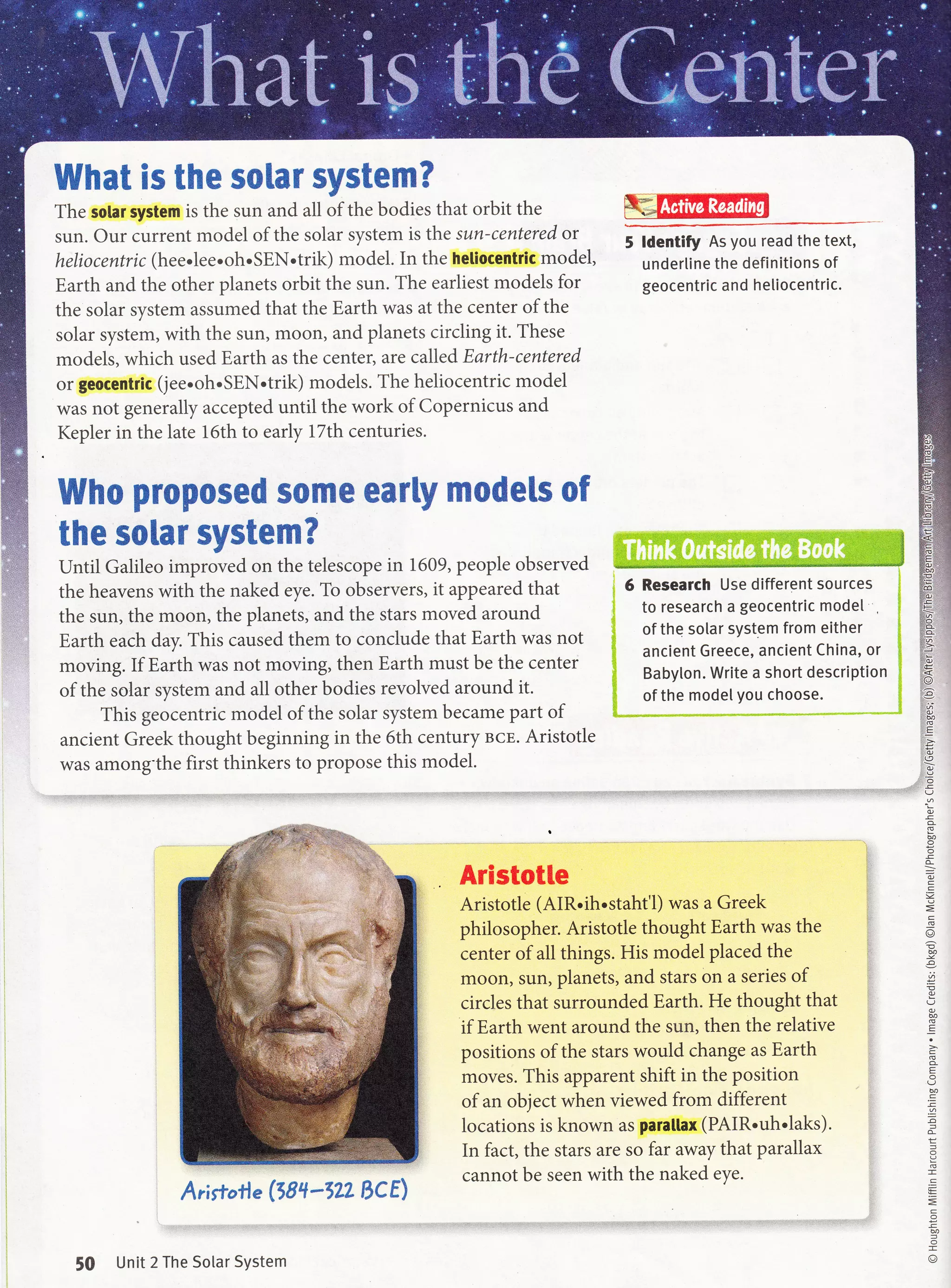
&rfistarchus
Aristarchus (air.i.STAHR.kuhs) was a Greek
astronomer and mathematician. Aristarchus
is reported to have proposed a heliocentric
model of the solar system. His model,
however, was not widely accepted at the time.
Aristarchus attempted to measure the relative
distances to the moon and sun. This was a
major contribution to scieltce. Aristarchus's
ratio of distances was much too small but
was important in the use of observation and
geom etry to solve a scientific problem.
Arirfa rehus (abouf IX}*ZSABCE)
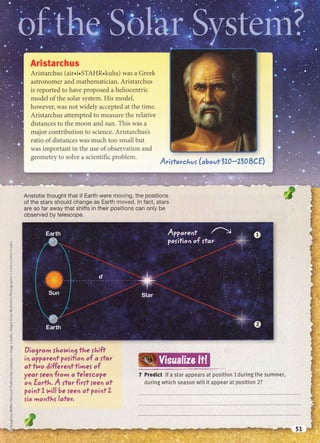
Aristotle,thought that:if, Edrth.6r- -
,moving, the positions
of the stars should change as Earth moved. ln fact, stars
are so far away that shiftb in their positions can only be
observed by telescope.
U.:
q)
bD.
ro
E
>P:.
CU
(9
'.'(u
U
-c(-) l
t,L
q)r
-C
o-'
g
b.lJ r,
O r:,
o
al .:
)i.'(I)
C:t
2.(J
E
C
S:
o
EI
bJ)
-O,v,
a
=13'
G)
u1.
q)
b/)
ro
Ela
;>
c.
,(E
o-
E
o(J
br).C
Ev1
:.o t'
i=
o-.
P
L
3:r
o:(J
L
:(6
E
C
:ta-
E'
iO.,
.C,
,'bfJ
r=
O
.-r
?r"
gra m to*i ?.g.
the
*i{trfi app arent y,a,siiion o{ a rtar
dffuo t: erenf times oT
year teen Srom a teletco?e
'on Earth. A starfirrt Eein at
pcirrf 1 t^,ill be reen af yoinf I
rix months later.
7 Predict lf a star appears at position l during the summer,
during which season witt it appear at position 2?
Pfo$emy {*bsaef 3S#*g?# #S}
P&w&mmy
Ptolemy (TOHL.uh.mee) was an astronomer,
geographer, and mathematician who lived in
Alexandria, Egypt, which was part of ancient
Rome. His book, the Almage.sf, is one of the
few books that we have from t"hese early times.
It was based on observations of the ptranets
going back as much as 800 years. Ptolemy
developed a detailed geocentric model that
was used by astronomers for the next 14
centuries. He believed that a celestial body
traveled at a constant speed in a perfect circle.
In Ptolemy's model, the planets moved on
small circles that in turn moved on larger
circles. This "wheels-on-wheels" system fit
observations better than any model that had
come before. It allowed prediction of the
motion of planets years into the future.
..i.',i.{J j
: lil ; OJ:
,i,1.:r(9,
..,,.S,
l.,ir*:l:'X
Pfoletndic fltod,el
-i!'.1iGCU,
_o
=ts
<
c
ro
E
c)
,w)
=L
'm
c)
F
P
C
a)
(,
c
ro
v1
o
o
o
-i3
a
q')
b')
ro
E
CJ
(,
CJ
(J
-C
(J
Ct
i-
q.J
_c
o_
ro
L
bD
+
.C
o_
C
C
=U
=C
=(ul
E
-:z
U
.:c
a
(-
c-
h^
Cc
E
a
C
C
E
(_
-c
=€
d
=-(-
(:
=c
ii:,?*+ I
lnti.j-rii.-
ar::
=
I D€sc-qibe Use the diagram at the
right to describe Ptolemy's geocentric
modet of the solar system.
ffi:
ffid6
ffi.*nn
,r
rrl, u
ffi*it ' ,;' ji*i
+,r',,iil
1i1,..,t,.i
iffiiliai,#
t,. .:x,':
'l: i'r
rlt,':Ltii,i "ul
t,-i!, tir:r:'g.t
1;1,:
'
..t -,]-,i
t..,.:.,,,-.i
,,1.t i .iti
, ., .i;j
i..i;i
'
rill'i
i:i.,ti,
jiii
; -,::
','.i,:: ,
.ri.,,,l-iil
'i1-'tl
'. ,:i,li:
.. ri.:li:
,r;{{
I Defend As a ctass activity, defend i
Ptotemy's geocentric mode[ of i
the solar system. Remember that :
during Ptolemy's time peopte i
were timited to what they could i
see with the naked eye. r
inii ii,,rrA mta* slrstegl' *'*'",-: i'',' " ili
,.i_.
. tit,-
,r.tit 1., ,,,,, ' '''ilt" i;;;l .',;,
...ri1,1.r,, li,;t
,''-',., ,,,,:t"',''t
'..'.
, .'.', ,,.' i
i.rai.i,.i
,,.. ,- -, ,,
C
-c
:
G
ffiwpffiffiffBffimwm
The Polish astronomer Nicolaus Copernicus
(nik.uh.LAY.uhs koh. PER.nuh.kuhs) felt
that Ptolemy's model of the solar system
was too complicated. He was aware of the
heliocentric idea of Aristarchus when he
developed the first detailed heliocentric model
of the solar system. In Copernicus's time,
data was still based on observations with the
naked eye. Because data had changed little
since the time of Ptolemy, Copernicus adopted
Ptolemy's idea that planetary paths should
be perfect circles. Like Ptolemy, he used a
"wheels-on-wheels" system. Copernicus's
model fit observations a little better than the
geocentric model of Ptolemy. The heliocentric
model of Copernicus is generally seen as
the first step in the development of modern
models of the solar system.
::!:ri::tr,::::ii::1:: :1t:::l::l
xryp
i:i:t:!li:
I
E
i
n
L
:::;i:j,i::::
3 $3$ffi*s$mps Csferfticses
::i::::::iil:ri!:il:i:i:i!
(,J
d8
xitii:
l&ffiff'
,#
10 Compare How does Copernicus's model
of the sotar system differ from Ptolemy's
modet of the solar system?
Copernican lYla del
Ptolemaic
madel
Copernican
model
II ldentify Underline text that summarizes Kepler's
three [aws.
t{ep[er
|ohannes Kepler (yoh.HAH.nuhs KEP.luhr) was
a German mathematician and astronomer. After
carefully an alyztng observations of the planets, he
reahrzed that requirirg planetary motions to be
exactly circular did not fit the observations perfectly.
Kepler then tried other types of paths and found
that ellipses fit best.
Kepler formulated three principles, which
today areknown as Kepler's laws. The first law states
that planetary orbits are ellipses with the sun at one
focus. The second law states that planets move faster
in their orbits when closer to the sult. The third law
relates the distance of a planet from the sun to the
time it takes to go once around its orbit.
12 Analyze How did Kepler's first law support the
idea of a hetiocentric sotar system?
perihelion
Gatfiteo
Galileo Galilei (gahl.uh.LAY.oh gahl.uh.LAY) was
a scientist who approached questions in the fashion
that today we call scientific methods. Galileo made
significant improvements to the newly invented
telescope. He then used his more powerful telescope
to view celestial objects. Galileo observed the moons
Io, Europa, Callisto, and Ganymede orbiting lupiter.
Today, these moons are known as the Galilean
satellites. His observations showed that Earth was ,.
not the only object that could be orbited. This gave
support to the heliocentric model. He also observed
that Venus went through phases similar to the
phases of Earths moon. These phases result from
changes in the direction that sunlight strikes Venus
as Venus orbits the sull.
*.""*, i...::
i:,ii :.fi1fl5::i:
fir$ligfii15lf.t$ $tfiiffil:.Irlr
Johanner Keple r (tnl*Yr5}
Kepler's First Law
For clarity, the
ellipse has been
exaggerated.
i:1:t.fi!:/.7,::lr-ii
:l::i:ii:.i+r!a:i
,;.t.l:;i.i '6.:'-.1'
lirl.l::j:ir,vii::t
itiiiitii,id;rir,
,lri;idiitl)ri:::
r::...':.,{-',
_.:_'_.2,
:.lirlii@:',',
, ]P
::::, i:r, :::: Ui :'
.:::::: 'l :ilO)'
: ',,:tlt)
,(U
>.P
q)
(,
q)
(J
'o
!
(J
tJ1
i'-
(u
-g
o
rO
br)
oP
o
-g
L
o)
C
c
=U
=E
(o
o
E
b/)
-o
tJ1
=E
(l)
(J
o)
br)
Cg
E
a
c
(g
o
E
o(J
b/l
.=
.C
V
_o
=o_
L
=o(J
L
(o
-C
q
=C
o
-c
b/)
=o
-o
Sun lies at Nothing Iies at
one focus the other focus
. /-_,
.,. t ---a. ;''-'jl.iiil.j

-
semimajor axis
tlsaq*t;ttt}fialileo fialilei

Solar System Models

  • 1.
    What is thesolar system? The solar system is the sun and all of the bodies that orbit the sun. Our current model of the solar system is the sun-centered or heliocentric (hee.leeooh.SEN.trik) model. In the heliocentric model, Earth and the other planets orbit the sun. The earliest models for the solar system assumed that the Earth was at the center of the solar system, with the sun, moon, and planets circling it. These models, which used Earth as the center, are called Earth-centered or geocentric (je..oh.SEN.trik) models. The heliocentric model was not generally accepted until the work of Copernicus and Kepler in the late 16th to early 17th centuries. Who proposed some earty models of the solar system? Until Galileo improved on the telescope in 1609, people observed the heavens with the naked eye. To observers, it appeared that the sun, the moon, the planets, and the stars moved around Earth each duy. This caused them to conclude that Earth was not moving. If Earth was not moving, then Earth must be the center of the solar system and all other bodies revolved around it. This geocentric model of the solar system became part of ancient Greek thought beginning in the 6th century BCE. Aristotle was among'the first thinkers to propose this model. 5 ldentify As you read the text, underline the definitions of geocentric and hetiocentric. Research Use different sources to research a geocentric modet , of thq solar syst.em from either ancient Greece, dflcient China, or Babyton. Write a short description of the modet you choose. Aristotle Aristotle (AlR.ih.staht'1) was a Greek philosopher. Aristotle thought Earth was the center of uU things. His model placed the moon, sun, planets, and stars on a series of circles that surrounded Earth. He thought that if Earth went around the sun, then the relative positions of the stars would change as Earth moves. This apparent shift in the position of an object when viewed from different locations is known as parattax (PAlR.uh.laks). In fact, the stars are so far away that parallax cannot be seen with the naked eye. :iO (J rn L o) ! o- ro L bJ) oP o o- o) C C =t-, =E rO o E b,) -o u', =E G., (J C) b,) (o E a L ro a E o(J bl) .c VI -oJ L P L J o(J L (o -L i= =t- o# bJ) =o -o Arirtofle $Aq*aL BCE) 50 Unit 2The Sotar System
  • 2.
    &rfistarchus Aristarchus (air.i.STAHR.kuhs) wasa Greek astronomer and mathematician. Aristarchus is reported to have proposed a heliocentric model of the solar system. His model, however, was not widely accepted at the time. Aristarchus attempted to measure the relative distances to the moon and sun. This was a major contribution to scieltce. Aristarchus's ratio of distances was much too small but was important in the use of observation and geom etry to solve a scientific problem. Arirfa rehus (abouf IX}*ZSABCE) Aristotle,thought that:if, Edrth.6r- - ,moving, the positions of the stars should change as Earth moved. ln fact, stars are so far away that shiftb in their positions can only be observed by telescope. U.: q) bD. ro E >P:. CU (9 '.'(u U -c(-) l t,L q)r -C o-' g b.lJ r, O r:, o al .: )i.'(I) C:t 2.(J E C S: o EI bJ) -O,v, a =13' G) u1. q) b/) ro Ela ;> c. ,(E o- E o(J br).C Ev1 :.o t' i= o-. P L 3:r o:(J L :(6 E C :ta- E' iO., .C, ,'bfJ r= O .-r ?r" gra m to*i ?.g. the *i{trfi app arent y,a,siiion o{ a rtar dffuo t: erenf times oT year teen Srom a teletco?e 'on Earth. A starfirrt Eein at pcirrf 1 t^,ill be reen af yoinf I rix months later. 7 Predict lf a star appears at position l during the summer, during which season witt it appear at position 2?
  • 3.
    Pfo$emy {*bsaef 3S#*g?##S} P&w&mmy Ptolemy (TOHL.uh.mee) was an astronomer, geographer, and mathematician who lived in Alexandria, Egypt, which was part of ancient Rome. His book, the Almage.sf, is one of the few books that we have from t"hese early times. It was based on observations of the ptranets going back as much as 800 years. Ptolemy developed a detailed geocentric model that was used by astronomers for the next 14 centuries. He believed that a celestial body traveled at a constant speed in a perfect circle. In Ptolemy's model, the planets moved on small circles that in turn moved on larger circles. This "wheels-on-wheels" system fit observations better than any model that had come before. It allowed prediction of the motion of planets years into the future. ..i.',i.{J j : lil ; OJ: ,i,1.:r(9, ..,,.S, l.,ir*:l:'X Pfoletndic fltod,el -i!'.1iGCU, _o =ts < c ro E c) ,w) =L 'm c) F P C a) (, c ro v1 o o o -i3 a q') b') ro E CJ (, CJ (J -C (J Ct i- q.J _c o_ ro L bD + .C o_ C C =U =C =(ul E -:z U .:c a (- c- h^ Cc E a C C E (_ -c =€ d =-(- (: =c ii:,?*+ I lnti.j-rii.- ar:: = I D€sc-qibe Use the diagram at the right to describe Ptolemy's geocentric modet of the solar system. ffi: ffid6 ffi.*nn ,r rrl, u ffi*it ' ,;' ji*i +,r',,iil 1i1,..,t,.i iffiiliai,# t,. .:x,': 'l: i'r rlt,':Ltii,i "ul t,-i!, tir:r:'g.t 1;1,: ' ..t -,]-,i t..,.:.,,,-.i ,,1.t i .iti , ., .i;j i..i;i ' rill'i i:i.,ti, jiii ; -,:: ','.i,:: , .ri.,,,l-iil 'i1-'tl '. ,:i,li: .. ri.:li: ,r;{{ I Defend As a ctass activity, defend i Ptotemy's geocentric mode[ of i the solar system. Remember that : during Ptolemy's time peopte i were timited to what they could i see with the naked eye. r inii ii,,rrA mta* slrstegl' *'*'",-: i'',' " ili ,.i_. . tit,- ,r.tit 1., ,,,,, ' '''ilt" i;;;l .',;, ...ri1,1.r,, li,;t ,''-',., ,,,,:t"',''t '..'. , .'.', ,,.' i i.rai.i,.i ,,.. ,- -, ,, C -c : G
  • 4.
    ffiwpffiffiffBffimwm The Polish astronomerNicolaus Copernicus (nik.uh.LAY.uhs koh. PER.nuh.kuhs) felt that Ptolemy's model of the solar system was too complicated. He was aware of the heliocentric idea of Aristarchus when he developed the first detailed heliocentric model of the solar system. In Copernicus's time, data was still based on observations with the naked eye. Because data had changed little since the time of Ptolemy, Copernicus adopted Ptolemy's idea that planetary paths should be perfect circles. Like Ptolemy, he used a "wheels-on-wheels" system. Copernicus's model fit observations a little better than the geocentric model of Ptolemy. The heliocentric model of Copernicus is generally seen as the first step in the development of modern models of the solar system. ::!:ri::tr,::::ii::1:: :1t:::l::l xryp i:i:t:!li: I E i n L :::;i:j,i:::: 3 $3$ffi*s$mps Csferfticses ::i::::::iil:ri!:il:i:i:i! (,J d8 xitii: l&ffiff' ,# 10 Compare How does Copernicus's model of the sotar system differ from Ptolemy's modet of the solar system? Copernican lYla del Ptolemaic madel Copernican model
  • 5.
    II ldentify Underlinetext that summarizes Kepler's three [aws. t{ep[er |ohannes Kepler (yoh.HAH.nuhs KEP.luhr) was a German mathematician and astronomer. After carefully an alyztng observations of the planets, he reahrzed that requirirg planetary motions to be exactly circular did not fit the observations perfectly. Kepler then tried other types of paths and found that ellipses fit best. Kepler formulated three principles, which today areknown as Kepler's laws. The first law states that planetary orbits are ellipses with the sun at one focus. The second law states that planets move faster in their orbits when closer to the sult. The third law relates the distance of a planet from the sun to the time it takes to go once around its orbit. 12 Analyze How did Kepler's first law support the idea of a hetiocentric sotar system? perihelion Gatfiteo Galileo Galilei (gahl.uh.LAY.oh gahl.uh.LAY) was a scientist who approached questions in the fashion that today we call scientific methods. Galileo made significant improvements to the newly invented telescope. He then used his more powerful telescope to view celestial objects. Galileo observed the moons Io, Europa, Callisto, and Ganymede orbiting lupiter. Today, these moons are known as the Galilean satellites. His observations showed that Earth was ,. not the only object that could be orbited. This gave support to the heliocentric model. He also observed that Venus went through phases similar to the phases of Earths moon. These phases result from changes in the direction that sunlight strikes Venus as Venus orbits the sull. *.""*, i...:: i:,ii :.fi1fl5::i: fir$ligfii15lf.t$ $tfiiffil:.Irlr Johanner Keple r (tnl*Yr5} Kepler's First Law For clarity, the ellipse has been exaggerated. i:1:t.fi!:/.7,::lr-ii :l::i:ii:.i+r!a:i ,;.t.l:;i.i '6.:'-.1' lirl.l::j:ir,vii::t itiiiitii,id;rir, ,lri;idiitl)ri::: r::...':.,{-', _.:_'_.2, :.lirlii@:',', , ]P ::::, i:r, :::: Ui :' .:::::: 'l :ilO)' : ',,:tlt) ,(U >.P q) (, q) (J 'o ! (J tJ1 i'- (u -g o rO br) oP o -g L o) C c =U =E (o o E b/) -o tJ1 =E (l) (J o) br) Cg E a c (g o E o(J b/l .= .C V _o =o_ L =o(J L (o -C q =C o -c b/) =o -o Sun lies at Nothing Iies at one focus the other focus . /-_, .,. t ---a. ;''-'jl.iiil.j - semimajor axis tlsaq*t;ttt}fialileo fialilei