zefry@sas.edu.my 1
BRIEF NOTES
ADDITIONAL MATHEMATICS
FORM 4
CHAPTER 1: FUNCTION
1. f : x  x + 3
x is the object, x + 3 is the image
f : x  x + 3 can be written as
f(x) = x + 3.
To find the image for 2 means
f(2) = 2 + 3 = 5
Image for 2 is 5.
Find the object for 8 means f(x) = 8 what is
the value of x ?
x + 3 = 8 ; x = 5
The object is 5.
If the function is written in the form of
ordered pairs (x, y) , x is the object and y is
the image.
E.g. (2, 4), (2, 6), (3, 7)
Image for 2 is 4 and 6 whereas object for 7
is 3.
In the arrow diagram, the set of object is
{1, 2, 3} and the set of image is {4, 5}
2. For f : x 
5
3x 
, x – 3  0, i.e. x  3
because
5
0
is undefined.
Thus, if f : x 
5
3x 
, x  k then k is 3.
3. Function which maps into itself means f (x)
= x
If f : x 
3
2x 
, find the value of x which
is mapped into itself.
3
2x 
= x
3 = x(x – 2) = x2
– 2x
Thus, x2
– 2x – 3 = 0
(x – 3)(x + 1) = 0
x = 3 or 1
3. Inverse Function
Symbol : f -1
To find the inverse function, change f(x) to
y and find x in tems of y.
Given f : x 
3
x
x
, find f -1
Let f(x) = y
y =
3
x
x
y(3 – x) = x
3y – xy = x
3y = x + xy
= x(1 + y)
x =
3
1
y
y
, thus f -1
(x) =
3
1
x
x
4. Composite Function
Given f : x  3x – 4 and g : x  2 – 3x,
find
(a) fg(x)
(b) gf(x)
(c) f 2
(3)
(d) gf -1
(4)
(a) fg(x) = f(2 – 3x) = 3(2 – 3x) - 4
= 6 – 9x – 4 = 2 – 9x
(b) gf(x) = g(3x – 4) = 2 – 3(3x – 4)
= 2 – 9x + 12 = 14 – 9x
(c) f 2
(3) = ff(3) = f(9 – 4) = f(5)
= 15 – 4 = 11.
(d) Let y = 3x – 4, x =
4
3
y 
Thus f -1
(4) =
8
3
gf -1
(4) = g(
8
3
) = 2 – 3 ×
8
3
= 6
5. To find f(x) or g(x) given the composite
function.
Given f(x) = 2x + 8 and fg(x) = 6x + 12,
find g(x).
f(x) = 2x + 8
f[g(x)] = 2g(x) + 8
= 6x + 12
2g(x) = 6x + 12 – 8
= 6x + 4
g(x) = 3x + 2
Given f(x) = 3x – 5 and gf(x) = 9x2
– 30x + 30,
find g(x)
zefry@sas.edu.my 2
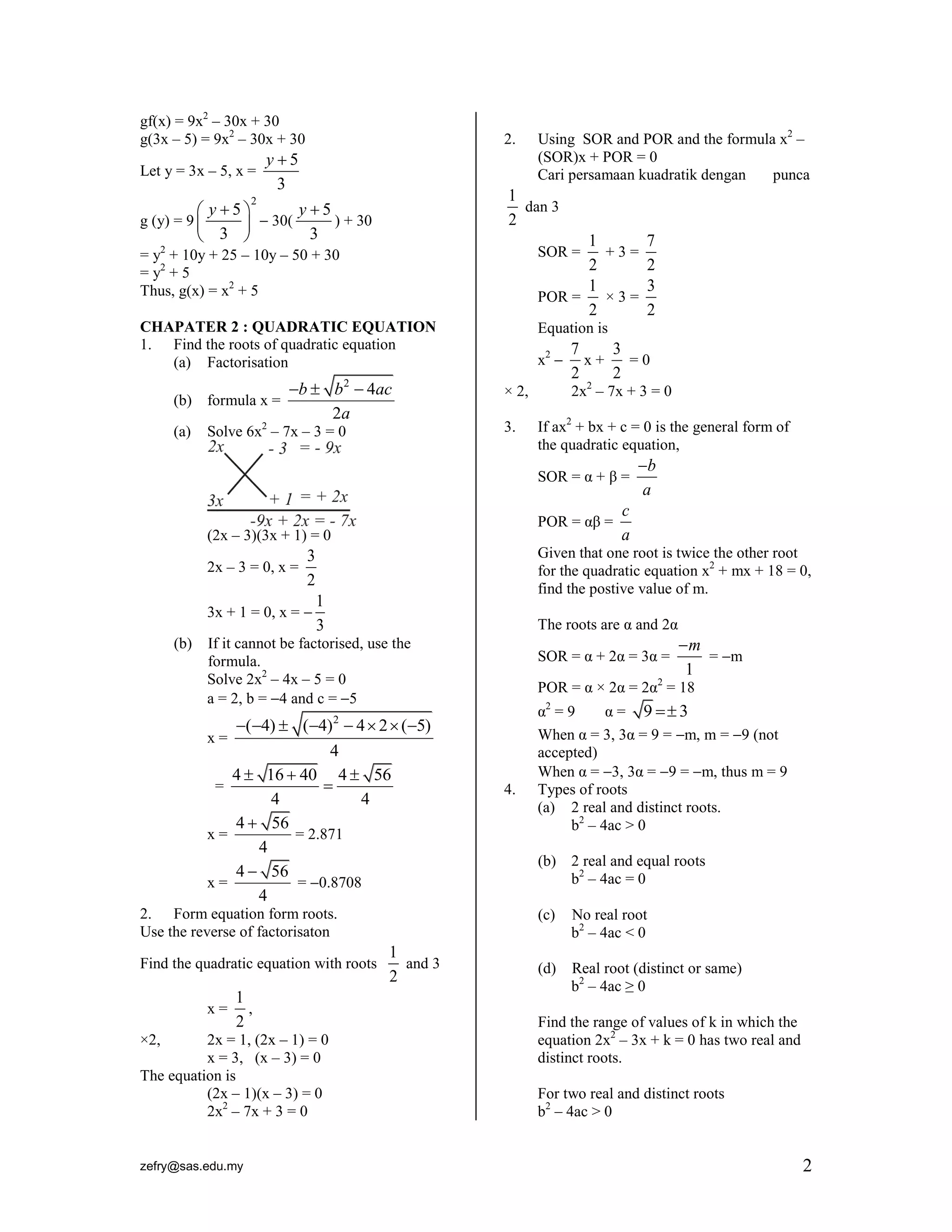
gf(x) = 9x2
– 30x + 30
g(3x – 5) = 9x2
– 30x + 30
Let y = 3x – 5, x =
5
3
y 
g (y) = 9
2
5
3
y  
 
 
 30(
5
3
y 
) + 30
= y2
+ 10y + 25 – 10y – 50 + 30
= y2
+ 5
Thus, g(x) = x2
+ 5
CHAPATER 2 : QUADRATIC EQUATION
1. Find the roots of quadratic equation
(a) Factorisation
(b) formula x =
2
4
2
b b ac
a
  
(a) Solve 6x2
– 7x – 3 = 0
(2x – 3)(3x + 1) = 0
2x – 3 = 0, x =
3
2
3x + 1 = 0, x = 
1
3
(b) If it cannot be factorised, use the
formula.
Solve 2x2
– 4x – 5 = 0
a = 2, b = 4 and c = 5
x =
2
( 4) ( 4) 4 2 ( 5)
4
       
=
4 16 40 4 56
4 4
  

x =
4 56
4

= 2.871
x =
4 56
4

= 0.8708
2. Form equation form roots.
Use the reverse of factorisaton
Find the quadratic equation with roots
1
2
and 3
x =
1
2
,
×2, 2x = 1, (2x – 1) = 0
x = 3, (x – 3) = 0
The equation is
(2x – 1)(x – 3) = 0
2x2
– 7x + 3 = 0
2. Using SOR and POR and the formula x2
–
(SOR)x + POR = 0
Cari persamaan kuadratik dengan punca
1
2
dan 3
SOR =
1
2
+ 3 =
7
2
POR =
1
2
× 3 =
3
2
Equation is
x2

7
2
x +
3
2
= 0
× 2, 2x2
– 7x + 3 = 0
3. If ax2
+ bx + c = 0 is the general form of
the quadratic equation,
SOR = α + β =
b
a

POR = αβ =
c
a
Given that one root is twice the other root
for the quadratic equation x2
+ mx + 18 = 0,
find the postive value of m.
The roots are α and 2α
SOR = α + 2α = 3α =
1
m
= m
POR = α × 2α = 2α2
= 18
α2
= 9 α = 9 3
When α = 3, 3α = 9 = m, m = 9 (not
accepted)
When α = 3, 3α = 9 = m, thus m = 9
4. Types of roots
(a) 2 real and distinct roots.
b2
– 4ac > 0
(b) 2 real and equal roots
b2
– 4ac = 0
(c) No real root
b2
– 4ac < 0
(d) Real root (distinct or same)
b2
– 4ac ≥ 0
Find the range of values of k in which the
equation 2x2
– 3x + k = 0 has two real and
distinct roots.
For two real and distinct roots
b2
– 4ac > 0
zefry@sas.edu.my 3
(3)2
– 4(2)k > 0
9 – 8k > 0
8k < 9 k <
9
8
CHAPTER 3: QUADRATIC FUNCTIONS
1. To find the maximum/minimum value by
completing the square.
Given f(x) = 2x2
– 6x + 8, find the
maximum or minimum value and state the
corresponding value of x.
f(x) = 2x2
– 6x + 8
= 2[x2
– 3x] + 8
= 2[x2
– 3x +
2
3
2
 
 
 

2
3
2
 
 
 
] + 8
=2[(x 
3
2
)2

9
4
] + 8
= 2 (x 
3
2
)2

9
2
+ 8
= 2(x 
3
2
)2
+
7
2
The minimum value (the coefficient of x2
is positive and the graph is ‘u’ shaped) is
7
2
when x 
3
2
= 0, or x =
3
2
.
2. To sketch quadratic function
(a) Determine the y-intercept and the x-
intercept (if available)
(b) Determine the maximum or minimum
value.
(c) Determine the third point opposite to
the y-intercept.
Sketch the graph f(x) = x2
– 8x + 6
(a) Y-intercept = 6
(b) f(x) = x2
– 8x + 42
– 42
+ 6
= (x – 4)2
– 16 + 6
= (x – 4)2
– 10
Min value = 10 when x – 4 = 0, x =
4. Min point (4, 10)
(c) when x = 8, f(8) = 82
– 8(8) + 6 = 6
3. Quadratic Inequality
(a) Factorise
(b) Find the roots
(c) Sketch the graph and determine the
range of x from the graph.
Find the range of value of x for which x2
–
7x – 8 < 0
x2
– 7x – 8 < 0
(x – 8)(x + 1) < 0
x = 8, x = 1
Sketch the graph
From the sketch, (x  8)(x + 1) < 0
1 < x < 8
4. Types of Roots
(a) If the graph intersects the x-axis at
two different points 2 real and
distinct roots  b2
– 4ac > 0
(b) If the graph touches the x-axis,  2
equal roots b2
– 4ac = 0
(c) If the graph does not intersect the x-
axis,(or the graph is always positiv or
always negative.)  no real root  b2
– 4ac < 0
The graph y = nx2
+ 4x + n  3 does not
intersect the x-axis for n < a and n > b, find
the value of a and b.
y = nx2
+ 4x + n – 3 does not intersect the
x-axis  no real root  b2
– 4ac < 0
42
– 4n(n – 3) < 0
16 – 4n2
+ 12n < 0
0 < 4n2
– 12n – 16
 4
n2
– 3n – 4 > 0
(n – 4)(n + 1) > 0
n = 4, n = 1
From the graph, for (n – 4)(n + 1) > 0, n <
1 and n > 4
Note: If the
coefficient of x2
is negative, the
shape of the
graph is‘n’
zefry@sas.edu.my 4
 a = 1 and b = 4
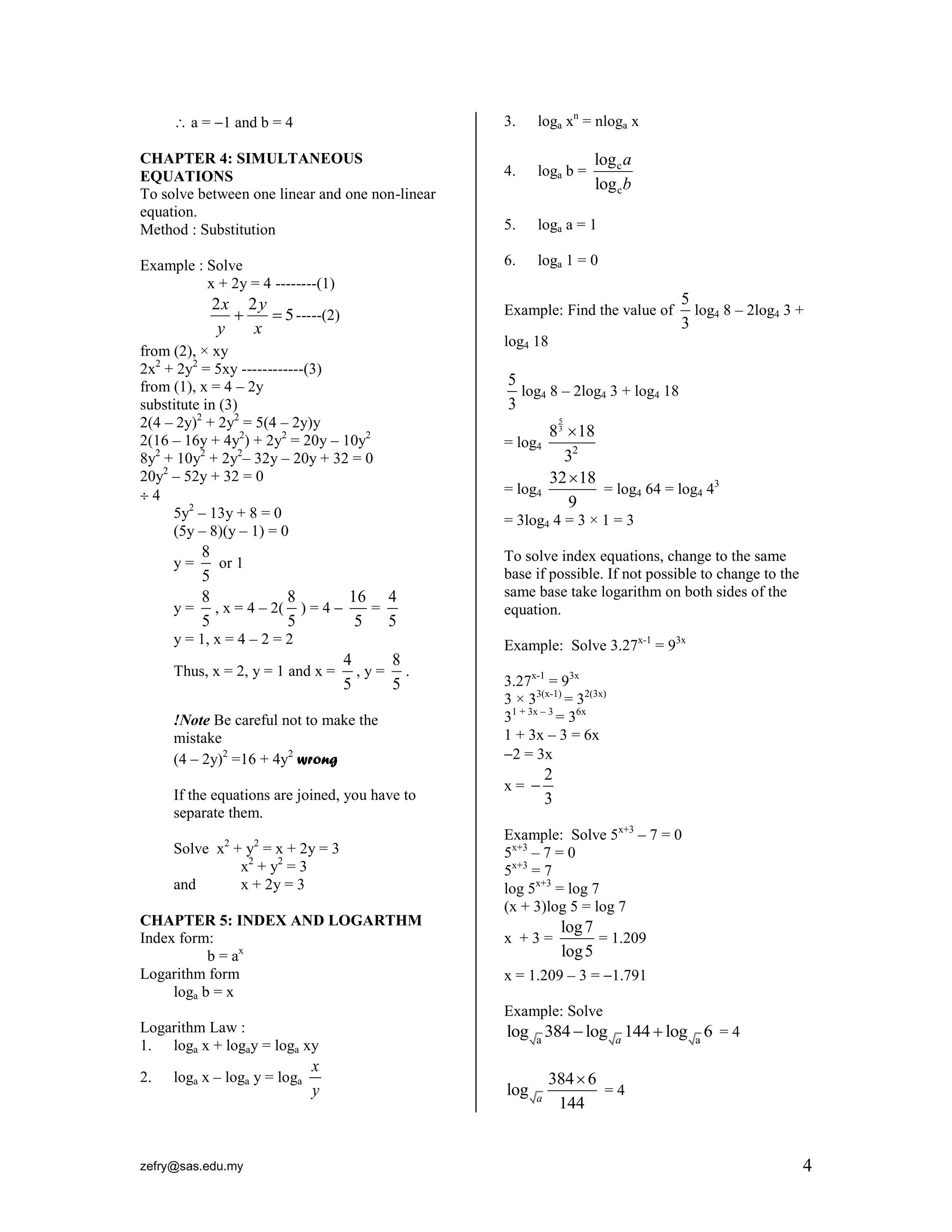
CHAPTER 4: SIMULTANEOUS
EQUATIONS
To solve between one linear and one non-linear
equation.
Method : Substitution
Example : Solve
x + 2y = 4 --------(1)
2 2
5
x y
y x
  -----(2)
from (2), × xy
2x2
+ 2y2
= 5xy ------------(3)
from (1), x = 4 – 2y
substitute in (3)
2(4 – 2y)2
+ 2y2
= 5(4 – 2y)y
2(16 – 16y + 4y2
) + 2y2
= 20y – 10y2
8y2
+ 10y2
+ 2y2
– 32y – 20y + 32 = 0
20y2
– 52y + 32 = 0
 4
5y2
– 13y + 8 = 0
(5y – 8)(y – 1) = 0
y =
8
5
or 1
y =
8
5
, x = 4 – 2(
8
5
) = 4 
16
5
=
4
5
y = 1, x = 4 – 2 = 2
Thus, x = 2, y = 1 and x =
4
5
, y =
8
5
.
!Note Be careful not to make the
mistake
(4 – 2y)2
=16 + 4y2
wrong
If the equations are joined, you have to
separate them.
Solve x2
+ y2
= x + 2y = 3
x2
+ y2
= 3
and x + 2y = 3
CHAPTER 5: INDEX AND LOGARTHM
Index form:
b = ax
Logarithm form
loga b = x
Logarithm Law :
1. loga x + logay = loga xy
2. loga x – loga y = loga
x
y
3. loga xn
= nloga x
4. loga b = c
c
log
log
a
b
5. loga a = 1
6. loga 1 = 0
Example: Find the value of
5
3
log4 8 – 2log4 3 +
log4 18
5
3
log4 8 – 2log4 3 + log4 18
= log4
5
3
2
8 18
3

= log4
32 18
9

= log4 64 = log4 43
= 3log4 4 = 3 × 1 = 3
To solve index equations, change to the same
base if possible. If not possible to change to the
same base take logarithm on both sides of the
equation.
Example: Solve 3.27x-1
= 93x
3.27x-1
= 93x
3 × 33(x-1)
= 32(3x)
31 + 3x – 3
= 36x
1 + 3x – 3 = 6x
2 = 3x
x =
2
3

Example: Solve 5x+3
– 7 = 0
5x+3
– 7 = 0
5x+3
= 7
log 5x+3
= log 7
(x + 3)log 5 = log 7
x + 3 =
log7
log5
= 1.209
x = 1.209 – 3 = 1.791
Example: Solve
a a
log 384 log 144 log 6a
  = 4
384 6
log
144a

= 4
zefry@sas.edu.my 5
a
log 16 = 4
16 =  
4
a = a2
a =  4
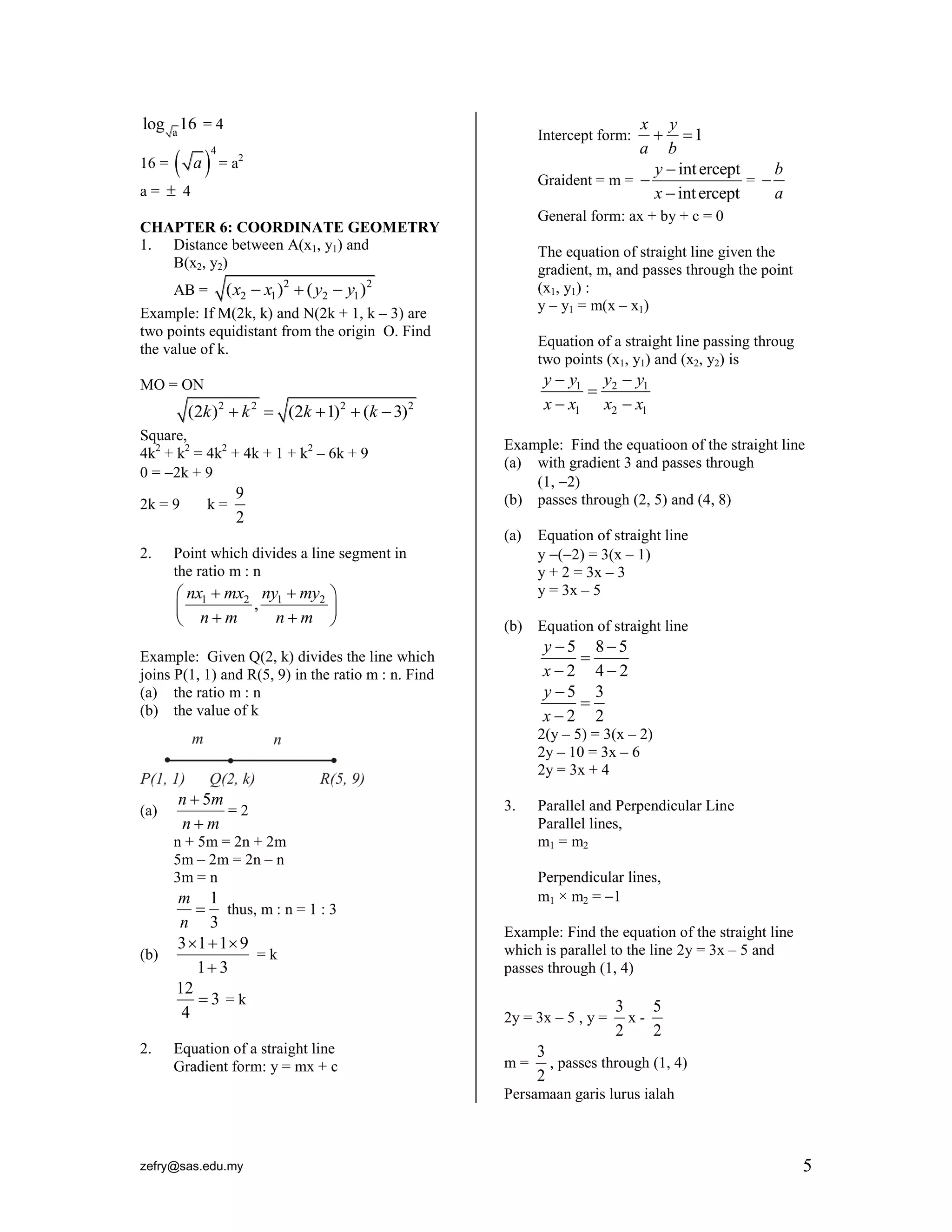
CHAPTER 6: COORDINATE GEOMETRY
1. Distance between A(x1, y1) and
B(x2, y2)
AB = 2 2
2 1 2 1( ) ( )x x y y  
Example: If M(2k, k) and N(2k + 1, k – 3) are
two points equidistant from the origin O. Find
the value of k.
MO = ON
2 2 2 2
(2 ) (2 1) ( 3)k k k k    
Square,
4k2
+ k2
= 4k2
+ 4k + 1 + k2
– 6k + 9
0 = 2k + 9
2k = 9 k =
9
2
2. Point which divides a line segment in
the ratio m : n
1 2 1 2
,
nx mx ny my
n m n m
  
   
Example: Given Q(2, k) divides the line which
joins P(1, 1) and R(5, 9) in the ratio m : n. Find
(a) the ratio m : n
(b) the value of k
(a)
5n m
n m


= 2
n + 5m = 2n + 2m
5m – 2m = 2n – n
3m = n
1
3
m
n
 thus, m : n = 1 : 3
(b)
3 1 1 9
1 3
  

= k
12
3
4
 = k
2. Equation of a straight line
Gradient form: y = mx + c
Intercept form: 1
x y
a b
 
Graident = m =
intercept
intercept
y
x



=
b
a

General form: ax + by + c = 0
The equation of straight line given the
gradient, m, and passes through the point
(x1, y1) :
y – y1 = m(x – x1)
Equation of a straight line passing throug
two points (x1, y1) and (x2, y2) is
1 2 1
1 2 1
y y y y
x x x x
 

 
Example: Find the equatioon of the straight line
(a) with gradient 3 and passes through
(1, 2)
(b) passes through (2, 5) and (4, 8)
(a) Equation of straight line
y (2) = 3(x – 1)
y + 2 = 3x – 3
y = 3x – 5
(b) Equation of straight line
5 8 5
2 4 2
y
x
 

 
5 3
2 2
y
x



2(y – 5) = 3(x – 2)
2y – 10 = 3x – 6
2y = 3x + 4
3. Parallel and Perpendicular Line
Parallel lines,
m1 = m2
Perpendicular lines,
m1 × m2 = 1
Example: Find the equation of the straight line
which is parallel to the line 2y = 3x – 5 and
passes through (1, 4)
2y = 3x – 5 , y =
3
2
x -
5
2
m =
3
2
, passes through (1, 4)
Persamaan garis lurus ialah
zefry@sas.edu.my 6
y – 4 =
3
2
(x – 1)
2y – 8 = 3x – 3
2y = 3x + 5
Example: Find the equation of the straight line
which is perpendicular to the line 1
3 4
x y
  and
passes through (2, 3)
1
3 4
x y
  , m1 =
( 4)
3
 
=
4
3
4
3
× m2 = 1
m2 = 
3
4
, passes through (2, 3)
The equation of the straight line is
y – 3 = 
3
4
(x – 2)
4y – 12 = 3x + 6
4y + 3x = 18
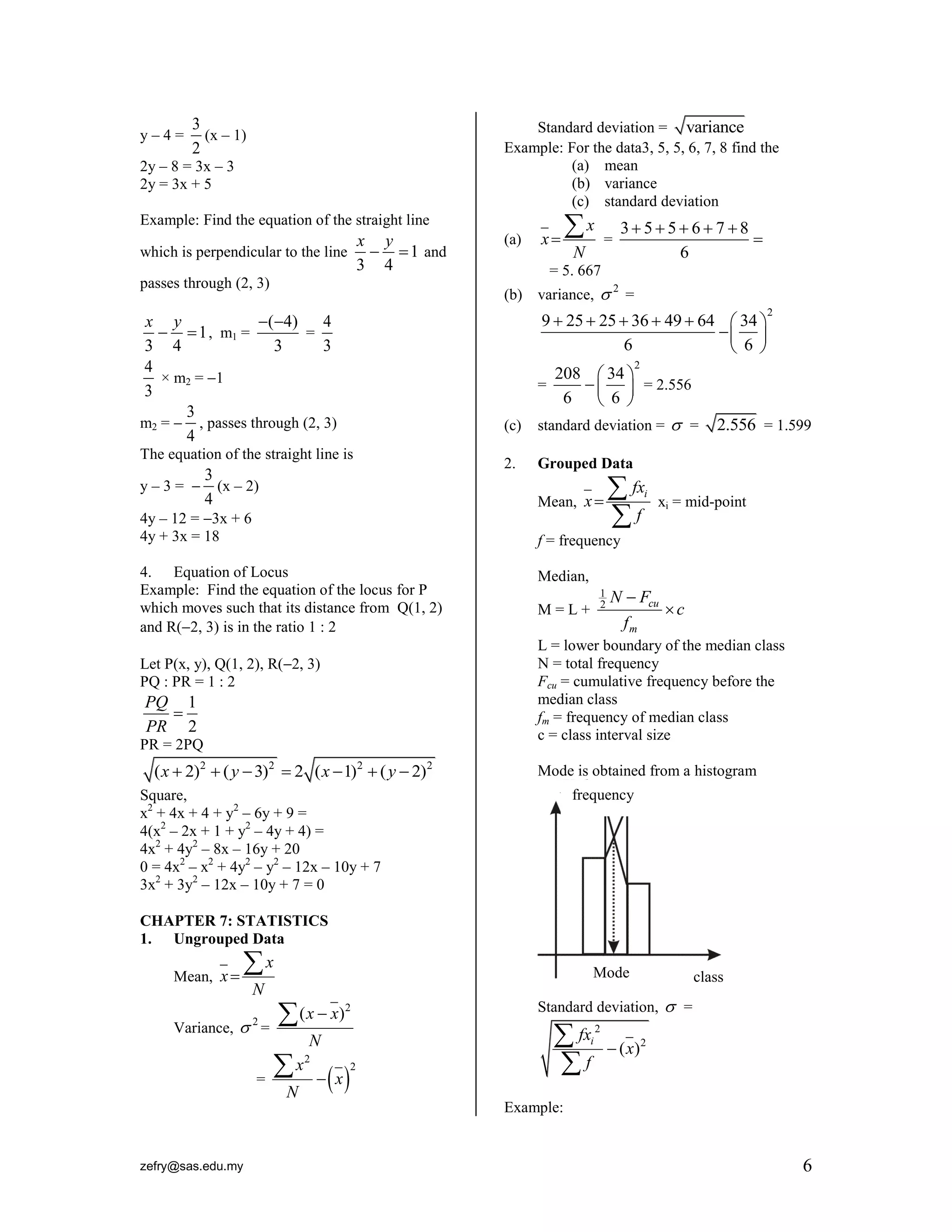
4. Equation of Locus
Example: Find the equation of the locus for P
which moves such that its distance from Q(1, 2)
and R(2, 3) is in the ratio 1 : 2
Let P(x, y), Q(1, 2), R(2, 3)
PQ : PR = 1 : 2
1
2
PQ
PR

PR = 2PQ
2 2 2 2
( 2) ( 3) 2 ( 1) ( 2)x y x y      
Square,
x2
+ 4x + 4 + y2
– 6y + 9 =
4(x2
– 2x + 1 + y2
– 4y + 4) =
4x2
+ 4y2
– 8x – 16y + 20
0 = 4x2
– x2
+ 4y2
– y2
– 12x – 10y + 7
3x2
+ 3y2
– 12x – 10y + 7 = 0
CHAPTER 7: STATISTICS
1. Ungrouped Data
Mean,
x
x
N


Variance, 2
 =
2
( )x x
N

=  
2
2x
x
N


Standard deviation = variance
Example: For the data3, 5, 5, 6, 7, 8 find the
(a) mean
(b) variance
(c) standard deviation
(a)
x
x
N

 =
3 5 5 6 7 8
6
    

= 5. 667
(b) variance, 2
 =
2
9 25 25 36 49 64 34
6 6
      
 
 
=
2
208 34
6 6
 
  
 
= 2.556
(c) standard deviation =  = 2.556 = 1.599
2. Grouped Data
Mean,
ifx
x
f



xi = mid-point
f = frequency
Median,
M = L +
1
2 cu
m
N F
c
f


L = lower boundary of the median class
N = total frequency
Fcu = cumulative frequency before the
median class
fm = frequency of median class
c = class interval size
Mode is obtained from a histogram
Standard deviation,  =
2
2
( )
ifx
x
f



Example:
frequency
classMode
zefry@sas.edu.my 7
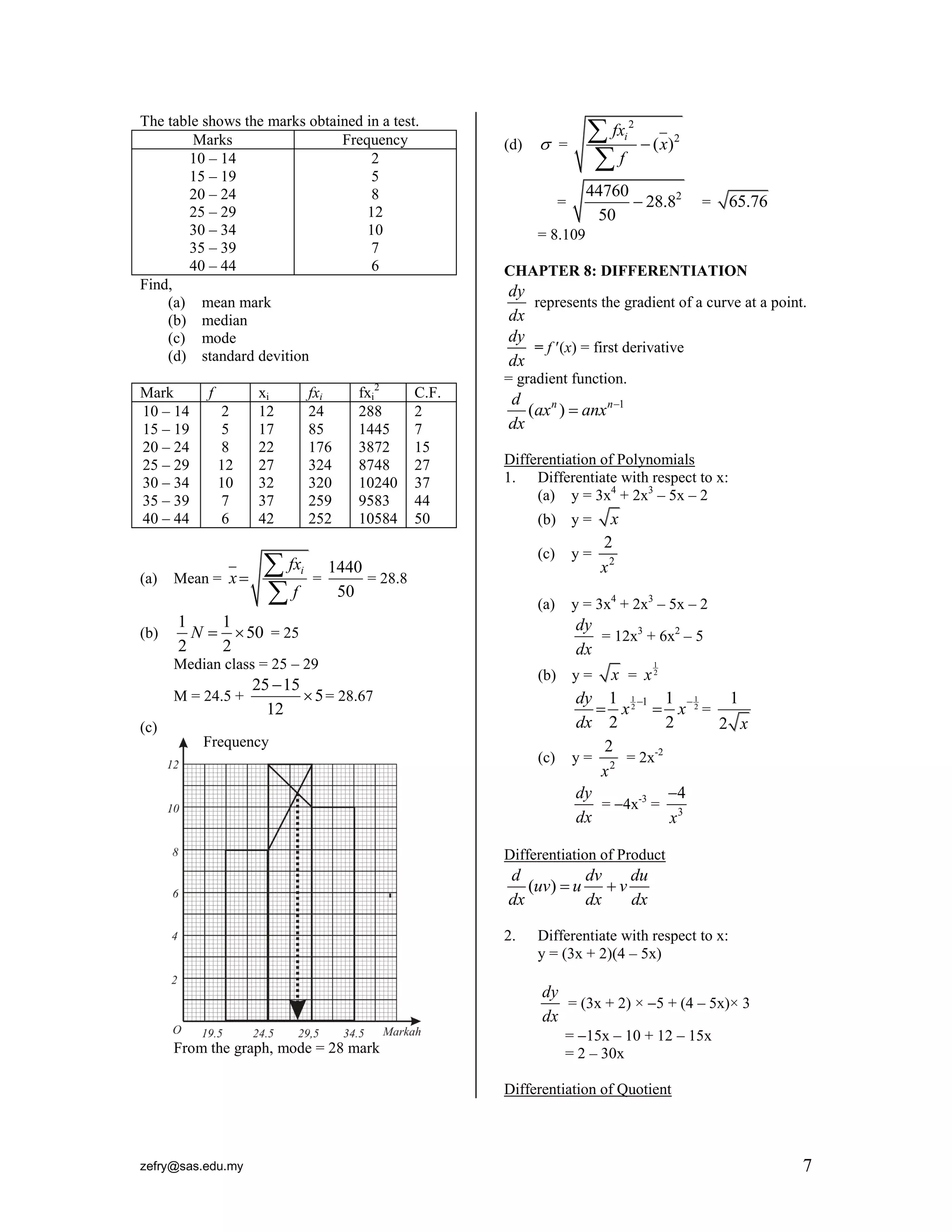
The table shows the marks obtained in a test.
Marks Frequency
10 – 14
15 – 19
20 – 24
25 – 29
30 – 34
35 – 39
40 – 44
2
5
8
12
10
7
6
Find,
(a) mean mark
(b) median
(c) mode
(d) standard devition
Mark f xi fxi fxi
2
C.F.
10 – 14
15 – 19
20 – 24
25 – 29
30 – 34
35 – 39
40 – 44
2
5
8
12
10
7
6
12
17
22
27
32
37
42
24
85
176
324
320
259
252
288
1445
3872
8748
10240
9583
10584
2
7
15
27
37
44
50
(a) Mean =
ifx
x
f



=
1440
50
= 28.8
(b)
1 1
50
2 2
N   = 25
Median class = 25 – 29
M = 24.5 +
25 15
5
12

 = 28.67
(c)
From the graph, mode = 28 mark
(d)  =
2
2
( )
ifx
x
f



= 244760
28.8
50
 = 65.76
= 8.109
CHAPTER 8: DIFFERENTIATION
dy
dx
represents the gradient of a curve at a point.
dy
dx
= f (x) = first derivative
= gradient function.
1
( )n nd
ax anx
dx


Differentiation of Polynomials
1. Differentiate with respect to x:
(a) y = 3x4
+ 2x3
– 5x – 2
(b) y = x
(c) y = 2
2
x
(a) y = 3x4
+ 2x3
– 5x – 2
dy
dx
= 12x3
+ 6x2
– 5
(b) y = x =
1
2
x
1 1
2 2
11 1
2 2
dy
x x
dx
 
  =
1
2 x
(c) y = 2
2
x
= 2x-2
dy
dx
= 4x-3
= 3
4
x

Differentiation of Product
( )
d dv du
uv u v
dx dx dx
 
2. Differentiate with respect to x:
y = (3x + 2)(4 – 5x)
dy
dx
= (3x + 2) × 5 + (4 – 5x)× 3
= 15x – 10 + 12 – 15x
= 2 – 30x
Differentiation of Quotient
Frequency
zefry@sas.edu.my 8
2
du dv
dx dx
v ud u
dx v v
 
 
 
3. Differentiate
3 4
2 5
x
x


with respect to x
y =
3 4
2 5
x
x


2
(2 5)3 (3 4)2
(2 5)
dy x x
dx x
  


= 2
6 15 6 8
(2 5)
x x
x
  

= 2
23
(2 5)x


Differentiation of Composite Function
( )nd
ax b
dx
 = n(ax + b)n-1
× a
4. Differentiate with respect to x :
(a) (3x + 5)8
(b) (2x – 1)4
(3x + 2)5
(a) y = (3x + 5)8
dy
dx
= 8(3x + 5)7
× 3
= 24(3x + 5)7
(b) y = (2x – 1)4
(3x + 2)5
dy
dx
= (2x – 1)4
5(3x + 2)4
× 3 + (3x +
2)5
4(2x – 1)3
× 2
= 15(2x – 1)4
(3x + 2)4
+
8(2x – 1)3
(3x + 2)5
= (2x – 1)3
(3x + 2)4
[15(2x – 1) + 8(3x
+ 2)]
= (2x – 1)3
(3x + 2)4
[30x – 15 + 24x +
16]
= (2x – 1)3
(3x + 2)4
(54x + 1)
Equation of Tangent and Normal
Gradient of tangent = gradient of curve =
dy
dx
Example: Find the equation of the tangent to the
curve y = 3x2
– 5x + 2 at the point x = 1.
y = 3x2
– 5x + 2
dy
dx
= 6x – 5
x = 1, y = 3 – 5 + 2 = 0
dy
dx
= 6 – 5 = 1
Equation of tangent :
y – 0 = 1( x – 1)
y = x – 1.
Maximum and Minimum Value
Given y = 2x2
– 8x + 3. Find the coordinates of
the turning point. Hence, determine if the turning
point is maximum or minimum.
y = 2x2
– 8x + 3
dy
dx
= 4x  8
For turning point
dy
dx
= 0
4x – 8 = 0
x = 2
x = 2, y = 2(4) – 16 + 3 = 5
2
2
d y
dx
= 4 > 0, thus the point (2, 5) is a
minimum point.
Rate of Change of Related Quantities
Example: The radius of a circle increases which
a rate of 0.2 cm s-1
, find the rate of change of the
area of the circle when the radius is 5 cm.
A = r2
dA
dr
= 2r
dr
dt
= 0.2 cm s-1
dA dA dr
dt dr dt
 
= 2r × 0.2
= 0.4 r
When r = 5 cm,
dA
dt
= 0.4 × 5
= 2 cm2
s-1
Small Changes and Approximation
dy
y x
dx
  
Example: Given y = 2x2
– 5x + 3, find the small
change in y when x increases from 2 to 2.01
y = 2x2
– 5x + 3
dy
dx
= 4x – 5
x = 2.02 – 2 = 0.01
Note:
you must
differentiate
the function in
the brackets.
zefry@sas.edu.my 9
y =
dy
x
dx

= (4x – 5) × 0.01
Substitute the original value, x = 2,
y = (8 – 5) × 0.01
= 0.03
Thus the small increment in y is 0.03.
CHAPTER 9: INDEX NUMBER
1. Price Index, I = 1
0
p
p
× 100
p1 = price at a certain time
p0 = price in the base year
2. Composite index
Iw
I
w



I = price index
w = weightage
Example:
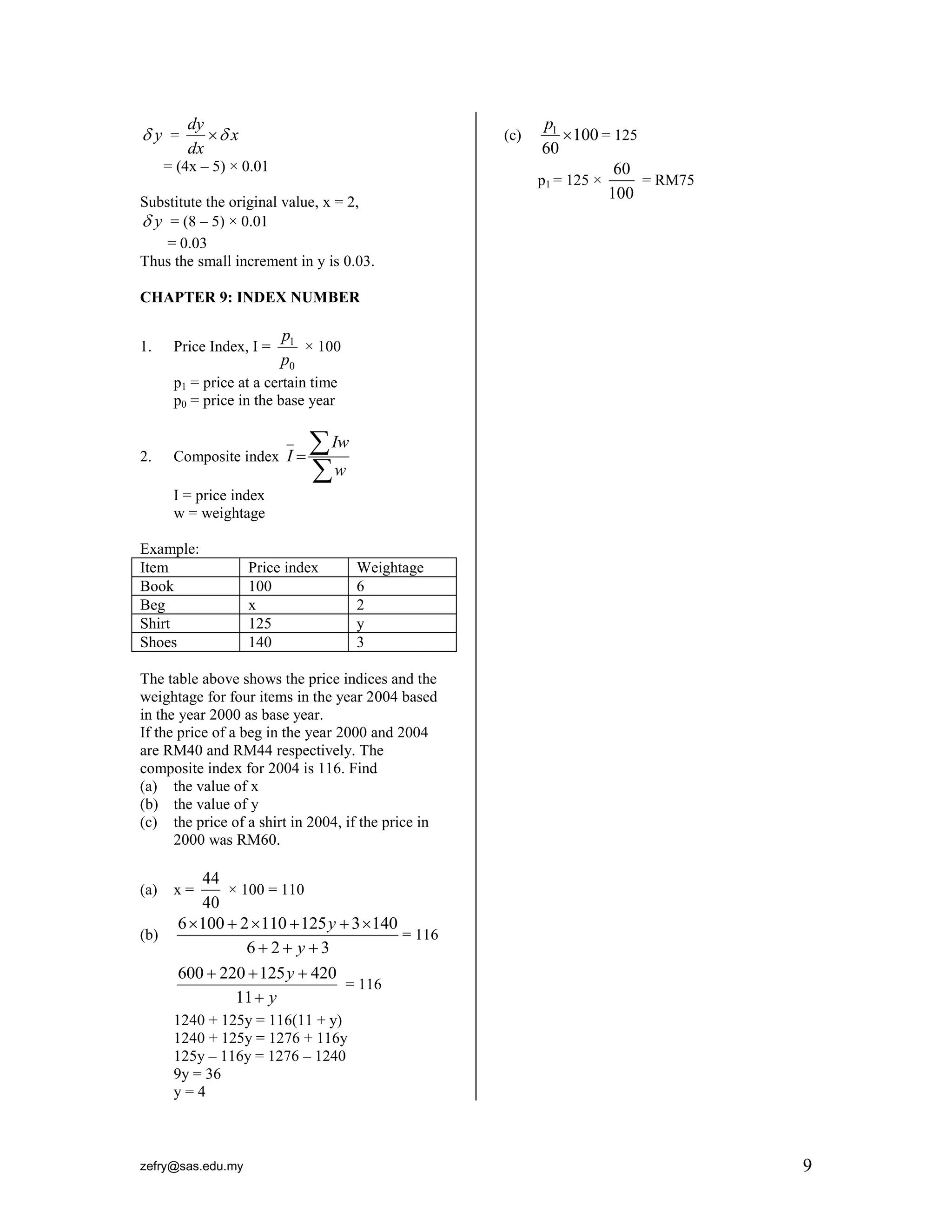
Item Price index Weightage
Book 100 6
Beg x 2
Shirt 125 y
Shoes 140 3
The table above shows the price indices and the
weightage for four items in the year 2004 based
in the year 2000 as base year.
If the price of a beg in the year 2000 and 2004
are RM40 and RM44 respectively. The
composite index for 2004 is 116. Find
(a) the value of x
(b) the value of y
(c) the price of a shirt in 2004, if the price in
2000 was RM60.
(a) x =
44
40
× 100 = 110
(b)
6 100 2 110 125 3 140
6 2 3
y
y
     
  
= 116
600 220 125 420
11
y
y
  

= 116
1240 + 125y = 116(11 + y)
1240 + 125y = 1276 + 116y
125y – 116y = 1276 – 1240
9y = 36
y = 4
(c) 1
100
60
p
 = 125
p1 = 125 ×
60
100
= RM75

Form 4 Add Maths Note

  • 1.
    zefry@sas.edu.my 1 BRIEF NOTES ADDITIONALMATHEMATICS FORM 4 CHAPTER 1: FUNCTION 1. f : x  x + 3 x is the object, x + 3 is the image f : x  x + 3 can be written as f(x) = x + 3. To find the image for 2 means f(2) = 2 + 3 = 5 Image for 2 is 5. Find the object for 8 means f(x) = 8 what is the value of x ? x + 3 = 8 ; x = 5 The object is 5. If the function is written in the form of ordered pairs (x, y) , x is the object and y is the image. E.g. (2, 4), (2, 6), (3, 7) Image for 2 is 4 and 6 whereas object for 7 is 3. In the arrow diagram, the set of object is {1, 2, 3} and the set of image is {4, 5} 2. For f : x  5 3x  , x – 3  0, i.e. x  3 because 5 0 is undefined. Thus, if f : x  5 3x  , x  k then k is 3. 3. Function which maps into itself means f (x) = x If f : x  3 2x  , find the value of x which is mapped into itself. 3 2x  = x 3 = x(x – 2) = x2 – 2x Thus, x2 – 2x – 3 = 0 (x – 3)(x + 1) = 0 x = 3 or 1 3. Inverse Function Symbol : f -1 To find the inverse function, change f(x) to y and find x in tems of y. Given f : x  3 x x , find f -1 Let f(x) = y y = 3 x x y(3 – x) = x 3y – xy = x 3y = x + xy = x(1 + y) x = 3 1 y y , thus f -1 (x) = 3 1 x x 4. Composite Function Given f : x  3x – 4 and g : x  2 – 3x, find (a) fg(x) (b) gf(x) (c) f 2 (3) (d) gf -1 (4) (a) fg(x) = f(2 – 3x) = 3(2 – 3x) - 4 = 6 – 9x – 4 = 2 – 9x (b) gf(x) = g(3x – 4) = 2 – 3(3x – 4) = 2 – 9x + 12 = 14 – 9x (c) f 2 (3) = ff(3) = f(9 – 4) = f(5) = 15 – 4 = 11. (d) Let y = 3x – 4, x = 4 3 y  Thus f -1 (4) = 8 3 gf -1 (4) = g( 8 3 ) = 2 – 3 × 8 3 = 6 5. To find f(x) or g(x) given the composite function. Given f(x) = 2x + 8 and fg(x) = 6x + 12, find g(x). f(x) = 2x + 8 f[g(x)] = 2g(x) + 8 = 6x + 12 2g(x) = 6x + 12 – 8 = 6x + 4 g(x) = 3x + 2 Given f(x) = 3x – 5 and gf(x) = 9x2 – 30x + 30, find g(x)
  • 2.
    zefry@sas.edu.my 2 gf(x) =9x2 – 30x + 30 g(3x – 5) = 9x2 – 30x + 30 Let y = 3x – 5, x = 5 3 y  g (y) = 9 2 5 3 y        30( 5 3 y  ) + 30 = y2 + 10y + 25 – 10y – 50 + 30 = y2 + 5 Thus, g(x) = x2 + 5 CHAPATER 2 : QUADRATIC EQUATION 1. Find the roots of quadratic equation (a) Factorisation (b) formula x = 2 4 2 b b ac a    (a) Solve 6x2 – 7x – 3 = 0 (2x – 3)(3x + 1) = 0 2x – 3 = 0, x = 3 2 3x + 1 = 0, x =  1 3 (b) If it cannot be factorised, use the formula. Solve 2x2 – 4x – 5 = 0 a = 2, b = 4 and c = 5 x = 2 ( 4) ( 4) 4 2 ( 5) 4         = 4 16 40 4 56 4 4     x = 4 56 4  = 2.871 x = 4 56 4  = 0.8708 2. Form equation form roots. Use the reverse of factorisaton Find the quadratic equation with roots 1 2 and 3 x = 1 2 , ×2, 2x = 1, (2x – 1) = 0 x = 3, (x – 3) = 0 The equation is (2x – 1)(x – 3) = 0 2x2 – 7x + 3 = 0 2. Using SOR and POR and the formula x2 – (SOR)x + POR = 0 Cari persamaan kuadratik dengan punca 1 2 dan 3 SOR = 1 2 + 3 = 7 2 POR = 1 2 × 3 = 3 2 Equation is x2  7 2 x + 3 2 = 0 × 2, 2x2 – 7x + 3 = 0 3. If ax2 + bx + c = 0 is the general form of the quadratic equation, SOR = α + β = b a  POR = αβ = c a Given that one root is twice the other root for the quadratic equation x2 + mx + 18 = 0, find the postive value of m. The roots are α and 2α SOR = α + 2α = 3α = 1 m = m POR = α × 2α = 2α2 = 18 α2 = 9 α = 9 3 When α = 3, 3α = 9 = m, m = 9 (not accepted) When α = 3, 3α = 9 = m, thus m = 9 4. Types of roots (a) 2 real and distinct roots. b2 – 4ac > 0 (b) 2 real and equal roots b2 – 4ac = 0 (c) No real root b2 – 4ac < 0 (d) Real root (distinct or same) b2 – 4ac ≥ 0 Find the range of values of k in which the equation 2x2 – 3x + k = 0 has two real and distinct roots. For two real and distinct roots b2 – 4ac > 0
  • 3.
    zefry@sas.edu.my 3 (3)2 – 4(2)k> 0 9 – 8k > 0 8k < 9 k < 9 8 CHAPTER 3: QUADRATIC FUNCTIONS 1. To find the maximum/minimum value by completing the square. Given f(x) = 2x2 – 6x + 8, find the maximum or minimum value and state the corresponding value of x. f(x) = 2x2 – 6x + 8 = 2[x2 – 3x] + 8 = 2[x2 – 3x + 2 3 2        2 3 2       ] + 8 =2[(x  3 2 )2  9 4 ] + 8 = 2 (x  3 2 )2  9 2 + 8 = 2(x  3 2 )2 + 7 2 The minimum value (the coefficient of x2 is positive and the graph is ‘u’ shaped) is 7 2 when x  3 2 = 0, or x = 3 2 . 2. To sketch quadratic function (a) Determine the y-intercept and the x- intercept (if available) (b) Determine the maximum or minimum value. (c) Determine the third point opposite to the y-intercept. Sketch the graph f(x) = x2 – 8x + 6 (a) Y-intercept = 6 (b) f(x) = x2 – 8x + 42 – 42 + 6 = (x – 4)2 – 16 + 6 = (x – 4)2 – 10 Min value = 10 when x – 4 = 0, x = 4. Min point (4, 10) (c) when x = 8, f(8) = 82 – 8(8) + 6 = 6 3. Quadratic Inequality (a) Factorise (b) Find the roots (c) Sketch the graph and determine the range of x from the graph. Find the range of value of x for which x2 – 7x – 8 < 0 x2 – 7x – 8 < 0 (x – 8)(x + 1) < 0 x = 8, x = 1 Sketch the graph From the sketch, (x  8)(x + 1) < 0 1 < x < 8 4. Types of Roots (a) If the graph intersects the x-axis at two different points 2 real and distinct roots  b2 – 4ac > 0 (b) If the graph touches the x-axis,  2 equal roots b2 – 4ac = 0 (c) If the graph does not intersect the x- axis,(or the graph is always positiv or always negative.)  no real root  b2 – 4ac < 0 The graph y = nx2 + 4x + n  3 does not intersect the x-axis for n < a and n > b, find the value of a and b. y = nx2 + 4x + n – 3 does not intersect the x-axis  no real root  b2 – 4ac < 0 42 – 4n(n – 3) < 0 16 – 4n2 + 12n < 0 0 < 4n2 – 12n – 16  4 n2 – 3n – 4 > 0 (n – 4)(n + 1) > 0 n = 4, n = 1 From the graph, for (n – 4)(n + 1) > 0, n < 1 and n > 4 Note: If the coefficient of x2 is negative, the shape of the graph is‘n’
  • 4.
    zefry@sas.edu.my 4  a= 1 and b = 4 CHAPTER 4: SIMULTANEOUS EQUATIONS To solve between one linear and one non-linear equation. Method : Substitution Example : Solve x + 2y = 4 --------(1) 2 2 5 x y y x   -----(2) from (2), × xy 2x2 + 2y2 = 5xy ------------(3) from (1), x = 4 – 2y substitute in (3) 2(4 – 2y)2 + 2y2 = 5(4 – 2y)y 2(16 – 16y + 4y2 ) + 2y2 = 20y – 10y2 8y2 + 10y2 + 2y2 – 32y – 20y + 32 = 0 20y2 – 52y + 32 = 0  4 5y2 – 13y + 8 = 0 (5y – 8)(y – 1) = 0 y = 8 5 or 1 y = 8 5 , x = 4 – 2( 8 5 ) = 4  16 5 = 4 5 y = 1, x = 4 – 2 = 2 Thus, x = 2, y = 1 and x = 4 5 , y = 8 5 . !Note Be careful not to make the mistake (4 – 2y)2 =16 + 4y2 wrong If the equations are joined, you have to separate them. Solve x2 + y2 = x + 2y = 3 x2 + y2 = 3 and x + 2y = 3 CHAPTER 5: INDEX AND LOGARTHM Index form: b = ax Logarithm form loga b = x Logarithm Law : 1. loga x + logay = loga xy 2. loga x – loga y = loga x y 3. loga xn = nloga x 4. loga b = c c log log a b 5. loga a = 1 6. loga 1 = 0 Example: Find the value of 5 3 log4 8 – 2log4 3 + log4 18 5 3 log4 8 – 2log4 3 + log4 18 = log4 5 3 2 8 18 3  = log4 32 18 9  = log4 64 = log4 43 = 3log4 4 = 3 × 1 = 3 To solve index equations, change to the same base if possible. If not possible to change to the same base take logarithm on both sides of the equation. Example: Solve 3.27x-1 = 93x 3.27x-1 = 93x 3 × 33(x-1) = 32(3x) 31 + 3x – 3 = 36x 1 + 3x – 3 = 6x 2 = 3x x = 2 3  Example: Solve 5x+3 – 7 = 0 5x+3 – 7 = 0 5x+3 = 7 log 5x+3 = log 7 (x + 3)log 5 = log 7 x + 3 = log7 log5 = 1.209 x = 1.209 – 3 = 1.791 Example: Solve a a log 384 log 144 log 6a   = 4 384 6 log 144a  = 4
  • 5.
    zefry@sas.edu.my 5 a log 16= 4 16 =   4 a = a2 a =  4 CHAPTER 6: COORDINATE GEOMETRY 1. Distance between A(x1, y1) and B(x2, y2) AB = 2 2 2 1 2 1( ) ( )x x y y   Example: If M(2k, k) and N(2k + 1, k – 3) are two points equidistant from the origin O. Find the value of k. MO = ON 2 2 2 2 (2 ) (2 1) ( 3)k k k k     Square, 4k2 + k2 = 4k2 + 4k + 1 + k2 – 6k + 9 0 = 2k + 9 2k = 9 k = 9 2 2. Point which divides a line segment in the ratio m : n 1 2 1 2 , nx mx ny my n m n m        Example: Given Q(2, k) divides the line which joins P(1, 1) and R(5, 9) in the ratio m : n. Find (a) the ratio m : n (b) the value of k (a) 5n m n m   = 2 n + 5m = 2n + 2m 5m – 2m = 2n – n 3m = n 1 3 m n  thus, m : n = 1 : 3 (b) 3 1 1 9 1 3     = k 12 3 4  = k 2. Equation of a straight line Gradient form: y = mx + c Intercept form: 1 x y a b   Graident = m = intercept intercept y x    = b a  General form: ax + by + c = 0 The equation of straight line given the gradient, m, and passes through the point (x1, y1) : y – y1 = m(x – x1) Equation of a straight line passing throug two points (x1, y1) and (x2, y2) is 1 2 1 1 2 1 y y y y x x x x      Example: Find the equatioon of the straight line (a) with gradient 3 and passes through (1, 2) (b) passes through (2, 5) and (4, 8) (a) Equation of straight line y (2) = 3(x – 1) y + 2 = 3x – 3 y = 3x – 5 (b) Equation of straight line 5 8 5 2 4 2 y x      5 3 2 2 y x    2(y – 5) = 3(x – 2) 2y – 10 = 3x – 6 2y = 3x + 4 3. Parallel and Perpendicular Line Parallel lines, m1 = m2 Perpendicular lines, m1 × m2 = 1 Example: Find the equation of the straight line which is parallel to the line 2y = 3x – 5 and passes through (1, 4) 2y = 3x – 5 , y = 3 2 x - 5 2 m = 3 2 , passes through (1, 4) Persamaan garis lurus ialah
  • 6.
    zefry@sas.edu.my 6 y –4 = 3 2 (x – 1) 2y – 8 = 3x – 3 2y = 3x + 5 Example: Find the equation of the straight line which is perpendicular to the line 1 3 4 x y   and passes through (2, 3) 1 3 4 x y   , m1 = ( 4) 3   = 4 3 4 3 × m2 = 1 m2 =  3 4 , passes through (2, 3) The equation of the straight line is y – 3 =  3 4 (x – 2) 4y – 12 = 3x + 6 4y + 3x = 18 4. Equation of Locus Example: Find the equation of the locus for P which moves such that its distance from Q(1, 2) and R(2, 3) is in the ratio 1 : 2 Let P(x, y), Q(1, 2), R(2, 3) PQ : PR = 1 : 2 1 2 PQ PR  PR = 2PQ 2 2 2 2 ( 2) ( 3) 2 ( 1) ( 2)x y x y       Square, x2 + 4x + 4 + y2 – 6y + 9 = 4(x2 – 2x + 1 + y2 – 4y + 4) = 4x2 + 4y2 – 8x – 16y + 20 0 = 4x2 – x2 + 4y2 – y2 – 12x – 10y + 7 3x2 + 3y2 – 12x – 10y + 7 = 0 CHAPTER 7: STATISTICS 1. Ungrouped Data Mean, x x N   Variance, 2  = 2 ( )x x N  =   2 2x x N   Standard deviation = variance Example: For the data3, 5, 5, 6, 7, 8 find the (a) mean (b) variance (c) standard deviation (a) x x N   = 3 5 5 6 7 8 6       = 5. 667 (b) variance, 2  = 2 9 25 25 36 49 64 34 6 6            = 2 208 34 6 6        = 2.556 (c) standard deviation =  = 2.556 = 1.599 2. Grouped Data Mean, ifx x f    xi = mid-point f = frequency Median, M = L + 1 2 cu m N F c f   L = lower boundary of the median class N = total frequency Fcu = cumulative frequency before the median class fm = frequency of median class c = class interval size Mode is obtained from a histogram Standard deviation,  = 2 2 ( ) ifx x f    Example: frequency classMode
  • 7.
    zefry@sas.edu.my 7 The tableshows the marks obtained in a test. Marks Frequency 10 – 14 15 – 19 20 – 24 25 – 29 30 – 34 35 – 39 40 – 44 2 5 8 12 10 7 6 Find, (a) mean mark (b) median (c) mode (d) standard devition Mark f xi fxi fxi 2 C.F. 10 – 14 15 – 19 20 – 24 25 – 29 30 – 34 35 – 39 40 – 44 2 5 8 12 10 7 6 12 17 22 27 32 37 42 24 85 176 324 320 259 252 288 1445 3872 8748 10240 9583 10584 2 7 15 27 37 44 50 (a) Mean = ifx x f    = 1440 50 = 28.8 (b) 1 1 50 2 2 N   = 25 Median class = 25 – 29 M = 24.5 + 25 15 5 12   = 28.67 (c) From the graph, mode = 28 mark (d)  = 2 2 ( ) ifx x f    = 244760 28.8 50  = 65.76 = 8.109 CHAPTER 8: DIFFERENTIATION dy dx represents the gradient of a curve at a point. dy dx = f (x) = first derivative = gradient function. 1 ( )n nd ax anx dx   Differentiation of Polynomials 1. Differentiate with respect to x: (a) y = 3x4 + 2x3 – 5x – 2 (b) y = x (c) y = 2 2 x (a) y = 3x4 + 2x3 – 5x – 2 dy dx = 12x3 + 6x2 – 5 (b) y = x = 1 2 x 1 1 2 2 11 1 2 2 dy x x dx     = 1 2 x (c) y = 2 2 x = 2x-2 dy dx = 4x-3 = 3 4 x  Differentiation of Product ( ) d dv du uv u v dx dx dx   2. Differentiate with respect to x: y = (3x + 2)(4 – 5x) dy dx = (3x + 2) × 5 + (4 – 5x)× 3 = 15x – 10 + 12 – 15x = 2 – 30x Differentiation of Quotient Frequency
  • 8.
    zefry@sas.edu.my 8 2 du dv dxdx v ud u dx v v       3. Differentiate 3 4 2 5 x x   with respect to x y = 3 4 2 5 x x   2 (2 5)3 (3 4)2 (2 5) dy x x dx x      = 2 6 15 6 8 (2 5) x x x     = 2 23 (2 5)x   Differentiation of Composite Function ( )nd ax b dx  = n(ax + b)n-1 × a 4. Differentiate with respect to x : (a) (3x + 5)8 (b) (2x – 1)4 (3x + 2)5 (a) y = (3x + 5)8 dy dx = 8(3x + 5)7 × 3 = 24(3x + 5)7 (b) y = (2x – 1)4 (3x + 2)5 dy dx = (2x – 1)4 5(3x + 2)4 × 3 + (3x + 2)5 4(2x – 1)3 × 2 = 15(2x – 1)4 (3x + 2)4 + 8(2x – 1)3 (3x + 2)5 = (2x – 1)3 (3x + 2)4 [15(2x – 1) + 8(3x + 2)] = (2x – 1)3 (3x + 2)4 [30x – 15 + 24x + 16] = (2x – 1)3 (3x + 2)4 (54x + 1) Equation of Tangent and Normal Gradient of tangent = gradient of curve = dy dx Example: Find the equation of the tangent to the curve y = 3x2 – 5x + 2 at the point x = 1. y = 3x2 – 5x + 2 dy dx = 6x – 5 x = 1, y = 3 – 5 + 2 = 0 dy dx = 6 – 5 = 1 Equation of tangent : y – 0 = 1( x – 1) y = x – 1. Maximum and Minimum Value Given y = 2x2 – 8x + 3. Find the coordinates of the turning point. Hence, determine if the turning point is maximum or minimum. y = 2x2 – 8x + 3 dy dx = 4x  8 For turning point dy dx = 0 4x – 8 = 0 x = 2 x = 2, y = 2(4) – 16 + 3 = 5 2 2 d y dx = 4 > 0, thus the point (2, 5) is a minimum point. Rate of Change of Related Quantities Example: The radius of a circle increases which a rate of 0.2 cm s-1 , find the rate of change of the area of the circle when the radius is 5 cm. A = r2 dA dr = 2r dr dt = 0.2 cm s-1 dA dA dr dt dr dt   = 2r × 0.2 = 0.4 r When r = 5 cm, dA dt = 0.4 × 5 = 2 cm2 s-1 Small Changes and Approximation dy y x dx    Example: Given y = 2x2 – 5x + 3, find the small change in y when x increases from 2 to 2.01 y = 2x2 – 5x + 3 dy dx = 4x – 5 x = 2.02 – 2 = 0.01 Note: you must differentiate the function in the brackets.
  • 9.
    zefry@sas.edu.my 9 y = dy x dx  =(4x – 5) × 0.01 Substitute the original value, x = 2, y = (8 – 5) × 0.01 = 0.03 Thus the small increment in y is 0.03. CHAPTER 9: INDEX NUMBER 1. Price Index, I = 1 0 p p × 100 p1 = price at a certain time p0 = price in the base year 2. Composite index Iw I w    I = price index w = weightage Example: Item Price index Weightage Book 100 6 Beg x 2 Shirt 125 y Shoes 140 3 The table above shows the price indices and the weightage for four items in the year 2004 based in the year 2000 as base year. If the price of a beg in the year 2000 and 2004 are RM40 and RM44 respectively. The composite index for 2004 is 116. Find (a) the value of x (b) the value of y (c) the price of a shirt in 2004, if the price in 2000 was RM60. (a) x = 44 40 × 100 = 110 (b) 6 100 2 110 125 3 140 6 2 3 y y          = 116 600 220 125 420 11 y y     = 116 1240 + 125y = 116(11 + y) 1240 + 125y = 1276 + 116y 125y – 116y = 1276 – 1240 9y = 36 y = 4 (c) 1 100 60 p  = 125 p1 = 125 × 60 100 = RM75