Exponential Functions and
Their Graphs
Digital Lesson
2
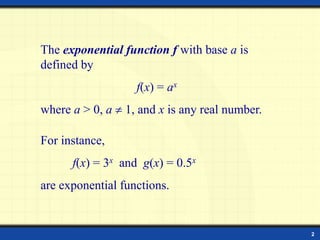
The exponential function f with base a is
defined by
f(x) = ax
where a > 0, a  1, and x is any real number.
For instance,
f(x) = 3x and g(x) = 0.5x
are exponential functions.
3
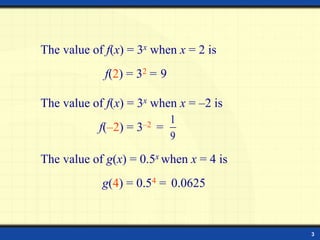
The value of f(x) = 3x when x = 2 is
f(2) = 32 =
The value of g(x) = 0.5x when x = 4 is
g(4) = 0.54 =
The value of f(x) = 3x when x = –2 is
9
1
9
f(–2) = 3–2 =
0.0625
4
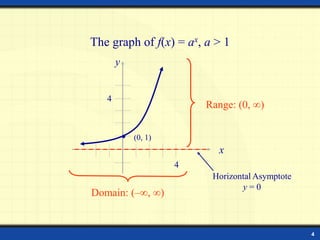
The graph of f(x) = ax, a > 1
y
x
(0, 1)
Domain: (–, )
Range: (0, )
Horizontal Asymptote
y = 0
4
4
5
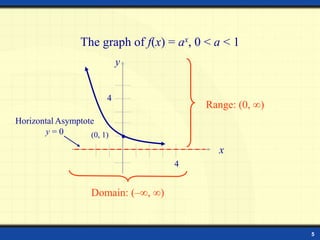
The graph of f(x) = ax, 0 < a < 1
y
x
(0, 1)
Domain: (–, )
Range: (0, )
Horizontal Asymptote
y = 0
4
4
6
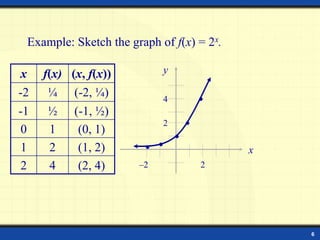
Example: Sketch the graph of f(x) = 2x.
x
x f(x) (x, f(x))
-2 ¼ (-2, ¼)
-1 ½ (-1, ½)
0 1 (0, 1)
1 2 (1, 2)
2 4 (2, 4)
y
2
–2
2
4
7
Example: Sketch the graph of g(x) = 2x – 1. State the
domain and range.
x
y
The graph of this
function is a vertical
translation of the
graph of f(x) = 2x
down one unit .
f(x) = 2x
y = –1
Domain: (–, )
Range: (–1, )
2
4
8
Example: Sketch the graph of g(x) = 2-x. State the
domain and range.
x
y
The graph of this
function is a
reflection the graph
of f(x) = 2x in the y-
axis.
f(x) = 2x
Domain: (–, )
Range: (0, ) 2
–2
4
9
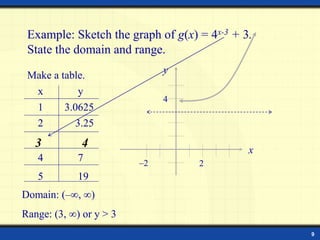
Example: Sketch the graph of g(x) = 4x-3 + 3.
State the domain and range.
x
y
Make a table.
Domain: (–, )
Range: (3, ) or y > 3
2
–2
4
x y
3 4
2 3.25
1 3.0625
4 7
5 19
10
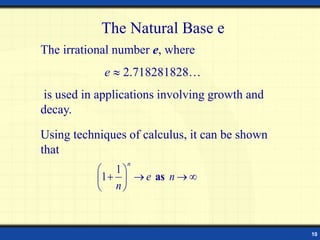
The irrational number e, where
e  2.718281828…
is used in applications involving growth and
decay.
Using techniques of calculus, it can be shown
that









 n
e
n
n
as
1
1
The Natural Base e
11
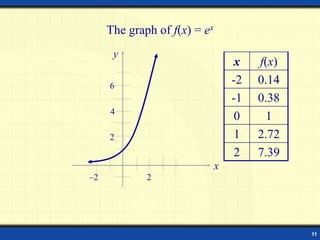
The graph of f(x) = ex
y
x
2
–2
2
4
6
x f(x)
-2 0.14
-1 0.38
0 1
1 2.72
2 7.39
12
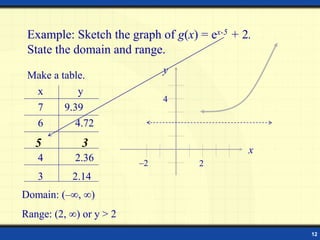
Example: Sketch the graph of g(x) = ex-5 + 2.
State the domain and range.
x
y
Make a table.
Domain: (–, )
Range: (2, ) or y > 2
2
–2
4
x y
5 3
6 4.72
7 9.39
4 2.36
3 2.14
13
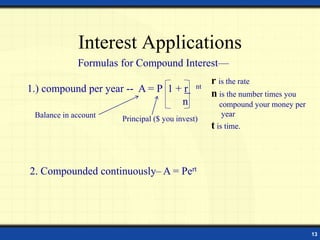
Formulas for Compound Interest—
1.) compound per year -- A = P 1 + r nt
n
Interest Applications
Balance in account Principal ($ you invest)
r is the rate
n is the number times you
compound your money per
year
t is time.
2. Compounded continuously– A = Pert
14
A total of $12000 is invested at an annual
interest rate of 9%. Find the balance after
5 years if it is compounded
a. quarterly
b. monthly
c. continuously

exponential functions and their graphs.ppt

  • 1.
    Exponential Functions and TheirGraphs Digital Lesson
  • 2.
    2 The exponential functionf with base a is defined by f(x) = ax where a > 0, a  1, and x is any real number. For instance, f(x) = 3x and g(x) = 0.5x are exponential functions.
  • 3.
    3 The value off(x) = 3x when x = 2 is f(2) = 32 = The value of g(x) = 0.5x when x = 4 is g(4) = 0.54 = The value of f(x) = 3x when x = –2 is 9 1 9 f(–2) = 3–2 = 0.0625
  • 4.
    4 The graph off(x) = ax, a > 1 y x (0, 1) Domain: (–, ) Range: (0, ) Horizontal Asymptote y = 0 4 4
  • 5.
    5 The graph off(x) = ax, 0 < a < 1 y x (0, 1) Domain: (–, ) Range: (0, ) Horizontal Asymptote y = 0 4 4
  • 6.
    6 Example: Sketch thegraph of f(x) = 2x. x x f(x) (x, f(x)) -2 ¼ (-2, ¼) -1 ½ (-1, ½) 0 1 (0, 1) 1 2 (1, 2) 2 4 (2, 4) y 2 –2 2 4
  • 7.
    7 Example: Sketch thegraph of g(x) = 2x – 1. State the domain and range. x y The graph of this function is a vertical translation of the graph of f(x) = 2x down one unit . f(x) = 2x y = –1 Domain: (–, ) Range: (–1, ) 2 4
  • 8.
    8 Example: Sketch thegraph of g(x) = 2-x. State the domain and range. x y The graph of this function is a reflection the graph of f(x) = 2x in the y- axis. f(x) = 2x Domain: (–, ) Range: (0, ) 2 –2 4
  • 9.
    9 Example: Sketch thegraph of g(x) = 4x-3 + 3. State the domain and range. x y Make a table. Domain: (–, ) Range: (3, ) or y > 3 2 –2 4 x y 3 4 2 3.25 1 3.0625 4 7 5 19
  • 10.
    10 The irrational numbere, where e  2.718281828… is used in applications involving growth and decay. Using techniques of calculus, it can be shown that           n e n n as 1 1 The Natural Base e
  • 11.
    11 The graph off(x) = ex y x 2 –2 2 4 6 x f(x) -2 0.14 -1 0.38 0 1 1 2.72 2 7.39
  • 12.
    12 Example: Sketch thegraph of g(x) = ex-5 + 2. State the domain and range. x y Make a table. Domain: (–, ) Range: (2, ) or y > 2 2 –2 4 x y 5 3 6 4.72 7 9.39 4 2.36 3 2.14
  • 13.
    13 Formulas for CompoundInterest— 1.) compound per year -- A = P 1 + r nt n Interest Applications Balance in account Principal ($ you invest) r is the rate n is the number times you compound your money per year t is time. 2. Compounded continuously– A = Pert
  • 14.
    14 A total of$12000 is invested at an annual interest rate of 9%. Find the balance after 5 years if it is compounded a. quarterly b. monthly c. continuously