JEYA MALIK
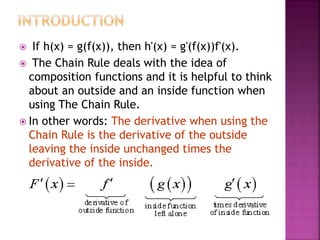
 If h(x) = g(f(x)), then h'(x) = g'(f(x))f'(x).
 The Chain Rule deals with the idea of
composition functions and it is helpful to think
about an outside and an inside function when
using The Chain Rule.
 In other words: The derivative when using the
Chain Rule is the derivative of the outside
leaving the inside unchanged times the
derivative of the inside.
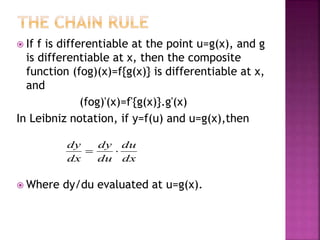
 If f is differentiable at the point u=g(x), and g
is differentiable at x, then the composite
function (fog)(x)=f{g(x)} is differentiable at x,
and
(fog)'(x)=f'{g(x)}.g'(x)
In Leibniz notation, if y=f(u) and u=g(x),then
 Where dy/du evaluated at u=g(x).
dx
du
du
dy
dx
dy

 We know how to differentiate sinx and x² - 4,
but how do we differentiate a composite like
sin (x² - 4)?
The answer is the Chain Rule.
 The Chain Rule is probably the most widely
used differentiation rule in mathematics.
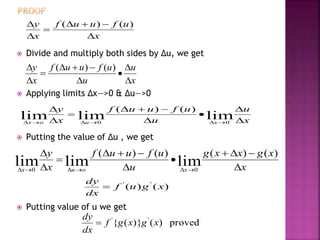
 If f and g are differentiable function, then its
composition function fog, and
 Let y=F(x) =fog(x) = f{g(x)}
 If u =g(x)
 y = F(x) = f(u)
 ∆y= F(x+∆x)-f(x)
 ∆y=f{g(x+∆x)}-f{g(x)}----------(1)
 ∆u=g(x+∆x)-g(x)
 ∆u+g(x)=g(x+∆x) This value we put in eq 1
 ∆y=f{∆u+g(x)}-f{g(x)}
 ∆y=f(∆u+u)-f(u)
 Dividing both sides by ∆x
''
)}]({[)]([ gxgfxfog
dx
d

 Divide and multiply both sides by ∆u, we get
 Applying limits ∆x—>0 & ∆u—>0
 Putting the value of ∆u , we get
 Putting value of u we get
x
ufuuf
x
y




 )()(
x
u
u
ufuuf
x
y







 )()(
x
u
u
ufuuf
x
y
xuox 








limlimlim 00
)()(
x
xgxxg
u
ufuuf
x
y
xoux 








)()()()(
limlimlim 00
)()( ''
xguf
dx
dy

proved)()}({ ''
xgxgf
dx
dy

2
7 6
3 5 3 10
7
u x x x
y
du
dy
du
x
u u
d


   
 
2 6
7(3 2 ) (3 10 )
dy
x x x
dx
  
2 7
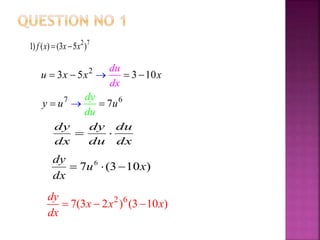
1) ( ) (3 5 )f x x x 
dx
du
du
dy
dx
dy

)103(7 6
xu
dx
dy

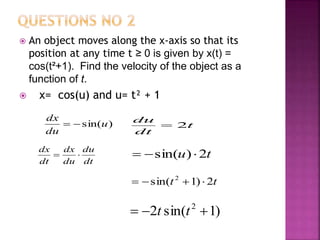
 An object moves along the x-axis so that its
position at any time t ≥ 0 is given by x(t) =
cos(t²+1). Find the velocity of the object as a
function of t.
 x= cos(u) and u= t² + 1
)sin(u
du
dx
 t
dt
du
2
dt
du
du
dx
dt
dx
 tu 2)sin( 
tt 2)1sin( 2

)1sin(2 2
 tt
     3 2
sin 3 sin sin
d d
dx dx
  
2
3sin cos 
)()}({)(sin)(sin 33
xgxgf
dx
d
dx
d
 
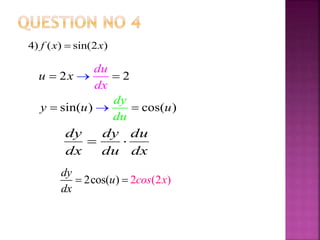
4) ( ) sin(2 )f x x
2 2
sin( ) cos( )
du
d
u x
y
y
d
u u
du
x


 
 
2co 2 (2 )s( )
dy
u
d
cos x
x
 
dx
du
du
dy
dx
dy

2
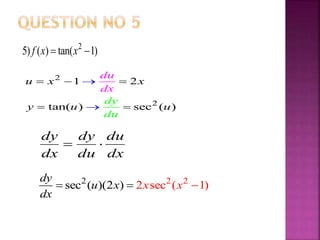
5) ( ) tan( 1)f x x 
2
2
1 2
tan( ) sec ( )
u x x
y u
dy
du
du
dx
u
  
 


2 2 2
2 secsec ( )(2 )) ( 1
dy
u x x
x
x
d
  
dx
du
du
dy
dx
dy

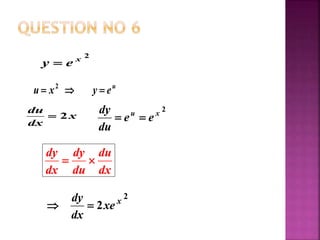
2
x
ey 
u
eyxu  2
x
dx
du
2
2
xu
ee
du
dy

dx
du
du
dy
dx
dy

2
2 x
xe
dx
dy

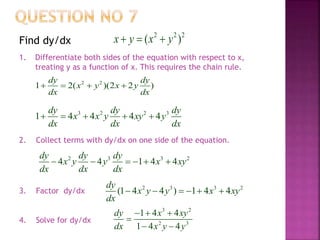
2 2 2
( )x y x y  Find dy/dx
1. Differentiate both sides of the equation with respect to x,
treating y as a function of x. This requires the chain rule.
2 2
1 2( )(2 2 )
dy dy
x y x y
dx dx
   
3 2 2 3
1 4 4 4 4
dy dy dy
x x y xy y
dx dx dx
    
2. Collect terms with dy/dx on one side of the equation.
2 3 3 2
4 4 1 4 4
dy dy dy
x y y x xy
dx dx dx
     
2 3 3 2
(1 4 4 ) 1 4 4
dy
x y y x xy
dx
     
3 2
2 3
1 4 4
1 4 4
dy x xy
dx x y y
  

 
4. Solve for dy/dx
3. Factor dy/dx
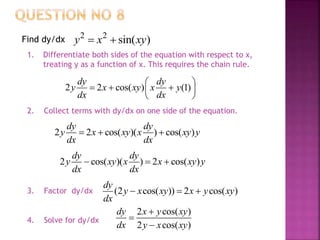
2 2
sin( )y x xy Find dy/dx
1. Differentiate both sides of the equation with respect to x,
treating y as a function of x. This requires the chain rule.
2 2 cos( ) (1)
dy dy
y x xy x y
dx dx
 
   
 
2. Collect terms with dy/dx on one side of the equation.
2 2 cos( )( ) cos( )
dy dy
y x xy x xy y
dx dx
  
2 cos( )( ) 2 cos( )
dy dy
y xy x x xy y
dx dx
  
(2 cos( )) 2 cos( )
dy
y x xy x y xy
dx
  
2 cos( )
2 cos( )
dy x y xy
dx y x xy



3. Factor dy/dx
4. Solve for dy/dx
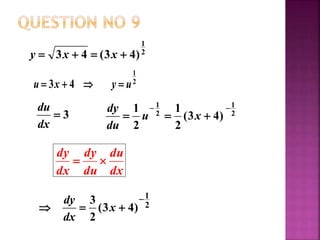
2
1
)43(43  xxy
2
1
43 uyxu 
3
dx
du 2
1
2
1
)43(
2
1
2
1 
 xu
du
dy
dx
du
du
dy
dx
dy

2
1
)43(
2
3 
 x
dx
dy
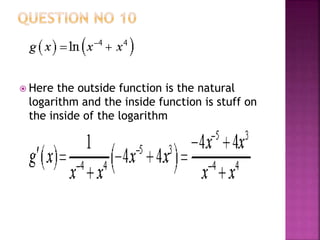
 Here the outside function is the natural
logarithm and the inside function is stuff on
the inside of the logarithm
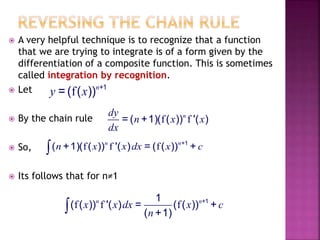
 A very helpful technique is to recognize that a function
that we are trying to integrate is of a form given by the
differentiation of a composite function. This is sometimes
called integration by recognition.
 Let
 By the chain rule
 So,
 Its follows that for n≠1
f +1
= ( ( ))n
y x
f f= ( +1)( ( )) '( )ndy
n x x
dx
f f f +1
( +1)( ( )) '( ) = ( ( )) +n n
n x x dx x c
f f f +11
( ( )) '( ) = ( ( )) +
( +1)
n n
x x dx x c
n
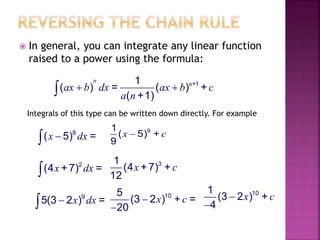
 In general, you can integrate any linear function
raised to a power using the formula:
+11
( ) = ( ) +
( +1)
n
n
ax b dx ax b c
a n
 
Integrals of this type can be written down directly. For example
8
( 5) =x dx
91
( 5) +
9
x c
2
(4 +7) =x dx
31
(4 + 7) +
12
x c
9
5(3 2 ) =x dx
105
(3 2 ) + =
20
x c

101
(3 2 ) +
4
x c

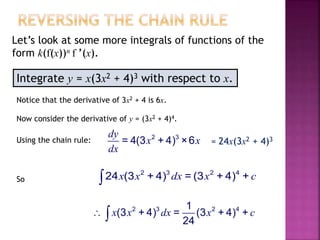
Integrate y = x(3x2 + 4)3 with respect to x.
Let’s look at some more integrals of functions of the
form k(f(x))n f ’(x).
Notice that the derivative of 3x2 + 4 is 6x.
Now consider the derivative of y = (3x2 + 4)4.
Using the chain rule: 2 3
= 4(3 + 4) ×6
dy
x x
dx
= 24x(3x2 + 4)3
So
2 3 2 4
24 (3 + 4) = (3 + 4) +x x dx x c
2 3 2 41
(3 + 4) = (3 + 4) +
24
x x dx x c 
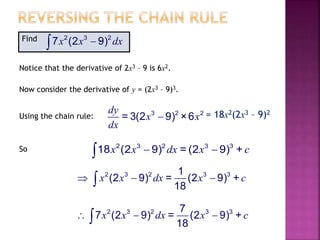
Find .2 3 2
7 (2 9)x x dx
Notice that the derivative of 2x3 – 9 is 6x2.
Now consider the derivative of y = (2x3 – 9)3.
Using the chain rule: 3 2 2
= 3(2 9) ×6
dy
x x
dx
 = 18x2(2x3 – 9)2
So 2 3 2 3 3
18 (2 9) = (2 9) +x x dx x c 
2 3 2 3 37
7 (2 9) = (2 9) +
18
x x dx x c  
2 3 2 3 31
(2 9) = (2 9) +
18
x x dx x c  
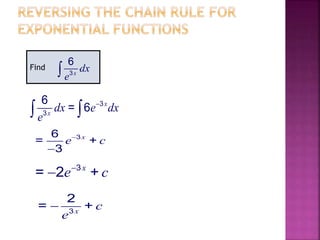
Find .
3
6
x
dx
e
3
3
6
= 6 x
x
dx e dx
e

 
36
= +
3
x
e c

3
= 2 +x
e c

3
2
= +x
c
e

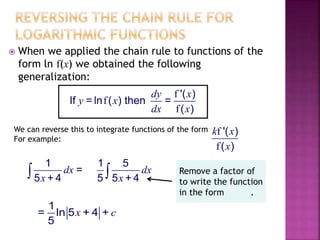
 When we applied the chain rule to functions of the
form ln f(x) we obtained the following
generalization:
f
f
f
'( )
If = ln ( ) then =
( )
dy x
y x
dx x
We can reverse this to integrate functions of the form
For example:
f
f
'( )
( )
k x
x
1
=
5 + 4
dx
x
1 5
5 5 + 4
dx
x
1
= ln 5 + 4 +
5
x c
Remove a factor of
to write the function
in the form .
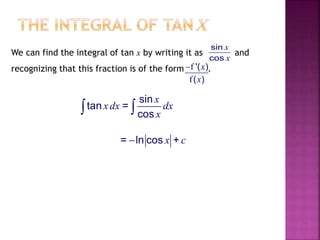
We can find the integral of tan x by writing it as and
recognizing that this fraction is of the form .
sin
tan =
cos
x
xdx dx
x 
= ln cos +x c
sin
cos
x
x
f
f
'( )
( )
x
x

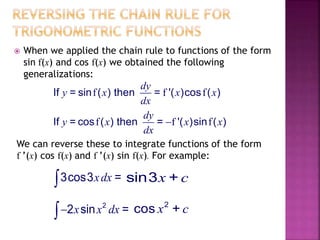
 When we applied the chain rule to functions of the form
sin f(x) and cos f(x) we obtained the following
generalizations:
f f fIf = sin ( ) then = '( )cos ( )
dy
y x x x
dx
f f fIf = cos ( ) then = '( )sin ( )
dy
y x x x
dx

We can reverse these to integrate functions of the form
f ’(x) cos f(x) and f ’(x) sin f(x). For example:
3cos3 =xdx sin3 +x c
2
2 sin =x x dx
2
cos +x c
The chain rule

The chain rule

  • 1.
  • 2.
     If h(x)= g(f(x)), then h'(x) = g'(f(x))f'(x).  The Chain Rule deals with the idea of composition functions and it is helpful to think about an outside and an inside function when using The Chain Rule.  In other words: The derivative when using the Chain Rule is the derivative of the outside leaving the inside unchanged times the derivative of the inside.
  • 3.
     If fis differentiable at the point u=g(x), and g is differentiable at x, then the composite function (fog)(x)=f{g(x)} is differentiable at x, and (fog)'(x)=f'{g(x)}.g'(x) In Leibniz notation, if y=f(u) and u=g(x),then  Where dy/du evaluated at u=g(x). dx du du dy dx dy 
  • 4.
     We knowhow to differentiate sinx and x² - 4, but how do we differentiate a composite like sin (x² - 4)? The answer is the Chain Rule.  The Chain Rule is probably the most widely used differentiation rule in mathematics.
  • 5.
     If fand g are differentiable function, then its composition function fog, and  Let y=F(x) =fog(x) = f{g(x)}  If u =g(x)  y = F(x) = f(u)  ∆y= F(x+∆x)-f(x)  ∆y=f{g(x+∆x)}-f{g(x)}----------(1)  ∆u=g(x+∆x)-g(x)  ∆u+g(x)=g(x+∆x) This value we put in eq 1  ∆y=f{∆u+g(x)}-f{g(x)}  ∆y=f(∆u+u)-f(u)  Dividing both sides by ∆x '' )}]({[)]([ gxgfxfog dx d 
  • 6.
     Divide andmultiply both sides by ∆u, we get  Applying limits ∆x—>0 & ∆u—>0  Putting the value of ∆u , we get  Putting value of u we get x ufuuf x y      )()( x u u ufuuf x y         )()( x u u ufuuf x y xuox          limlimlim 00 )()( x xgxxg u ufuuf x y xoux          )()()()( limlimlim 00 )()( '' xguf dx dy  proved)()}({ '' xgxgf dx dy 
  • 7.
    2 7 6 3 53 10 7 u x x x y du dy du x u u d         2 6 7(3 2 ) (3 10 ) dy x x x dx    2 7 1) ( ) (3 5 )f x x x  dx du du dy dx dy  )103(7 6 xu dx dy 
  • 8.
     An objectmoves along the x-axis so that its position at any time t ≥ 0 is given by x(t) = cos(t²+1). Find the velocity of the object as a function of t.  x= cos(u) and u= t² + 1 )sin(u du dx  t dt du 2 dt du du dx dt dx  tu 2)sin(  tt 2)1sin( 2  )1sin(2 2  tt
  • 9.
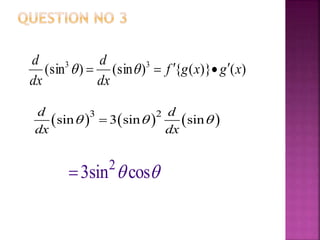
        3 2 sin 3 sin sin d d dx dx    2 3sin cos  )()}({)(sin)(sin 33 xgxgf dx d dx d  
  • 10.
    4) ( )sin(2 )f x x 2 2 sin( ) cos( ) du d u x y y d u u du x       2co 2 (2 )s( ) dy u d cos x x   dx du du dy dx dy 
  • 11.
    2 5) ( )tan( 1)f x x  2 2 1 2 tan( ) sec ( ) u x x y u dy du du dx u        2 2 2 2 secsec ( )(2 )) ( 1 dy u x x x x d    dx du du dy dx dy 
  • 12.
    2 x ey  u eyxu 2 x dx du 2 2 xu ee du dy  dx du du dy dx dy  2 2 x xe dx dy 
  • 13.
    2 2 2 ()x y x y  Find dy/dx 1. Differentiate both sides of the equation with respect to x, treating y as a function of x. This requires the chain rule. 2 2 1 2( )(2 2 ) dy dy x y x y dx dx     3 2 2 3 1 4 4 4 4 dy dy dy x x y xy y dx dx dx      2. Collect terms with dy/dx on one side of the equation. 2 3 3 2 4 4 1 4 4 dy dy dy x y y x xy dx dx dx       2 3 3 2 (1 4 4 ) 1 4 4 dy x y y x xy dx       3 2 2 3 1 4 4 1 4 4 dy x xy dx x y y       4. Solve for dy/dx 3. Factor dy/dx
  • 14.
    2 2 sin( )yx xy Find dy/dx 1. Differentiate both sides of the equation with respect to x, treating y as a function of x. This requires the chain rule. 2 2 cos( ) (1) dy dy y x xy x y dx dx         2. Collect terms with dy/dx on one side of the equation. 2 2 cos( )( ) cos( ) dy dy y x xy x xy y dx dx    2 cos( )( ) 2 cos( ) dy dy y xy x x xy y dx dx    (2 cos( )) 2 cos( ) dy y x xy x y xy dx    2 cos( ) 2 cos( ) dy x y xy dx y x xy    3. Factor dy/dx 4. Solve for dy/dx
  • 15.
    2 1 )43(43  xxy 2 1 43uyxu  3 dx du 2 1 2 1 )43( 2 1 2 1   xu du dy dx du du dy dx dy  2 1 )43( 2 3   x dx dy
  • 16.
     Here theoutside function is the natural logarithm and the inside function is stuff on the inside of the logarithm
  • 17.
     A veryhelpful technique is to recognize that a function that we are trying to integrate is of a form given by the differentiation of a composite function. This is sometimes called integration by recognition.  Let  By the chain rule  So,  Its follows that for n≠1 f +1 = ( ( ))n y x f f= ( +1)( ( )) '( )ndy n x x dx f f f +1 ( +1)( ( )) '( ) = ( ( )) +n n n x x dx x c f f f +11 ( ( )) '( ) = ( ( )) + ( +1) n n x x dx x c n
  • 18.
     In general,you can integrate any linear function raised to a power using the formula: +11 ( ) = ( ) + ( +1) n n ax b dx ax b c a n   Integrals of this type can be written down directly. For example 8 ( 5) =x dx 91 ( 5) + 9 x c 2 (4 +7) =x dx 31 (4 + 7) + 12 x c 9 5(3 2 ) =x dx 105 (3 2 ) + = 20 x c  101 (3 2 ) + 4 x c 
  • 19.
    Integrate y =x(3x2 + 4)3 with respect to x. Let’s look at some more integrals of functions of the form k(f(x))n f ’(x). Notice that the derivative of 3x2 + 4 is 6x. Now consider the derivative of y = (3x2 + 4)4. Using the chain rule: 2 3 = 4(3 + 4) ×6 dy x x dx = 24x(3x2 + 4)3 So 2 3 2 4 24 (3 + 4) = (3 + 4) +x x dx x c 2 3 2 41 (3 + 4) = (3 + 4) + 24 x x dx x c 
  • 20.
    Find .2 32 7 (2 9)x x dx Notice that the derivative of 2x3 – 9 is 6x2. Now consider the derivative of y = (2x3 – 9)3. Using the chain rule: 3 2 2 = 3(2 9) ×6 dy x x dx  = 18x2(2x3 – 9)2 So 2 3 2 3 3 18 (2 9) = (2 9) +x x dx x c  2 3 2 3 37 7 (2 9) = (2 9) + 18 x x dx x c   2 3 2 3 31 (2 9) = (2 9) + 18 x x dx x c  
  • 21.
    Find . 3 6 x dx e 3 3 6 = 6x x dx e dx e    36 = + 3 x e c  3 = 2 +x e c  3 2 = +x c e 
  • 22.
     When weapplied the chain rule to functions of the form ln f(x) we obtained the following generalization: f f f '( ) If = ln ( ) then = ( ) dy x y x dx x We can reverse this to integrate functions of the form For example: f f '( ) ( ) k x x 1 = 5 + 4 dx x 1 5 5 5 + 4 dx x 1 = ln 5 + 4 + 5 x c Remove a factor of to write the function in the form .
  • 23.
    We can findthe integral of tan x by writing it as and recognizing that this fraction is of the form . sin tan = cos x xdx dx x  = ln cos +x c sin cos x x f f '( ) ( ) x x 
  • 24.
     When weapplied the chain rule to functions of the form sin f(x) and cos f(x) we obtained the following generalizations: f f fIf = sin ( ) then = '( )cos ( ) dy y x x x dx f f fIf = cos ( ) then = '( )sin ( ) dy y x x x dx  We can reverse these to integrate functions of the form f ’(x) cos f(x) and f ’(x) sin f(x). For example: 3cos3 =xdx sin3 +x c 2 2 sin =x x dx 2 cos +x c