
PRESENTED TO: MR. K.S. BUMRAH
PRESENTED BY: PAPU KUMAR
SECTION: B
ROLL:- 2061424(47)
SEMESTER: III
BRANCH: C.S.E.
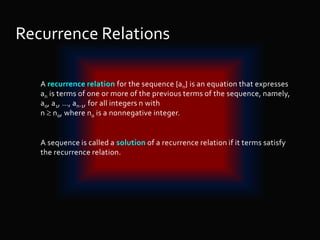
A recurrence relation for the sequence {an} is an equation that expresses
an is terms of one or more of the previous terms of the sequence, namely,
a0, a1, …, an-1, for all integers n with
n  n0, where n0 is a nonnegative integer.
A sequence is called a solution of a recurrence relation if it terms satisfy
the recurrence relation.
Recurrence Relations
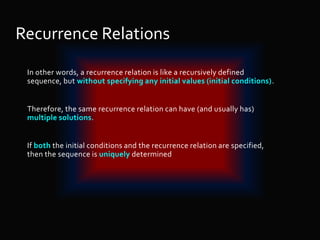
In other words, a recurrence relation is like a recursively defined
sequence, but without specifying any initial values (initial conditions).
Therefore, the same recurrence relation can have (and usually has)
multiple solutions.
If both the initial conditions and the recurrence relation are specified,
then the sequence is uniquely determined
Recurrence Relations
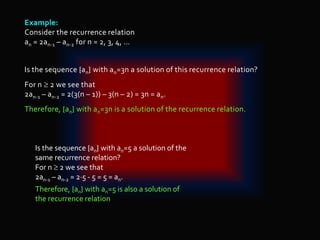
Example:
Consider the recurrence relation
an = 2an-1 – an-2 for n = 2, 3, 4, …
Is the sequence {an} with an=3n a solution of this recurrence relation?
For n  2 we see that
2an-1 – an-2 = 2(3(n – 1)) – 3(n – 2) = 3n = an.
Therefore, {an} with an=3n is a solution of the recurrence relation.
Is the sequence {an} with an=5 a solution of the
same recurrence relation?
For n  2 we see that
2an-1 – an-2 = 25 - 5 = 5 = an.
Therefore, {an} with an=5 is also a solution of
the recurrence relation
Example:
Someone deposits $10,000 in a savings account at a bank yielding 5% per year
with interest compounded annually. How much money will be in the account
after 30 years?
We can derive the following recurrence relation:
Pn = Pn-1 + 0.05Pn-1 = 1.05Pn-1.
The initial condition is P0 = 10,000.
Then we have:
P1 = 1.05P0
P2 = 1.05P1 = (1.05)2P0
P3 = 1.05P2 = (1.05)3P0
…
Pn = 1.05Pn-1 = (1.05)nP0
Applications :
Financial Recurrence Relations
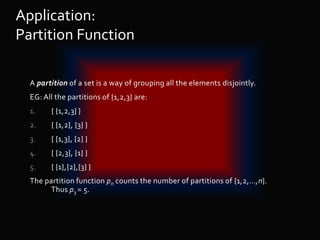
A partition of a set is a way of grouping all the elements disjointly.
EG: All the partitions of {1,2,3} are:
1. { {1,2,3} }
2. { {1,2}, {3} }
3. { {1,3}, {2} }
4. { {2,3}, {1} }
5. { {1},{2},{3} }
The partition function pn counts the number of partitions of {1,2,…,n}.
Thus p3 = 5.
Application:
Partition Function
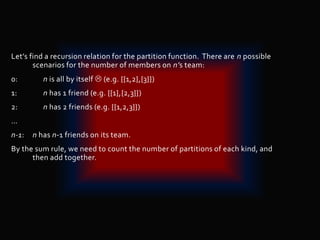
Let’s find a recursion relation for the partition function. There are n possible
scenarios for the number of members on n’s team:
0: n is all by itself  (e.g. {{1,2},{3}})
1: n has 1 friend (e.g. {{1},{2,3}})
2: n has 2 friends (e.g. {{1,2,3}})
…
n-1: n has n-1 friends on its team.
By the sum rule, we need to count the number of partitions of each kind, and
then add together.
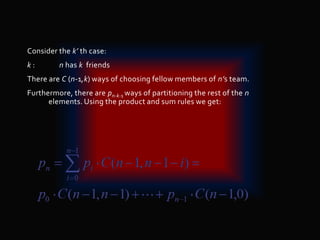
Consider the k’ th case:
k : n has k friends
There are C (n-1,k) ways of choosing fellow members of n’s team.
Furthermore, there are pn-k-1 ways of partitioning the rest of the n
elements. Using the product and sum rules we get:
Recurrence relations are also of fundamental importance in Analysis
of Algorithms. If an algorithm is designed so that it will break a
problem into smaller sub problems, its running time is described by a
recurrence relation.
A simple example is the time an algorithm takes to search an element
in an ordered vector with elements, in the worst case.
A naive algorithm will search from left to right, one element at a time.
The worst possible scenario is when the required element is the last,
so the number of comparisons is .
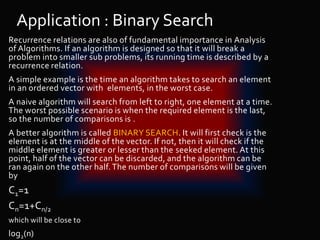
A better algorithm is called BINARY SEARCH. It will first check is the
element is at the middle of the vector. If not, then it will check if the
middle element is greater or lesser than the seeked element. At this
point, half of the vector can be discarded, and the algorithm can be
ran again on the other half.The number of comparisons will be given
by
C1=1
Cn=1+Cn/2
which will be close to
log2(n)
Application : Binary Search
In general, we would prefer to have an explicit formula to compute the
value of an rather than conducting n iterations.
For one class of recurrence relations, we can obtain such formulas in a
systematic way.
Those are the recurrence relations that express the terms of a sequence
as linear combinations of previous terms.
Solving Recurrence Relations
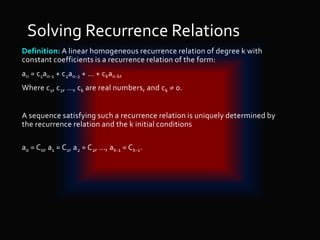
Definition: A linear homogeneous recurrence relation of degree k with
constant coefficients is a recurrence relation of the form:
an = c1an-1 + c2an-2 + … + ckan-k,
Where c1, c2, …, ck are real numbers, and ck  0.
A sequence satisfying such a recurrence relation is uniquely determined by
the recurrence relation and the k initial conditions
a0 = C0, a1 = C1, a2 = C2, …, ak-1 = Ck-1.
Solving Recurrence Relations
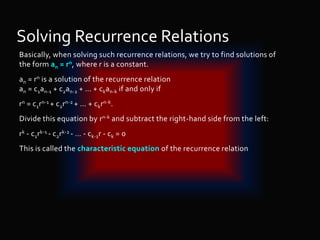
Basically, when solving such recurrence relations, we try to find solutions of
the form an = rn, where r is a constant.
an = rn is a solution of the recurrence relation
an = c1an-1 + c2an-2 + … + ckan-k if and only if
rn = c1rn-1 + c2rn-2 + … + ckrn-k.
Divide this equation by rn-k and subtract the right-hand side from the left:
rk - c1rk-1 - c2rk-2 - … - ck-1r - ck = 0
This is called the characteristic equation of the recurrence relation
Solving Recurrence Relations
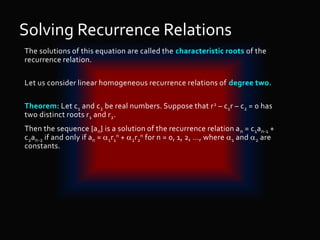
The solutions of this equation are called the characteristic roots of the
recurrence relation.
Let us consider linear homogeneous recurrence relations of degree two.
Theorem: Let c1 and c2 be real numbers. Suppose that r2 – c1r – c2 = 0 has
two distinct roots r1 and r2.
Then the sequence {an} is a solution of the recurrence relation an = c1an-1 +
c2an-2 if and only if an = 1r1
n + 2r2
n for n = 0, 1, 2, …, where 1 and 2 are
constants.
Solving Recurrence Relations
Recurrence Relation

Recurrence Relation

  • 1.
    PRESENTED TO: MR.K.S. BUMRAH PRESENTED BY: PAPU KUMAR SECTION: B ROLL:- 2061424(47) SEMESTER: III BRANCH: C.S.E.
  • 2.
    A recurrence relationfor the sequence {an} is an equation that expresses an is terms of one or more of the previous terms of the sequence, namely, a0, a1, …, an-1, for all integers n with n  n0, where n0 is a nonnegative integer. A sequence is called a solution of a recurrence relation if it terms satisfy the recurrence relation. Recurrence Relations
  • 3.
    In other words,a recurrence relation is like a recursively defined sequence, but without specifying any initial values (initial conditions). Therefore, the same recurrence relation can have (and usually has) multiple solutions. If both the initial conditions and the recurrence relation are specified, then the sequence is uniquely determined Recurrence Relations
  • 4.
    Example: Consider the recurrencerelation an = 2an-1 – an-2 for n = 2, 3, 4, … Is the sequence {an} with an=3n a solution of this recurrence relation? For n  2 we see that 2an-1 – an-2 = 2(3(n – 1)) – 3(n – 2) = 3n = an. Therefore, {an} with an=3n is a solution of the recurrence relation. Is the sequence {an} with an=5 a solution of the same recurrence relation? For n  2 we see that 2an-1 – an-2 = 25 - 5 = 5 = an. Therefore, {an} with an=5 is also a solution of the recurrence relation
  • 5.
    Example: Someone deposits $10,000in a savings account at a bank yielding 5% per year with interest compounded annually. How much money will be in the account after 30 years? We can derive the following recurrence relation: Pn = Pn-1 + 0.05Pn-1 = 1.05Pn-1. The initial condition is P0 = 10,000. Then we have: P1 = 1.05P0 P2 = 1.05P1 = (1.05)2P0 P3 = 1.05P2 = (1.05)3P0 … Pn = 1.05Pn-1 = (1.05)nP0 Applications : Financial Recurrence Relations
  • 6.
    A partition ofa set is a way of grouping all the elements disjointly. EG: All the partitions of {1,2,3} are: 1. { {1,2,3} } 2. { {1,2}, {3} } 3. { {1,3}, {2} } 4. { {2,3}, {1} } 5. { {1},{2},{3} } The partition function pn counts the number of partitions of {1,2,…,n}. Thus p3 = 5. Application: Partition Function
  • 7.
    Let’s find arecursion relation for the partition function. There are n possible scenarios for the number of members on n’s team: 0: n is all by itself  (e.g. {{1,2},{3}}) 1: n has 1 friend (e.g. {{1},{2,3}}) 2: n has 2 friends (e.g. {{1,2,3}}) … n-1: n has n-1 friends on its team. By the sum rule, we need to count the number of partitions of each kind, and then add together.
  • 8.
    Consider the k’th case: k : n has k friends There are C (n-1,k) ways of choosing fellow members of n’s team. Furthermore, there are pn-k-1 ways of partitioning the rest of the n elements. Using the product and sum rules we get:
  • 9.
    Recurrence relations arealso of fundamental importance in Analysis of Algorithms. If an algorithm is designed so that it will break a problem into smaller sub problems, its running time is described by a recurrence relation. A simple example is the time an algorithm takes to search an element in an ordered vector with elements, in the worst case. A naive algorithm will search from left to right, one element at a time. The worst possible scenario is when the required element is the last, so the number of comparisons is . A better algorithm is called BINARY SEARCH. It will first check is the element is at the middle of the vector. If not, then it will check if the middle element is greater or lesser than the seeked element. At this point, half of the vector can be discarded, and the algorithm can be ran again on the other half.The number of comparisons will be given by C1=1 Cn=1+Cn/2 which will be close to log2(n) Application : Binary Search
  • 10.
    In general, wewould prefer to have an explicit formula to compute the value of an rather than conducting n iterations. For one class of recurrence relations, we can obtain such formulas in a systematic way. Those are the recurrence relations that express the terms of a sequence as linear combinations of previous terms. Solving Recurrence Relations
  • 11.
    Definition: A linearhomogeneous recurrence relation of degree k with constant coefficients is a recurrence relation of the form: an = c1an-1 + c2an-2 + … + ckan-k, Where c1, c2, …, ck are real numbers, and ck  0. A sequence satisfying such a recurrence relation is uniquely determined by the recurrence relation and the k initial conditions a0 = C0, a1 = C1, a2 = C2, …, ak-1 = Ck-1. Solving Recurrence Relations
  • 12.
    Basically, when solvingsuch recurrence relations, we try to find solutions of the form an = rn, where r is a constant. an = rn is a solution of the recurrence relation an = c1an-1 + c2an-2 + … + ckan-k if and only if rn = c1rn-1 + c2rn-2 + … + ckrn-k. Divide this equation by rn-k and subtract the right-hand side from the left: rk - c1rk-1 - c2rk-2 - … - ck-1r - ck = 0 This is called the characteristic equation of the recurrence relation Solving Recurrence Relations
  • 13.
    The solutions ofthis equation are called the characteristic roots of the recurrence relation. Let us consider linear homogeneous recurrence relations of degree two. Theorem: Let c1 and c2 be real numbers. Suppose that r2 – c1r – c2 = 0 has two distinct roots r1 and r2. Then the sequence {an} is a solution of the recurrence relation an = c1an-1 + c2an-2 if and only if an = 1r1 n + 2r2 n for n = 0, 1, 2, …, where 1 and 2 are constants. Solving Recurrence Relations