
DEPARTMENT OF CIVIL ENGINEERING
GOVT. POLYTECHNIC MANESAR, GURGAON
HARYANA
Reinforced Soil Retaining Walls
Study Work
Guided By-
Mr. M.P. Singh
Submitted by-
Mohit Goyal
13007070060
Reinforced soil• Reinforced earth is a combination of earth and linear reinforcing strips that are
capable of bearing large tensile stresses.
• The reinforcement provided by these strips enable the mass to resist the
tension in a way which the earth alone could not. The source of this resistance
to tension is the internal friction of soil, because the stresses that are created
within the mass are transferred from soil to the reinforcement strips by
friction.
Retaining walls
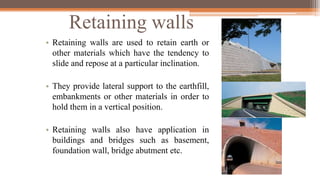
• Retaining walls are used to retain earth or
other materials which have the tendency to
slide and repose at a particular inclination.
• They provide lateral support to the earthfill,
embankments or other materials in order to
hold them in a vertical position.
• Retaining walls also have application in
buildings and bridges such as basement,
foundation wall, bridge abutment etc.
Idea of Reinforced Soil
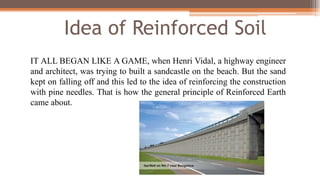
IT ALL BEGAN LIKE A GAME, when Henri Vidal, a highway engineer
and architect, was trying to built a sandcastle on the beach. But the sand
kept on falling off and this led to the idea of reinforcing the construction
with pine needles. That is how the general principle of Reinforced Earth
came about.
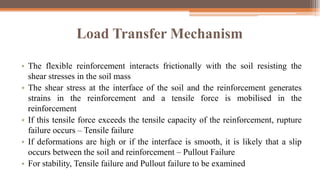
Load Transfer Mechanism
• The flexible reinforcement interacts frictionally with the soil resisting the
shear stresses in the soil mass
• The shear stress at the interface of the soil and the reinforcement generates
strains in the reinforcement and a tensile force is mobilised in the
reinforcement
• If this tensile force exceeds the tensile capacity of the reinforcement, rupture
failure occurs – Tensile failure
• If deformations are high or if the interface is smooth, it is likely that a slip
occurs between the soil and reinforcement – Pullout Failure
• For stability, Tensile failure and Pullout failure to be examined
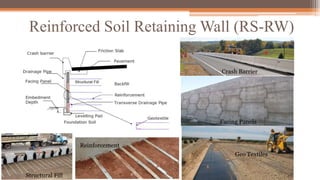
Reinforced Soil Retaining Wall (RS-RW)
Crash Barrier
Facing Panels
Geo Textiles
Reinforcement
Structural Fill
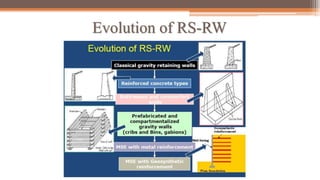
Evolution of RS-RW
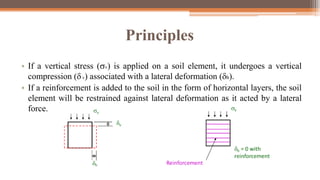
Principles
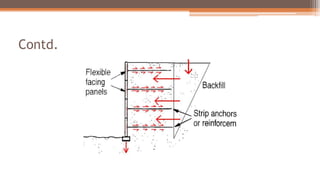
• If a vertical stress (v) is applied on a soil element, it undergoes a vertical
compression (v) associated with a lateral deformation (h).
• If a reinforcement is added to the soil in the form of horizontal layers, the soil
element will be restrained against lateral deformation as it acted by a lateral
force.
Contd.
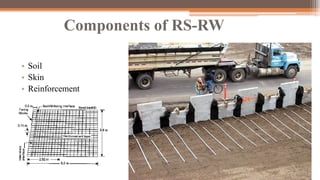
Components of RS-RW
• Soil
• Skin
• Reinforcement
Soil
• It should be granular, cohesion less material, not too much silt or clay having
particle size not more than 125 mm.
• Not more than 10 percent of the particles shall pass 75 micron sieve & the
earth reinforcement coefficient of friction to be either higher than or equal to
0.4 & Plasticity Index < 6.
• The soil must have a moisture content suitable for compaction.
Skin
• Skin is the facing element of the reinforced soil wall.
• These elements support the backfill and keeps the reinforcement at a desired
elevation in the reinforced soil wall and also protect the granular at the edge
falling off.
• Made of either metal units or precast concrete panels.
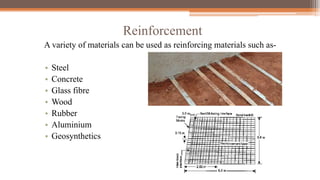
Reinforcement
A variety of materials can be used as reinforcing materials such as-
• Steel
• Concrete
• Glass fibre
• Wood
• Rubber
• Aluminium
• Geosynthetics
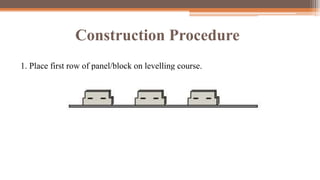
Construction Procedure
1. Place first row of panel/block on levelling course.
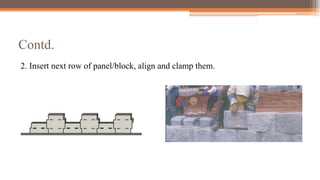
Contd.
2. Insert next row of panel/block, align and clamp them.
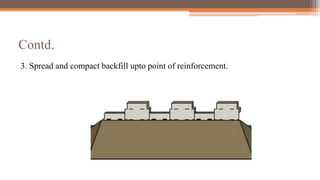
Contd.
3. Spread and compact backfill upto point of reinforcement.
Contd.
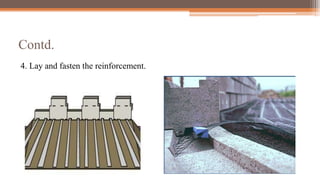
4. Lay and fasten the reinforcement.
Contd.
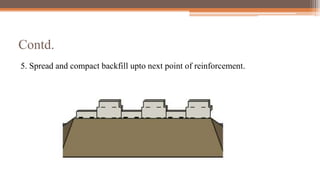
5. Spread and compact backfill upto next point of reinforcement.
Contd.
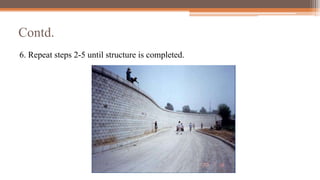
6. Repeat steps 2-5 until structure is completed.
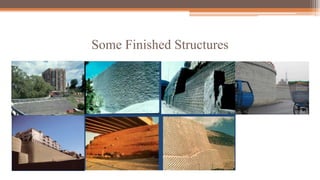
Some Finished Structures
Applications
1. Roads
2. Airfields
3. Railroads
4. Embankments
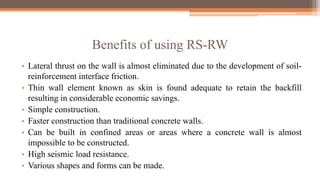
5. Retaining structures
Benefits of using RS-RW
• Lateral thrust on the wall is almost eliminated due to the development of soil-
reinforcement interface friction.
• Thin wall element known as skin is found adequate to retain the backfill
resulting in considerable economic savings.
• Simple construction.
• Faster construction than traditional concrete walls.
• Can be built in confined areas or areas where a concrete wall is almost
impossible to be constructed.
• High seismic load resistance.
• Various shapes and forms can be made.
Conclusion
• Reinforced soil retaining walls have evolved as viable technique and
contributed to infrastructure in terms of speed, ease of construction, economy,
aesthetics etc.
• It is a technology that needs to be understood well in terms of its response,
construction features etc. Failures of RE walls have also been noted in a few
places due to lack of understanding of behaviour of reinforced soil walls.
References
1. i) Ranjan Gopal and Rao ASR “Basic and Applied Soil Mechanics”, New Age Publication
(P) Ltd., New Delhi
2. ii) Singh Harbhajan “Soil and Foundation Engineering”, Abhishek Publishers, Chandigarh
3. iii) S Mittal and JP Shukla, “Soil Testing for Engineers”, Khanna Publishers Ltd., Delhi
4. iv) BIS Codes IS 6403 (latest edition) and IS 1498 (latest edition)
5. v) Jagroop Singh, “Soil and Foundation Engineering”, Eagle Parkashan, Jalandhar
6. Vi) http://www.bayt.com/en/specialties/q/178593/in-engineering-what-is-the-meaning-of-
soil-reinforcement/
7. Vii) http://www.sciencedirect.com/science/article/pii/S0950061811006763
8. Viii) https://en.wikipedia.org/wiki/Mechanically_stabilized_earth
Thank You

Reinforced soil

  • 1.
    DEPARTMENT OF CIVILENGINEERING GOVT. POLYTECHNIC MANESAR, GURGAON HARYANA Reinforced Soil Retaining Walls Study Work Guided By- Mr. M.P. Singh Submitted by- Mohit Goyal 13007070060
  • 2.
    Reinforced soil• Reinforcedearth is a combination of earth and linear reinforcing strips that are capable of bearing large tensile stresses. • The reinforcement provided by these strips enable the mass to resist the tension in a way which the earth alone could not. The source of this resistance to tension is the internal friction of soil, because the stresses that are created within the mass are transferred from soil to the reinforcement strips by friction.
  • 3.
    Retaining walls • Retainingwalls are used to retain earth or other materials which have the tendency to slide and repose at a particular inclination. • They provide lateral support to the earthfill, embankments or other materials in order to hold them in a vertical position. • Retaining walls also have application in buildings and bridges such as basement, foundation wall, bridge abutment etc.
  • 4.
    Idea of ReinforcedSoil IT ALL BEGAN LIKE A GAME, when Henri Vidal, a highway engineer and architect, was trying to built a sandcastle on the beach. But the sand kept on falling off and this led to the idea of reinforcing the construction with pine needles. That is how the general principle of Reinforced Earth came about.
  • 5.
    Load Transfer Mechanism •The flexible reinforcement interacts frictionally with the soil resisting the shear stresses in the soil mass • The shear stress at the interface of the soil and the reinforcement generates strains in the reinforcement and a tensile force is mobilised in the reinforcement • If this tensile force exceeds the tensile capacity of the reinforcement, rupture failure occurs – Tensile failure • If deformations are high or if the interface is smooth, it is likely that a slip occurs between the soil and reinforcement – Pullout Failure • For stability, Tensile failure and Pullout failure to be examined
  • 6.
    Reinforced Soil RetainingWall (RS-RW) Crash Barrier Facing Panels Geo Textiles Reinforcement Structural Fill
  • 7.
  • 8.
    Principles • If avertical stress (v) is applied on a soil element, it undergoes a vertical compression (v) associated with a lateral deformation (h). • If a reinforcement is added to the soil in the form of horizontal layers, the soil element will be restrained against lateral deformation as it acted by a lateral force.
  • 9.
  • 10.
    Components of RS-RW •Soil • Skin • Reinforcement
  • 11.
    Soil • It shouldbe granular, cohesion less material, not too much silt or clay having particle size not more than 125 mm. • Not more than 10 percent of the particles shall pass 75 micron sieve & the earth reinforcement coefficient of friction to be either higher than or equal to 0.4 & Plasticity Index < 6. • The soil must have a moisture content suitable for compaction.
  • 12.
    Skin • Skin isthe facing element of the reinforced soil wall. • These elements support the backfill and keeps the reinforcement at a desired elevation in the reinforced soil wall and also protect the granular at the edge falling off. • Made of either metal units or precast concrete panels.
  • 13.
    Reinforcement A variety ofmaterials can be used as reinforcing materials such as- • Steel • Concrete • Glass fibre • Wood • Rubber • Aluminium • Geosynthetics
  • 14.
    Construction Procedure 1. Placefirst row of panel/block on levelling course.
  • 15.
    Contd. 2. Insert nextrow of panel/block, align and clamp them.
  • 16.
    Contd. 3. Spread andcompact backfill upto point of reinforcement.
  • 17.
    Contd. 4. Lay andfasten the reinforcement.
  • 18.
    Contd. 5. Spread andcompact backfill upto next point of reinforcement.
  • 19.
    Contd. 6. Repeat steps2-5 until structure is completed.
  • 20.
  • 21.
    Applications 1. Roads 2. Airfields 3.Railroads 4. Embankments 5. Retaining structures
  • 22.
    Benefits of usingRS-RW • Lateral thrust on the wall is almost eliminated due to the development of soil- reinforcement interface friction. • Thin wall element known as skin is found adequate to retain the backfill resulting in considerable economic savings. • Simple construction. • Faster construction than traditional concrete walls. • Can be built in confined areas or areas where a concrete wall is almost impossible to be constructed. • High seismic load resistance. • Various shapes and forms can be made.
  • 23.
    Conclusion • Reinforced soilretaining walls have evolved as viable technique and contributed to infrastructure in terms of speed, ease of construction, economy, aesthetics etc. • It is a technology that needs to be understood well in terms of its response, construction features etc. Failures of RE walls have also been noted in a few places due to lack of understanding of behaviour of reinforced soil walls.
  • 24.
    References 1. i) RanjanGopal and Rao ASR “Basic and Applied Soil Mechanics”, New Age Publication (P) Ltd., New Delhi 2. ii) Singh Harbhajan “Soil and Foundation Engineering”, Abhishek Publishers, Chandigarh 3. iii) S Mittal and JP Shukla, “Soil Testing for Engineers”, Khanna Publishers Ltd., Delhi 4. iv) BIS Codes IS 6403 (latest edition) and IS 1498 (latest edition) 5. v) Jagroop Singh, “Soil and Foundation Engineering”, Eagle Parkashan, Jalandhar 6. Vi) http://www.bayt.com/en/specialties/q/178593/in-engineering-what-is-the-meaning-of- soil-reinforcement/ 7. Vii) http://www.sciencedirect.com/science/article/pii/S0950061811006763 8. Viii) https://en.wikipedia.org/wiki/Mechanically_stabilized_earth
  • 25.