VISHWAKARMA GOVT.
ENGINEERING
COLLEGE,CHANDKHEDA
Prepared By :-
Gamit Kaushal A.
CALIFORNIA BERING RATIO (CBR) TEST
 This is a penetration test developed by the
california division of highway.
 This is most widely used method for the
design of flexible pavement.
 The thickness of the different element
comprising a pavement is determine by CBR
value.
Apparatus
a) Cylindrical mould of inside dia. 150 mm & height 175 mm
with a detachable collar & a base plate,
b) Spacer disc of 148 mm in Dia. & 47.7 mm height,
c) Surcharge weight of mass 2.5 kg,
d) Penetration plunger of 50 mm dia. & height 100 mm,
e) Loading m/c of capacity of 500 kg,
f) Compaction rammers,
g) Dial gauges, Filter paper, Mixing tools, Measuring cylinder,
TEST PROCEDURE
 Test specimen can be prepared either by static compaction or
by dynamic compaction.
• In static compaction soil is compacted in loading m/c, while in
dynamic compaction soil is compacted by specified rammers.
• Dynamically compacted specimen can be prepared by light
compaction or by heavy compaction.
Dynamic Compaction Light compaction Heavy Compaction
Rammer Weight 2.6 kg 4.89 kg
No. of layer 3 5
Free Fall 31 cm 45 cm
Blows per layer 56 56
• Fix the collar to the top of the mould & the base plate to its
bottom.
• Insert the spacer disc over the base with the central hole of
disc at lower side & put disc of course filter paper on the top
of spacer disc.
• Take about 5 kg of soil passing 20 mm sieve but retained on
4.75 mm sieve.
• Add predetermined quantity of water such that w/c of soil is
either equal to OMC or FMC & mix throughly.
• Compact the mixed soil in the mould using either the light or
heavy compaction.
• After compacting remove the collar ,base plate ,& filter paper.
• Note down weight of soil along with mould.
• Then place the mould assembly on the penetration test m/c
& fix the penetration plunger.
• Allow the plunger to penetrate at rate of 1.25 mm / min.
• Record the load reading at penetrations of 0, 0.5, 1, 1.5, 2,
4, 5, 7.5, 10 & 12.5 mm.
• Draw graph of penetration v/s load.
CBR Value =
Test load corresponding to 2.5mm or 5 mm * 100%
Standard load for 2.5 or 5 mm penetration
Standard Load Value
Penetration
( mm )
Unit Load
( kg / cm^2 )
Total Load
( kg )
2.5 70 1350
5.0 105 2055
• The curve is mainly convex upward although the
initial portion of the curve may be concave
upwards. A correction is then applied by drawing a
tangent to the curve at the point of greatest slope.
The corrected origin will be point where the
tangent meets the abscissa.
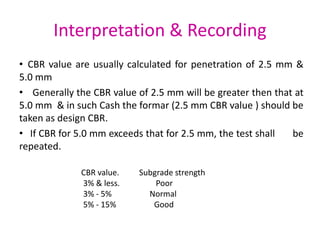
Interpretation & Recording
• CBR value are usually calculated for penetration of 2.5 mm &
5.0 mm
• Generally the CBR value of 2.5 mm will be greater then that at
5.0 mm & in such Cash the formar (2.5 mm CBR value ) should be
taken as design CBR.
• If CBR for 5.0 mm exceeds that for 2.5 mm, the test shall be
repeated.
CBR value. Subgrade strength
​ 3% & less. Poor
​ 3% - 5% Normal
​ 5% - 15% Good
Cbr test

Cbr test

  • 1.
  • 2.
    CALIFORNIA BERING RATIO(CBR) TEST  This is a penetration test developed by the california division of highway.  This is most widely used method for the design of flexible pavement.  The thickness of the different element comprising a pavement is determine by CBR value.
  • 3.
    Apparatus a) Cylindrical mouldof inside dia. 150 mm & height 175 mm with a detachable collar & a base plate, b) Spacer disc of 148 mm in Dia. & 47.7 mm height, c) Surcharge weight of mass 2.5 kg, d) Penetration plunger of 50 mm dia. & height 100 mm, e) Loading m/c of capacity of 500 kg, f) Compaction rammers, g) Dial gauges, Filter paper, Mixing tools, Measuring cylinder,
  • 5.
    TEST PROCEDURE  Testspecimen can be prepared either by static compaction or by dynamic compaction. • In static compaction soil is compacted in loading m/c, while in dynamic compaction soil is compacted by specified rammers. • Dynamically compacted specimen can be prepared by light compaction or by heavy compaction. Dynamic Compaction Light compaction Heavy Compaction Rammer Weight 2.6 kg 4.89 kg No. of layer 3 5 Free Fall 31 cm 45 cm Blows per layer 56 56
  • 6.
    • Fix thecollar to the top of the mould & the base plate to its bottom. • Insert the spacer disc over the base with the central hole of disc at lower side & put disc of course filter paper on the top of spacer disc. • Take about 5 kg of soil passing 20 mm sieve but retained on 4.75 mm sieve. • Add predetermined quantity of water such that w/c of soil is either equal to OMC or FMC & mix throughly. • Compact the mixed soil in the mould using either the light or heavy compaction. • After compacting remove the collar ,base plate ,& filter paper. • Note down weight of soil along with mould.
  • 7.
    • Then placethe mould assembly on the penetration test m/c & fix the penetration plunger. • Allow the plunger to penetrate at rate of 1.25 mm / min. • Record the load reading at penetrations of 0, 0.5, 1, 1.5, 2, 4, 5, 7.5, 10 & 12.5 mm. • Draw graph of penetration v/s load. CBR Value = Test load corresponding to 2.5mm or 5 mm * 100% Standard load for 2.5 or 5 mm penetration Standard Load Value Penetration ( mm ) Unit Load ( kg / cm^2 ) Total Load ( kg ) 2.5 70 1350 5.0 105 2055
  • 8.
    • The curveis mainly convex upward although the initial portion of the curve may be concave upwards. A correction is then applied by drawing a tangent to the curve at the point of greatest slope. The corrected origin will be point where the tangent meets the abscissa.
  • 9.
    Interpretation & Recording •CBR value are usually calculated for penetration of 2.5 mm & 5.0 mm • Generally the CBR value of 2.5 mm will be greater then that at 5.0 mm & in such Cash the formar (2.5 mm CBR value ) should be taken as design CBR. • If CBR for 5.0 mm exceeds that for 2.5 mm, the test shall be repeated. CBR value. Subgrade strength ​ 3% & less. Poor ​ 3% - 5% Normal ​ 5% - 15% Good