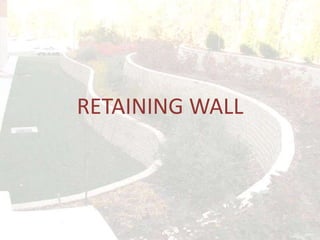
RETAINING WALL
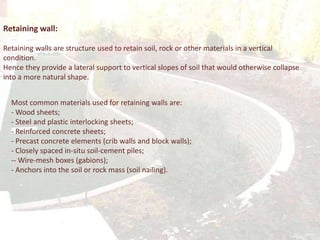
Retaining wall:
Retaining walls are structure used to retain soil, rock or other materials in a vertical
condition.
Hence they provide a lateral support to vertical slopes of soil that would otherwise collapse
into a more natural shape.
Most common materials used for retaining walls are:
- Wood sheets;
- Steel and plastic interlocking sheets;
- Reinforced concrete sheets;
- Precast concrete elements (crib walls and block walls);
- Closely spaced in-situ soil-cement piles;
-- Wire-mesh boxes (gabions);
- Anchors into the soil or rock mass (soil nailing).
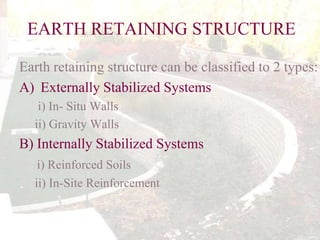
EARTH RETAINING STRUCTURE
Earth retaining structure can be classified to 2 types:
A) Externally Stabilized Systems
i) In- Situ Walls
ii) Gravity Walls

B) Internally Stabilized Systems
i) Reinforced Soils
ii) In-Site Reinforcement
FUNCTION

To retain the soil at a slope that is greater than it would
naturally assume, usually at a vertical or near vertical
position.
DESIGN
The designed retaining wall must be able to
ensure the following :
 Overturning doesn’t occur
 Sliding doesn’t occur
 The soil on which the wall rests mustn’t be
overloaded
 The material used in construction are not
overstressed.
DESIGN CONSIDERATION
In order to calculate the pressure exerted at
any point on the wall, the following must be
taken in account:
 height of water table
 nature & type of soil
 subsoil water movements
 type of wall
 material used in the construction of wall
The effect of 2 forms of earth pressure need to
be considered during the process of designing
the retaining wall that is:
a) Active Earth Pressure
“ It is the pressure that at all times are tending
to move or overturn the retaining wall”
a) Passive Earth Pressure
“It is reactionary pressures that will react in
the form of a resistance to movement of the
wall.
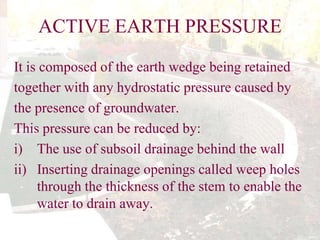
ACTIVE EARTH PRESSURE
It is composed of the earth wedge being retained
together with any hydrostatic pressure caused by
the presence of groundwater.
This pressure can be reduced by:
i) The use of subsoil drainage behind the wall
ii) Inserting drainage openings called weep holes
through the thickness of the stem to enable the
water to drain away.
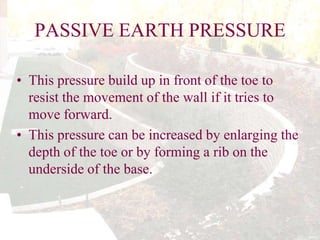
PASSIVE EARTH PRESSURE
• This pressure build up in front of the toe to
resist the movement of the wall if it tries to
move forward.
• This pressure can be increased by enlarging the
depth of the toe or by forming a rib on the
underside of the base.
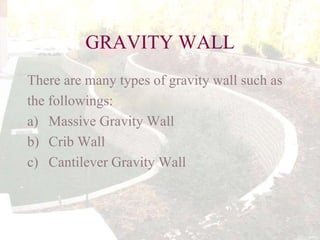
GRAVITY WALL
There are many types of gravity wall such as
the followings:
a) Massive Gravity Wall
b) Crib Wall
c) Cantilever Gravity Wall
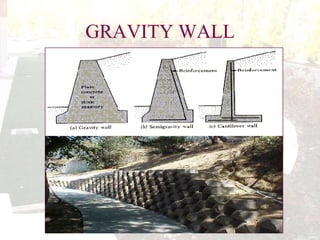
GRAVITY WALL
cement mortar

plain concrete or
stone masonry
cobbles

They rely on their self weight to
support the backfill
12
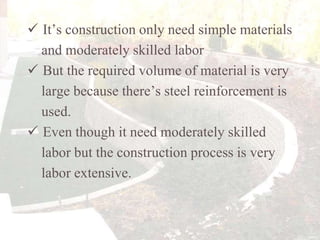
 It’s construction only need simple materials
and moderately skilled labor
 But the required volume of material is very
large because there’s steel reinforcement is
used.
 Even though it need moderately skilled
labor but the construction process is very
labor extensive.
MASSIVE GRAVITY WALL
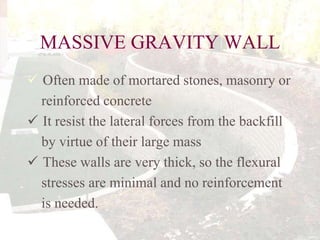
 Often made of mortared stones, masonry or
reinforced concrete
 It resist the lateral forces from the backfill
by virtue of their large mass
 These walls are very thick, so the flexural
stresses are minimal and no reinforcement
is needed.
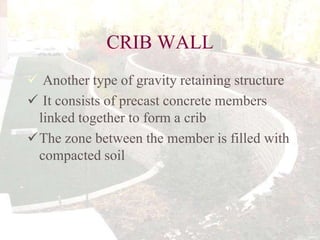
CRIB WALL
 Another type of gravity retaining structure
 It consists of precast concrete members
linked together to form a crib
The zone between the member is filled with
compacted soil
CRIB WALL
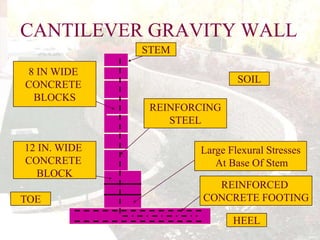
CANTILEVER GRAVITY WALL
STEM
8 IN WIDE
CONCRETE
BLOCKS

SOIL
REINFORCING
STEEL

12 IN. WIDE
CONCRETE
BLOCK
TOE

Large Flexural Stresses
At Base Of Stem
REINFORCED
CONCRETE FOOTING
HEEL
CANTILEVER GRAVITY WALL


It is a refinement of the massive gravity wall concept

 These wall have much thinner stem and utilize the weight of the
backfill soil to provide most of the resistance to sliding and overturning
 These walls require much less construction material because the cross
section of this wall is much smaller.
 It have a large flexural stresses which requires the use of reinforced concrete
or reinforced masonry
 It must be carefully constructed & requires skillful labor
 less expensive than mass gravity walls
 most common type of earth retaining structure.
Reinforced;
smaller section
than gravity
walls

They act like vertical
cantilever, fixed to the ground
19
COUNTERFORT WALL
GABION WALL
IN-SITU WALL
 Different from gravity walls
 There are many types of In-Situ wall such
as the followings:
a) Sheet Pile Walls
b) Soldier Pile Walls
c) Slurry Pile Walls
SHEET PILE WALLS


Sheet piles are tine, wide steel piles

 Driven to the ground using pile hammer
 Series of sheet piles in a row form a sheet pile wall
 It’s usually necessary to provide lateral support at 1 or more levels above
the ground that can be done using 2 ways that is internal braces or tieback
anchor.
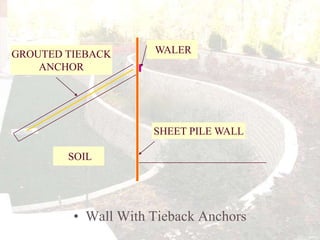
 Tieback Anchors are tension members drilled into the ground behind the
wall
 The most common type is a grouted anchor with a steel tendon.
GROUTED TIEBACK
ANCHOR

WALER

SHEET PILE WALL
SOIL

• Wall With Tieback Anchors
SHEET PILES
SHEET PILE WALLS
SOLDIER PILE WALLS


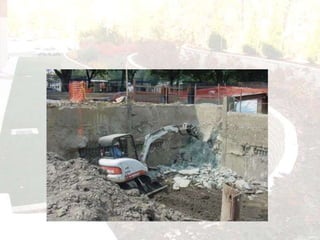
Consist of a vertical wide flange steel members with horizontal timber
lagging.
 Often used as temporary retaining structures for construction
excavation
SLURRY WALLS
 It’s a cast-in-place concrete walls built using
betonies slurry
 The contractor digs a trench along the proposed
wall alignment and keeps it open using the slurry
 The reinforcing steel is inserted and the concrete
is placed using pumps.
As the concrete fills the trench, slurry exits at the
ground surface.
Basha

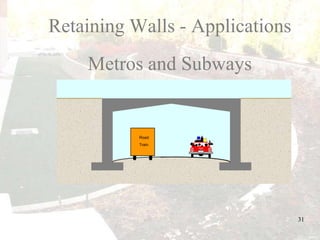
Retaining Walls - Applications

Metros and Subways

Road
Train

31
Basha

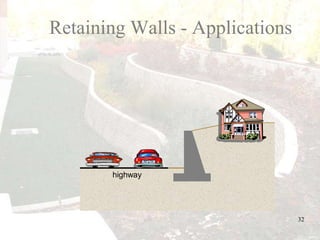
Retaining Walls - Applications

highway

32
Basha

Retaining Walls - Applications

High-rise building

basement wall

33
Advances in retaining wall
Reinforced Retaining Walls
• Sometimes the complexity or wall height required for certain
installations require retaining walls that are reinforced by either
geofabric material or, in really tough cases, concrete filled doubleskin
layers of blocks
Geosynthetic Reinforced Soil
Segmental Retaining Walls
• Geosynthetic reinforced soil segmental retaining
walls utilize reinforcing sheets of geogrid or
suitable woven geotextile which are attached to the
fascia and are embedded in a body of engineered
fill.
• The integrated nature of the fascia and the abutting
large body of reinforced soil thereby supports the
applied earth forces. In this case the 'gravity'
component of the retaining wall is provided by the
reinforced soil mass acting as a monolithic unit.

Retaining wall

  • 1.
  • 2.
    Retaining wall: Retaining wallsare structure used to retain soil, rock or other materials in a vertical condition. Hence they provide a lateral support to vertical slopes of soil that would otherwise collapse into a more natural shape. Most common materials used for retaining walls are: - Wood sheets; - Steel and plastic interlocking sheets; - Reinforced concrete sheets; - Precast concrete elements (crib walls and block walls); - Closely spaced in-situ soil-cement piles; -- Wire-mesh boxes (gabions); - Anchors into the soil or rock mass (soil nailing).
  • 3.
    EARTH RETAINING STRUCTURE Earthretaining structure can be classified to 2 types: A) Externally Stabilized Systems i) In- Situ Walls ii) Gravity Walls B) Internally Stabilized Systems i) Reinforced Soils ii) In-Site Reinforcement
  • 4.
    FUNCTION To retain thesoil at a slope that is greater than it would naturally assume, usually at a vertical or near vertical position.
  • 5.
    DESIGN The designed retainingwall must be able to ensure the following :  Overturning doesn’t occur  Sliding doesn’t occur  The soil on which the wall rests mustn’t be overloaded  The material used in construction are not overstressed.
  • 6.
    DESIGN CONSIDERATION In orderto calculate the pressure exerted at any point on the wall, the following must be taken in account:  height of water table  nature & type of soil  subsoil water movements  type of wall  material used in the construction of wall
  • 7.
    The effect of2 forms of earth pressure need to be considered during the process of designing the retaining wall that is: a) Active Earth Pressure “ It is the pressure that at all times are tending to move or overturn the retaining wall” a) Passive Earth Pressure “It is reactionary pressures that will react in the form of a resistance to movement of the wall.
  • 8.
    ACTIVE EARTH PRESSURE Itis composed of the earth wedge being retained together with any hydrostatic pressure caused by the presence of groundwater. This pressure can be reduced by: i) The use of subsoil drainage behind the wall ii) Inserting drainage openings called weep holes through the thickness of the stem to enable the water to drain away.
  • 9.
    PASSIVE EARTH PRESSURE •This pressure build up in front of the toe to resist the movement of the wall if it tries to move forward. • This pressure can be increased by enlarging the depth of the toe or by forming a rib on the underside of the base.
  • 10.
    GRAVITY WALL There aremany types of gravity wall such as the followings: a) Massive Gravity Wall b) Crib Wall c) Cantilever Gravity Wall
  • 11.
  • 12.
    cement mortar plain concreteor stone masonry cobbles They rely on their self weight to support the backfill 12
  • 13.
     It’s constructiononly need simple materials and moderately skilled labor  But the required volume of material is very large because there’s steel reinforcement is used.  Even though it need moderately skilled labor but the construction process is very labor extensive.
  • 14.
    MASSIVE GRAVITY WALL Often made of mortared stones, masonry or reinforced concrete  It resist the lateral forces from the backfill by virtue of their large mass  These walls are very thick, so the flexural stresses are minimal and no reinforcement is needed.
  • 15.
    CRIB WALL  Anothertype of gravity retaining structure  It consists of precast concrete members linked together to form a crib The zone between the member is filled with compacted soil
  • 16.
  • 17.
    CANTILEVER GRAVITY WALL STEM 8IN WIDE CONCRETE BLOCKS SOIL REINFORCING STEEL 12 IN. WIDE CONCRETE BLOCK TOE Large Flexural Stresses At Base Of Stem REINFORCED CONCRETE FOOTING HEEL
  • 18.
    CANTILEVER GRAVITY WALL  Itis a refinement of the massive gravity wall concept  These wall have much thinner stem and utilize the weight of the backfill soil to provide most of the resistance to sliding and overturning  These walls require much less construction material because the cross section of this wall is much smaller.  It have a large flexural stresses which requires the use of reinforced concrete or reinforced masonry  It must be carefully constructed & requires skillful labor  less expensive than mass gravity walls  most common type of earth retaining structure.
  • 19.
    Reinforced; smaller section than gravity walls Theyact like vertical cantilever, fixed to the ground 19
  • 20.
  • 21.
  • 22.
    IN-SITU WALL  Differentfrom gravity walls  There are many types of In-Situ wall such as the followings: a) Sheet Pile Walls b) Soldier Pile Walls c) Slurry Pile Walls
  • 23.
    SHEET PILE WALLS  Sheetpiles are tine, wide steel piles  Driven to the ground using pile hammer  Series of sheet piles in a row form a sheet pile wall  It’s usually necessary to provide lateral support at 1 or more levels above the ground that can be done using 2 ways that is internal braces or tieback anchor.  Tieback Anchors are tension members drilled into the ground behind the wall  The most common type is a grouted anchor with a steel tendon.
  • 24.
    GROUTED TIEBACK ANCHOR WALER SHEET PILEWALL SOIL • Wall With Tieback Anchors
  • 25.
  • 26.
  • 27.
    SOLDIER PILE WALLS  Consistof a vertical wide flange steel members with horizontal timber lagging.  Often used as temporary retaining structures for construction excavation
  • 28.
    SLURRY WALLS  It’sa cast-in-place concrete walls built using betonies slurry  The contractor digs a trench along the proposed wall alignment and keeps it open using the slurry  The reinforcing steel is inserted and the concrete is placed using pumps. As the concrete fills the trench, slurry exits at the ground surface.
  • 31.
    Basha Retaining Walls -Applications Metros and Subways Road Train 31
  • 32.
    Basha Retaining Walls -Applications highway 32
  • 33.
    Basha Retaining Walls -Applications High-rise building basement wall 33
  • 34.
    Advances in retainingwall Reinforced Retaining Walls • Sometimes the complexity or wall height required for certain installations require retaining walls that are reinforced by either geofabric material or, in really tough cases, concrete filled doubleskin layers of blocks
  • 35.
    Geosynthetic Reinforced Soil SegmentalRetaining Walls • Geosynthetic reinforced soil segmental retaining walls utilize reinforcing sheets of geogrid or suitable woven geotextile which are attached to the fascia and are embedded in a body of engineered fill. • The integrated nature of the fascia and the abutting large body of reinforced soil thereby supports the applied earth forces. In this case the 'gravity' component of the retaining wall is provided by the reinforced soil mass acting as a monolithic unit.