Presentation on
GROUND IMPROVEMENT
TECHNIQUES
Rapid urban and industrial growth demands
more land for further development, to
meet this demand land reclamation and
utilization of unsuitable and
environmentally affected lands have been
taken up and converted to useful ones by
adopting one or more
Ground Improvement Techniques.
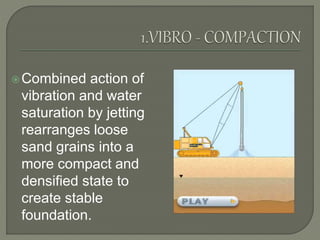
Combined action of
vibration and water
saturation by jetting
rearranges loose
sand grains into a
more compact and
densified state to
create stable
foundation.
2.VACCUM CONSOLIDATION
 The soil site is covered with an
airtight membrane and vacuum is
created underneath it by using
dual venture and vacuum pump
which improves saturated soft
soils.
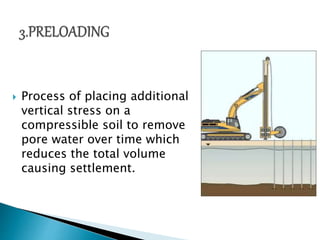
 Process of placing additional
vertical stress on a
compressible soil to remove
pore water over time which
reduces the total volume
causing settlement.
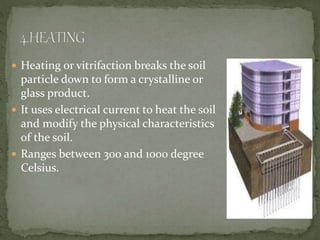
 Heating or vitrifaction breaks the soil
particle down to form a crystalline or
glass product.
 It uses electrical current to heat the soil
and modify the physical characteristics
of the soil.
 Ranges between 300 and 1000 degree
Celsius.
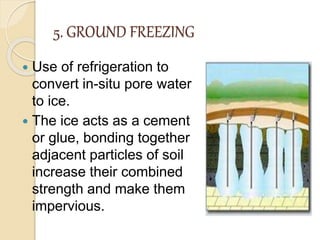
5. GROUND FREEZING
 Use of refrigeration to
convert in-situ pore water
to ice.
 The ice acts as a cement
or glue, bonding together
adjacent particles of soil
increase their combined
strength and make them
impervious.
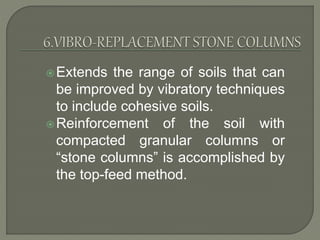
Extends the range of soils that can
be improved by vibratory techniques
to include cohesive soils.
Reinforcement of the soil with
compacted granular columns or
“stone columns” is accomplished by
the top-feed method.
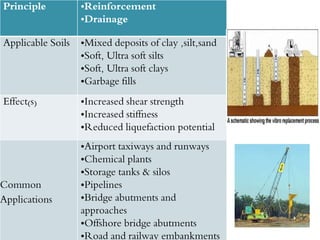
Principle •Reinforcement
•Drainage
Applicable Soils •Mixed deposits of clay ,silt,sand
•Soft, Ultra soft silts
•Soft, Ultra soft clays
•Garbage fills
Effect(s) •Increased shear strength
•Increased stiffness
•Reduced liquefaction potential
Common
Applications
•Airport taxiways and runways
•Chemical plants
•Storage tanks & silos
•Pipelines
•Bridge abutments and
approaches
•Offshore bridge abutments
•Road and railway embankments
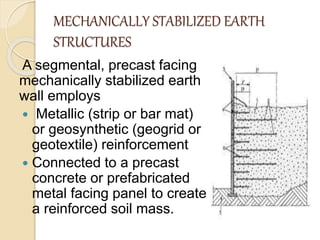
MECHANICALLY STABILIZED EARTH
STRUCTURES
A segmental, precast facing
mechanically stabilized earth
wall employs
 Metallic (strip or bar mat)
or geosynthetic (geogrid or
geotextile) reinforcement
 Connected to a precast
concrete or prefabricated
metal facing panel to create
a reinforced soil mass.
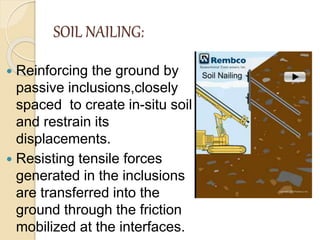
SOIL NAILING:
 Reinforcing the ground by
passive inclusions,closely
spaced to create in-situ soil
and restrain its
displacements.
 Resisting tensile forces
generated in the inclusions
are transferred into the
ground through the friction
mobilized at the interfaces.
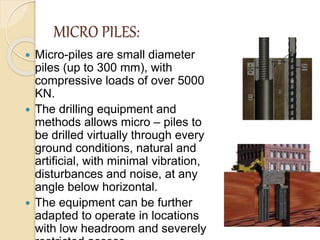
MICRO PILES:
 Micro-piles are small diameter
piles (up to 300 mm), with
compressive loads of over 5000
KN.
 The drilling equipment and
methods allows micro – piles to
be drilled virtually through every
ground conditions, natural and
artificial, with minimal vibration,
disturbances and noise, at any
angle below horizontal.
 The equipment can be further
adapted to operate in locations
with low headroom and severely
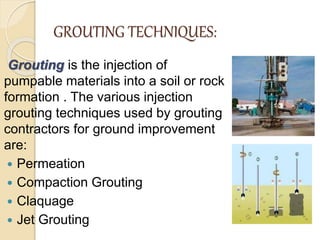
GROUTING TECHNIQUES:
Grouting is the injection of
pumpable materials into a soil or rock
formation . The various injection
grouting techniques used by grouting
contractors for ground improvement
are:
 Permeation
 Compaction Grouting
 Claquage
 Jet Grouting
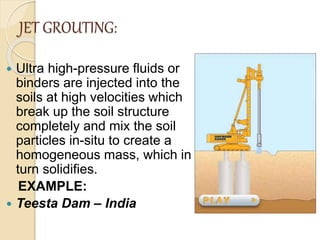
JET GROUTING:
 Ultra high-pressure fluids or
binders are injected into the
soils at high velocities which
break up the soil structure
completely and mix the soil
particles in-situ to create a
homogeneous mass, which in
turn solidifies.
EXAMPLE:
 Teesta Dam – India
CONCLUSION:
 Application of Ground Improvement is not only
cheaper but reduce the construction time
significantly.
 Conscious effort to prepare and follow up the
techniques will lead to successful completion of
the project , we are now technically sound at
hand.
 The ground improvement technique also plays
a vital role in the development of our mother
land by 2020.

Ground improvement techniques

  • 1.
  • 2.
    Rapid urban andindustrial growth demands more land for further development, to meet this demand land reclamation and utilization of unsuitable and environmentally affected lands have been taken up and converted to useful ones by adopting one or more Ground Improvement Techniques.
  • 3.
    Combined action of vibrationand water saturation by jetting rearranges loose sand grains into a more compact and densified state to create stable foundation.
  • 4.
    2.VACCUM CONSOLIDATION  Thesoil site is covered with an airtight membrane and vacuum is created underneath it by using dual venture and vacuum pump which improves saturated soft soils.
  • 5.
     Process ofplacing additional vertical stress on a compressible soil to remove pore water over time which reduces the total volume causing settlement.
  • 6.
     Heating orvitrifaction breaks the soil particle down to form a crystalline or glass product.  It uses electrical current to heat the soil and modify the physical characteristics of the soil.  Ranges between 300 and 1000 degree Celsius.
  • 7.
    5. GROUND FREEZING Use of refrigeration to convert in-situ pore water to ice.  The ice acts as a cement or glue, bonding together adjacent particles of soil increase their combined strength and make them impervious.
  • 8.
    Extends the rangeof soils that can be improved by vibratory techniques to include cohesive soils. Reinforcement of the soil with compacted granular columns or “stone columns” is accomplished by the top-feed method.
  • 9.
    Principle •Reinforcement •Drainage Applicable Soils•Mixed deposits of clay ,silt,sand •Soft, Ultra soft silts •Soft, Ultra soft clays •Garbage fills Effect(s) •Increased shear strength •Increased stiffness •Reduced liquefaction potential Common Applications •Airport taxiways and runways •Chemical plants •Storage tanks & silos •Pipelines •Bridge abutments and approaches •Offshore bridge abutments •Road and railway embankments
  • 10.
    MECHANICALLY STABILIZED EARTH STRUCTURES Asegmental, precast facing mechanically stabilized earth wall employs  Metallic (strip or bar mat) or geosynthetic (geogrid or geotextile) reinforcement  Connected to a precast concrete or prefabricated metal facing panel to create a reinforced soil mass.
  • 11.
    SOIL NAILING:  Reinforcingthe ground by passive inclusions,closely spaced to create in-situ soil and restrain its displacements.  Resisting tensile forces generated in the inclusions are transferred into the ground through the friction mobilized at the interfaces.
  • 12.
    MICRO PILES:  Micro-pilesare small diameter piles (up to 300 mm), with compressive loads of over 5000 KN.  The drilling equipment and methods allows micro – piles to be drilled virtually through every ground conditions, natural and artificial, with minimal vibration, disturbances and noise, at any angle below horizontal.  The equipment can be further adapted to operate in locations with low headroom and severely
  • 13.
    GROUTING TECHNIQUES: Grouting isthe injection of pumpable materials into a soil or rock formation . The various injection grouting techniques used by grouting contractors for ground improvement are:  Permeation  Compaction Grouting  Claquage  Jet Grouting
  • 14.
    JET GROUTING:  Ultrahigh-pressure fluids or binders are injected into the soils at high velocities which break up the soil structure completely and mix the soil particles in-situ to create a homogeneous mass, which in turn solidifies. EXAMPLE:  Teesta Dam – India
  • 15.
    CONCLUSION:  Application ofGround Improvement is not only cheaper but reduce the construction time significantly.  Conscious effort to prepare and follow up the techniques will lead to successful completion of the project , we are now technically sound at hand.  The ground improvement technique also plays a vital role in the development of our mother land by 2020.