ADVANCEMENT IN RETAINING WALL
Retaining means to hold
back the masses of earth
or

loose

soil

conditions

where

make

it

impossible to let those

masses

assume

their

natural slopes.

BY,
MOHD.RIZWAN
RETAINING WALL





A retaining wall is a structure designed and constructed to resist the lateral pressure of soil when
there is a desired change in ground elevation that exceeds the angle of repose of the soil.
Retaining walls are structure used to retain soil, rock or other materials in a vertical condition
Their purpose is to stabilize slopes and provide useful areas at different elevations, e.g. terraces for
agriculture, buildings, roads and railways.



TYPES OF RETAINING WALLS



- Gravity walls
- Pre-cast crib walls
- Gabion walls
- Reinforced concrete walls
- Sheet pile walls
- MS walls (mechanically stabilized)
- Slurry and Secant Walls
- Soil nailing








MASSIVE GRAVITY WALLS.






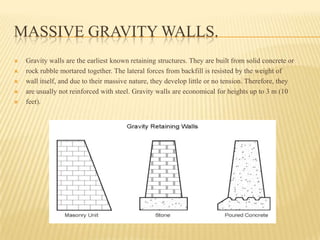
Gravity walls are the earliest known retaining structures. They are built from solid concrete or
rock rubble mortared together. The lateral forces from backfill is resisted by the weight of
wall itself, and due to their massive nature, they develop little or no tension. Therefore, they
are usually not reinforced with steel. Gravity walls are economical for heights up to 3 m (10
feet).
CRIB WALLS.







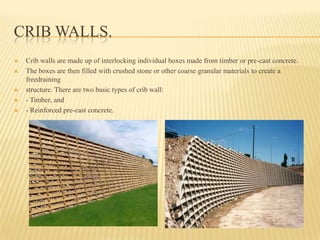
Crib walls are made up of interlocking individual boxes made from timber or pre-cast concrete.
The boxes are then filled with crushed stone or other coarse granular materials to create a
freedraining
structure. There are two basic types of crib wall:
- Timber, and
- Reinforced pre-cast concrete.
GABBION WALLS.












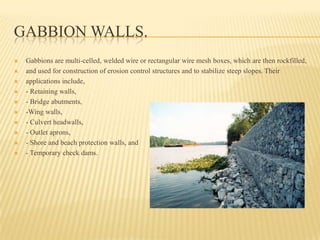
Gabbions are multi-celled, welded wire or rectangular wire mesh boxes, which are then rockfilled,
and used for construction of erosion control structures and to stabilize steep slopes. Their
applications include,
- Retaining walls,
- Bridge abutments,
-Wing walls,
- Culvert headwalls,
- Outlet aprons,
- Shore and beach protection walls, and
- Temporary check dams.
CANTILEVER WALLS.


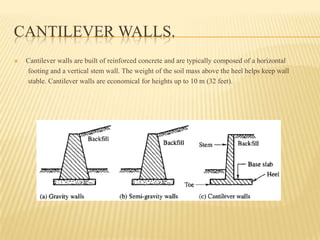
Cantilever walls are built of reinforced concrete and are typically composed of a horizontal
footing and a vertical stem wall. The weight of the soil mass above the heel helps keep wall
stable. Cantilever walls are economical for heights up to 10 m (32 feet).
SHEET PILE WALLS.


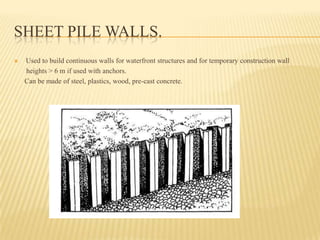
Used to build continuous walls for waterfront structures and for temporary construction wall
heights > 6 m if used with anchors.
Can be made of steel, plastics, wood, pre-cast concrete.
The advantages of using steel sheet-piling:
1. Provides higher resistance to driving stresses;
2. Is of an overall lighter weight;
3. Can be reused on several projects;
4. Provides a long service life above or below the water table;
5. Easy to adapt the pile length by either welding or bolting; and
6. Their joints are less apt to deform during driving.
Retaining Walls Materials
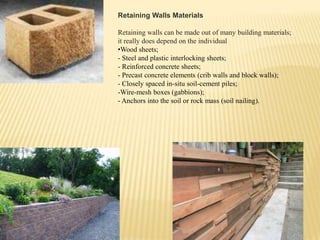
Retaining walls can be made out of many building materials;
it really does depend on the individual
•Wood sheets;
- Steel and plastic interlocking sheets;
- Reinforced concrete sheets;
- Precast concrete elements (crib walls and block walls);
- Closely spaced in-situ soil-cement piles;
-Wire-mesh boxes (gabbions);
- Anchors into the soil or rock mass (soil nailing).
Considerations
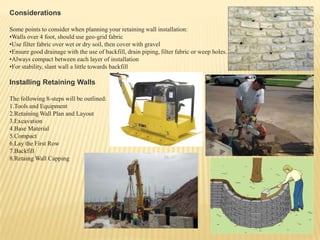
Some points to consider when planning your retaining wall installation:
•Walls over 4 foot, should use geo-grid fabric
•Use filter fabric over wet or dry soil, then cover with gravel
•Ensure good drainage with the use of backfill, drain piping, filter fabric or weep holes.
•Always compact between each layer of installation
•For stability, slant wall a little towards backfill

Installing Retaining Walls
The following 8-steps will be outlined:
1.Tools and Equipment
2.Retaining Wall Plan and Layout
3.Excavation
4.Base Material
5.Compact
6.Lay the First Row
7.Backfill
8.Retaing Wall Capping
Retaining Wall Use
•Retaining walls are used for both commercial and
•residential purposes.
•They have gained popularity in a short period of time, becoming
commonly used for landscaping projects around the home and for
commercial landscapes also.
•Retaining walls are found around the home garden, to highlight
flower beds. Not only do they add aesthetic appeal to your
landscaping. They can also have a functional application.
•Retaining walls can make use of sloping or steep land and help
with storm water management and drainage
•This rise in popularity is mainly due to the advances in available
designs, colors, shapes and sizes. Also, retaining walls can be selfinstalled, making them very cost efficient. Installation can be as
simple as stacking blocks together!
Different Technologies
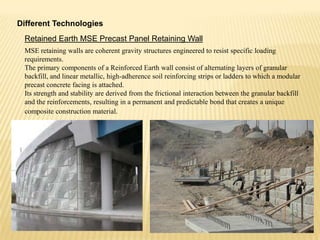
Retained Earth MSE Precast Panel Retaining Wall
MSE retaining walls are coherent gravity structures engineered to resist specific loading
requirements.
The primary components of a Reinforced Earth wall consist of alternating layers of granular
backfill, and linear metallic, high-adherence soil reinforcing strips or ladders to which a modular
precast concrete facing is attached.
Its strength and stability are derived from the frictional interaction between the granular backfill
and the reinforcements, resulting in a permanent and predictable bond that creates a unique
composite construction material.
Advantages
Considerable advantages over cast-in-place, both in construction time and quantity of
materials
Flexibility, making it possible to build directly upon compressible soils
High load-carrying capabilities, both to static and dynamic loads
Ease of installation since construction using prefabricated components is rapid and
predictable
The Mesa Systems were chosen because of their dependable connection
strength to withstand extremely difficult site conditions

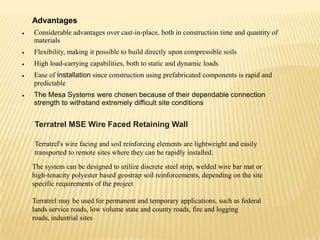
Terratrel MSE Wire Faced Retaining Wall
Terratrel's wire facing and soil reinforcing elements are lightweight and easily
transported to remote sites where they can be rapidly installed.
The system can be designed to utilize discrete steel strip, welded wire bar mat or
high-tenacity polyester based geostrap soil reinforcements, depending on the site
specific requirements of the project
Terratrel may be used for permanent and temporary applications, such as federal
lands service roads, low volume state and county roads, fire and logging
roads, industrial sites
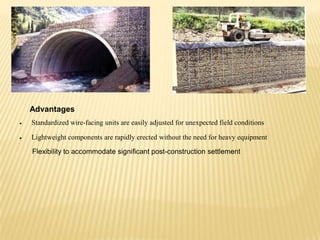
Advantages
Standardized wire-facing units are easily adjusted for unexpected field conditions
Lightweight components are rapidly erected without the need for heavy equipment
Flexibility to accommodate significant post-construction settlement
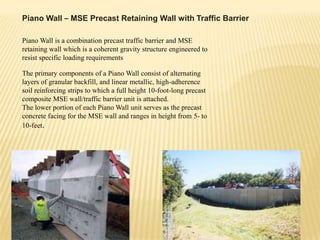
Piano Wall – MSE Precast Retaining Wall with Traffic Barrier
Piano Wall is a combination precast traffic barrier and MSE
retaining wall which is a coherent gravity structure engineered to
resist specific loading requirements
The primary components of a Piano Wall consist of alternating
layers of granular backfill, and linear metallic, high-adherence
soil reinforcing strips to which a full height 10-foot-long precast
composite MSE wall/traffic barrier unit is attached.
The lower portion of each Piano Wall unit serves as the precast
concrete facing for the MSE wall and ranges in height from 5- to
10-feet.
Advantages
Considerable cost advantages over cast-in-place, by eliminating
the need of forming, curing and anchoring mechanisms
Rapid and predictable construction with the simultaneous

installation of both traffic barrier and retaining wall segments
Durable precast concrete offers a long service life with minimal maintenance
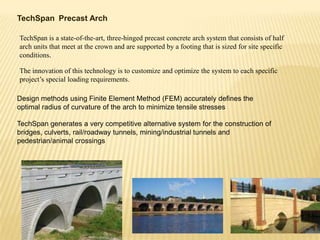
TechSpan Precast Arch
TechSpan is a state-of-the-art, three-hinged precast concrete arch system that consists of half
arch units that meet at the crown and are supported by a footing that is sized for site specific
conditions.
The innovation of this technology is to customize and optimize the system to each specific
project’s special loading requirements.
Design methods using Finite Element Method (FEM) accurately defines the
optimal radius of curvature of the arch to minimize tensile stresses
TechSpan generates a very competitive alternative system for the construction of
bridges, culverts, rail/roadway tunnels, mining/industrial tunnels and
pedestrian/animal crossings
Advantages
Durable precast concrete offers a long service life with minimal maintenance
Erection is simple, rapid and predictable without disruption to flow of traffic
Advanced design procedures and unique fabrication capabilities provide the most
efficient use of concrete and steel
Customize and optimize design for project specific loading conditions and geometry
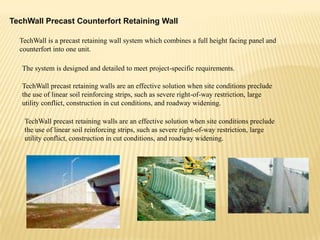
TechWall Precast Counterfort Retaining Wall
TechWall is a precast retaining wall system which combines a full height facing panel and
counterfort into one unit.
The system is designed and detailed to meet project-specific requirements.
TechWall precast retaining walls are an effective solution when site conditions preclude
the use of linear soil reinforcing strips, such as severe right-of-way restriction, large
utility conflict, construction in cut conditions, and roadway widening.
TechWall precast retaining walls are an effective solution when site conditions preclude
the use of linear soil reinforcing strips, such as severe right-of-way restriction, large
utility conflict, construction in cut conditions, and roadway widening.
Advantages
Considerable advantages over cast-in-place, both in construction time and
quantity of materials
Simple, rapid, and predictable construction
Durable precast concrete offers a long service life with minimal maintenance
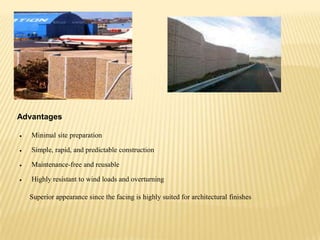
Fan wall Noisewall/Security Barrier
Fan wall is a precast permanent or temporary barrier system which consists of precast modular
panels and stainless steel connector cables that can be used for nearly every noise or security
problem.
These engineered wall systems include both freestanding concrete barriers and post-andpanel structures.
Fan wall provides a low cost, effective and aesthetically pleasing permanent or temporary
barrier solution for transportation, utility, industrial and commercial applications.
The barrier system can incorporate either a full height precast panel or a stacked panel
configuration.
The most efficient and economical design is of a repeating trapezoidal layout where
panels are connected at engineered angles in a wind-stable pattern and can be completely
dismantled, relocated and reassembled if necessary; where sufficient right-of-way is not
available the post-and-panel Fan wall system can be utilized.
Advantages
Minimal site preparation
Simple, rapid, and predictable construction
Maintenance-free and reusable
Highly resistant to wind loads and overturning
Superior appearance since the facing is highly suited for architectural finishes
RE/Tension Precast Counterfort Retaining Wall
RE/Tension is a precast counterfort retaining wall system consisting of integral hollow box
attached to the backside of standard MSE concrete facing panels stacked on a continuous, castin-place, reinforced concrete footing.
The attached box serves as a form for a cast-in-place concrete column of which flexural
rebar is carried and connected to the cast-in-place footing.
The counterfort acts as an equivalent cantilever beam, which transfers horizontal earth
pressures from the precast facing system to the concrete foundation.
RE/Tension is a unique retaining wall solution that can be used for areas where constraints
prohibit installation of linear soil reinforcements such as severe right-of-way restriction,
large utility conflict, construction in rock cut conditions, and roadway widening.
The system is easily constructed by pouring a continuous strip footing with protruding
dowels and stacking the prefabricated precast concrete panels consisting of two elements, a
U-shaped concrete counterfort box and standard MSE facing over the dowels in the footing
and then onto one another in lifts.
At periodic intervals, the counterfort blockouts are filled with concrete and reinforcing
steel extended vertically as needed.
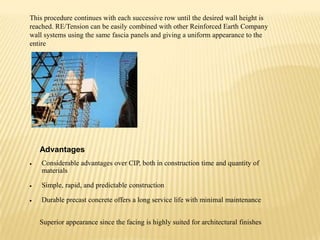
This procedure continues with each successive row until the desired wall height is
reached. RE/Tension can be easily combined with other Reinforced Earth Company
wall systems using the same fascia panels and giving a uniform appearance to the
entire

Advantages
Considerable advantages over CIP, both in construction time and quantity of
materials
Simple, rapid, and predictable construction
Durable precast concrete offers a long service life with minimal maintenance
Superior appearance since the facing is highly suited for architectural finishes
MODULAR BLOCK
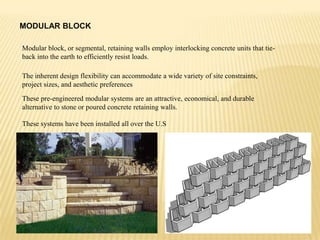
Modular block, or segmental, retaining walls employ interlocking concrete units that tieback into the earth to efficiently resist loads.

The inherent design flexibility can accommodate a wide variety of site constraints,
project sizes, and aesthetic preferences
These pre-engineered modular systems are an attractive, economical, and durable
alternative to stone or poured concrete retaining walls.
These systems have been installed all over the U.S
ARES(Advanced Reinforced Soil)
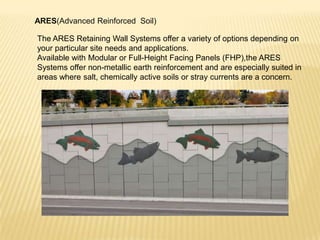
The ARES Retaining Wall Systems offer a variety of options depending on
your particular site needs and applications.
Available with Modular or Full-Height Facing Panels (FHP),the ARES
Systems offer non-metallic earth reinforcement and are especially suited in
areas where salt, chemically active soils or stray currents are a concern.
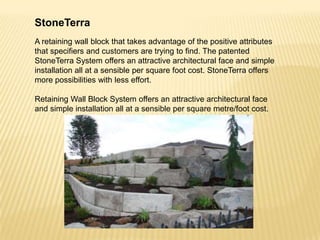
StoneTerra
A retaining wall block that takes advantage of the positive attributes
that specifiers and customers are trying to find. The patented
StoneTerra System offers an attractive architectural face and simple
installation all at a sensible per square foot cost. StoneTerra offers
more possibilities with less effort.
Retaining Wall Block System offers an attractive architectural face
and simple installation all at a sensible per square metre/foot cost.
Advantages:
•Interlocking
•Fast and simple installation
•Can easily be set with small equipment
•Curved or straight walls
•Ability to build in limited space
•Cost effective
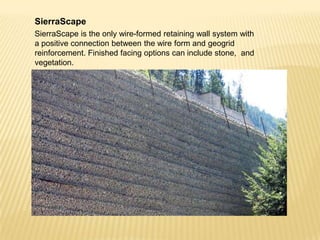
SierraScape
SierraScape is the only wire-formed retaining wall system with
a positive connection between the wire form and geogrid
reinforcement. Finished facing options can include stone, and
vegetation.
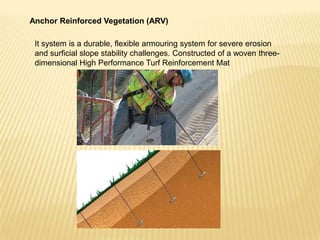
Anchor Reinforced Vegetation (ARV)
It system is a durable, flexible armouring system for severe erosion
and surficial slope stability challenges. Constructed of a woven threedimensional High Performance Turf Reinforcement Mat
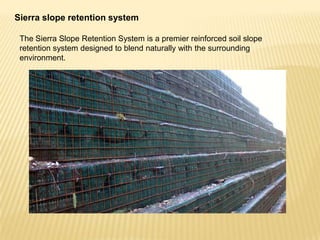
Sierra slope retention system
The Sierra Slope Retention System is a premier reinforced soil slope
retention system designed to blend naturally with the surrounding
environment.
THANKYOU

Advancement in retaining wall

  • 1.
    ADVANCEMENT IN RETAININGWALL Retaining means to hold back the masses of earth or loose soil conditions where make it impossible to let those masses assume their natural slopes. BY, MOHD.RIZWAN
  • 2.
    RETAINING WALL    A retainingwall is a structure designed and constructed to resist the lateral pressure of soil when there is a desired change in ground elevation that exceeds the angle of repose of the soil. Retaining walls are structure used to retain soil, rock or other materials in a vertical condition Their purpose is to stabilize slopes and provide useful areas at different elevations, e.g. terraces for agriculture, buildings, roads and railways.  TYPES OF RETAINING WALLS  - Gravity walls - Pre-cast crib walls - Gabion walls - Reinforced concrete walls - Sheet pile walls - MS walls (mechanically stabilized) - Slurry and Secant Walls - Soil nailing       
  • 3.
    MASSIVE GRAVITY WALLS.      Gravitywalls are the earliest known retaining structures. They are built from solid concrete or rock rubble mortared together. The lateral forces from backfill is resisted by the weight of wall itself, and due to their massive nature, they develop little or no tension. Therefore, they are usually not reinforced with steel. Gravity walls are economical for heights up to 3 m (10 feet).
  • 4.
    CRIB WALLS.      Crib wallsare made up of interlocking individual boxes made from timber or pre-cast concrete. The boxes are then filled with crushed stone or other coarse granular materials to create a freedraining structure. There are two basic types of crib wall: - Timber, and - Reinforced pre-cast concrete.
  • 5.
    GABBION WALLS.           Gabbions aremulti-celled, welded wire or rectangular wire mesh boxes, which are then rockfilled, and used for construction of erosion control structures and to stabilize steep slopes. Their applications include, - Retaining walls, - Bridge abutments, -Wing walls, - Culvert headwalls, - Outlet aprons, - Shore and beach protection walls, and - Temporary check dams.
  • 6.
    CANTILEVER WALLS.  Cantilever wallsare built of reinforced concrete and are typically composed of a horizontal footing and a vertical stem wall. The weight of the soil mass above the heel helps keep wall stable. Cantilever walls are economical for heights up to 10 m (32 feet).
  • 7.
    SHEET PILE WALLS.  Usedto build continuous walls for waterfront structures and for temporary construction wall heights > 6 m if used with anchors. Can be made of steel, plastics, wood, pre-cast concrete.
  • 8.
    The advantages ofusing steel sheet-piling: 1. Provides higher resistance to driving stresses; 2. Is of an overall lighter weight; 3. Can be reused on several projects; 4. Provides a long service life above or below the water table; 5. Easy to adapt the pile length by either welding or bolting; and 6. Their joints are less apt to deform during driving.
  • 9.
    Retaining Walls Materials Retainingwalls can be made out of many building materials; it really does depend on the individual •Wood sheets; - Steel and plastic interlocking sheets; - Reinforced concrete sheets; - Precast concrete elements (crib walls and block walls); - Closely spaced in-situ soil-cement piles; -Wire-mesh boxes (gabbions); - Anchors into the soil or rock mass (soil nailing).
  • 10.
    Considerations Some points toconsider when planning your retaining wall installation: •Walls over 4 foot, should use geo-grid fabric •Use filter fabric over wet or dry soil, then cover with gravel •Ensure good drainage with the use of backfill, drain piping, filter fabric or weep holes. •Always compact between each layer of installation •For stability, slant wall a little towards backfill Installing Retaining Walls The following 8-steps will be outlined: 1.Tools and Equipment 2.Retaining Wall Plan and Layout 3.Excavation 4.Base Material 5.Compact 6.Lay the First Row 7.Backfill 8.Retaing Wall Capping
  • 11.
    Retaining Wall Use •Retainingwalls are used for both commercial and •residential purposes. •They have gained popularity in a short period of time, becoming commonly used for landscaping projects around the home and for commercial landscapes also. •Retaining walls are found around the home garden, to highlight flower beds. Not only do they add aesthetic appeal to your landscaping. They can also have a functional application. •Retaining walls can make use of sloping or steep land and help with storm water management and drainage •This rise in popularity is mainly due to the advances in available designs, colors, shapes and sizes. Also, retaining walls can be selfinstalled, making them very cost efficient. Installation can be as simple as stacking blocks together!
  • 12.
    Different Technologies Retained EarthMSE Precast Panel Retaining Wall MSE retaining walls are coherent gravity structures engineered to resist specific loading requirements. The primary components of a Reinforced Earth wall consist of alternating layers of granular backfill, and linear metallic, high-adherence soil reinforcing strips or ladders to which a modular precast concrete facing is attached. Its strength and stability are derived from the frictional interaction between the granular backfill and the reinforcements, resulting in a permanent and predictable bond that creates a unique composite construction material.
  • 13.
    Advantages Considerable advantages overcast-in-place, both in construction time and quantity of materials Flexibility, making it possible to build directly upon compressible soils High load-carrying capabilities, both to static and dynamic loads Ease of installation since construction using prefabricated components is rapid and predictable The Mesa Systems were chosen because of their dependable connection strength to withstand extremely difficult site conditions Terratrel MSE Wire Faced Retaining Wall Terratrel's wire facing and soil reinforcing elements are lightweight and easily transported to remote sites where they can be rapidly installed. The system can be designed to utilize discrete steel strip, welded wire bar mat or high-tenacity polyester based geostrap soil reinforcements, depending on the site specific requirements of the project Terratrel may be used for permanent and temporary applications, such as federal lands service roads, low volume state and county roads, fire and logging roads, industrial sites
  • 14.
    Advantages Standardized wire-facing unitsare easily adjusted for unexpected field conditions Lightweight components are rapidly erected without the need for heavy equipment Flexibility to accommodate significant post-construction settlement
  • 15.
    Piano Wall –MSE Precast Retaining Wall with Traffic Barrier Piano Wall is a combination precast traffic barrier and MSE retaining wall which is a coherent gravity structure engineered to resist specific loading requirements The primary components of a Piano Wall consist of alternating layers of granular backfill, and linear metallic, high-adherence soil reinforcing strips to which a full height 10-foot-long precast composite MSE wall/traffic barrier unit is attached. The lower portion of each Piano Wall unit serves as the precast concrete facing for the MSE wall and ranges in height from 5- to 10-feet.
  • 16.
    Advantages Considerable cost advantagesover cast-in-place, by eliminating the need of forming, curing and anchoring mechanisms Rapid and predictable construction with the simultaneous installation of both traffic barrier and retaining wall segments Durable precast concrete offers a long service life with minimal maintenance
  • 17.
    TechSpan Precast Arch TechSpanis a state-of-the-art, three-hinged precast concrete arch system that consists of half arch units that meet at the crown and are supported by a footing that is sized for site specific conditions. The innovation of this technology is to customize and optimize the system to each specific project’s special loading requirements. Design methods using Finite Element Method (FEM) accurately defines the optimal radius of curvature of the arch to minimize tensile stresses TechSpan generates a very competitive alternative system for the construction of bridges, culverts, rail/roadway tunnels, mining/industrial tunnels and pedestrian/animal crossings
  • 18.
    Advantages Durable precast concreteoffers a long service life with minimal maintenance Erection is simple, rapid and predictable without disruption to flow of traffic Advanced design procedures and unique fabrication capabilities provide the most efficient use of concrete and steel Customize and optimize design for project specific loading conditions and geometry
  • 19.
    TechWall Precast CounterfortRetaining Wall TechWall is a precast retaining wall system which combines a full height facing panel and counterfort into one unit. The system is designed and detailed to meet project-specific requirements. TechWall precast retaining walls are an effective solution when site conditions preclude the use of linear soil reinforcing strips, such as severe right-of-way restriction, large utility conflict, construction in cut conditions, and roadway widening. TechWall precast retaining walls are an effective solution when site conditions preclude the use of linear soil reinforcing strips, such as severe right-of-way restriction, large utility conflict, construction in cut conditions, and roadway widening.
  • 20.
    Advantages Considerable advantages overcast-in-place, both in construction time and quantity of materials Simple, rapid, and predictable construction Durable precast concrete offers a long service life with minimal maintenance
  • 21.
    Fan wall Noisewall/SecurityBarrier Fan wall is a precast permanent or temporary barrier system which consists of precast modular panels and stainless steel connector cables that can be used for nearly every noise or security problem. These engineered wall systems include both freestanding concrete barriers and post-andpanel structures. Fan wall provides a low cost, effective and aesthetically pleasing permanent or temporary barrier solution for transportation, utility, industrial and commercial applications. The barrier system can incorporate either a full height precast panel or a stacked panel configuration. The most efficient and economical design is of a repeating trapezoidal layout where panels are connected at engineered angles in a wind-stable pattern and can be completely dismantled, relocated and reassembled if necessary; where sufficient right-of-way is not available the post-and-panel Fan wall system can be utilized.
  • 22.
    Advantages Minimal site preparation Simple,rapid, and predictable construction Maintenance-free and reusable Highly resistant to wind loads and overturning Superior appearance since the facing is highly suited for architectural finishes
  • 23.
    RE/Tension Precast CounterfortRetaining Wall RE/Tension is a precast counterfort retaining wall system consisting of integral hollow box attached to the backside of standard MSE concrete facing panels stacked on a continuous, castin-place, reinforced concrete footing. The attached box serves as a form for a cast-in-place concrete column of which flexural rebar is carried and connected to the cast-in-place footing. The counterfort acts as an equivalent cantilever beam, which transfers horizontal earth pressures from the precast facing system to the concrete foundation. RE/Tension is a unique retaining wall solution that can be used for areas where constraints prohibit installation of linear soil reinforcements such as severe right-of-way restriction, large utility conflict, construction in rock cut conditions, and roadway widening. The system is easily constructed by pouring a continuous strip footing with protruding dowels and stacking the prefabricated precast concrete panels consisting of two elements, a U-shaped concrete counterfort box and standard MSE facing over the dowels in the footing and then onto one another in lifts. At periodic intervals, the counterfort blockouts are filled with concrete and reinforcing steel extended vertically as needed.
  • 24.
    This procedure continueswith each successive row until the desired wall height is reached. RE/Tension can be easily combined with other Reinforced Earth Company wall systems using the same fascia panels and giving a uniform appearance to the entire Advantages Considerable advantages over CIP, both in construction time and quantity of materials Simple, rapid, and predictable construction Durable precast concrete offers a long service life with minimal maintenance Superior appearance since the facing is highly suited for architectural finishes
  • 25.
    MODULAR BLOCK Modular block,or segmental, retaining walls employ interlocking concrete units that tieback into the earth to efficiently resist loads. The inherent design flexibility can accommodate a wide variety of site constraints, project sizes, and aesthetic preferences These pre-engineered modular systems are an attractive, economical, and durable alternative to stone or poured concrete retaining walls. These systems have been installed all over the U.S
  • 26.
    ARES(Advanced Reinforced Soil) TheARES Retaining Wall Systems offer a variety of options depending on your particular site needs and applications. Available with Modular or Full-Height Facing Panels (FHP),the ARES Systems offer non-metallic earth reinforcement and are especially suited in areas where salt, chemically active soils or stray currents are a concern.
  • 27.
    StoneTerra A retaining wallblock that takes advantage of the positive attributes that specifiers and customers are trying to find. The patented StoneTerra System offers an attractive architectural face and simple installation all at a sensible per square foot cost. StoneTerra offers more possibilities with less effort. Retaining Wall Block System offers an attractive architectural face and simple installation all at a sensible per square metre/foot cost.
  • 28.
    Advantages: •Interlocking •Fast and simpleinstallation •Can easily be set with small equipment •Curved or straight walls •Ability to build in limited space •Cost effective
  • 29.
    SierraScape SierraScape is theonly wire-formed retaining wall system with a positive connection between the wire form and geogrid reinforcement. Finished facing options can include stone, and vegetation.
  • 30.
    Anchor Reinforced Vegetation(ARV) It system is a durable, flexible armouring system for severe erosion and surficial slope stability challenges. Constructed of a woven threedimensional High Performance Turf Reinforcement Mat
  • 31.
    Sierra slope retentionsystem The Sierra Slope Retention System is a premier reinforced soil slope retention system designed to blend naturally with the surrounding environment.
  • 32.