GROUND IMPROVEMENT TECHNIQUES
GROUTING
Presented By:-
RAVAL CHAITANYA
IU1751210010
Guided By:-
NEELAM BELANI
WHY GROUND IMPROVEMENT ?
 Soil having low bearing strength
 Water-logged area
 Waste land, mine wastes, sanitary dumps
 Collapsible soil
 Expansive soil
 High permeability
2
GOALS OF GROUND IMPROVEMENT
 To increase the bearing capacity
 To provide lateral stability
 To increase resistance to liquefaction
 Modify soil properties
 To increase the stiffness
 Low permeability
3
DIFFERENT METHODS OF GROUND IMPROVEMENT
 Mechanical stabilization
 Soil nailing
 Soil anchoring
 Micro piles
 Stone columns
 Fiber reinforcement
 Vibro - compaction
 Dynamic Compaction
 Blasting
 Drainage
 Chemical treatment (Grouting)
 Thermal treatment
4
WHAT IS GROUTING?
 Improvement of soil or rock through injection of grout, cement or chemical grout.
 Grouting may be divided into following :-
1. Intrusion grouting
2. Compaction grouting
3. Permeation grouting
4. Jet grouting
5. Compensation grouting
5
INTRUSION GROUTING
 The joints or fractures in soil or rock are filled with injection
of grout
 Pipes are first inserted into the soil from surface and than the
grout is added with pump
 Advantage is, it decreases the permeability of rocks
 Generally cement grout is used
 Water retaining structures like dams, it is used to reduce
seepage
6
Fig 1. Intrusion Grouting
COMPACTION GROUTING
(DISPLACEMENT GROUTING)
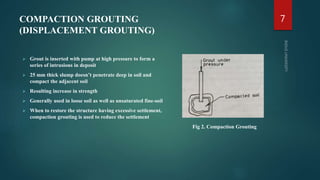
 Grout is inserted with pump at high pressure to form a
series of intrusions in deposit
 25 mm thick slump doesn’t penetrate deep in soil and
compact the adjacent soil
 Resulting increase in strength
 Generally used in loose soil as well as unsaturated fine-soil
 When to restore the structure having excessive settlement,
compaction grouting is used to reduce the settlement
7
Fig 2. Compaction Grouting
PERMEATION GROUTING
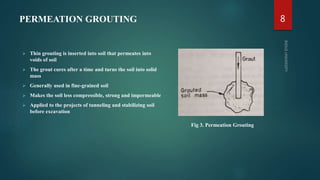
 Thin grouting is inserted into soil that permeates into
voids of soil
 The grout cures after a time and turns the soil into solid
mass
 Generally used in fine-grained soil
 Makes the soil less compressible, strong and impermeable
 Applied to the projects of tunneling and stabilizing soil
before excavation
8
Fig 3. Permeation Grouting
JET GROUTING
 Pipe fitted with horizontal jets inserted into soil at require
depth and with pressure grout is inserted
 Pipe is gradually raised and rotated while grouting still
being injected
 Column is formed in the soil that makes the soil
impermeable and strong
 Applied to water-logged area as well as in stabilization of
soil before excavation and tunneling operations
9
Fig 4. Jet Grouting
COMPENSATION GROUTING
 Compensation Grouting is a process used to control or
reverse the settlement of structures
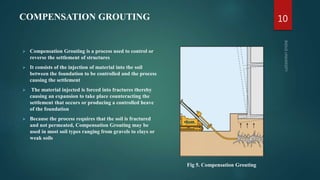
 It consists of the injection of material into the soil
between the foundation to be controlled and the process
causing the settlement
 The material injected is forced into fractures thereby
causing an expansion to take place counteracting the
settlement that occurs or producing a controlled heave
of the foundation
 Because the process requires that the soil is fractured
and not permeated, Compensation Grouting may be
used in most soil types ranging from gravels to clays or
weak soils
10
Fig 5. Compensation Grouting
CASE STUDY 1
LONDON VICTORIA STATION UPGRADE BY JET
GROUTING
 Keller carried out the UK‘s largest ever Jet Grouting
project as part of a £700m scheme to upgrade one of
London‘s busiest rail interchanges.
 The scheme involved the construction of a new ticket
hall and underground walkway to the mainline
station. Much of these new structures are to be
constructed at the level of the interface between
the London Clay and water-bearing Terrace
Gravels.
 Additionally, the site was surrounded by numerous
fragile listed buildings and one of London's
important theatres.
11
FIG 6. VICTORIA STATION UNDER
CONSTRUCTION
CONT…
 Keller initially carried out a trial at the site in 2008 to prove the performance of Jet Grouting. Work on
the project itself began in October 2011 and lasted until 2014. The primary aim of the scheme was to
provide a 2m thick annulus around all of the proposed tunnels and so allow safe excavation through solid
ground. This was done by installing overlapping columns ranging in diameter from 1.4m to 1.8m to
depths up to 14m. The grout columns were installed to achieve a target strength of between 1N/mm2 and
10N/mm2.
 One of the most complex parts of the project was the careful measurement of the orientation of the drill
string using GPS sensors at the top and bottom of the masts in order to achieve the required 50mm
tolerance. Additionally, column diameter was monitored by thermal degradation, a technique used by
Keller in Austria and Germany. All of this information can be entered into the BIM Model to ensure
quality control.
12
CONT…
 Excavation of the early shafts was successful and allowed for the installation of 2500 Jet Grout columns.
 System: Jet Grouting
 Client: Transport For London
 Contractor : Taylor Woodrow BAM Nuttall
 Engineer: Mott McDonald
13
CASE STUDY 2
Cross-rail C300/C410 Compensation Grouting
 Cross-rail is the largest and most ambitious projects in Europe.
 Works started n May 2009 and required over 10,000 people working across over 40 construction
sites.
 The compensation grouting scheme on the Cross-rail contract for the Western Running Tunnel
and Caverns (C300/C410) required the installation of over 45000m of 75mm diameter steel tube
pipes.
The TaM pipes cover an approximate area of 50000 m2 in the Bond Street and Tottenham Court
Road stations.
 It involves the construction of 42km of twin underground railway tunnels and 10 new stations.
The line commences in Maidenhead and the existing station, runs beneath London from
Paddington to East London When it opens in 2018, it will transform rail transport in London,
increasing capacity by 10% and cutting journey times across the city.
14
CONT…
 Keller carried out the Compensation grouting works as mitigation to the large diameter platform
tunnel and cross passage excavations underneath densely populated areas of high value and with
critical assets.
 System: Compensation Grouting
 Client: Cross-rail
 Contractor: Bam Ferrovial Kier JV
 Year of Execution: 2013/14
15
REFERENCES
1. SOIL MECHANICS AND ENGINEERING, K.R.ARORA
2. KELLER INDIA/WWW.KELLER.COM
3. KELLER UK/WWW.KELKER.CO.UK
4. Ground Improvement and Ground Control including Waste Containment with Geosynthetics ,
DR. J.N.JHA
16
THANK YOU

Grouting

  • 1.
    GROUND IMPROVEMENT TECHNIQUES GROUTING PresentedBy:- RAVAL CHAITANYA IU1751210010 Guided By:- NEELAM BELANI
  • 2.
    WHY GROUND IMPROVEMENT?  Soil having low bearing strength  Water-logged area  Waste land, mine wastes, sanitary dumps  Collapsible soil  Expansive soil  High permeability 2
  • 3.
    GOALS OF GROUNDIMPROVEMENT  To increase the bearing capacity  To provide lateral stability  To increase resistance to liquefaction  Modify soil properties  To increase the stiffness  Low permeability 3
  • 4.
    DIFFERENT METHODS OFGROUND IMPROVEMENT  Mechanical stabilization  Soil nailing  Soil anchoring  Micro piles  Stone columns  Fiber reinforcement  Vibro - compaction  Dynamic Compaction  Blasting  Drainage  Chemical treatment (Grouting)  Thermal treatment 4
  • 5.
    WHAT IS GROUTING? Improvement of soil or rock through injection of grout, cement or chemical grout.  Grouting may be divided into following :- 1. Intrusion grouting 2. Compaction grouting 3. Permeation grouting 4. Jet grouting 5. Compensation grouting 5
  • 6.
    INTRUSION GROUTING  Thejoints or fractures in soil or rock are filled with injection of grout  Pipes are first inserted into the soil from surface and than the grout is added with pump  Advantage is, it decreases the permeability of rocks  Generally cement grout is used  Water retaining structures like dams, it is used to reduce seepage 6 Fig 1. Intrusion Grouting
  • 7.
    COMPACTION GROUTING (DISPLACEMENT GROUTING) Grout is inserted with pump at high pressure to form a series of intrusions in deposit  25 mm thick slump doesn’t penetrate deep in soil and compact the adjacent soil  Resulting increase in strength  Generally used in loose soil as well as unsaturated fine-soil  When to restore the structure having excessive settlement, compaction grouting is used to reduce the settlement 7 Fig 2. Compaction Grouting
  • 8.
    PERMEATION GROUTING  Thingrouting is inserted into soil that permeates into voids of soil  The grout cures after a time and turns the soil into solid mass  Generally used in fine-grained soil  Makes the soil less compressible, strong and impermeable  Applied to the projects of tunneling and stabilizing soil before excavation 8 Fig 3. Permeation Grouting
  • 9.
    JET GROUTING  Pipefitted with horizontal jets inserted into soil at require depth and with pressure grout is inserted  Pipe is gradually raised and rotated while grouting still being injected  Column is formed in the soil that makes the soil impermeable and strong  Applied to water-logged area as well as in stabilization of soil before excavation and tunneling operations 9 Fig 4. Jet Grouting
  • 10.
    COMPENSATION GROUTING  CompensationGrouting is a process used to control or reverse the settlement of structures  It consists of the injection of material into the soil between the foundation to be controlled and the process causing the settlement  The material injected is forced into fractures thereby causing an expansion to take place counteracting the settlement that occurs or producing a controlled heave of the foundation  Because the process requires that the soil is fractured and not permeated, Compensation Grouting may be used in most soil types ranging from gravels to clays or weak soils 10 Fig 5. Compensation Grouting
  • 11.
    CASE STUDY 1 LONDONVICTORIA STATION UPGRADE BY JET GROUTING  Keller carried out the UK‘s largest ever Jet Grouting project as part of a £700m scheme to upgrade one of London‘s busiest rail interchanges.  The scheme involved the construction of a new ticket hall and underground walkway to the mainline station. Much of these new structures are to be constructed at the level of the interface between the London Clay and water-bearing Terrace Gravels.  Additionally, the site was surrounded by numerous fragile listed buildings and one of London's important theatres. 11 FIG 6. VICTORIA STATION UNDER CONSTRUCTION
  • 12.
    CONT…  Keller initiallycarried out a trial at the site in 2008 to prove the performance of Jet Grouting. Work on the project itself began in October 2011 and lasted until 2014. The primary aim of the scheme was to provide a 2m thick annulus around all of the proposed tunnels and so allow safe excavation through solid ground. This was done by installing overlapping columns ranging in diameter from 1.4m to 1.8m to depths up to 14m. The grout columns were installed to achieve a target strength of between 1N/mm2 and 10N/mm2.  One of the most complex parts of the project was the careful measurement of the orientation of the drill string using GPS sensors at the top and bottom of the masts in order to achieve the required 50mm tolerance. Additionally, column diameter was monitored by thermal degradation, a technique used by Keller in Austria and Germany. All of this information can be entered into the BIM Model to ensure quality control. 12
  • 13.
    CONT…  Excavation ofthe early shafts was successful and allowed for the installation of 2500 Jet Grout columns.  System: Jet Grouting  Client: Transport For London  Contractor : Taylor Woodrow BAM Nuttall  Engineer: Mott McDonald 13
  • 14.
    CASE STUDY 2 Cross-railC300/C410 Compensation Grouting  Cross-rail is the largest and most ambitious projects in Europe.  Works started n May 2009 and required over 10,000 people working across over 40 construction sites.  The compensation grouting scheme on the Cross-rail contract for the Western Running Tunnel and Caverns (C300/C410) required the installation of over 45000m of 75mm diameter steel tube pipes. The TaM pipes cover an approximate area of 50000 m2 in the Bond Street and Tottenham Court Road stations.  It involves the construction of 42km of twin underground railway tunnels and 10 new stations. The line commences in Maidenhead and the existing station, runs beneath London from Paddington to East London When it opens in 2018, it will transform rail transport in London, increasing capacity by 10% and cutting journey times across the city. 14
  • 15.
    CONT…  Keller carriedout the Compensation grouting works as mitigation to the large diameter platform tunnel and cross passage excavations underneath densely populated areas of high value and with critical assets.  System: Compensation Grouting  Client: Cross-rail  Contractor: Bam Ferrovial Kier JV  Year of Execution: 2013/14 15
  • 16.
    REFERENCES 1. SOIL MECHANICSAND ENGINEERING, K.R.ARORA 2. KELLER INDIA/WWW.KELLER.COM 3. KELLER UK/WWW.KELKER.CO.UK 4. Ground Improvement and Ground Control including Waste Containment with Geosynthetics , DR. J.N.JHA 16
  • 17.