Prashant Patil.et al. Int. Journal of Engineering Research and Application www.ijera.com
ISSN : 2248-9622, Vol. 6, Issue 8, ( Part -2) August 2016, pp.25-31
www.ijera.com 25|P a g e
Soil Reinforcement Techniques
Prashant Patil*
, Ipupu Mena*
, Shubham Goski*
, Yogesh Urs**
*Graduated B.E. Civil, N. K. Orchid College of Engineering & Technology, Solapur
**Assistant Professor, N. K. Orchid College of Engineering & Technology, Solapur.
ABSTRACT
In many activities concerned with the use of soil, the physical properties like Stiffness, Compressibility and
Strength are some of the few important parameters to be considered. Of the many methods involved in
improvement of soil properties, soil reinforcement is method concerned with increase of strength properties of
soil. In soil reinforcement, the reinforcements or resisting element are of different materials and of various
forms depending upon the intended use. The reinforcement can be provided permanently or temporarily to
increase strength of adjacent structures. The present topic of discussion involves different materials, forms and
applications of soil reinforcement
Keywords: strength, reinforcement, materials, applications.
I. HISTORY OF THE SOIL
REINFORCEMENT
Basic principles of soil reinforcement
already existing in nature and are demonstrated by
animals, plants and birds. The modern form of the
soil reinforcement was first applied by Vidal
(1969). Based on the Vidal’s concept the
interaction between soil and the reinforcing
horizontal member is solely by friction generated
by gravity.
Applying this concept retaining walls
were built in France in 1986. Nowadays this
technique is widely used in Europe and U.S.A. This
technique is yet to become popular in India, and the
constraining factor being identified as the non-
availability of fiber and cost of reinforcing
material.
Reinforced soil is somewhat analogous to
the reinforced concrete. But direct comparison
between the functions of reinforcement in the two
cases is not valid. The mode of action of
reinforcement in soil is not one of carrying the
developed tensile stresses as in reinforced concrete
but of anisotropic reduction of normal strain rate.
II. MECHANISM
To understand the mechanism by which
reinforcement improves the performance of soil, let
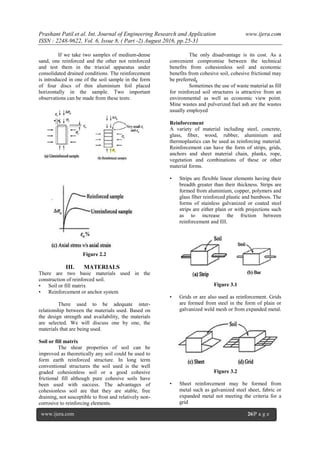
us look at two laboratory scale experiments. In the
first case, a tank ABCD as shown in figure is filled
with dry sand. When we remove side AB of the
container, the vertical face of the sand does not
remain stable and the soil mass rearranges itself as
a sloping surface. We now repeat the same
experiment by using geotextile material as
reinforcement in soil mass. The geotextile is the
flexible material that resembles a strong or thick
sheet of cloth. This material is placed in horizontal
layers when the sand is filled in the tank and it is
folded at the ends as shown in figure. After
removing the side AB, the vertical side does not
collapse. We may observe some bulging but the
face remains vertical and stable. This is so because,
when the soil particles in the failure zone begin to
collapse, the geotextile reinforcement prevents their
movement
1. During the shearing stage, prior to failure, the
reinforced soil sample shows lower radial and
axial strain under the same deviator stress as
compared to unreinforced sample.
2. At failure, the deviator stress of the reinforced
sample is significantly larger than that of
sample without reinforcement indicating
higher shear strength of the former
Figure 2.1
RESEARCH ARTICLE OPEN ACCESS
Prashant Patil.et al. Int. Journal of Engineering Research and Application www.ijera.com
ISSN : 2248-9622, Vol. 6, Issue 8, ( Part -2) August 2016, pp.25-31
www.ijera.com 26|P a g e
If we take two samples of medium-dense
sand, one reinforced and the other not reinforced
and test them in the triaxial apparatus under
consolidated drained conditions. The reinforcement
is introduced in one of the soil sample in the form
of four discs of thin aluminium foil placed
horizontally in the sample. Two important
observations can be made from these tests:
Figure 2.2
III. MATERIALS
There are two basic materials used in the
construction of reinforced soil.
• Soil or fill matrix
• Reinforcement or anchor system
There used to be adequate inter-
relationship between the materials used. Based on
the design strength and availability, the materials
are selected. We will discuss one by one, the
materials that are being used.
Soil or fill matrix
The shear properties of soil can be
improved as theoretically any soil could be used to
form earth reinforced structure. In long term
conventional structures the soil used is the well
graded cohesionless soil or a good cohesive
frictional fill although pure cohesive soils have
been used with success. The advantages of
cohesionless soil are that they are stable, free
draining, not susceptible to frost and relatively non-
corrosive to reinforcing elements.
The only disadvantage is its cost. As a
convenient compromise between the technical
benefits from cohesionless soil and economic
benefits from cohesive soil, cohesive frictional may
be preferred.
Sometimes the use of waste material as fill
for reinforced soil structures is attractive from an
environmental as well as economic view point.
Mine wastes and pulverized fuel ash are the wastes
usually employed
Reinforcement
A variety of material including steel, concrete,
glass, fiber, wood, rubber, aluminium and
thermoplastics can be used as reinforcing material.
Reinforcement can have the form of strips, grids,
anchors and sheet material chain, planks, rope,
vegetation and combinations of these or other
material forms.
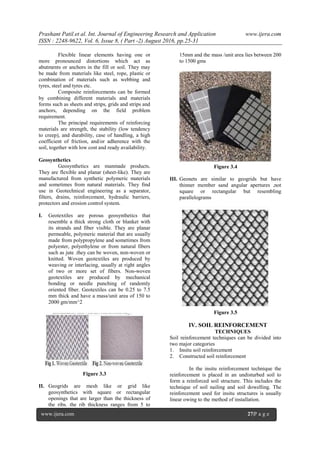
• Strips are flexible linear elements having their
breadth greater than their thickness. Strips are
formed from aluminium, copper, polymers and
glass fiber reinforced plastic and bamboos. The
forms of stainless galvanized or coated steel
strips are either plain or with projections such
as to increase the friction between
reinforcement and fill.
Figure 3.1
• Grids or are also used as reinforcement. Grids
are formed from steel in the form of plain or
galvanized weld mesh or from expanded metal.
Figure 3.2
• Sheet reinforcement may be formed from
metal such as galvanized steel sheet, fabric or
expanded metal not meeting the criteria for a
grid
Prashant Patil.et al. Int. Journal of Engineering Research and Application www.ijera.com
ISSN : 2248-9622, Vol. 6, Issue 8, ( Part -2) August 2016, pp.25-31
www.ijera.com 27|P a g e
Flexible linear elements having one or
more pronounced distortions which act as
abutments or anchors in the fill or soil. They may
be made from materials like steel, rope, plastic or
combination of materials such as webbing and
tyres, steel and tyres etc.
Composite reinforcements can be formed
by combining different materials and materials
forms such as sheets and strips, grids and strips and
anchors, depending on the field problem
requirement.
The principal requirements of reinforcing
materials are strength, the stability (low tendency
to creep), and durability, case of handling, a high
coefficient of friction, and/or adherence with the
soil, together with low cost and ready availability.
Geosynthetics
Geosynthetics are manmade products.
They are flexible and planar (sheet-like). They are
manufactured from synthetic polymeric materials
and sometimes from natural materials. They find
use in Geotechnical engineering as a separator,
filters, drains, reinforcement, hydraulic barriers,
protectors and erosion control system.
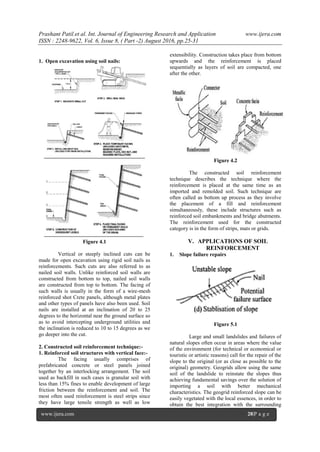
I. Geotextiles are porous geosynthetics that
resemble a thick strong cloth or blanket with
its strands and fiber visible. They are planar
permeable, polymeric material that are usually
made from polypropylene and sometimes from
polyester, polyethylene or from natural fibers
such as jute .they can be woven, non-woven or
knitted. Woven geotextiles are produced by
weaving or interlacing, usually at right angles
of two or more set of fibers. Non-woven
geotextiles are produced by mechanical
bonding or needle punching of randomly
oriented fiber. Geotextiles can be 0.25 to 7.5
mm thick and have a mass/unit area of 150 to
2000 gm/mm^2
Figure 3.3
II. Geogrids are mesh like or grid like
geosynthetics with square or rectangular
openings that are larger than the thickness of
the ribs. the rib thickness ranges from 5 to
15mm and the mass /unit area lies between 200
to 1500 gms
Figure 3.4
III. Geonets are similar to geogrids but have
thinner member sand angular apertures ,not
square or rectangular but resembling
parallelograms
Figure 3.5
IV. SOIL REINFORCEMENT
TECHNIQUES
Soil reinforcement techniques can be divided into
two major categories
1. Insitu soil reinforcement
2. Constructed soil reinforcement
In the insitu reinforcement technique the
reinforcement is placed in an undisturbed soil to
form a reinforced soil structure. This includes the
technique of soil nailing and soil dowelling. The
reinforcement used for insitu structures is usually
linear owing to the method of installation.
Prashant Patil.et al. Int. Journal of Engineering Research and Application www.ijera.com
ISSN : 2248-9622, Vol. 6, Issue 8, ( Part -2) August 2016, pp.25-31
www.ijera.com 28|P a g e
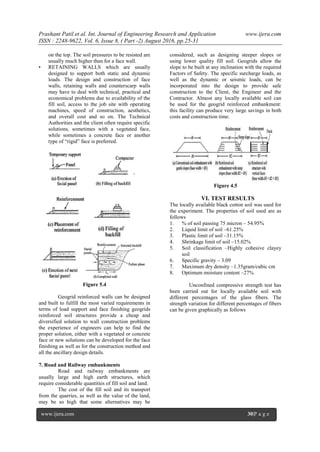
1. Open excavation using soil nails:
Figure 4.1
Vertical or steeply inclined cuts can be
made for open excavation using rigid soil nails as
reinforcements. Such cuts are also referred to as
nailed soil walls. Unlike reinforced soil walls are
constructed from bottom to top, nailed soil walls
are constructed from top to bottom. The facing of
such walls is usually in the form of a wire-mesh
reinforced shot Crete panels, although metal plates
and other types of panels have also been used. Soil
nails are installed at an inclination of 20 to 25
degrees to the horizontal near the ground surface so
as to avoid intercepting underground utilities and
the inclination is reduced to 10 to 15 degrees as we
go deeper into the cut.
2. Constructed soil reinforcement technique:-
1. Reinforced soil structures with vertical face:-
The facing usually comprises of
prefabricated concrete or steel panels joined
together by an interlocking arrangement. The soil
used as backfill in such cases is granular soil with
less than 15% fines to enable development of large
friction between the reinforcement and soil. The
most often used reinforcement is steel strips since
they have large tensile strength as well as low
extensibility. Construction takes place from bottom
upwards and the reinforcement is placed
sequentially as layers of soil are compacted, one
after the other.
Figure 4.2
The constructed soil reinforcement
technique describes the technique where the
reinforcement is placed at the same time as an
imported and remolded soil. Such technique are
often called as bottom up process as they involve
the placement of a fill and reinforcement
simultaneously, these include structures such as
reinforced soil embankments and bridge abutments.
The reinforcement used for the constructed
category is in the form of strips, mats or grids.
V. APPLICATIONS OF SOIL
REINFORCEMENT
1. Slope failure repairs
Figure 5.1
Large and small landslides and failures of
natural slopes often occur in areas where the value
of the environment (for technical or economical or
touristic or artistic reasons) call for the repair of the
slope to the original (or as close as possible to the
original) geometry. Geogrids allow using the same
soil of the landslide to reinstate the slopes thus
achieving fundamental savings over the solution of
importing a soil with better mechanical
characteristics. The geogrid reinforced slope can be
easily vegetated with the local essences, in order to
obtain the best integration with the surrounding
Prashant Patil.et al. Int. Journal of Engineering Research and Application www.ijera.com
ISSN : 2248-9622, Vol. 6, Issue 8, ( Part -2) August 2016, pp.25-31
www.ijera.com 29|P a g e
environment.
2. Slope cutting repairs
The installation of pipelines and other
underground structures often requires cutting a
slope in protected or valuable areas where the
Authority imposes to repair the cutting to the
original situation. This may produce geotechnical
problems due to the fact that the excavated soil
results in lower mechanical characteristics than the
original soil in the slope. Geogrids allow improving
the stability of the soil: the slope can be rebuilt
without using expensive consolidation techniques.
3. Steep slopes embankments and bunds
Figure 5.2
There are many situations where the
shortage of space or fill material calls for the
construction of embankments and bunds with very
steep slopes, greatly in excess of the naturally
stable angle.
Geogrid reinforced soil structure provide a
safe, sound and economical solution which can be
used for some of these applications:
• Noise protection bunds along highways,
railways and airport taxiways
• Blast protection embankments
• Increase of the available volume in exhausted
landfills
• Construction of embankment dams for solid or
liquid impoundments.
In all these applications, the inherent
flexibility, the ease of construction, and the use of
any locally available fill soil are the technical and
economic advantages of geogrid reinforced soil
structures.
4. Widening of slope crest.
There are different cases where a rather
flat slope has to be converted to a sub-vertical wall
enlargement of parking areas, smoothing of sharp
road bends, land reclamation projects and housing
developments are just examples of them. In most of
these cases the toe of the slope cannot be moved
forward, due to the right-of-way limits or natural
boundaries (rivers, roads, etc.). Therefore the crest
of the slope shall be widened, making the slope
steeper or even vertical. Geogrids allow building
steep slopes and walls with almost any locally
available fill soil. The face can be built with a
vegetated or concrete finishing different solutions
can be easily implemented at design and
construction stages to meet technical, architectural,
environmental requirements. The original slope has
usually to be cut at the bottom to yield enough
space for placing the reinforcing geogrids. All the
operations can be performed with standard earth-
moving machinery and easily available tools, even
by unskilled labourers. And, very important, the
traffic and the activities in front of the slope are not
disturbed by the construction operation.
5. Bridge abutments and wing walls
Bridge abutments and wing walls are often
the earth retaining structures that support the
highest loads. Besides the high vertical and
horizontal loads directly applied by the bridge
deck, dynamic loads from heavy traffic, and
sometimes seismic loads, challenge the design
engineer. Soft foundation soils, high water table,
environmental impact regulations often provide
further problem. Geogrid reinforced soil structures
provide strong, yet flexible, retaining structures.
Bridge abutments and wing walls can be designed
and built to resist all the anticipated loads with the
required Factors of Safety, even with low quality
fill soil. Soft soil stabilization and drainage
problems can be solved with geogrids and
geocomposites. The face can be designed to fulfill
any requirement regarding visual and
environmental impact.
Figure 5.3
6. Soil retaining structures
Soil retaining structures can be divided into:
• FACE WALLS which are usually designed to
cover a steep rock slope or a cliff, for
environmental and safety reasons. This kind of
wall usually has only small or no horizontal
pressures from the backfill, but has to resist the
internal outward pressure of the fill soil.
• COUNTERSCARP WALLS which must
support the constant load of a sloping terrain
Prashant Patil.et al. Int. Journal of Engineering Research and Application www.ijera.com
ISSN : 2248-9622, Vol. 6, Issue 8, ( Part -2) August 2016, pp.25-31
www.ijera.com 30|P a g e
on the top. The soil pressures to be resisted are
usually much higher than for a face wall.
• RETAINING WALLS which are usually
designed to support both static and dynamic
loads. The design and construction of face
walls, retaining walls and counterscarp walls
may have to deal with technical, practical and
economical problems due to availability of the
fill soil, access to the job site with operating
machines, speed of construction, aesthetics,
and overall cost and so on. The Technical
Authorities and the client often require specific
solutions, sometimes with a vegetated face,
while sometimes a concrete face or another
type of “rigid” face is preferred.
Figure 5.4
Geogrid reinforced walls can be designed
and built to fulfill the most varied requirements in
terms of load support and face finishing geogrids
reinforced soil structures provide a cheap and
diversified solution to wall construction problems
the experience of engineers can help to find the
proper solution, either with a vegetated or concrete
face or new solutions can be developed for the face
finishing as well as for the construction method and
all the ancillary design details.
7. Road and Railway embankments
Road and railway embankments are
usually large and high earth structures, which
require considerable quantities of fill soil and land.
The cost of the fill soil and its transport
from the quarries, as well as the value of the land,
may be so high that some alternatives may be
considered, such as designing steeper slopes or
using lower quality fill soil. Geogrids allow the
slope to be built at any inclination with the required
Factors of Safety. The specific surcharge loads, as
well as the dynamic or seismic loads, can be
incorporated into the design to provide safe
construction to the Client, the Engineer and the
Contractor. Almost any locally available soil can
be used for the geogrid reinforced embankment:
this facility can produce very large savings in both
costs and construction time.
Figure 4.5
VI. TEST RESULTS
The locally available black cotton soil was used for
the experiment. The properties of soil used are as
follows
1. % of soil passing 75 micron – 54.95%
2. Liquid limit of soil –61.25%
3. Plastic limit of soil –31.15%
4. Shrinkage limit of soil –15.02%
5. Soil classification –Highly cohesive clayey
soil
6. Specific gravity – 3.09
7. Maximum dry density –1.35gram/cubic cm
8. Optimum moisture content –27%
Unconfined compressive strength test has
been carried out for locally available soil with
different percentages of the glass fibers. The
strength variation for different percentages of fibers
can be given graphically as follows
Prashant Patil.et al. Int. Journal of Engineering Research and Application www.ijera.com
ISSN : 2248-9622, Vol. 6, Issue 8, ( Part -2) August 2016, pp.25-31
www.ijera.com 31|P a g e
The results are as follows
Sr.
No
% of fibers
added
Unconfined compressive
strength(N/cm2
)
1 0% 4.676614383
2 0.1% 4.690550575
3 0.2% 4.704426486
4 0.3% 6.090866115
5 0.4% 5.787868872
6 0.5% 4.594023642
VII. CONCLUSION
The use of reinforcement and its effect in
increasing soil strength has been discussed. The
different material techniques used and its
application area have been discussed. In addition to
this economical aspect of reinforced soil with
unreinforced soil and traditional structure has been
discussed and soil reinforced structure is found to
be economical.
According to the results, the strength of
soil increases on addition of fibers but up to certain
limits. Further increase in percentage of fiber
results in decrease in the strength. This may be
caused because of balling action of fibers, which
may result in poor compaction of soil. In this study
we observed 0.3% was optimum percentage of
fibers causing increase in strength.
REFERENCES
[1]. Dr. P. Purushothama “Ground
Improvement Techniques”. University
Science Press
[2]. Shashi K. Gulhati and Manoj Datta
“Geotechnical Engineering”. Tata
McGraw Hill Education Private Limite.

Soil Reinforcement Techniques

  • 1.
    Prashant Patil.et al.Int. Journal of Engineering Research and Application www.ijera.com ISSN : 2248-9622, Vol. 6, Issue 8, ( Part -2) August 2016, pp.25-31 www.ijera.com 25|P a g e Soil Reinforcement Techniques Prashant Patil* , Ipupu Mena* , Shubham Goski* , Yogesh Urs** *Graduated B.E. Civil, N. K. Orchid College of Engineering & Technology, Solapur **Assistant Professor, N. K. Orchid College of Engineering & Technology, Solapur. ABSTRACT In many activities concerned with the use of soil, the physical properties like Stiffness, Compressibility and Strength are some of the few important parameters to be considered. Of the many methods involved in improvement of soil properties, soil reinforcement is method concerned with increase of strength properties of soil. In soil reinforcement, the reinforcements or resisting element are of different materials and of various forms depending upon the intended use. The reinforcement can be provided permanently or temporarily to increase strength of adjacent structures. The present topic of discussion involves different materials, forms and applications of soil reinforcement Keywords: strength, reinforcement, materials, applications. I. HISTORY OF THE SOIL REINFORCEMENT Basic principles of soil reinforcement already existing in nature and are demonstrated by animals, plants and birds. The modern form of the soil reinforcement was first applied by Vidal (1969). Based on the Vidal’s concept the interaction between soil and the reinforcing horizontal member is solely by friction generated by gravity. Applying this concept retaining walls were built in France in 1986. Nowadays this technique is widely used in Europe and U.S.A. This technique is yet to become popular in India, and the constraining factor being identified as the non- availability of fiber and cost of reinforcing material. Reinforced soil is somewhat analogous to the reinforced concrete. But direct comparison between the functions of reinforcement in the two cases is not valid. The mode of action of reinforcement in soil is not one of carrying the developed tensile stresses as in reinforced concrete but of anisotropic reduction of normal strain rate. II. MECHANISM To understand the mechanism by which reinforcement improves the performance of soil, let us look at two laboratory scale experiments. In the first case, a tank ABCD as shown in figure is filled with dry sand. When we remove side AB of the container, the vertical face of the sand does not remain stable and the soil mass rearranges itself as a sloping surface. We now repeat the same experiment by using geotextile material as reinforcement in soil mass. The geotextile is the flexible material that resembles a strong or thick sheet of cloth. This material is placed in horizontal layers when the sand is filled in the tank and it is folded at the ends as shown in figure. After removing the side AB, the vertical side does not collapse. We may observe some bulging but the face remains vertical and stable. This is so because, when the soil particles in the failure zone begin to collapse, the geotextile reinforcement prevents their movement 1. During the shearing stage, prior to failure, the reinforced soil sample shows lower radial and axial strain under the same deviator stress as compared to unreinforced sample. 2. At failure, the deviator stress of the reinforced sample is significantly larger than that of sample without reinforcement indicating higher shear strength of the former Figure 2.1 RESEARCH ARTICLE OPEN ACCESS
  • 2.
    Prashant Patil.et al.Int. Journal of Engineering Research and Application www.ijera.com ISSN : 2248-9622, Vol. 6, Issue 8, ( Part -2) August 2016, pp.25-31 www.ijera.com 26|P a g e If we take two samples of medium-dense sand, one reinforced and the other not reinforced and test them in the triaxial apparatus under consolidated drained conditions. The reinforcement is introduced in one of the soil sample in the form of four discs of thin aluminium foil placed horizontally in the sample. Two important observations can be made from these tests: Figure 2.2 III. MATERIALS There are two basic materials used in the construction of reinforced soil. • Soil or fill matrix • Reinforcement or anchor system There used to be adequate inter- relationship between the materials used. Based on the design strength and availability, the materials are selected. We will discuss one by one, the materials that are being used. Soil or fill matrix The shear properties of soil can be improved as theoretically any soil could be used to form earth reinforced structure. In long term conventional structures the soil used is the well graded cohesionless soil or a good cohesive frictional fill although pure cohesive soils have been used with success. The advantages of cohesionless soil are that they are stable, free draining, not susceptible to frost and relatively non- corrosive to reinforcing elements. The only disadvantage is its cost. As a convenient compromise between the technical benefits from cohesionless soil and economic benefits from cohesive soil, cohesive frictional may be preferred. Sometimes the use of waste material as fill for reinforced soil structures is attractive from an environmental as well as economic view point. Mine wastes and pulverized fuel ash are the wastes usually employed Reinforcement A variety of material including steel, concrete, glass, fiber, wood, rubber, aluminium and thermoplastics can be used as reinforcing material. Reinforcement can have the form of strips, grids, anchors and sheet material chain, planks, rope, vegetation and combinations of these or other material forms. • Strips are flexible linear elements having their breadth greater than their thickness. Strips are formed from aluminium, copper, polymers and glass fiber reinforced plastic and bamboos. The forms of stainless galvanized or coated steel strips are either plain or with projections such as to increase the friction between reinforcement and fill. Figure 3.1 • Grids or are also used as reinforcement. Grids are formed from steel in the form of plain or galvanized weld mesh or from expanded metal. Figure 3.2 • Sheet reinforcement may be formed from metal such as galvanized steel sheet, fabric or expanded metal not meeting the criteria for a grid
  • 3.
    Prashant Patil.et al.Int. Journal of Engineering Research and Application www.ijera.com ISSN : 2248-9622, Vol. 6, Issue 8, ( Part -2) August 2016, pp.25-31 www.ijera.com 27|P a g e Flexible linear elements having one or more pronounced distortions which act as abutments or anchors in the fill or soil. They may be made from materials like steel, rope, plastic or combination of materials such as webbing and tyres, steel and tyres etc. Composite reinforcements can be formed by combining different materials and materials forms such as sheets and strips, grids and strips and anchors, depending on the field problem requirement. The principal requirements of reinforcing materials are strength, the stability (low tendency to creep), and durability, case of handling, a high coefficient of friction, and/or adherence with the soil, together with low cost and ready availability. Geosynthetics Geosynthetics are manmade products. They are flexible and planar (sheet-like). They are manufactured from synthetic polymeric materials and sometimes from natural materials. They find use in Geotechnical engineering as a separator, filters, drains, reinforcement, hydraulic barriers, protectors and erosion control system. I. Geotextiles are porous geosynthetics that resemble a thick strong cloth or blanket with its strands and fiber visible. They are planar permeable, polymeric material that are usually made from polypropylene and sometimes from polyester, polyethylene or from natural fibers such as jute .they can be woven, non-woven or knitted. Woven geotextiles are produced by weaving or interlacing, usually at right angles of two or more set of fibers. Non-woven geotextiles are produced by mechanical bonding or needle punching of randomly oriented fiber. Geotextiles can be 0.25 to 7.5 mm thick and have a mass/unit area of 150 to 2000 gm/mm^2 Figure 3.3 II. Geogrids are mesh like or grid like geosynthetics with square or rectangular openings that are larger than the thickness of the ribs. the rib thickness ranges from 5 to 15mm and the mass /unit area lies between 200 to 1500 gms Figure 3.4 III. Geonets are similar to geogrids but have thinner member sand angular apertures ,not square or rectangular but resembling parallelograms Figure 3.5 IV. SOIL REINFORCEMENT TECHNIQUES Soil reinforcement techniques can be divided into two major categories 1. Insitu soil reinforcement 2. Constructed soil reinforcement In the insitu reinforcement technique the reinforcement is placed in an undisturbed soil to form a reinforced soil structure. This includes the technique of soil nailing and soil dowelling. The reinforcement used for insitu structures is usually linear owing to the method of installation.
  • 4.
    Prashant Patil.et al.Int. Journal of Engineering Research and Application www.ijera.com ISSN : 2248-9622, Vol. 6, Issue 8, ( Part -2) August 2016, pp.25-31 www.ijera.com 28|P a g e 1. Open excavation using soil nails: Figure 4.1 Vertical or steeply inclined cuts can be made for open excavation using rigid soil nails as reinforcements. Such cuts are also referred to as nailed soil walls. Unlike reinforced soil walls are constructed from bottom to top, nailed soil walls are constructed from top to bottom. The facing of such walls is usually in the form of a wire-mesh reinforced shot Crete panels, although metal plates and other types of panels have also been used. Soil nails are installed at an inclination of 20 to 25 degrees to the horizontal near the ground surface so as to avoid intercepting underground utilities and the inclination is reduced to 10 to 15 degrees as we go deeper into the cut. 2. Constructed soil reinforcement technique:- 1. Reinforced soil structures with vertical face:- The facing usually comprises of prefabricated concrete or steel panels joined together by an interlocking arrangement. The soil used as backfill in such cases is granular soil with less than 15% fines to enable development of large friction between the reinforcement and soil. The most often used reinforcement is steel strips since they have large tensile strength as well as low extensibility. Construction takes place from bottom upwards and the reinforcement is placed sequentially as layers of soil are compacted, one after the other. Figure 4.2 The constructed soil reinforcement technique describes the technique where the reinforcement is placed at the same time as an imported and remolded soil. Such technique are often called as bottom up process as they involve the placement of a fill and reinforcement simultaneously, these include structures such as reinforced soil embankments and bridge abutments. The reinforcement used for the constructed category is in the form of strips, mats or grids. V. APPLICATIONS OF SOIL REINFORCEMENT 1. Slope failure repairs Figure 5.1 Large and small landslides and failures of natural slopes often occur in areas where the value of the environment (for technical or economical or touristic or artistic reasons) call for the repair of the slope to the original (or as close as possible to the original) geometry. Geogrids allow using the same soil of the landslide to reinstate the slopes thus achieving fundamental savings over the solution of importing a soil with better mechanical characteristics. The geogrid reinforced slope can be easily vegetated with the local essences, in order to obtain the best integration with the surrounding
  • 5.
    Prashant Patil.et al.Int. Journal of Engineering Research and Application www.ijera.com ISSN : 2248-9622, Vol. 6, Issue 8, ( Part -2) August 2016, pp.25-31 www.ijera.com 29|P a g e environment. 2. Slope cutting repairs The installation of pipelines and other underground structures often requires cutting a slope in protected or valuable areas where the Authority imposes to repair the cutting to the original situation. This may produce geotechnical problems due to the fact that the excavated soil results in lower mechanical characteristics than the original soil in the slope. Geogrids allow improving the stability of the soil: the slope can be rebuilt without using expensive consolidation techniques. 3. Steep slopes embankments and bunds Figure 5.2 There are many situations where the shortage of space or fill material calls for the construction of embankments and bunds with very steep slopes, greatly in excess of the naturally stable angle. Geogrid reinforced soil structure provide a safe, sound and economical solution which can be used for some of these applications: • Noise protection bunds along highways, railways and airport taxiways • Blast protection embankments • Increase of the available volume in exhausted landfills • Construction of embankment dams for solid or liquid impoundments. In all these applications, the inherent flexibility, the ease of construction, and the use of any locally available fill soil are the technical and economic advantages of geogrid reinforced soil structures. 4. Widening of slope crest. There are different cases where a rather flat slope has to be converted to a sub-vertical wall enlargement of parking areas, smoothing of sharp road bends, land reclamation projects and housing developments are just examples of them. In most of these cases the toe of the slope cannot be moved forward, due to the right-of-way limits or natural boundaries (rivers, roads, etc.). Therefore the crest of the slope shall be widened, making the slope steeper or even vertical. Geogrids allow building steep slopes and walls with almost any locally available fill soil. The face can be built with a vegetated or concrete finishing different solutions can be easily implemented at design and construction stages to meet technical, architectural, environmental requirements. The original slope has usually to be cut at the bottom to yield enough space for placing the reinforcing geogrids. All the operations can be performed with standard earth- moving machinery and easily available tools, even by unskilled labourers. And, very important, the traffic and the activities in front of the slope are not disturbed by the construction operation. 5. Bridge abutments and wing walls Bridge abutments and wing walls are often the earth retaining structures that support the highest loads. Besides the high vertical and horizontal loads directly applied by the bridge deck, dynamic loads from heavy traffic, and sometimes seismic loads, challenge the design engineer. Soft foundation soils, high water table, environmental impact regulations often provide further problem. Geogrid reinforced soil structures provide strong, yet flexible, retaining structures. Bridge abutments and wing walls can be designed and built to resist all the anticipated loads with the required Factors of Safety, even with low quality fill soil. Soft soil stabilization and drainage problems can be solved with geogrids and geocomposites. The face can be designed to fulfill any requirement regarding visual and environmental impact. Figure 5.3 6. Soil retaining structures Soil retaining structures can be divided into: • FACE WALLS which are usually designed to cover a steep rock slope or a cliff, for environmental and safety reasons. This kind of wall usually has only small or no horizontal pressures from the backfill, but has to resist the internal outward pressure of the fill soil. • COUNTERSCARP WALLS which must support the constant load of a sloping terrain
  • 6.
    Prashant Patil.et al.Int. Journal of Engineering Research and Application www.ijera.com ISSN : 2248-9622, Vol. 6, Issue 8, ( Part -2) August 2016, pp.25-31 www.ijera.com 30|P a g e on the top. The soil pressures to be resisted are usually much higher than for a face wall. • RETAINING WALLS which are usually designed to support both static and dynamic loads. The design and construction of face walls, retaining walls and counterscarp walls may have to deal with technical, practical and economical problems due to availability of the fill soil, access to the job site with operating machines, speed of construction, aesthetics, and overall cost and so on. The Technical Authorities and the client often require specific solutions, sometimes with a vegetated face, while sometimes a concrete face or another type of “rigid” face is preferred. Figure 5.4 Geogrid reinforced walls can be designed and built to fulfill the most varied requirements in terms of load support and face finishing geogrids reinforced soil structures provide a cheap and diversified solution to wall construction problems the experience of engineers can help to find the proper solution, either with a vegetated or concrete face or new solutions can be developed for the face finishing as well as for the construction method and all the ancillary design details. 7. Road and Railway embankments Road and railway embankments are usually large and high earth structures, which require considerable quantities of fill soil and land. The cost of the fill soil and its transport from the quarries, as well as the value of the land, may be so high that some alternatives may be considered, such as designing steeper slopes or using lower quality fill soil. Geogrids allow the slope to be built at any inclination with the required Factors of Safety. The specific surcharge loads, as well as the dynamic or seismic loads, can be incorporated into the design to provide safe construction to the Client, the Engineer and the Contractor. Almost any locally available soil can be used for the geogrid reinforced embankment: this facility can produce very large savings in both costs and construction time. Figure 4.5 VI. TEST RESULTS The locally available black cotton soil was used for the experiment. The properties of soil used are as follows 1. % of soil passing 75 micron – 54.95% 2. Liquid limit of soil –61.25% 3. Plastic limit of soil –31.15% 4. Shrinkage limit of soil –15.02% 5. Soil classification –Highly cohesive clayey soil 6. Specific gravity – 3.09 7. Maximum dry density –1.35gram/cubic cm 8. Optimum moisture content –27% Unconfined compressive strength test has been carried out for locally available soil with different percentages of the glass fibers. The strength variation for different percentages of fibers can be given graphically as follows
  • 7.
    Prashant Patil.et al.Int. Journal of Engineering Research and Application www.ijera.com ISSN : 2248-9622, Vol. 6, Issue 8, ( Part -2) August 2016, pp.25-31 www.ijera.com 31|P a g e The results are as follows Sr. No % of fibers added Unconfined compressive strength(N/cm2 ) 1 0% 4.676614383 2 0.1% 4.690550575 3 0.2% 4.704426486 4 0.3% 6.090866115 5 0.4% 5.787868872 6 0.5% 4.594023642 VII. CONCLUSION The use of reinforcement and its effect in increasing soil strength has been discussed. The different material techniques used and its application area have been discussed. In addition to this economical aspect of reinforced soil with unreinforced soil and traditional structure has been discussed and soil reinforced structure is found to be economical. According to the results, the strength of soil increases on addition of fibers but up to certain limits. Further increase in percentage of fiber results in decrease in the strength. This may be caused because of balling action of fibers, which may result in poor compaction of soil. In this study we observed 0.3% was optimum percentage of fibers causing increase in strength. REFERENCES [1]. Dr. P. Purushothama “Ground Improvement Techniques”. University Science Press [2]. Shashi K. Gulhati and Manoj Datta “Geotechnical Engineering”. Tata McGraw Hill Education Private Limite.