Don Bosco College of Engineering & Technology
TOPIC- TYPES OF SAMPLERS
Geotechnical Engineering 2
CVE-6
Presented by-
Anamika Debbarma (dc2011bte0127)
There are 2 types of soil sample
• Disturbed sample
• Undisturbed sample
• Disturbed sample :- Natural structure of the soil gets modified or
destroyed during the sampling operation. These are also called
representative samples.
Non-representative samples are those in which soils from other
layers get mixed up.
• Undisturbed sample :- Natural structure of the soil and material
properties remain preserved.
 Depends upon design samplers and method of sampling.
 Design features governing the degree of disturbance
 Cutting edge
 Inside wall friction
 Non-return valve
The following ratios of the cutting edge and the sampler are
shown :-
Fig –Lower section of a sampler
Inside clearance= [(D3 – D1 ) / D1 ]x 100 %
•Should lie in between 1 to 3 %
Outside clearance = [(D2 – D4 ) / D4 ]x
100%
•Outside clearance should not be much
greater than the inside clearance .
Area ratio= [(D2
2 – D1
2 ) / D1
2] x 100 %
•Should be as low as possible
•For soft sensitive soil, > 25%
•Preferably, ≤ 10 %
 Depending upon the area ratio
 Thick wall sampler
 Thin wall sampler
• Thick wall samplers :-Used for obtaining disturbed but representative
soil samples.
 Area ratio > 10 %
• Thin wall samplers :-Used for obtaining undisturbed samples.
 Area ratio < 10 %
Depending upon the mode of operation
1. Open drive sampler
2. Piston sampler
3. Rotary sampler
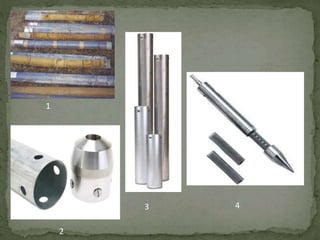
 Undisturbed samples are obtained from boreholes by open drive
samplers.
 Open drive samplers consist of thin walled tubes which are pushed or
driven in to the soil at the bottom of the hole and then rotated detach
the lower end of the sample from the soil.
 Most soft or moderately stiff cohesive soil can be sampled without
extensive disturbance in thin walled seamless steel tubes having
diameter not less than 50 mm.
 The lower end of the tube is sharpened to form a cutting edge and the
other end is machined for attachment to the drill rods.
 The entire tube is pushed or driven in to the soil at the bottom of the
hole and is removed sample with inside.
 The two ends of the tube are then sealed and sample shifted to the
laboratory.
2
1
3 4
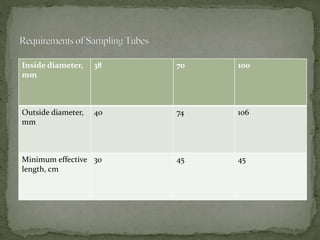
Inside diameter,
mm
38 70 100
Outside diameter,
mm
40 74 106
Minimum effective
length, cm
30 45 45
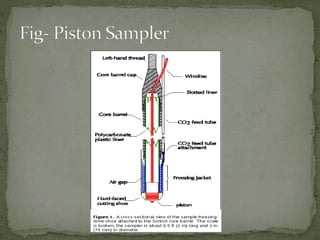
Piston sampler consists of two parts-
 Sampler Cylinder
 Piston system
 The piston fits tightly in the sampler cylinder.
 Good quality undisturbed samples are obtained from piston samplers
which use thin –walled sampling tubes with a piston inside.
 The tube is being lowered to the bottom of the drill hole, the piston rods
and piston are held at the bottom of the sampler by means of a drill rod
which rises to the top of the bore hole.
 The presence of the piston prevents excess soil from squeezing in to the
tube and thus, maintains the integrity of the sample.
 A Rotary Sampler is a double –walled tube sampler with an
inner removable liner.
 The outer tube or the rotating barrel is provided with a cutting
bit.
 The bit cuts an annular ring when the barrel is rotated.
 The inner tube which is stationary, slides over the cylindrical
sample cut by the outer rotating barrel. The sample is collected
in the inner liner.
 Rotary samples are useful for sampling in firm to hard cohesive
soils and particularly in rocks
Soil sampling is the process of obtaining samples of soil from the
desired depth at the desired location in a natural soil deposit, with a
view to assessing the engineering properties of the soil for ensuring a
proper design of the foundation. The devices used for the purpose of
sampling are known as soil samplers. With the help of soil samplers,
various kinds of soil samples can be obtained and studied.
1. Basic and Applied Soil Mechanics-By Gopal Ranjan and A.S.R Rao
2. Geotechnical Engineering-By C. Venkatramaiah

Types of samplers used in soil sampling

  • 1.
    Don Bosco Collegeof Engineering & Technology TOPIC- TYPES OF SAMPLERS Geotechnical Engineering 2 CVE-6 Presented by- Anamika Debbarma (dc2011bte0127)
  • 2.
    There are 2types of soil sample • Disturbed sample • Undisturbed sample • Disturbed sample :- Natural structure of the soil gets modified or destroyed during the sampling operation. These are also called representative samples. Non-representative samples are those in which soils from other layers get mixed up. • Undisturbed sample :- Natural structure of the soil and material properties remain preserved.
  • 3.
     Depends upondesign samplers and method of sampling.  Design features governing the degree of disturbance  Cutting edge  Inside wall friction  Non-return valve The following ratios of the cutting edge and the sampler are shown :-
  • 4.
    Fig –Lower sectionof a sampler Inside clearance= [(D3 – D1 ) / D1 ]x 100 % •Should lie in between 1 to 3 % Outside clearance = [(D2 – D4 ) / D4 ]x 100% •Outside clearance should not be much greater than the inside clearance . Area ratio= [(D2 2 – D1 2 ) / D1 2] x 100 % •Should be as low as possible •For soft sensitive soil, > 25% •Preferably, ≤ 10 %
  • 5.
     Depending uponthe area ratio  Thick wall sampler  Thin wall sampler • Thick wall samplers :-Used for obtaining disturbed but representative soil samples.  Area ratio > 10 % • Thin wall samplers :-Used for obtaining undisturbed samples.  Area ratio < 10 %
  • 6.
    Depending upon themode of operation 1. Open drive sampler 2. Piston sampler 3. Rotary sampler
  • 7.
     Undisturbed samplesare obtained from boreholes by open drive samplers.  Open drive samplers consist of thin walled tubes which are pushed or driven in to the soil at the bottom of the hole and then rotated detach the lower end of the sample from the soil.  Most soft or moderately stiff cohesive soil can be sampled without extensive disturbance in thin walled seamless steel tubes having diameter not less than 50 mm.  The lower end of the tube is sharpened to form a cutting edge and the other end is machined for attachment to the drill rods.  The entire tube is pushed or driven in to the soil at the bottom of the hole and is removed sample with inside.  The two ends of the tube are then sealed and sample shifted to the laboratory.
  • 8.
  • 9.
    Inside diameter, mm 38 70100 Outside diameter, mm 40 74 106 Minimum effective length, cm 30 45 45
  • 12.
    Piston sampler consistsof two parts-  Sampler Cylinder  Piston system  The piston fits tightly in the sampler cylinder.  Good quality undisturbed samples are obtained from piston samplers which use thin –walled sampling tubes with a piston inside.  The tube is being lowered to the bottom of the drill hole, the piston rods and piston are held at the bottom of the sampler by means of a drill rod which rises to the top of the bore hole.  The presence of the piston prevents excess soil from squeezing in to the tube and thus, maintains the integrity of the sample.
  • 14.
     A RotarySampler is a double –walled tube sampler with an inner removable liner.  The outer tube or the rotating barrel is provided with a cutting bit.  The bit cuts an annular ring when the barrel is rotated.  The inner tube which is stationary, slides over the cylindrical sample cut by the outer rotating barrel. The sample is collected in the inner liner.  Rotary samples are useful for sampling in firm to hard cohesive soils and particularly in rocks
  • 16.
    Soil sampling isthe process of obtaining samples of soil from the desired depth at the desired location in a natural soil deposit, with a view to assessing the engineering properties of the soil for ensuring a proper design of the foundation. The devices used for the purpose of sampling are known as soil samplers. With the help of soil samplers, various kinds of soil samples can be obtained and studied.
  • 17.
    1. Basic andApplied Soil Mechanics-By Gopal Ranjan and A.S.R Rao 2. Geotechnical Engineering-By C. Venkatramaiah