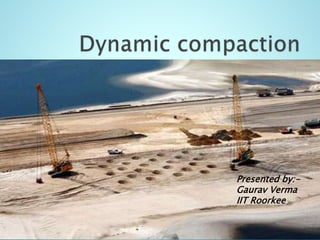
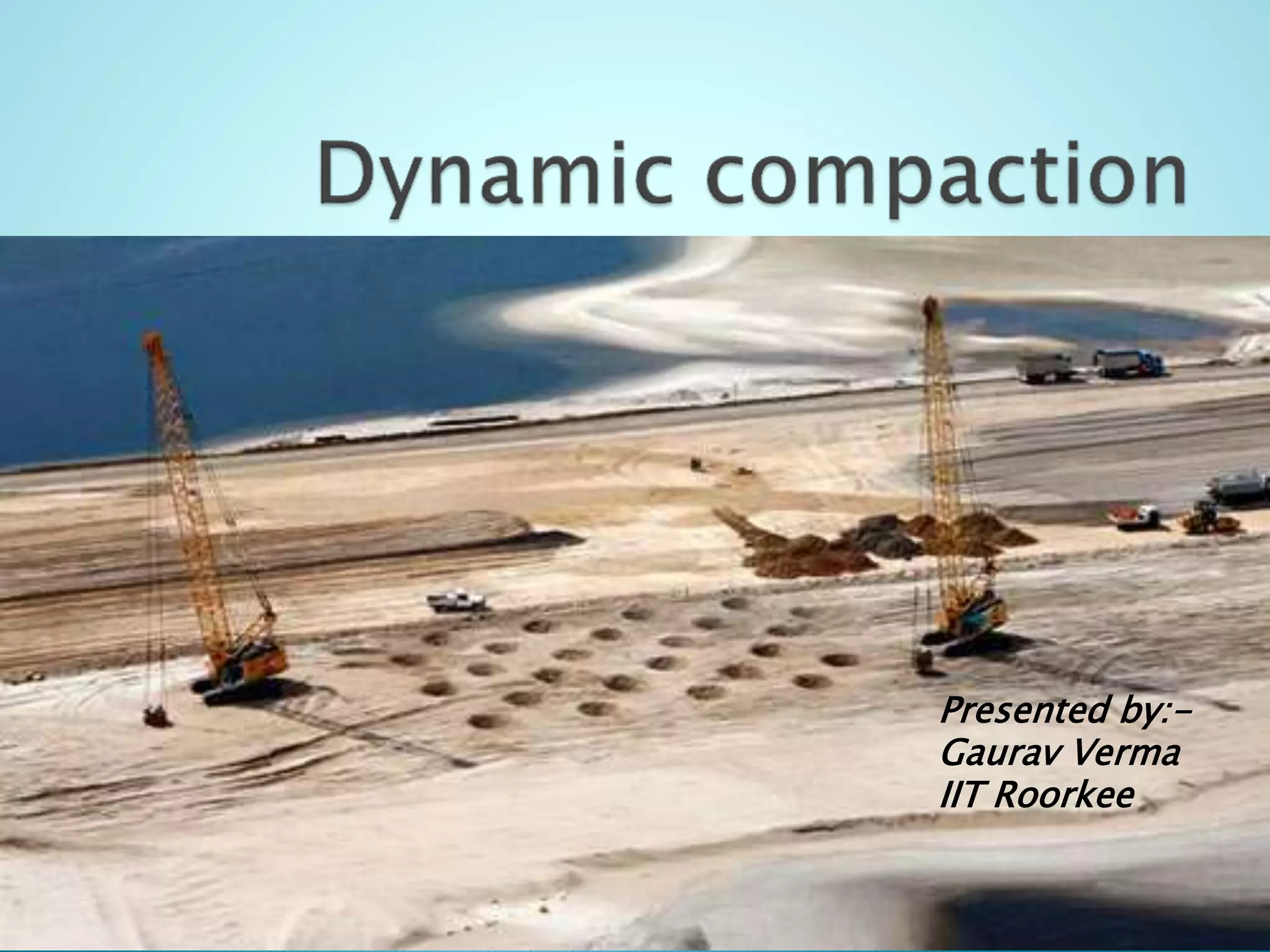
Presented by:- 
Gaurav Verma 
IIT Roorkee
 Method invented and developed by Menard 
Company in Late 1960’s 
 Dynamic Compaction has been used on the 
numerous sites all over the world for various 
soil conditions and for a variety of 
applications such as: roads, airports, large 
halls
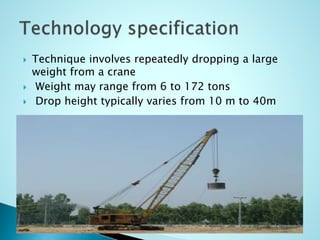
 Technique involves repeatedly dropping a large 
weight from a crane 
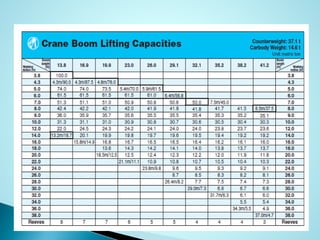
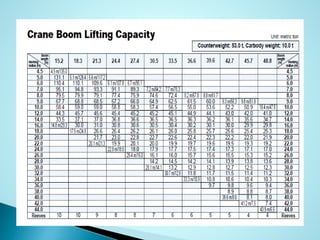
 Weight may range from 6 to 172 tons 
 Drop height typically varies from 10 m to 40m
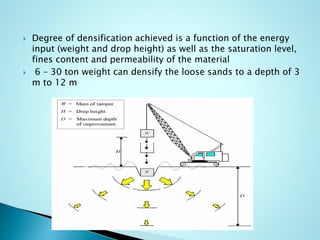
 Degree of densification achieved is a function of the energy 
input (weight and drop height) as well as the saturation level, 
fines content and permeability of the material 
 6 – 30 ton weight can densify the loose sands to a depth of 3 
m to 12 m
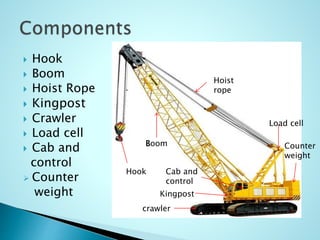
 Hook 
 Boom 
 Hoist Rope 
 Kingpost 
 Crawler 
 Load cell 
 Cab and 
control 
 Counter 
weight 
Hook 
Hoist 
rope 
Boom 
Kingpost 
crawler 
Load cell 
Cab and 
control 
Counter 
weight
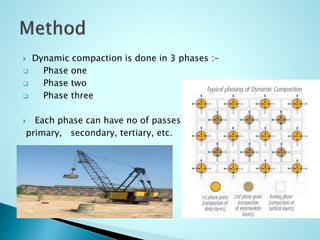
 Dynamic compaction is done in 3 phases :- 
 Phase one 
 Phase two 
 Phase three 
 Each phase can have no of passes 
primary, secondary, tertiary, etc.
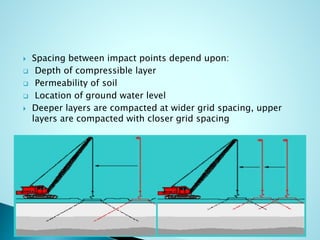
 Spacing between impact points depend upon: 
 Depth of compressible layer 
 Permeability of soil 
 Location of ground water level 
 Deeper layers are compacted at wider grid spacing, upper 
layers are compacted with closer grid spacing
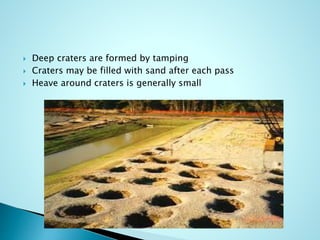
 Deep craters are formed by tamping 
 Craters may be filled with sand after each pass 
 Heave around craters is generally small
 Applicable for all type of granular soil 
 This technique is particularly well adapted to 
non-organic, non-homogeneous fill and 
reclamation areas with variable characteristics 
 It is effective in both saturated and un-saturated 
soils. 
 The depth of the compaction most often 
varies between 3.0 and 7.0 m.
 Expensive and time consuming 
 Shock waves affect underground utilities in 
developed areas 
 The soil can be treated as close as 3 m from 
underground services and can be treated 6 m 
from the sound structures 
 Causes environmental pollution by making 
noise, gusts of air, vibrations
Dynamic compaction
Dynamic compaction
Dynamic compaction
Dynamic compaction
Dynamic compaction

Dynamic compaction

  • 1.
    Presented by:- GauravVerma IIT Roorkee
  • 2.
     Method inventedand developed by Menard Company in Late 1960’s  Dynamic Compaction has been used on the numerous sites all over the world for various soil conditions and for a variety of applications such as: roads, airports, large halls
  • 3.
     Technique involvesrepeatedly dropping a large weight from a crane  Weight may range from 6 to 172 tons  Drop height typically varies from 10 m to 40m
  • 4.
     Degree ofdensification achieved is a function of the energy input (weight and drop height) as well as the saturation level, fines content and permeability of the material  6 – 30 ton weight can densify the loose sands to a depth of 3 m to 12 m
  • 5.
     Hook Boom  Hoist Rope  Kingpost  Crawler  Load cell  Cab and control  Counter weight Hook Hoist rope Boom Kingpost crawler Load cell Cab and control Counter weight
  • 6.
     Dynamic compactionis done in 3 phases :-  Phase one  Phase two  Phase three  Each phase can have no of passes primary, secondary, tertiary, etc.
  • 7.
     Spacing betweenimpact points depend upon:  Depth of compressible layer  Permeability of soil  Location of ground water level  Deeper layers are compacted at wider grid spacing, upper layers are compacted with closer grid spacing
  • 8.
     Deep cratersare formed by tamping  Craters may be filled with sand after each pass  Heave around craters is generally small
  • 9.
     Applicable forall type of granular soil  This technique is particularly well adapted to non-organic, non-homogeneous fill and reclamation areas with variable characteristics  It is effective in both saturated and un-saturated soils.  The depth of the compaction most often varies between 3.0 and 7.0 m.
  • 10.
     Expensive andtime consuming  Shock waves affect underground utilities in developed areas  The soil can be treated as close as 3 m from underground services and can be treated 6 m from the sound structures  Causes environmental pollution by making noise, gusts of air, vibrations