 Reinforced Earth is a composite material formed by
the association of frictional soil and tension resistant
elements in the form of sheets, strips, or nets of
metal, synthetic fabrics or fibre reinforced plastics.
or
 Reinforced earth is a combination of earth and linear
reinforcing strips that are capable of bearing large
tensile stresses
 Reinforced earth is also called as Reinforced soil.
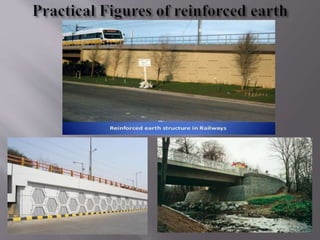
 Generally used in retaining walls, embankments, quay
walls, underground structures.
 Henri Vidal ,a French engineer ,demonstrated the
concept of the “Reinforced Earth” in 1966 and later on
Dr.Jones (scientist) continued it.
 Objectives:-
 this methods are opted to improve the engineering
and mechanical properties of soil.
 Because of its technical superiority and economic
advantages, reinforced earth has become a widely
used in the construction of earth-retaining
structures.
 Types Of Reinforcement :-
 Sheet reinforcement
 Strip reinforcement
 Geo-grid reinforcement
a) Uniaxial
b) Bi-axial
c) Triaxial
 It is be formed from metal such as galvanized steel, fabric
(textile).
 These are manufactured from synthetic materials such as
polypropylene, polyester and glass fibres.
 The thickness ranging from 0.125mm to 7.5mm
 These reinforcement has high tensile strength, which can last
up to 400kN/m
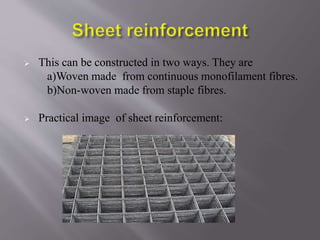
 This can be constructed in two ways. They are
a)Woven made from continuous monofilament fibres.
b)Non-woven made from staple fibres.
 Practical image of sheet reinforcement:
 These are flexible linear members having greater
breadth than their thickness.
 Thickness usually varies from 3mm-9mm & breadth
is between 40mm-120mm.
 These strips can also be formed from bamboo,
polymers and glass fibre reinforced plastics
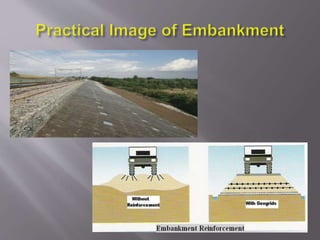
 An embankment is an artificial barrier that typically
is used to hold back water or to support a roadway
, railway, or canal.
 These are man-made mounds mainly consist of
stones , rocks, and earth.
 Generally, these embankments are longer than they
are in height.
 A vertical-walled structure formed by increasing
the stability of the backfill of the retaining wall
with the installation of reinforcement materials
such as geogrids and steel strips into the backfill.
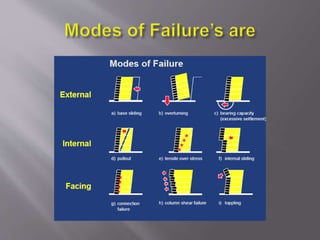
 While designing a reinforcement soil wall, we need
to consider
a)External stability
b)Internal stability
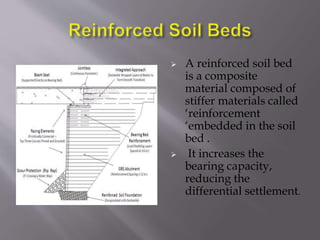
 A reinforced soil bed
is a composite
material composed of
stiffer materials called
‘reinforcement
‘embedded in the soil
bed .
 It increases the
bearing capacity,
reducing the
differential settlement.
 1) Reinforced Soil and it's Engineering
Applications by Swami Saran
 2)Basic & Applied Soil Mechanics by Gopala Rajan
& A.S.R.Rao
 3) Soil Mechanics and Foundation Engineering
(Geotechnical Engineering) (English literature)
 Author : K. R. Arora
 THANK YOU
BY
B.VENKAT PRANAY
11B91A0113

Reinforced earth & its application

  • 2.
     Reinforced Earthis a composite material formed by the association of frictional soil and tension resistant elements in the form of sheets, strips, or nets of metal, synthetic fabrics or fibre reinforced plastics. or  Reinforced earth is a combination of earth and linear reinforcing strips that are capable of bearing large tensile stresses  Reinforced earth is also called as Reinforced soil.
  • 3.
     Generally usedin retaining walls, embankments, quay walls, underground structures.  Henri Vidal ,a French engineer ,demonstrated the concept of the “Reinforced Earth” in 1966 and later on Dr.Jones (scientist) continued it.  Objectives:-  this methods are opted to improve the engineering and mechanical properties of soil.  Because of its technical superiority and economic advantages, reinforced earth has become a widely used in the construction of earth-retaining structures.
  • 5.
     Types OfReinforcement :-  Sheet reinforcement  Strip reinforcement  Geo-grid reinforcement a) Uniaxial b) Bi-axial c) Triaxial
  • 6.
     It isbe formed from metal such as galvanized steel, fabric (textile).  These are manufactured from synthetic materials such as polypropylene, polyester and glass fibres.  The thickness ranging from 0.125mm to 7.5mm  These reinforcement has high tensile strength, which can last up to 400kN/m
  • 7.
     This canbe constructed in two ways. They are a)Woven made from continuous monofilament fibres. b)Non-woven made from staple fibres.  Practical image of sheet reinforcement:
  • 8.
     These areflexible linear members having greater breadth than their thickness.  Thickness usually varies from 3mm-9mm & breadth is between 40mm-120mm.  These strips can also be formed from bamboo, polymers and glass fibre reinforced plastics
  • 9.
     An embankmentis an artificial barrier that typically is used to hold back water or to support a roadway , railway, or canal.  These are man-made mounds mainly consist of stones , rocks, and earth.  Generally, these embankments are longer than they are in height.
  • 11.
     A vertical-walledstructure formed by increasing the stability of the backfill of the retaining wall with the installation of reinforcement materials such as geogrids and steel strips into the backfill.  While designing a reinforcement soil wall, we need to consider a)External stability b)Internal stability
  • 13.
     A reinforcedsoil bed is a composite material composed of stiffer materials called ‘reinforcement ‘embedded in the soil bed .  It increases the bearing capacity, reducing the differential settlement.
  • 14.
     1) ReinforcedSoil and it's Engineering Applications by Swami Saran  2)Basic & Applied Soil Mechanics by Gopala Rajan & A.S.R.Rao  3) Soil Mechanics and Foundation Engineering (Geotechnical Engineering) (English literature)  Author : K. R. Arora
  • 15.
     THANK YOU BY B.VENKATPRANAY 11B91A0113