By: Asst. Prof. Imran Hafeez
References:
 Pavement Analysis and Design by Yang H.
Huang
 AASHTO Guide for Design of Pavement
structures
 Principles of Pavement Design by
E.J.Yoder
Contents
Design of Flexible Pavements
Mechanistic Design Approach
Empirical Design Approach
Mechanistic-Empirical Design
Approach
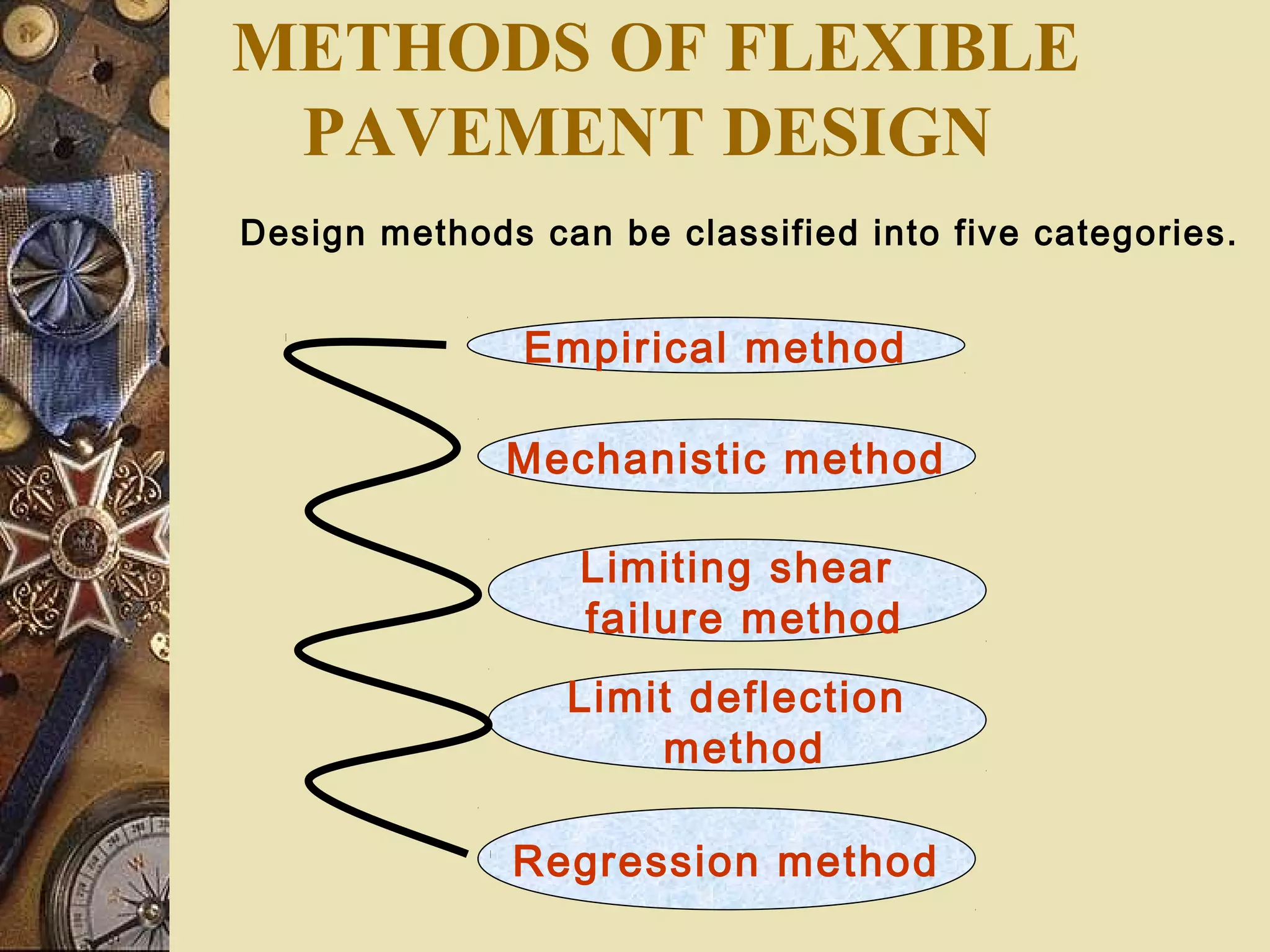
METHODS OF FLEXIBLE
PAVEMENT DESIGN
Empirical method
Mechanistic method
Limiting shear
failure method
Limit deflection
method
Regression method
Design methods can be classified into five categories.
Mechanistic Approach
 Mechanics is the science of motion and the action
of forces on bodies. Thus, a mechanistic
approach seeks to explain phenomena only by
reference to physical causes.
 In pavement design, the phenomena are the
stresses, strains and deflections within a
pavement structure, and the physical causes are
the loads and material properties of the pavement
structure.
Engr. Imran Hafeez
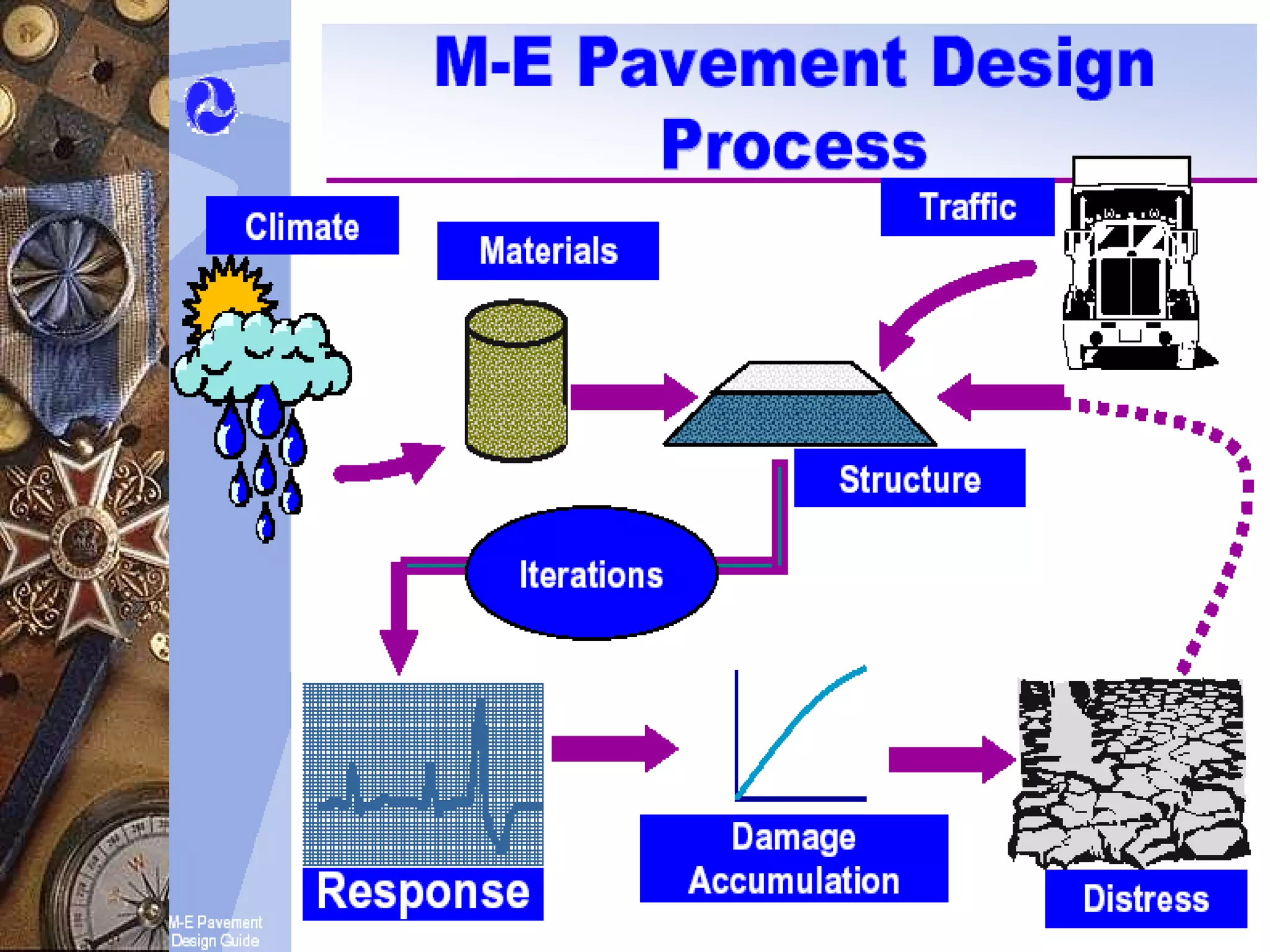
Mechanistic Design
A method that involve numerical capability
to calculate the stress, strain, or deflection
in a multi-layered system, such as a
pavement, when subjected to external
loads, or the effects of temperature or
moisture.
A method that refer to the
ability to translate the
analytical calculations of
pavement response to
performance.
(Function of Traffic & Environment)
Mechanistic Design
Benefits
 Improved reliability for design
 Ability to predict specific types of distress
 Ability to extrapolate from limited field and
laboratory results.
 Damaging effects of increased loads, high
tire pressure, multiple axles can be modeled.
 Better utilization of available materials
 Improved method for premature distress
analysis
1) Aging factor can be accommodated in
analysis
2) Seasonal effects like freezing-thaw
weakening
3) Long-term evaluation
4) Drainage factors
Benefits
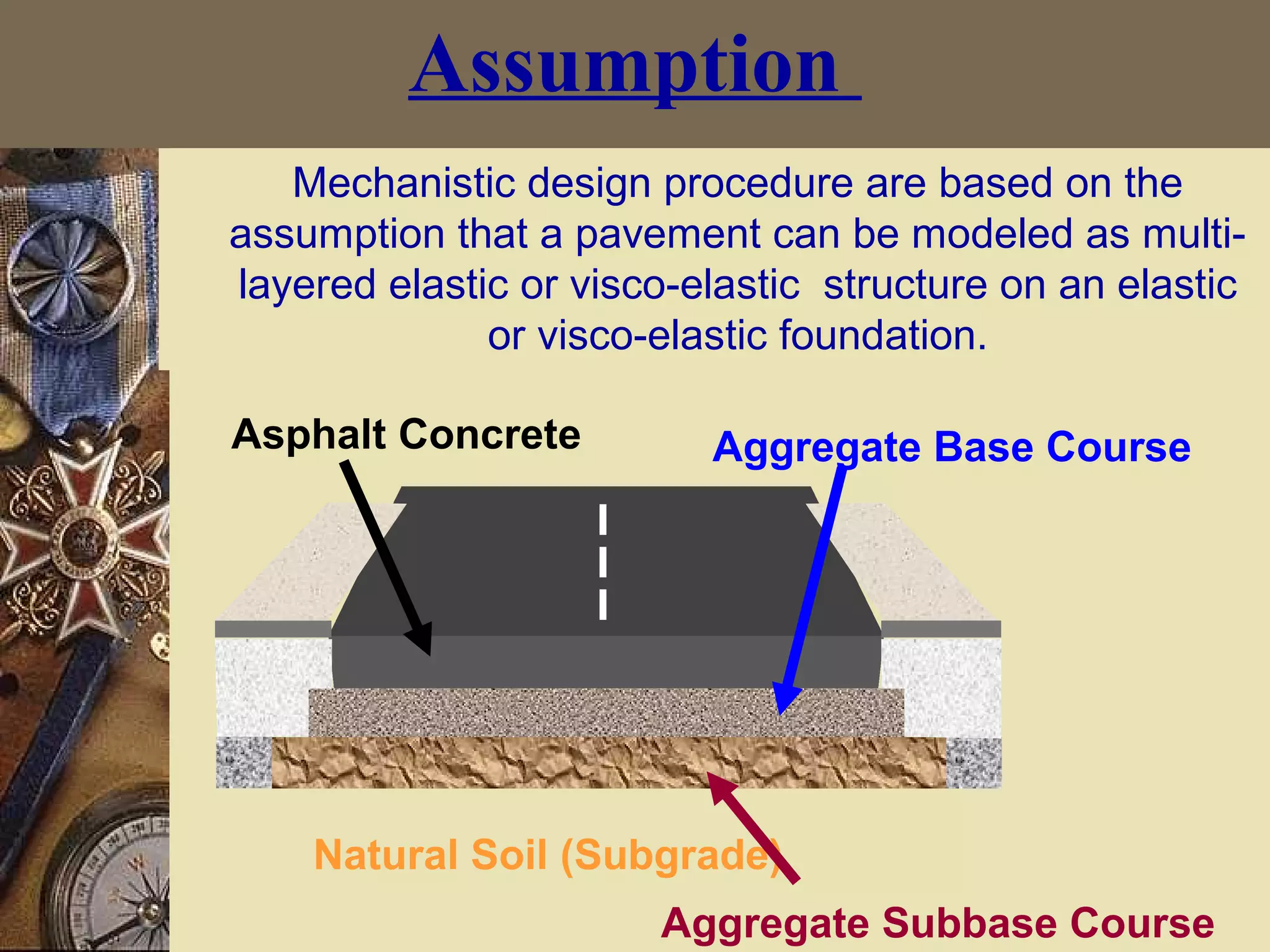
Mechanistic design procedure are based on the
assumption that a pavement can be modeled as multi-
layered elastic or visco-elastic structure on an elastic
or visco-elastic foundation.
Assumption
Natural Soil (Subgrade)
Aggregate Subbase Course
Aggregate Base CourseAsphalt Concrete
Low Temp. ~Short Loading Time
 Asphalt is a visco-elastic material. The
strain developed by imposing a particular
stress will depend on temperature and the
loading time. At low temperature or short
loading times, the material approaches
elastic behavior. Under these conditions,
the stiffness of a mix depends only on that
of the binder and VMA of the mix, which
is called elastic stiffness.
High Temp. ~Long Loading Time
 At higher temperature or longer loading
time, the stiffness of the mix is influenced
by additional parameters associated with
the mineral aggregates, which is also
known as viscous stiffness and depends on
the type of the grading, shape, and the
texture of aggregate, the confining
conditions and the method of compaction
in addition to the stiffness and VMA.
Stress~Strain
Stress~Strain Linearity
(Linear)
(Non-Linear)
ε(Strain)
δ(Stress)
Typical Creep Stress and strain relationship
Resilient Modulus
Layered System Concepts
Analytical solutions to the state of stress or strain has
several assumptions
1) The material properties of each layer are homogenous,
2) Each layer has finite thickness except for the lower layer
3) All layers are infinite in lateral directions
4) Each layer is isotropic
5) Full friction is developed between layers at each interface
6) Surface shearing forces are not present at the surface
7) The stress solution are characterized by two material
properties for each layer (E &µ)
The use of multilayered elastic theory in
conjunction with a limiting strain criteria
(Dorman and Metcalf in 1965) for design involve the
consideration of three factors:
(a) The theory
(b)Material characterization values
(c) The development of failure criterion for
each mode of distress
Fundamentals of design procedure
Foster and Ahlvin (1954)
presented charts for
determining vertical
stress radial stress
tangential stress
shear stress T, and
vertical deflection w.
The load is applied
over a circular area
with a radius a
Stress Components under Pavements
BISAR
CHEVRON-X
MICHPAVE
Mechanistic based Software
BISAR
(Bitumen Stress Analysis in Roads)
•BISAR 3.0 is capable of
calculating
•Comprehensive stress and
strain profiles
•Deflections
•Horizontal forces
•Slip between the pavement
layers via a shear spring
compliance at the interface
The centerof the loads and the positions at which stresses, strains and displacement
have to be calculated are given as co-ordinates in a fixed Cartesian system.
MICHPAVE
MICHPAVE is a user-friendly, non-linear finite element
program for the analysis of flexible pavements. The program
computes displacements, stresses and strains within the
pavement due to a single circular wheel load.
Useful design information such as fatigue life and rut depth
are also estimated through empirical equations.
Most of MICHPAVE is written in FORTRAN 77. Graphics
and screen manipulations are performed using the ORTRAN
callable GRAFMATIC graphics library, marketed by
Microcompatibles
Mechanistic based Software
Allowable Vertical strain at Top of sub grade
Basic Equation: Strain (allowable)-A* (N/10*6) *B
Where A and B are coefficients, and N is the number of load repetitions
Subgrade Strain Criteria Table
Model A B Allowable Strain
Shell 1978, 50% probability 0.000885 0.250 318
Shell 1978,84 % probability 0.000696 0.250 250
Shell 1978,95% probability 0.000569 0.200 251
Chevron, mean rut 10mm 0.000482 0.223 193
University of Nottingham,
mean rut 13mm
0.000451 0.280 143
South Africa, Terminal
PSI=1.5
0.001005 0.100 667
South Africa, Terminal PSI=
2.0
0.000728 0.100 483
South Africa, Terminal
PSI=2.5
0.000495 0.088 345
NAASRA, Austraila 0.001212 0.141 680
Verstraeten, rut less than 15
mm
0.000459 0.230 179
Kenya 0.001318 0.245 483
Giannini & Camomilla Italia 0.000675 0.202 295
Empirical Approach
“An empirical approach is one which is
based on the results of experiments or
experience.”
Generally, it requires a number of observations to
be made in order to ascertain the relationships
between input variables and outcomes.
It is not necessary to firmly establish the scientific basis for the
relationships between variables and outcomes as long as the
limitations with such approach are reorganized.
– It uses material properties that relates
better to actual pavement performance
– It provides more reliable performance
predictions
– It better defines the role of construction
– It accommodates environmental and aging
effects on materials
Benefits
Empirical equations are used to relate
observed or measurable phenomena
(pavement characteristics) with outcomes
(pavement performance). There are many
different types of empirical equations
available today e.g.
 1993 AASHTO Guide basic design
equation for flexible pavements.
 Group Index method
 CBR Method
Empirical Approach
AASHTO Guide basic design equation for flexible
pavements.
Log10(W18)=Zr x So+ 9.36 x log10(SN + 1)-0.20+(log10((ΔPSI)/
(4.2-1.5)) /(0.4+(1094/(SN+1)5.19
)+2.32x log10(MR)-8.07
where:
W18 =standard 18-kip (80.1-kN)-equivalent single-axle load (ESAL)
ZR = Reliability/probability of service
So = Standard Deviation of ESAL’S
ΔPSI = Loss of Serviceability
Empirical Approach
• SN=Structural Number (an index that is indicative
of the total pavement thickness required)
• SN =a1D1 + a2D2m2 + a3D3m3+...
ai = ith
layer coefficient
di = ith
layer thickness (inches)
Mi = ith
layer drainage coefficient
Δ PSI= difference between the initial design
serviceability index, po, and the design
terminal serviceability index, pt
MR= sub-grade resilient modulus (in psi)
Empirical Approach
ROAD TESTS
Maryland Road TestMaryland Road Test
The objective of this project was to determine the
relative effects of four different axle loadings on a
particular concrete pavement (HRB, 1952). The tests
were conducted on a 1-1-mile (1.76 km) section of
concrete pavement constructed in 1941 on US 301
approximately 9 mile (1.44 km) south of La Plata,
Maryland
HRB 1940~ 60.
WASHO Road Test
After the successful completion of Maryland
Road Test sponsored by the eleven Midwestern
and eastern states, the Western Association of
States Highway Officials (WASHO) conducted a
similar test but on sections of flexible
pavements in Malad. Idaho, with the same
objective in mind (HRB, 1955).
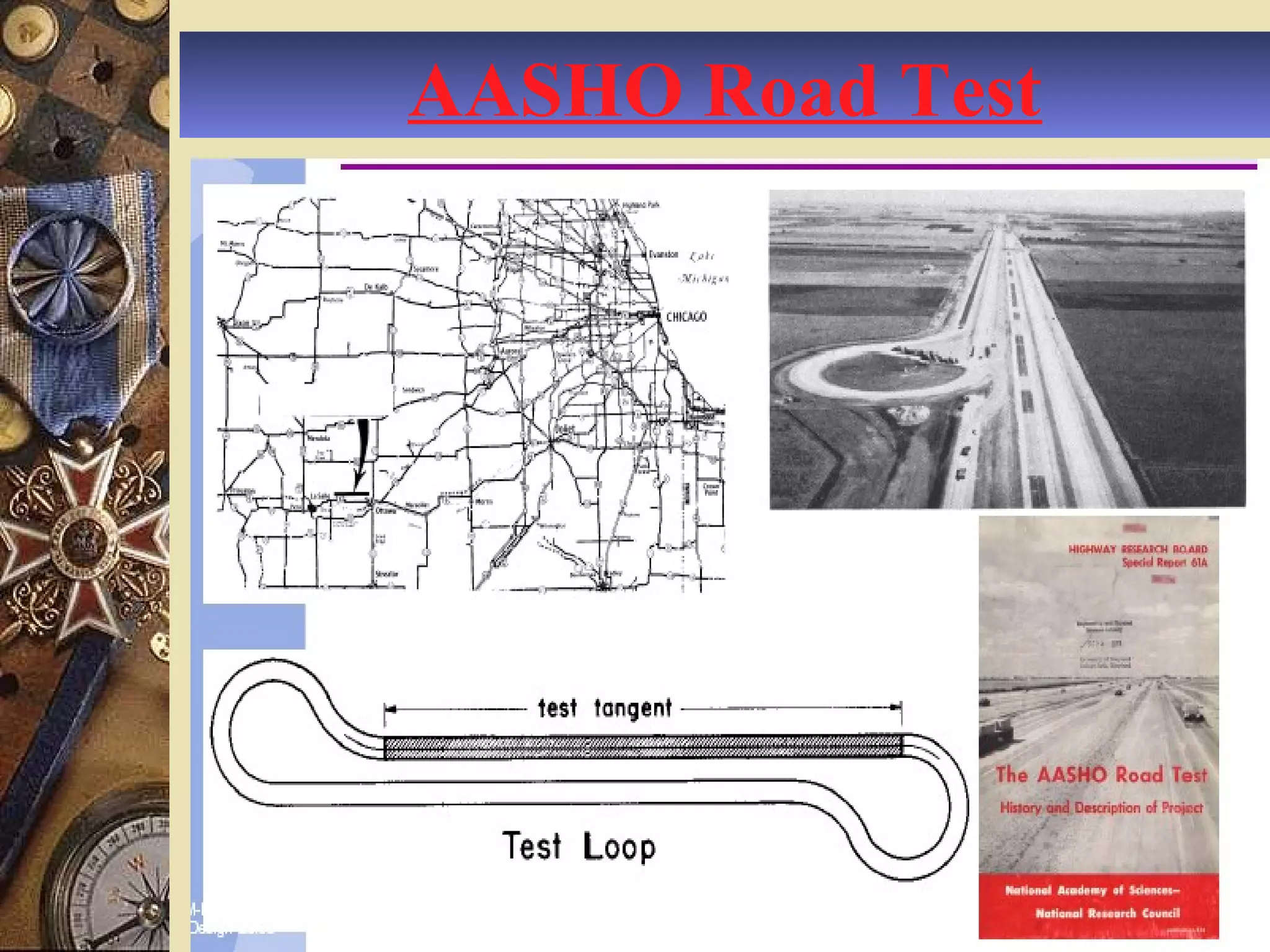
AASHO Road TestAASHO Road Test
The objective of this project was to determine the
significant relationship between the number of repetitions
of specified axle loads of different magnitudes and
arrangements and the performance of different
thicknesses of flexible and rigid pavements (HRB. 1962).
The test facility was constructed along the alignment of
Interstate 80 near Ottawa. Illinois, about 80 miles (128
km) south west of Chicago.
178
Utica
UticaRoad
23
2371
71
US
6
North
US
6Ottaw
a
Loop 4Loop 5
Loop 6Loop 3
Frontage Road
Frontage Road
Maintenance Building
AASHO Adm’n
12
Proposed FA 1
Route 80
Army Barracks
AASHO Road Test
Along with this mechanistic
approach, empirical elements are
used when defining what value
of the calculated stresses, strains
and deflections result in
pavement failure.
Mechanistic-Empirical Approach
The basic advantages of a mechanistic-
empirical pavement design method over a
purely empirical one are:
It can be used for both existing pavement
rehabilitation and new pavement construction It
accommodates changing load types
It can better characterize materials allowing for:
•Better utilization of available materials
•Accommodation of new materials
•An improved definition of existing layer properties
M-E Methods Advantages
National Cooperative Highway Research Projects
Flexible Pavement Design

Flexible Pavement Design

  • 1.
    By: Asst. Prof.Imran Hafeez
  • 2.
    References:  Pavement Analysisand Design by Yang H. Huang  AASHTO Guide for Design of Pavement structures  Principles of Pavement Design by E.J.Yoder
  • 3.
    Contents Design of FlexiblePavements Mechanistic Design Approach Empirical Design Approach Mechanistic-Empirical Design Approach
  • 4.
    METHODS OF FLEXIBLE PAVEMENTDESIGN Empirical method Mechanistic method Limiting shear failure method Limit deflection method Regression method Design methods can be classified into five categories.
  • 6.
    Mechanistic Approach  Mechanicsis the science of motion and the action of forces on bodies. Thus, a mechanistic approach seeks to explain phenomena only by reference to physical causes.  In pavement design, the phenomena are the stresses, strains and deflections within a pavement structure, and the physical causes are the loads and material properties of the pavement structure.
  • 7.
    Engr. Imran Hafeez MechanisticDesign A method that involve numerical capability to calculate the stress, strain, or deflection in a multi-layered system, such as a pavement, when subjected to external loads, or the effects of temperature or moisture.
  • 8.
    A method thatrefer to the ability to translate the analytical calculations of pavement response to performance. (Function of Traffic & Environment) Mechanistic Design
  • 9.
    Benefits  Improved reliabilityfor design  Ability to predict specific types of distress  Ability to extrapolate from limited field and laboratory results.  Damaging effects of increased loads, high tire pressure, multiple axles can be modeled.  Better utilization of available materials  Improved method for premature distress analysis
  • 10.
    1) Aging factorcan be accommodated in analysis 2) Seasonal effects like freezing-thaw weakening 3) Long-term evaluation 4) Drainage factors Benefits
  • 11.
    Mechanistic design procedureare based on the assumption that a pavement can be modeled as multi- layered elastic or visco-elastic structure on an elastic or visco-elastic foundation. Assumption Natural Soil (Subgrade) Aggregate Subbase Course Aggregate Base CourseAsphalt Concrete
  • 12.
    Low Temp. ~ShortLoading Time  Asphalt is a visco-elastic material. The strain developed by imposing a particular stress will depend on temperature and the loading time. At low temperature or short loading times, the material approaches elastic behavior. Under these conditions, the stiffness of a mix depends only on that of the binder and VMA of the mix, which is called elastic stiffness.
  • 13.
    High Temp. ~LongLoading Time  At higher temperature or longer loading time, the stiffness of the mix is influenced by additional parameters associated with the mineral aggregates, which is also known as viscous stiffness and depends on the type of the grading, shape, and the texture of aggregate, the confining conditions and the method of compaction in addition to the stiffness and VMA.
  • 15.
  • 16.
  • 17.
    Typical Creep Stressand strain relationship
  • 18.
  • 19.
    Layered System Concepts Analyticalsolutions to the state of stress or strain has several assumptions 1) The material properties of each layer are homogenous, 2) Each layer has finite thickness except for the lower layer 3) All layers are infinite in lateral directions 4) Each layer is isotropic 5) Full friction is developed between layers at each interface 6) Surface shearing forces are not present at the surface 7) The stress solution are characterized by two material properties for each layer (E &µ)
  • 20.
    The use ofmultilayered elastic theory in conjunction with a limiting strain criteria (Dorman and Metcalf in 1965) for design involve the consideration of three factors: (a) The theory (b)Material characterization values (c) The development of failure criterion for each mode of distress Fundamentals of design procedure
  • 21.
    Foster and Ahlvin(1954) presented charts for determining vertical stress radial stress tangential stress shear stress T, and vertical deflection w. The load is applied over a circular area with a radius a Stress Components under Pavements
  • 23.
  • 24.
    Mechanistic based Software BISAR (BitumenStress Analysis in Roads) •BISAR 3.0 is capable of calculating •Comprehensive stress and strain profiles •Deflections •Horizontal forces •Slip between the pavement layers via a shear spring compliance at the interface The centerof the loads and the positions at which stresses, strains and displacement have to be calculated are given as co-ordinates in a fixed Cartesian system.
  • 25.
    MICHPAVE MICHPAVE is auser-friendly, non-linear finite element program for the analysis of flexible pavements. The program computes displacements, stresses and strains within the pavement due to a single circular wheel load. Useful design information such as fatigue life and rut depth are also estimated through empirical equations. Most of MICHPAVE is written in FORTRAN 77. Graphics and screen manipulations are performed using the ORTRAN callable GRAFMATIC graphics library, marketed by Microcompatibles Mechanistic based Software
  • 26.
    Allowable Vertical strainat Top of sub grade Basic Equation: Strain (allowable)-A* (N/10*6) *B Where A and B are coefficients, and N is the number of load repetitions Subgrade Strain Criteria Table Model A B Allowable Strain Shell 1978, 50% probability 0.000885 0.250 318 Shell 1978,84 % probability 0.000696 0.250 250 Shell 1978,95% probability 0.000569 0.200 251 Chevron, mean rut 10mm 0.000482 0.223 193 University of Nottingham, mean rut 13mm 0.000451 0.280 143 South Africa, Terminal PSI=1.5 0.001005 0.100 667 South Africa, Terminal PSI= 2.0 0.000728 0.100 483 South Africa, Terminal PSI=2.5 0.000495 0.088 345 NAASRA, Austraila 0.001212 0.141 680 Verstraeten, rut less than 15 mm 0.000459 0.230 179 Kenya 0.001318 0.245 483 Giannini & Camomilla Italia 0.000675 0.202 295
  • 28.
    Empirical Approach “An empiricalapproach is one which is based on the results of experiments or experience.” Generally, it requires a number of observations to be made in order to ascertain the relationships between input variables and outcomes. It is not necessary to firmly establish the scientific basis for the relationships between variables and outcomes as long as the limitations with such approach are reorganized.
  • 29.
    – It usesmaterial properties that relates better to actual pavement performance – It provides more reliable performance predictions – It better defines the role of construction – It accommodates environmental and aging effects on materials Benefits
  • 30.
    Empirical equations areused to relate observed or measurable phenomena (pavement characteristics) with outcomes (pavement performance). There are many different types of empirical equations available today e.g.  1993 AASHTO Guide basic design equation for flexible pavements.  Group Index method  CBR Method Empirical Approach
  • 31.
    AASHTO Guide basicdesign equation for flexible pavements. Log10(W18)=Zr x So+ 9.36 x log10(SN + 1)-0.20+(log10((ΔPSI)/ (4.2-1.5)) /(0.4+(1094/(SN+1)5.19 )+2.32x log10(MR)-8.07 where: W18 =standard 18-kip (80.1-kN)-equivalent single-axle load (ESAL) ZR = Reliability/probability of service So = Standard Deviation of ESAL’S ΔPSI = Loss of Serviceability Empirical Approach
  • 32.
    • SN=Structural Number(an index that is indicative of the total pavement thickness required) • SN =a1D1 + a2D2m2 + a3D3m3+... ai = ith layer coefficient di = ith layer thickness (inches) Mi = ith layer drainage coefficient Δ PSI= difference between the initial design serviceability index, po, and the design terminal serviceability index, pt MR= sub-grade resilient modulus (in psi) Empirical Approach
  • 34.
    ROAD TESTS Maryland RoadTestMaryland Road Test The objective of this project was to determine the relative effects of four different axle loadings on a particular concrete pavement (HRB, 1952). The tests were conducted on a 1-1-mile (1.76 km) section of concrete pavement constructed in 1941 on US 301 approximately 9 mile (1.44 km) south of La Plata, Maryland HRB 1940~ 60.
  • 35.
    WASHO Road Test Afterthe successful completion of Maryland Road Test sponsored by the eleven Midwestern and eastern states, the Western Association of States Highway Officials (WASHO) conducted a similar test but on sections of flexible pavements in Malad. Idaho, with the same objective in mind (HRB, 1955).
  • 36.
    AASHO Road TestAASHORoad Test The objective of this project was to determine the significant relationship between the number of repetitions of specified axle loads of different magnitudes and arrangements and the performance of different thicknesses of flexible and rigid pavements (HRB. 1962). The test facility was constructed along the alignment of Interstate 80 near Ottawa. Illinois, about 80 miles (128 km) south west of Chicago. 178 Utica UticaRoad 23 2371 71 US 6 North US 6Ottaw a Loop 4Loop 5 Loop 6Loop 3 Frontage Road Frontage Road Maintenance Building AASHO Adm’n 12 Proposed FA 1 Route 80 Army Barracks
  • 37.
  • 46.
    Along with thismechanistic approach, empirical elements are used when defining what value of the calculated stresses, strains and deflections result in pavement failure. Mechanistic-Empirical Approach
  • 50.
    The basic advantagesof a mechanistic- empirical pavement design method over a purely empirical one are: It can be used for both existing pavement rehabilitation and new pavement construction It accommodates changing load types It can better characterize materials allowing for: •Better utilization of available materials •Accommodation of new materials •An improved definition of existing layer properties M-E Methods Advantages
  • 51.
  • 52.