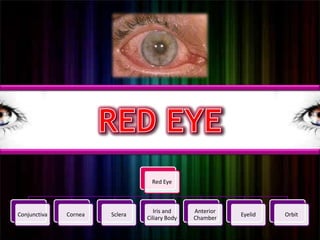
RED EYE
INTRODUCTIONRed eye-non-specific term to describe an eye that appears red due to illness, injury, or some other conditionCaused by enlarged, dilated blood vessels, leading to the appearance of redness on surface of eye2/85
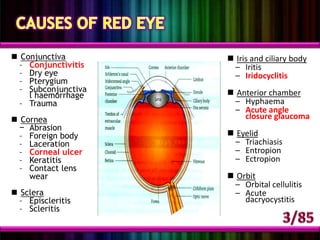
CAUSES OF RED EYEConjunctiva
Conjunctivitis
Dry eye
Pterygium
Subconjunctivalhaemorrhage
Trauma
Cornea
Abrasion
Foreign body
Laceration
Corneal ulcer
Keratitis
Contact lens 	wearSclera
Episcleritis
Scleritis
Iris and ciliary body
Iritis
Iridocyclitis
Anterior chamber
Hyphaema
Acute angle closure glaucoma
Eyelid
Triachiasis
Entropion
Ectropion
Orbit
Orbital cellulitis
Acute dacryocystitis3/85
SYMPTOMS ASSOCIATED WITH RED EYESYMPTOMSPain –corneal ulcer, iritis, acute glaucoma
Visual loss
Eye discharge
 Purulent – bacterial conjunctivitis
Clear – viral or allergic cause
Gritty sensation – common in conjunctivitis
Itching – common in allergic eye disease, blepharitis and topical drop hypersensitivity
Photophobia  -panuveitis4/85
SIGNS OF THE RED EYESVesicles Follicles Ciliary flushIrregular pupil Papillae Foreign bodyDilated conjunctival vesselsDischargeCorneal ulcerHypopyonDendritic ulcer Dilated episcleral vessels3512648101271195/85
blepharitisConjuctivitis with follicularViral conjuctivitis6/85
OCULAR HISTORYCharacterize the symptoms: Duration – hours, days, weeks 			Acute , Subacute and ChronicTypes of discharge – clear, purulent, etc.Unilateral or bilateral Precipitating event – trauma, contact lens usage Previous episodes of a similar problem  Past medical history – DM, hypertensionAllergic history 7/85
CONJUNCTIVA
CONJUNCTIVAThin, vascular mucous membrane/ epitheliumConjuntival causes of red eyes:Bact, viral, chlamydial, allergic conjunctivitis, opthalmianeonatorum(will be presented further by Nafis) dry eye, pterygium, subconjunctival haemorrhage, injury.9/85
PTERYGIUMTriangular fold of conjunctiva that usually grows from the medial portion of the palpebral fissure towards & invades the corneaNon-malignant fibrovascular growthPredisposing factors:Hot climatesChronic drynessExposure to sun*Prevalent in Southern countriesMx – surgical removal10/85
SUBCONJUNCTIVAL HAEMORRHAGE‘Extensive bleeding under the conjunctiva’Features: red eye, comfortable, no visual disturbance, Hx of trauma, spontaneously in elderly patient (compromised vascular struc in arteriosclerosis), may occur after coughing, sneezing, heavy lifting objects.Mx: check BP to exclude HPT (esp if occur repeatedly), usually resolve spontaneously within 2 weeks.11/85
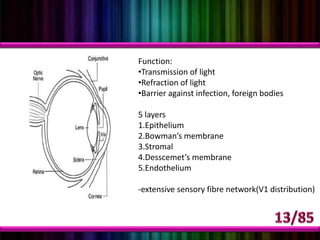
CORNEA
Function:Transmission of light
Refraction of light
Barrier against infection, foreign bodies5 layersEpitheliumBowman’s membraneStromalDesscemet’s membraneEndothelium-extensive sensory fibre network(V1 distribution)13/85
Corneal Ulcer (will be presented later)Corneal abrasion epithelium defect due to   trauma, contact lens use fluorescein and blue light,      defect shine in green.Corneal foreign body foreign body in or on  cornea. cause intense irritation and      profuse watering.MxTopical antibiotic (drop/ointment)Tropical NSAIDS, cyclopegicTight patch14/85
KERATITISDef : Inflammation of the corneaType : InfectiveBacterialViralProtozoalNon InfectiveAutoimmune (eg: RA, SLE)Non Autoimmune (eg: Marginal keratitis)15/85
BACTERIAL KERATITISCAUSES	- Staphylococcus epidermidis		     	- Staphylococcus aureus		     	- Streptococcus pneumoniae		     	- Coliforms		     	- Pseudomonas		     	- HaemophilisPREDISPOSING FACTOR
Keratoconjunctivitissicca (dry eye)
A breach in corneal epithelium     (eg following trauma)Prolonged contact lens wear
Prolonged use of topical steroids16/85
SYMPTOMS & SIGNS
severe pain
purulent discharge
ciliary injection
visual loss
hypopyon
white corneal opacity, can be seen with naked eye
MANAGEMENT
Scrapes taken from base of ulcer for Gram-staining & culture
Rx: Dual therapy of intensive topical antibiotics (eg: cefuroxime for Gram +ve bacteria and gentamicin for Gram –ve bacteria)
Monotherapy: fluoroquinolones (eg: ciprofloxacin, ofloxacin)
Initially by tissue adhessive (cyanoacrylate glue) and subsequent corneal graft– for severe or unresponsive disease where cornea may perforate.17/85
VIRAL KERATITISHerpes simplex keratitisCauses: Type 1 or Type 2 Herpes Simplex VirusMost are asymptomaticAccompanied by:FeverVesicular lid lesionFollicular conjunctivitisPre-auricular lymphadenopathyPathognomonic: dendritic ulcer on corneaDendritic ulcer may heal without scar, but may progress to stromal keratitis, a/w inflammatory infiltration, oedema and ultimately loss of corneal transparency and permanent scarring  if severe – corneal graftRx: topical antivirus (trifluridine)– heal within 2 weeks.18/85
19/85
Herpes zoster ophthalmicus(ophthalmic shingles)
Cause : Varicella zoster virus
Area affected: ophthalmic division of CN V
Accompanied by: prodromal period with systemically unwell, vesicles, lid swelling, iritis, 2° glaucoma.
Rx: - oral antiviral (eg: aciclovir, famciclovir) to   	  reduce  post-infective neuralgia	      - topical antiviral and steroids and 	antibacterials to cover secondary infection 	for the ocular disease.20/85
PROTOZOAL KERATITISAcanthamoeba keratitisCommonly due to used of contact lenses and exposure to contaminated water or soil.Presentation: painful keratitis, redness of the eye and photophobia.Rx: topical chlorhexidine, polyhexamethylene biguanide (PHMB) and propamidine.21/85
SCLERAWhite fibrous outer protective coat of eyeContinous with cornea ant and the dura of optic nerve posteriorly
ScleritisEtiology50% systemiccollagen vascular dzGranulomatousMetabolicInfectiouschemical/physical agents50% idiopathicRxSystemic NSAID/steroidTreat underlying etiologyEpiscleritisEtiologyMostly idiopathic, rest collagen vascular dz, infections(herpes zoster,herpessimplex,syphillis),IBDRxSelf-limitedTropical steroid if painful23/85
ANTERIOR CHAMBER
Anterior chamber’s causes of red eyes:-Hyphaemais blood in the front (anterior) chamber of the eye. It may appear as a reddish tinge, or it may appear as a small pool of blood at the bottom of the iris or in the cornea.Acute Congestive Glaucoma(will be presented by Joo Qing)25/85
EYELIDS
TRICHIASISIrritation of cornea due to aberrant eyelashes grow inward with a normal eyelid position.
May result from chronic inflammatory lid diseases(blepharitis), Steven-johnsonsyn, trauma,burn etc
Rx: - topical lubricant		-epilation with forceps	      - electrolysis for isolated 		  lashes	      - cryotherapy	      - laser ablation	      - surgery  in cases resistant            to other treatment.27/85
ECTROPIONEversion of the lid leads to disruption of tears flow.
Types:-

Red eye