Hernia
-Ventral hernia
  By Dr.Teo Zue Hiong
Contents
 Definition
 Classification
 Incisional hernia
  management
 Spigelian hernia
  management
Hernia
• Definition
  – An abnormal protrusion of an organ or tissue
    outside its normal body cavity or restraining
    sheath
Anatomical structure


                              Fundus
Covering of
hernia sac
                                     Contents of sac
                                     (usually bowel)


                                     Neck/Mouth
Causes of Hernia
• May exploit natural openings(inguinal,femoral and
  obturator canals, umbilicus and oesophageal hiatus) or
  weak areas caused by stretching, surgical incision or
  laparotomy
• Any condition that increases the pressure of the abdominal
  cavity may contribute to the formation or worsening of a
  hernia.
   – Obesity
   – Heavy lifting
   – Coughing
   – Straining during a bowel movement or urination
   – Chronic ling disease
   – Fluid in the abdominal cavity
   – Hereditary
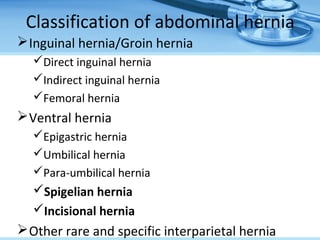
Classification of abdominal hernia
 Inguinal hernia/Groin hernia
  Direct inguinal hernia
  Indirect inguinal hernia
  Femoral hernia
 Ventral hernia
  Epigastric hernia
  Umbilical hernia
  Para-umbilical hernia
  Spigelian hernia
  Incisional hernia
 Other rare and specific interparietal hernia
Sign and symptoms
• The signs and symptoms of a hernia can range from
  noticing a painless lump to the painful, tender,
  swollen protrusion of tissue that you are unable to
  push back into the abdomen—possibly a
  strangulated hernia.
   –   Reducible hernia
   –   Irreducible hernia
   –   Obstructed hernia
   –   Strangulated hernia
   –   Inflammed hernia
Reducible hernia
– Asymptomatic reducible hernia
   • New lump and the groin or other abdominal wall area
   • May ache but is not tender when touched.
   • Sometimes pain precedes the discovery of the lump.
   • Lump increases in size when standing or when abdominal pressure
     is increased (such as coughing)
   • May be reduced (pushed back into the abdomen) unless very large
Irreducible hernia
– Irreducible hernia
   • Usually painful enlargement of a previous hernia that
     cannot be returned into the abdominal cavity on its
     own or when you push it
   • Some may be long term without pain
   • Can lead to strangulation
   • Signs and symptoms of bowel obstruction may occur,
     such as nausea and vomiting
Strangulated hernia
– Strangulated hernia
   • Irreducible hernia where the entrapped intestine has
     its blood supply cut off
   • Pain always present followed quickly by tenderness and
     sometimes symptoms of bowel obstruction (nausea
     and vomiting)
   • You may appear ill with or without fever
   • Surgical emergency
   • All strangulated hernias are irreducible (but all
     irreducible hernias are not strangulated)
Ventral hernia
Ventral hernia
Incisional hernia
• One that occurs through the wound of a
  previous operation
• Same features as a hernia that is caused by
  non-surgical injury to the abdominal wall
• 1% of transparietal abdominal incisions are
  followed by a hernia
Aetiology
• A postoperative complication,can be
  considered in terms of three factor
  – Preoperative factors
  – Operative factors
  – Postoperative factors
Preoperative factors
•   Age: older usually need more time to heal
•   Malnutrition
•   Sepsis: worsen
•   Uraemia: inhibit fibroblast division
•   Jaundice: impedes collagen maturation
•   Obesity
•   Diabetes mellitus
•   Steroids
•   Peritonitis
Operative factors
 Type of incisions
  vertical are more prone to hernia than transverse
 Technique and materials
  Tension in the closure decrease the blood supply
   in wound
  Loosen knots
  Closure using rapidly absorbable suture materials
 Type of operation
  Operations involve bowel or urinary tract are
   more likely to develop wound infection
 Drain tube
Postoperative factors
• Wound infection:
   – Same important with the wrong choice of suture
     material
   – Enzyme destruction of healing tissues
   – Inflammatory swelling raises tissue tension and impedes
     blood supply
   – 5-20% of wound infections result in a hernia
• Abdominal distension
   – Postoperative ileus increase the tension on a wound
   – Stitches may cut out
• Coughing:generates wound tension
Signs and symptoms
• A bulge in the scar
• As the hernia enlarges and loculates, symptoms of
  subacute I/O are common
• Overlying skin:thin and atrophic,eventually ulcer and
  rupture
• Strangulation is a surgical emergency
• P/E:
   – Usually reducible
   – Hernia with a cough impulse at the site of an old scar
   – When the patient lies flat, hernias deceptively small,any
     manoeuvre that raise intra-abdominal pressure
     produces the hernia in all its glory
Management
 Even small symptomatic hernias should be repaired early

 Prolonged observation simply increase the difficulties of
  subsequent repair and hazardous

 Surgical technique:same as for para-umbilical hernia
    Exicision of the sac after reduction of its contents
    Insertion of overlapping sutures into the rectus sheath
Spigelian hernia
• Rare but clinically important, less than 1% of total
• An interparietal hernia in the line of the linea
  semilunaris(the lateral margin of the rectus sheath)
• Usually at the level of the arcuate line:due to all
  aponeurotic layers are reflected anterior to the rectus
  muscle
• The hernial sac emerges and enlarges like a mushroom
  deep to the external oblique
S&S
Symptoms
 Local pain that is worse on straining
 Lumps
 Non-specific lower quadrant discomfort which needs to be
  investigated
 Features of obstruction or strangulation


Signs:
 Tenderness at the site of the hernial orifice
 Lump which may be difficult or even impossible to feel
Management
• Abdominal USG/CT:useful in the demonstration of these
  hernias
• Repair:A simple matter of excising the sac and closing the
  defect/Laparoscopic repairs
References
1. Clincal surgery 2nd edition
2. Principle and practice of surgery 5th edition
Thank you

Ventral hernia by Dr Teo

  • 1.
    Hernia -Ventral hernia By Dr.Teo Zue Hiong
  • 2.
    Contents  Definition  Classification Incisional hernia management  Spigelian hernia management
  • 3.
    Hernia • Definition – An abnormal protrusion of an organ or tissue outside its normal body cavity or restraining sheath
  • 4.
    Anatomical structure Fundus Covering of hernia sac Contents of sac (usually bowel) Neck/Mouth
  • 5.
    Causes of Hernia •May exploit natural openings(inguinal,femoral and obturator canals, umbilicus and oesophageal hiatus) or weak areas caused by stretching, surgical incision or laparotomy • Any condition that increases the pressure of the abdominal cavity may contribute to the formation or worsening of a hernia. – Obesity – Heavy lifting – Coughing – Straining during a bowel movement or urination – Chronic ling disease – Fluid in the abdominal cavity – Hereditary
  • 6.
    Classification of abdominalhernia  Inguinal hernia/Groin hernia Direct inguinal hernia Indirect inguinal hernia Femoral hernia  Ventral hernia Epigastric hernia Umbilical hernia Para-umbilical hernia Spigelian hernia Incisional hernia  Other rare and specific interparietal hernia
  • 8.
    Sign and symptoms •The signs and symptoms of a hernia can range from noticing a painless lump to the painful, tender, swollen protrusion of tissue that you are unable to push back into the abdomen—possibly a strangulated hernia. – Reducible hernia – Irreducible hernia – Obstructed hernia – Strangulated hernia – Inflammed hernia
  • 9.
    Reducible hernia – Asymptomaticreducible hernia • New lump and the groin or other abdominal wall area • May ache but is not tender when touched. • Sometimes pain precedes the discovery of the lump. • Lump increases in size when standing or when abdominal pressure is increased (such as coughing) • May be reduced (pushed back into the abdomen) unless very large
  • 10.
    Irreducible hernia – Irreduciblehernia • Usually painful enlargement of a previous hernia that cannot be returned into the abdominal cavity on its own or when you push it • Some may be long term without pain • Can lead to strangulation • Signs and symptoms of bowel obstruction may occur, such as nausea and vomiting
  • 11.
    Strangulated hernia – Strangulatedhernia • Irreducible hernia where the entrapped intestine has its blood supply cut off • Pain always present followed quickly by tenderness and sometimes symptoms of bowel obstruction (nausea and vomiting) • You may appear ill with or without fever • Surgical emergency • All strangulated hernias are irreducible (but all irreducible hernias are not strangulated)
  • 12.
  • 13.
  • 16.
    Incisional hernia • Onethat occurs through the wound of a previous operation • Same features as a hernia that is caused by non-surgical injury to the abdominal wall • 1% of transparietal abdominal incisions are followed by a hernia
  • 17.
    Aetiology • A postoperativecomplication,can be considered in terms of three factor – Preoperative factors – Operative factors – Postoperative factors
  • 18.
    Preoperative factors • Age: older usually need more time to heal • Malnutrition • Sepsis: worsen • Uraemia: inhibit fibroblast division • Jaundice: impedes collagen maturation • Obesity • Diabetes mellitus • Steroids • Peritonitis
  • 19.
    Operative factors  Typeof incisions vertical are more prone to hernia than transverse  Technique and materials Tension in the closure decrease the blood supply in wound Loosen knots Closure using rapidly absorbable suture materials  Type of operation Operations involve bowel or urinary tract are more likely to develop wound infection  Drain tube
  • 20.
    Postoperative factors • Woundinfection: – Same important with the wrong choice of suture material – Enzyme destruction of healing tissues – Inflammatory swelling raises tissue tension and impedes blood supply – 5-20% of wound infections result in a hernia • Abdominal distension – Postoperative ileus increase the tension on a wound – Stitches may cut out • Coughing:generates wound tension
  • 21.
    Signs and symptoms •A bulge in the scar • As the hernia enlarges and loculates, symptoms of subacute I/O are common • Overlying skin:thin and atrophic,eventually ulcer and rupture • Strangulation is a surgical emergency • P/E: – Usually reducible – Hernia with a cough impulse at the site of an old scar – When the patient lies flat, hernias deceptively small,any manoeuvre that raise intra-abdominal pressure produces the hernia in all its glory
  • 22.
    Management  Even smallsymptomatic hernias should be repaired early  Prolonged observation simply increase the difficulties of subsequent repair and hazardous  Surgical technique:same as for para-umbilical hernia  Exicision of the sac after reduction of its contents  Insertion of overlapping sutures into the rectus sheath
  • 23.
    Spigelian hernia • Rarebut clinically important, less than 1% of total • An interparietal hernia in the line of the linea semilunaris(the lateral margin of the rectus sheath) • Usually at the level of the arcuate line:due to all aponeurotic layers are reflected anterior to the rectus muscle • The hernial sac emerges and enlarges like a mushroom deep to the external oblique
  • 24.
    S&S Symptoms  Local painthat is worse on straining  Lumps  Non-specific lower quadrant discomfort which needs to be investigated  Features of obstruction or strangulation Signs:  Tenderness at the site of the hernial orifice  Lump which may be difficult or even impossible to feel
  • 25.
    Management • Abdominal USG/CT:usefulin the demonstration of these hernias • Repair:A simple matter of excising the sac and closing the defect/Laparoscopic repairs
  • 26.
    References 1. Clincal surgery2nd edition 2. Principle and practice of surgery 5th edition
  • 27.