Pre and Post HIV Counseling
Theoretical vs practical
Dr Ruby Bazeer @ Dr Rubz
Executive Director of PAMT
What is HIV / AIDS Counselling?
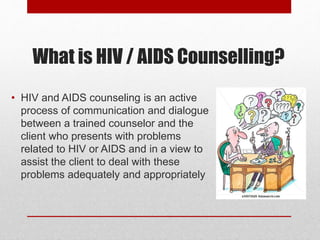
• HIV and AIDS counseling is an active
process of communication and dialogue
between a trained counselor and the
client who presents with problems
related to HIV or AIDS and in a view to
assist the client to deal with these
problems adequately and appropriately
Objectives of HIV / AIDS Counselling
HIV AIDS counslling is done to achieve various objectives.
Among them are :
• Prevention of infection through promotion of healthy lifestyles,
behaviour, moral and spiritual values.
• Prevention of transmission through modification of risky
lifestyles and behaviours.
• Provision of psychosocial support to those infected and /or
affected by HIV / AIDS to achieve optimum level of functioning
and satisfactory quality of life.
• To complement health education and correct misconceptions or
myths about HIV and AIDS.
Who Needs Counselling
• Target group :Key affected population:
Ex: SW, PWID,TG,MSM, high risk behaviour and their partners.
But…
The new statistic stated that new HIV infections are highly due to
heterosexual transmission. Detected highly in married men
and housewives,
Who is HIV/AIDS Counsellor ?
• trained in skills and technique of counselling, has adequate
knowledge in issues of HIV infection and AIDS and involved
in management of these cases
• ex:Doctors, nurses etc; Drug Rehabilitation Officers; Prison
Officers; Non-Governmental Organization (NGOs)
workers; religious personnel and community leaders.
What are the Fundamentals of
Counselling ?
• responsible and caring in his/her management of his/her clients
• willing to accept his/her clients in a non judgemental manner
with regards to their sexual practices and habits, subcultural
groups such as prostitutes, transvestites, drug dependents etc
• issue of confidentiality; The setting should be done in privacy,
not in open wards
• ensure adequate time is given and punctuality must be strictly
observed at almost all times. There may be occasion that a
client may request unscheduled appointments to which the
counsellor has to deal with
Cozy Ambience?
No…they just need privacy
• HIV testing and counseling services require:
• a private space to provide counseling;
• the capability to undertake testing, and mechanisms for easy
sample referral for regular quality assurance testing (10% of
samples to be confirmed centrally);
• mechanisms for referral to post-test diagnostic and care services;
• accurate documentation and information management
procedures to ensure accuracy and confidentiality of all patient
test and diagnostic information; and
• an adequate supply of simple/rapid tests, condoms and client
information materials.
Technique of Counselling
• rapport (self introduction, hand shake,eye contact)
• speak in a non-threatening tone or manner
• should be able to empatise with the client
• Avoid use of technical terms and if certain jargon terms are used by
the clients, they should be clarified
• evaluate the emotional state and explore the feelings of the client
such as worries, anxieties, mood, fears, suicidal ideas, hope for the
future etc
• The counsellor should allow ventilation of various feelings such as
fear, anger, despair etc
• be honest in providing all information while giving support and must
avoid giving false reassurances to the clients while on the other hand
giving hope to them
ISSUES IN HIV / AIDS COUNSELLING
• General Issues (misconception,knowledge)
• Social Issues(marriage, divorce, employment and financial
problems)
• Sex and Drug Related Culture Sensitive (Issues
masturbation and other sexual practices; use of condom, sexually
transmitted disease etc)
• Psychological Issues (denial,shock, fear, anxiety, depression
and guilt, suicidal ideas and threat)
STAGES OF COUNSELLlNG
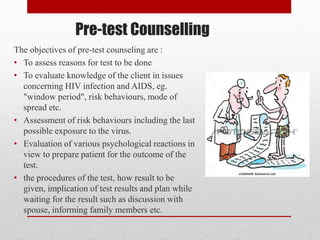
Pre-test Counselling
The objectives of pre-test counseling are :
• To assess reasons for test to be done
• To evaluate knowledge of the client in issues
concerning HIV infection and AIDS, eg.
"window period", risk behaviours, mode of
spread etc.
• Assessment of risk behaviours including the last
possible exposure to the virus.
• Evaluation of various psychological reactions in
view to prepare patient for the outcome of the
test.
• the procedures of the test, how result to be
given, implication of test results and plan while
waiting for the result such as discussion with
spouse, informing family members etc.
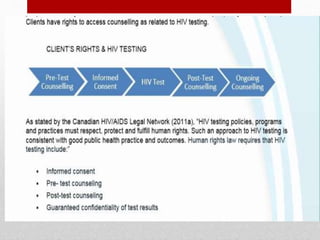
Informed consent
• When testing for the presence of a life threatening disease such as HIV, the informed
consent process is of critical importance. Without respect for a client’s autonomy or
self-rule, informed consent cannot be given. This process involves the provision of
unprejudiced information that has been understood by the client and is facilitated by a
dialogical approach through which the perspective of the client is the focal point.The
dialogical approach takes in the consideration of a client’s identity, such as cultural
position, emotions, and uncertainty.
According to the Counselling Guidelines for HIV Testing published by the Canadian
Medical Association in 1995 (as in Canadian HIV/AIDS Legal Network, 2011b, p. 9):-
- Informed consent cannot be implied or presumed;-
- Obtaining informed consent “involves educating, disclosing advantages and
disadvantages of testing for HIV, listening, answering questions and seeking permission
to proceed through each step of counselling and testing”; and
- To obtain informed consent for testing to HIV, a client must be deemed competent, must
understand the purposes, risks, harms and benefits of being tested, as well as those of
not being tested, and his/her consent must be voluntary.
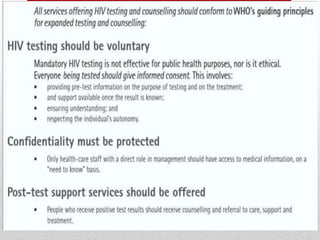
People who are tested for
HIV without their
knowledge or against their
will are regarded as having
their human rights violated
blatantly!
Post – test Counseling
• Post-test counseling should ideally be done by the
same counsellor who did the pre-test counselling.
This should cover negative, positive and
indeterminate results.
HIV Test Negative Result
• Interpretation that the test result indicate that no antibodies to HIV
were detected and there is no evidence of HIV infection. This
interpretation is framed in view of any further testing
recommendations that may result due to the window period or re-
exposure
• Confirmation that the client understands the test results
• Opportunity for questions related to the result or further testing
• Opportunity for the client to discuss any concerns related to activities
or situations that might increase the transmission of HIV
• Discussion of any further needs for education, community-based
resources, and access to harm reduction supplies
• Recommendations for future testing
• Documentation of discussion in client record as per agency standards
or regulatory body requirements
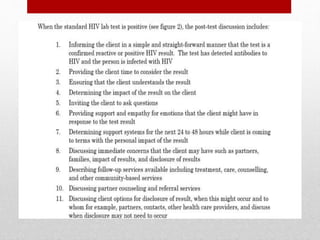
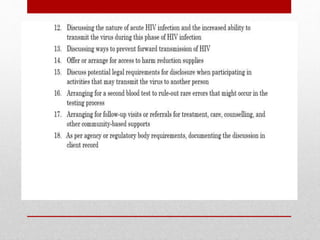
HIV Positive Test Result
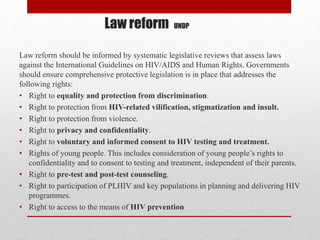
Law reform UNDP
Law reform should be informed by systematic legislative reviews that assess laws
against the International Guidelines on HIV/AIDS and Human Rights. Governments
should ensure comprehensive protective legislation is in place that addresses the
following rights:
• Right to equality and protection from discrimination.
• Right to protection from HIV-related vilification, stigmatization and insult.
• Right to protection from violence.
• Right to privacy and confidentiality.
• Right to voluntary and informed consent to HIV testing and treatment.
• Rights of young people. This includes consideration of young people’s rights to
confidentiality and to consent to testing and treatment, independent of their parents.
• Right to pre-test and post-test counseling.
• Right to participation of PLHIV and key populations in planning and delivering HIV
programmes.
• Right to access to the means of HIV prevention
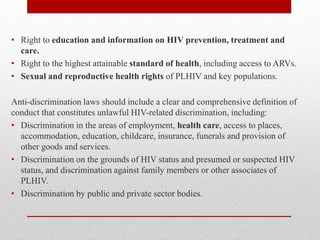
• Right to education and information on HIV prevention, treatment and
care.
• Right to the highest attainable standard of health, including access to ARVs.
• Sexual and reproductive health rights of PLHIV and key populations.
Anti-discrimination laws should include a clear and comprehensive definition of
conduct that constitutes unlawful HIV-related discrimination, including:
• Discrimination in the areas of employment, health care, access to places,
accommodation, education, childcare, insurance, funerals and provision of
other goods and services.
• Discrimination on the grounds of HIV status and presumed or suspected HIV
status, and discrimination against family members or other associates of
PLHIV.
• Discrimination by public and private sector bodies.
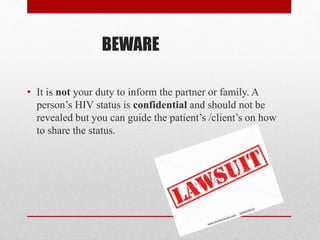
BEWARE
• It is not your duty to inform the partner or family. A
person’s HIV status is confidential and should not be
revealed but you can guide the patient’s /client’s on how
to share the status.
• Fiji’s HIV/AIDS Amendment Decree 2011 provides
an example of good practice.
Checklist - requirement for quality testing and
counseling
• It is the responsibility of governments to ensure that testing and counselling
services are available for all who might wish to know their status, and all who
might benefit from learning their status as a part of their health management.
Operational responsibility may be shared with NGOs and other partners that have
established facilities and expertise in delivery of testing and counselling services.
The establishment of a quality system of testing and counselling requires:
• government commitment and support;
• national policies for testing and counselling-service delivery, training and
assessment;
• a coordinated plan for testing and counselling roll-out involving all key partners,
including professional bodies, training institutions, referral laboratories, NGOs and
community-based organizations (CBOs);
• a human capacity building plan;
• a national system to ensure quality assurance of counselling and of testing services;
• aggressive advocacy and activities to combat stigma and to promote the "right to
know" one's HIV status;
• development and enforcement of anti-discrimination laws.
Quality > quantity
Theoretically we are perfect. We are very efficient
but…unfortunately not everyone practice it.
References
• Legal protections against HIV-related human rights violations UNDP
• http://www.infosihat.gov.my/infosihat/media/garis_panduan/A/pdf/37_counsel
lingHIVInfection_BI.pdf
• http://www.mashm.org.my/counselling.html
• http://www.moh.gov.my/images/gallery/Garispanduan/HIVGUIDELINES.pdf
• Communicable Disease Control ManualChapter 5 – Sexually Transmitted
Infections HIV Pre and Post Test Guidelines September 2011
• http://www.aids.gov/hiv-aids-basics/prevention/hiv-testing/pre-post-test-
counseling/
• Pre and Post HIV Test Counselling Guide Canadian Aboriginal AIDS Network
• Ontario Guidelines for HIV Counseling and testing
• WHO’s guiding principles on HIV counseling

Pre and post HIV counseling (VCT)

  • 1.
    Pre and PostHIV Counseling Theoretical vs practical Dr Ruby Bazeer @ Dr Rubz Executive Director of PAMT
  • 2.
    What is HIV/ AIDS Counselling? • HIV and AIDS counseling is an active process of communication and dialogue between a trained counselor and the client who presents with problems related to HIV or AIDS and in a view to assist the client to deal with these problems adequately and appropriately
  • 3.
    Objectives of HIV/ AIDS Counselling HIV AIDS counslling is done to achieve various objectives. Among them are : • Prevention of infection through promotion of healthy lifestyles, behaviour, moral and spiritual values. • Prevention of transmission through modification of risky lifestyles and behaviours. • Provision of psychosocial support to those infected and /or affected by HIV / AIDS to achieve optimum level of functioning and satisfactory quality of life. • To complement health education and correct misconceptions or myths about HIV and AIDS.
  • 4.
    Who Needs Counselling •Target group :Key affected population: Ex: SW, PWID,TG,MSM, high risk behaviour and their partners. But… The new statistic stated that new HIV infections are highly due to heterosexual transmission. Detected highly in married men and housewives,
  • 5.
    Who is HIV/AIDSCounsellor ? • trained in skills and technique of counselling, has adequate knowledge in issues of HIV infection and AIDS and involved in management of these cases • ex:Doctors, nurses etc; Drug Rehabilitation Officers; Prison Officers; Non-Governmental Organization (NGOs) workers; religious personnel and community leaders.
  • 6.
    What are theFundamentals of Counselling ? • responsible and caring in his/her management of his/her clients • willing to accept his/her clients in a non judgemental manner with regards to their sexual practices and habits, subcultural groups such as prostitutes, transvestites, drug dependents etc • issue of confidentiality; The setting should be done in privacy, not in open wards • ensure adequate time is given and punctuality must be strictly observed at almost all times. There may be occasion that a client may request unscheduled appointments to which the counsellor has to deal with
  • 7.
    Cozy Ambience? No…they justneed privacy • HIV testing and counseling services require: • a private space to provide counseling; • the capability to undertake testing, and mechanisms for easy sample referral for regular quality assurance testing (10% of samples to be confirmed centrally); • mechanisms for referral to post-test diagnostic and care services; • accurate documentation and information management procedures to ensure accuracy and confidentiality of all patient test and diagnostic information; and • an adequate supply of simple/rapid tests, condoms and client information materials.
  • 8.
    Technique of Counselling •rapport (self introduction, hand shake,eye contact) • speak in a non-threatening tone or manner • should be able to empatise with the client • Avoid use of technical terms and if certain jargon terms are used by the clients, they should be clarified • evaluate the emotional state and explore the feelings of the client such as worries, anxieties, mood, fears, suicidal ideas, hope for the future etc • The counsellor should allow ventilation of various feelings such as fear, anger, despair etc • be honest in providing all information while giving support and must avoid giving false reassurances to the clients while on the other hand giving hope to them
  • 9.
    ISSUES IN HIV/ AIDS COUNSELLING • General Issues (misconception,knowledge) • Social Issues(marriage, divorce, employment and financial problems) • Sex and Drug Related Culture Sensitive (Issues masturbation and other sexual practices; use of condom, sexually transmitted disease etc) • Psychological Issues (denial,shock, fear, anxiety, depression and guilt, suicidal ideas and threat)
  • 11.
  • 12.
    Pre-test Counselling The objectivesof pre-test counseling are : • To assess reasons for test to be done • To evaluate knowledge of the client in issues concerning HIV infection and AIDS, eg. "window period", risk behaviours, mode of spread etc. • Assessment of risk behaviours including the last possible exposure to the virus. • Evaluation of various psychological reactions in view to prepare patient for the outcome of the test. • the procedures of the test, how result to be given, implication of test results and plan while waiting for the result such as discussion with spouse, informing family members etc.
  • 13.
    Informed consent • Whentesting for the presence of a life threatening disease such as HIV, the informed consent process is of critical importance. Without respect for a client’s autonomy or self-rule, informed consent cannot be given. This process involves the provision of unprejudiced information that has been understood by the client and is facilitated by a dialogical approach through which the perspective of the client is the focal point.The dialogical approach takes in the consideration of a client’s identity, such as cultural position, emotions, and uncertainty. According to the Counselling Guidelines for HIV Testing published by the Canadian Medical Association in 1995 (as in Canadian HIV/AIDS Legal Network, 2011b, p. 9):- - Informed consent cannot be implied or presumed;- - Obtaining informed consent “involves educating, disclosing advantages and disadvantages of testing for HIV, listening, answering questions and seeking permission to proceed through each step of counselling and testing”; and - To obtain informed consent for testing to HIV, a client must be deemed competent, must understand the purposes, risks, harms and benefits of being tested, as well as those of not being tested, and his/her consent must be voluntary.
  • 14.
    People who aretested for HIV without their knowledge or against their will are regarded as having their human rights violated blatantly!
  • 15.
    Post – testCounseling • Post-test counseling should ideally be done by the same counsellor who did the pre-test counselling. This should cover negative, positive and indeterminate results.
  • 16.
    HIV Test NegativeResult • Interpretation that the test result indicate that no antibodies to HIV were detected and there is no evidence of HIV infection. This interpretation is framed in view of any further testing recommendations that may result due to the window period or re- exposure • Confirmation that the client understands the test results • Opportunity for questions related to the result or further testing • Opportunity for the client to discuss any concerns related to activities or situations that might increase the transmission of HIV • Discussion of any further needs for education, community-based resources, and access to harm reduction supplies • Recommendations for future testing • Documentation of discussion in client record as per agency standards or regulatory body requirements
  • 17.
  • 20.
    Law reform UNDP Lawreform should be informed by systematic legislative reviews that assess laws against the International Guidelines on HIV/AIDS and Human Rights. Governments should ensure comprehensive protective legislation is in place that addresses the following rights: • Right to equality and protection from discrimination. • Right to protection from HIV-related vilification, stigmatization and insult. • Right to protection from violence. • Right to privacy and confidentiality. • Right to voluntary and informed consent to HIV testing and treatment. • Rights of young people. This includes consideration of young people’s rights to confidentiality and to consent to testing and treatment, independent of their parents. • Right to pre-test and post-test counseling. • Right to participation of PLHIV and key populations in planning and delivering HIV programmes. • Right to access to the means of HIV prevention
  • 21.
    • Right toeducation and information on HIV prevention, treatment and care. • Right to the highest attainable standard of health, including access to ARVs. • Sexual and reproductive health rights of PLHIV and key populations. Anti-discrimination laws should include a clear and comprehensive definition of conduct that constitutes unlawful HIV-related discrimination, including: • Discrimination in the areas of employment, health care, access to places, accommodation, education, childcare, insurance, funerals and provision of other goods and services. • Discrimination on the grounds of HIV status and presumed or suspected HIV status, and discrimination against family members or other associates of PLHIV. • Discrimination by public and private sector bodies.
  • 22.
    BEWARE • It isnot your duty to inform the partner or family. A person’s HIV status is confidential and should not be revealed but you can guide the patient’s /client’s on how to share the status.
  • 23.
    • Fiji’s HIV/AIDSAmendment Decree 2011 provides an example of good practice.
  • 24.
    Checklist - requirementfor quality testing and counseling • It is the responsibility of governments to ensure that testing and counselling services are available for all who might wish to know their status, and all who might benefit from learning their status as a part of their health management. Operational responsibility may be shared with NGOs and other partners that have established facilities and expertise in delivery of testing and counselling services. The establishment of a quality system of testing and counselling requires: • government commitment and support; • national policies for testing and counselling-service delivery, training and assessment; • a coordinated plan for testing and counselling roll-out involving all key partners, including professional bodies, training institutions, referral laboratories, NGOs and community-based organizations (CBOs); • a human capacity building plan; • a national system to ensure quality assurance of counselling and of testing services; • aggressive advocacy and activities to combat stigma and to promote the "right to know" one's HIV status; • development and enforcement of anti-discrimination laws.
  • 25.
    Quality > quantity Theoreticallywe are perfect. We are very efficient but…unfortunately not everyone practice it.
  • 26.
    References • Legal protectionsagainst HIV-related human rights violations UNDP • http://www.infosihat.gov.my/infosihat/media/garis_panduan/A/pdf/37_counsel lingHIVInfection_BI.pdf • http://www.mashm.org.my/counselling.html • http://www.moh.gov.my/images/gallery/Garispanduan/HIVGUIDELINES.pdf • Communicable Disease Control ManualChapter 5 – Sexually Transmitted Infections HIV Pre and Post Test Guidelines September 2011 • http://www.aids.gov/hiv-aids-basics/prevention/hiv-testing/pre-post-test- counseling/ • Pre and Post HIV Test Counselling Guide Canadian Aboriginal AIDS Network • Ontario Guidelines for HIV Counseling and testing • WHO’s guiding principles on HIV counseling