   On pectoral fascia and musculature of
    the chest wall
   Over upper anterior rib cage 2nd or 3rd to
    6th
   Fat surrounding
   Internal mammary artery & lateral
    thoracic artery
   Axillary vein, internal mammary veins &
    intercostal veins
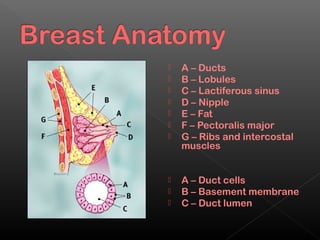
   A – Ducts
   B – Lobules
   C – Lactiferous sinus
   D – Nipple
   E – Fat
   F – Pectoralis major
   G – Ribs and intercostal
    muscles


   A – Duct cells
   B – Basement membrane
   C – Duct lumen
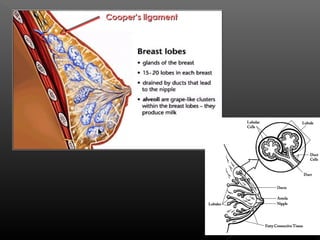
Cooper’s ligament
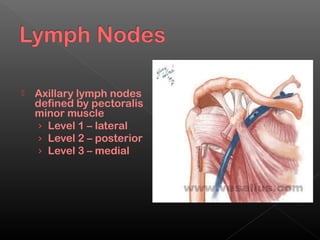
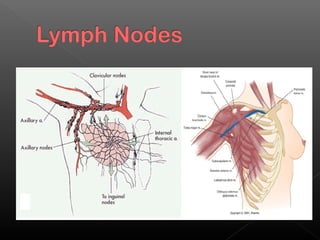
   Axillary lymph nodes
    defined by pectoralis
    minor muscle
    › Level 1 – lateral
    › Level 2 – posterior
    › Level 3 – medial
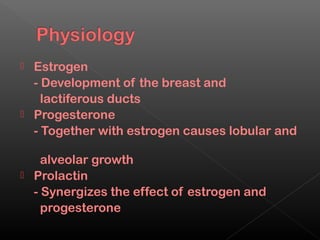
   Estrogen
    - Development of the breast and
      lactiferous ducts
   Progesterone
    - Together with estrogen causes lobular and

      alveolar growth
   Prolactin
    - Synergizes the effect of estrogen and
      progesterone
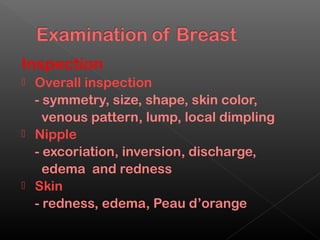
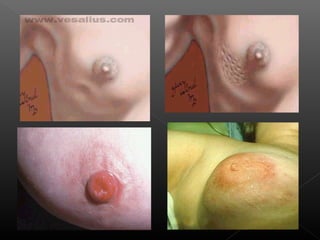
Inspection
 Overall inspection
  - symmetry, size, shape, skin color,
    venous pattern, lump, local dimpling
 Nipple
  - excoriation, inversion, discharge,
    edema and redness
 Skin
  - redness, edema, Peau d’orange
Palpation
 Gentle palpation
  - quadrant by quadrant
 Mass
  - number, size, consistency and mobility
 Lymph node
  - anterior, posterior, lateral, central and apical
 Character of the discharge
  - Milky, serous, or green-brown discharge
  - Bloody discharge
 90% of the breast lump are found by
  patients themselves.
 Encourage female have regular self
  breast examination.
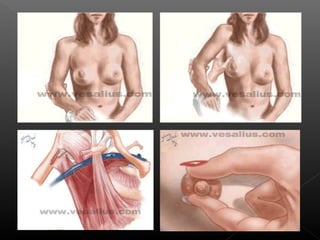
In Front a Mirror
In The Shower
Lying Down
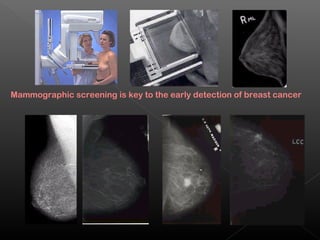
   Mammography
   Ultrasound
   Magnetic Resonance (MR)
   Computed tomography (CT)
   Positron Emission Tomography (PET)
Mammographic screening is key to the early detection of breast cancer
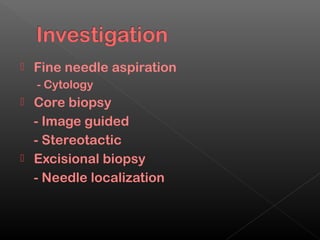
   Fine needle aspiration
    - Cytology
 Core biopsy
  - Image guided
  - Stereotactic
 Excisional biopsy
  - Needle localization
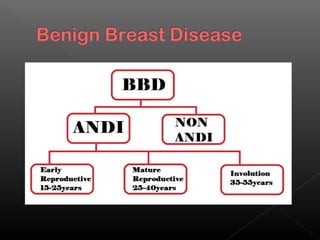
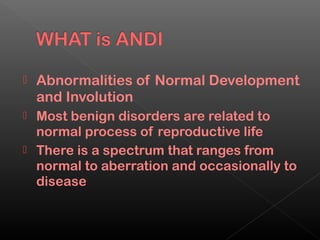
   Abnormalities of Normal Development
    and Involution
 Most benign disorders are related to
  normal process of reproductive life
 There is a spectrum that ranges from
  normal to aberration and occasionally to
  disease
 These include conditions of well define
  etiology
 Example: fat necrosis, breast abscess
 Cyst formation
 Fibrosis
 Hyperplasia of epithelium in the lining of
  the ducts and acini may occur
 Papillomatosis
 Breast lump
 Mastalgia – cyclical and non cyclical
 Nipple discharge
 Infection
   Normal breast nodularity or cyclical
    nodularity
    - Upper quad and axillary tail
    - Assessment is clinical, supplemented by
      USG cytology or core needle histology
    - Excisional biopsy if doubt persists
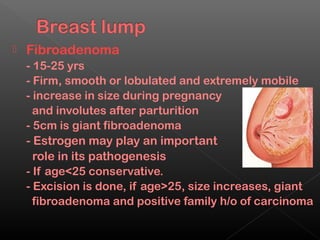
   Fibroadenoma
    - 15-25 yrs
    - Firm, smooth or lobulated and extremely mobile
    - increase in size during pregnancy
      and involutes after parturition
    - 5cm is giant fibroadenoma
    - Estrogen may play an important
      role in its pathogenesis
    - If age<25 conservative.
    - Excision is done, if age>25, size increases, giant
      fibroadenoma and positive family h/o of carcinoma
   Breast cysts
    - 40-50 years
    - smooth and tense and easily
      palpable against the chest wall
    - USG and needle aspiration confirms
    - Excisional biopsy is done if residual
      mass is present or blood stained fluid is
      present
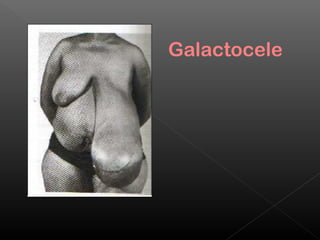
   Galactocele
    - Painless swelling appears in breast
      during or after cessation of lactation
    - Cyst filled with milky material and
      has same character as other cysts
    - Mainly found towards areola
    - Repeated aspiration
Galactocele
   Cyclical
    - Related to menstrual cycle
    - Duration of >1 week per cycle is significant
      and called “pronounced” symptoms
    - Etiology
      1. Hyperprolactenemia
      2. Increase level of estrogen after ovulation
      3. Abnormality of prostaglandin secondary
         to deficient essential fatty acid intake in diet
   Non Cyclical Mastalgia
    - True non cyclical mastalgia
    - Chest wall pain
 Non Medical Measures
  - Reassurance
  - Breast support
  - Dietary measures
 Medical Measures
  - NSAIDS
  - Evening primrose oil
  - Danazol
  - Tamoxifen
 Surgical measures
  - subcutaneous mastectomy – the last resort
   Discharge from single duct
    - Blood stained
      1. Intraductal carcinoma
      2. Intraductal papilloma
      3. Duct ectasia
    - Serous
      1. Fibrocystic disease
      2. Duct ectasia
      3. Carcinoma
   Discharge from more than one duct
    - Blood Stained
      1. Carcinoma
      2. Duct ectasia
    - Grumous
      1. Duct ectasia
    - Purulent
      1. Infection
    - Serous
      1. Duct ectasia
      2. Fibrocystic disease
      3. Carcinoma
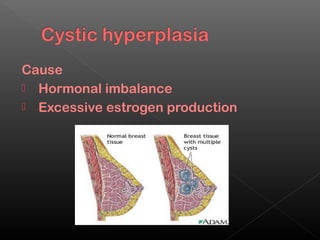
Cause
 Hormonal imbalance
 Excessive estrogen production
Clinical present
   Pain or lump, nipple discharge (15%)
   Tense cyst no fluctuant
   Cyst may appear rapidly and then maintain
    their size or shrink after next menstraual
    flow
   Most painful in pre-menstraual period
   Diagnosis
    - Pain or lump
    - FNA
   Management
    - Hormonal therapy
    - Mastectomy
 Dilation of ducts associated with
  periductal inflammation
 Presented as nipple discharge, subareolar
  mass, abscess, mammary fistula and/or
  nipple retraction
 To rule out malignancy if lump or nipple
  retraction
  - if suspicion remain excisional biopsy
  - excision of all major ducts
 Bacterial mastitis
  - cellulitic stage
  - abscess form
 Tuberculosis
 Actinomycosis
 Syphilis
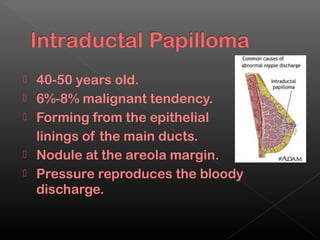
   40-50 years old.
   6%-8% malignant tendency.
   Forming from the epithelial
    linings of the main ducts.
   Nodule at the areola margin.
   Pressure reproduces the bloody
    discharge.
Types of Intraductal Papilloma
 Solitary intraductal papillomas – one lump,
  usually near a nipple, causes nipple
  discharge
 Multiple papillomas – groups of lumps,
  farther away from a nipple, usually doesn't
  cause discharge, and can't be felt
Treatment
 Surgical excision (involved duct or radical
  resection if it is proved malignant by frozen
  section)
   Cause
    - Lactic stasis
    - Bacterial invasion
   Clinical present
    - Swelling pain
  - Painful mass with reddish skin
 General features:
  Chill, fever, ipsilateral LN enlargement,
  bacteriaemia
 Abscess formation
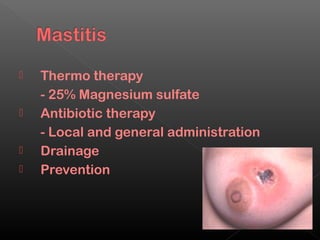
   Thermo therapy
    - 25% Magnesium sulfate
   Antibiotic therapy
    - Local and general administration
   Drainage
   Prevention
 After breast surgery or breast injury
 Bruised, injured, or dead fatty tissue
 Clinical features
  - Hard lump
  - Tender or painful
  - drainage from nipple
  - nipple will pull inward
 Triple assessment
 Management
  - NSAIDS
  - Vacuum-assisted core needle or lumpectomy
THE END

Benign breast disease by Dr. Kong

  • 2.
    On pectoral fascia and musculature of the chest wall  Over upper anterior rib cage 2nd or 3rd to 6th  Fat surrounding  Internal mammary artery & lateral thoracic artery  Axillary vein, internal mammary veins & intercostal veins
  • 3.
    A – Ducts  B – Lobules  C – Lactiferous sinus  D – Nipple  E – Fat  F – Pectoralis major  G – Ribs and intercostal muscles  A – Duct cells  B – Basement membrane  C – Duct lumen
  • 4.
  • 5.
    Axillary lymph nodes defined by pectoralis minor muscle › Level 1 – lateral › Level 2 – posterior › Level 3 – medial
  • 7.
    Estrogen - Development of the breast and lactiferous ducts  Progesterone - Together with estrogen causes lobular and alveolar growth  Prolactin - Synergizes the effect of estrogen and progesterone
  • 8.
    Inspection  Overall inspection - symmetry, size, shape, skin color, venous pattern, lump, local dimpling  Nipple - excoriation, inversion, discharge, edema and redness  Skin - redness, edema, Peau d’orange
  • 10.
    Palpation  Gentle palpation - quadrant by quadrant  Mass - number, size, consistency and mobility  Lymph node - anterior, posterior, lateral, central and apical  Character of the discharge - Milky, serous, or green-brown discharge - Bloody discharge
  • 12.
     90% ofthe breast lump are found by patients themselves.  Encourage female have regular self breast examination.
  • 13.
    In Front aMirror
  • 14.
  • 15.
  • 16.
    Mammography  Ultrasound  Magnetic Resonance (MR)  Computed tomography (CT)  Positron Emission Tomography (PET)
  • 17.
    Mammographic screening iskey to the early detection of breast cancer
  • 18.
    Fine needle aspiration - Cytology  Core biopsy - Image guided - Stereotactic  Excisional biopsy - Needle localization
  • 20.
    Abnormalities of Normal Development and Involution  Most benign disorders are related to normal process of reproductive life  There is a spectrum that ranges from normal to aberration and occasionally to disease
  • 21.
     These includeconditions of well define etiology  Example: fat necrosis, breast abscess
  • 22.
     Cyst formation Fibrosis  Hyperplasia of epithelium in the lining of the ducts and acini may occur  Papillomatosis
  • 23.
     Breast lump Mastalgia – cyclical and non cyclical  Nipple discharge  Infection
  • 24.
    Normal breast nodularity or cyclical nodularity - Upper quad and axillary tail - Assessment is clinical, supplemented by USG cytology or core needle histology - Excisional biopsy if doubt persists
  • 25.
    Fibroadenoma - 15-25 yrs - Firm, smooth or lobulated and extremely mobile - increase in size during pregnancy and involutes after parturition - 5cm is giant fibroadenoma - Estrogen may play an important role in its pathogenesis - If age<25 conservative. - Excision is done, if age>25, size increases, giant fibroadenoma and positive family h/o of carcinoma
  • 26.
    Breast cysts - 40-50 years - smooth and tense and easily palpable against the chest wall - USG and needle aspiration confirms - Excisional biopsy is done if residual mass is present or blood stained fluid is present
  • 27.
    Galactocele - Painless swelling appears in breast during or after cessation of lactation - Cyst filled with milky material and has same character as other cysts - Mainly found towards areola - Repeated aspiration
  • 28.
  • 29.
    Cyclical - Related to menstrual cycle - Duration of >1 week per cycle is significant and called “pronounced” symptoms - Etiology 1. Hyperprolactenemia 2. Increase level of estrogen after ovulation 3. Abnormality of prostaglandin secondary to deficient essential fatty acid intake in diet
  • 30.
    Non Cyclical Mastalgia - True non cyclical mastalgia - Chest wall pain
  • 31.
     Non MedicalMeasures - Reassurance - Breast support - Dietary measures  Medical Measures - NSAIDS - Evening primrose oil - Danazol - Tamoxifen  Surgical measures - subcutaneous mastectomy – the last resort
  • 32.
    Discharge from single duct - Blood stained 1. Intraductal carcinoma 2. Intraductal papilloma 3. Duct ectasia - Serous 1. Fibrocystic disease 2. Duct ectasia 3. Carcinoma
  • 33.
    Discharge from more than one duct - Blood Stained 1. Carcinoma 2. Duct ectasia - Grumous 1. Duct ectasia - Purulent 1. Infection - Serous 1. Duct ectasia 2. Fibrocystic disease 3. Carcinoma
  • 34.
    Cause  Hormonal imbalance Excessive estrogen production
  • 35.
    Clinical present  Pain or lump, nipple discharge (15%)  Tense cyst no fluctuant  Cyst may appear rapidly and then maintain their size or shrink after next menstraual flow  Most painful in pre-menstraual period
  • 36.
    Diagnosis - Pain or lump - FNA  Management - Hormonal therapy - Mastectomy
  • 37.
     Dilation ofducts associated with periductal inflammation  Presented as nipple discharge, subareolar mass, abscess, mammary fistula and/or nipple retraction  To rule out malignancy if lump or nipple retraction - if suspicion remain excisional biopsy - excision of all major ducts
  • 38.
     Bacterial mastitis - cellulitic stage - abscess form  Tuberculosis  Actinomycosis  Syphilis
  • 39.
    40-50 years old.  6%-8% malignant tendency.  Forming from the epithelial linings of the main ducts.  Nodule at the areola margin.  Pressure reproduces the bloody discharge.
  • 40.
    Types of IntraductalPapilloma  Solitary intraductal papillomas – one lump, usually near a nipple, causes nipple discharge  Multiple papillomas – groups of lumps, farther away from a nipple, usually doesn't cause discharge, and can't be felt Treatment  Surgical excision (involved duct or radical resection if it is proved malignant by frozen section)
  • 41.
    Cause - Lactic stasis - Bacterial invasion  Clinical present - Swelling pain - Painful mass with reddish skin  General features: Chill, fever, ipsilateral LN enlargement, bacteriaemia  Abscess formation
  • 42.
    Thermo therapy - 25% Magnesium sulfate  Antibiotic therapy - Local and general administration  Drainage  Prevention
  • 43.
     After breastsurgery or breast injury  Bruised, injured, or dead fatty tissue  Clinical features - Hard lump - Tender or painful - drainage from nipple - nipple will pull inward  Triple assessment  Management - NSAIDS - Vacuum-assisted core needle or lumpectomy
  • 44.