Dr. Chamath Fernando
MBBS (Sri Jayewardenepura)
Lecturer
Department of Family Medicine
FMS
USJP
Common Symptoms
 Blurring of vision
 Redness
 Pain
 Loss of vision
 Photophobia
 Discharge
 Refractive Errors
 Disorders of the lids
 Conjunctivitis
 Corneal disorders
 Episcleristis / Scleritis
 Sub Conjunctival Haemorrhages
 Dry eye syndrome
 Cataracts
 Glaucoma
 Uveitis
 Disorders of the retina
 Loss of vision
 Amarausis Fugax
 Temporal arteritis
 Hypertensive changes in the retina
 Diabetic eye disease
 Strabismus
Eye Condition Treatment (spectacles, contact
lenses or excimer laser)
Emmetropia Normal refraction of the cornea
and lens
Myopia Short sightedness Corrective– Concave lenses
Hypermetropia Long sightedness Convex lenses
Presbyopia The ability of the lens to change the
convexity is lost after the fourth
decade of life – causing difficulties
with near vision
Bifocals
Astigmatism The eye is not the same curvature
of radius for refraction. (e.g.
myopic in one plane and
emmetropic in the other)
Cylindrical lenses corrected
according to the axis
 Bifocals
Conditions Treatment
Entropion Inward rolling of the lid margins
Rubbing of the eye lashes
against the globe
Irritation
Mimics conjunctivitis
Surgical Correction
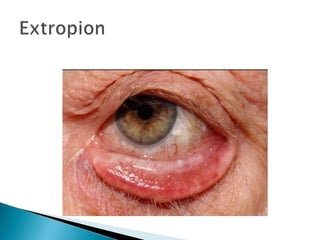
Ectropion The eyelid margins are not
apposed to the globe
Lacrimal puncta cannot drain
tears
Causes a watery eye
Surgical treatment
Dacrocystitis Inflammation of the lacrimal
sac
Presents as a painful lump by
the side of the nose
Broad spectrum antibiotics
Ophthalmologist referral for
surgical treatment
Blepharitis Inflammation of the eyelid
margin
Stye- Inflammation of the
eyelashes and lash follicles
Chalazion -Inflammation and
blockage of the Meibomian
glands
Lid toilet
Topical antibiotics –
Chloramphenicol or Fusidic
acid
If orbital cellulitis – Broad
spectrum antibiotics
If residual lump – Incision and
 Commonest cause of Red eye
 Causes: Viral, Bacterial, Chlamydial, Allergic
 Clinical features:
◦ Redness
◦ Soreness (sandy gritty sensation)
◦ Discharge
◦ Vision not impaired
◦ Usually bilateral involvement
Aetiology Dischar
ge
Preaur
icular
node
Corneal
Involve
ment
Comment Treatment
Bacterial (5%)
(Gonococcus -
copious
H. Influenzae
S.
Pneumoniae
Staphylococcu
s
Moraxella)
Mucopurule
nt
-ve
except
gonococc
i
+ve
Gonococcu
s
Rapid onset
Gonococcal infection in the
neonate – symptoms occur
within 2 days of birth
Gonococcal –
Conjunctival swab
shows diplococci
Treated with Oral and
Topical Penicillin
Chloramphenicol
Viral
Adenovirus
HSV 1
commonly
Molluscum
Contagiosum
Watery +ve +ve
Adenovirus
50% Unilateral
Cold and / or sorethroat
Ass. With chemosis, lid oedema
May cause blurring of vision
due to corneal involvement
Adenoviral – Very contagious
Dendritic corneal ulcer
HSV – Vesicles around the eye
Molluscum – umbilicated lesions
on eyelids
Adenoviral – Self
limiting
Lubricants
Cold compress
Prevent cross
infection
If intense – may
require steroids
HSV – Self limiting
Some may use
Aciclovir topically
Molluscum-
Ophthalmologist
referral for surgical
treatment
If severe - Steroids
Aetiology Discharge Preauricular
node
Corneal
Involvem
ent
Comment Treatment
Chlamydial
(Chlamydia
trachomatis)
Watery + ve +ve GU discharge
Slow onset of
symptoms
Sexually transmitted
(in active individuals)
Neonatal – with
maternal reproductive
tract secretions (2
weeks)
Trachoma –blindness
Topical
erythromycin bd
Adolescents and
adults to GU
surgeon
Neonates to
paediatrician to
exclude
associated
pneumonitis or
otitis
Allergic
Seasonal
Perinnial
Stringy/ sticky -ve +ve Itchy Avoidence of
allergens
Topical anti-
histamines like
azelastine
Topical mast cell
stabilizer like Na
Chromoglicate
Steroids avoided
generally
 1. Trauma
 2. Keratitis
Condition Features Treatment
Corneal Abrasions – a
focal area of the
epithelium gets rubbed
away
Intense pain
Inability to open the eye
(blepharospasm)
Lacrimation
Visual acuity reduced
Ex: may require topical anaesthetic
(Tetracaine)
Use Florescin (orange) dye with a blue
lamp examination to identify the
abrasion (in green colour)
G. Chloramphenicol qds X 5
days
Pad the eye X 24 hours
Corneal Foreign
body
e.g. flies
Lacrimation
Photophobia
Remove gently with copious
amounts of saline
Topical antibiotics
(Choramphenicol and Fusidic
acid)
Direct Trauma FB may be visible
Flat anterior chamber
Hyphaemia (Blood in anterior
chamber) SCH
Brusing if associated blunt trauma
Instill no drops
Refer to an ophthalmologist
urgently
 Corneal inflammation
 Causes: HSV infection, Contact lens, blepharitis
 Cilnical features: Redness, Pain, Lacrimation,
Sensation of a foreign body, photophobia
 HSV- Dendritic ulcer
◦ The Virus remains dorment in the CN V
◦ Gets activated in immunosuppression
◦ Can lead to a geographical ulcer
 Contact Lens Keratitis
◦ Can be life threatening
◦ Urgent referral to an ophthalmologist
 Blepharitis
◦ Staphelococcus aureus is responbible for most of the
cases
◦ Rx: with Chloramphenicol
Episcleritis (between the conjunctiva and the sclera)
 Localized, deep redness
 Tender area +/-
 Not painful
 No discharge
 Normal vision
 No photophobia
 Normal pupils and cornea
 Rx: topical/oral steroids
Scleritis
 Symptoms are intense
 Painful loss of vision
 Severe form associated with Rheumatoid arthritis causes Scleromalacia
perforans
 Urgent referral
 Symptoms – A bright red eye due to a bleed beneath the
conjunctiva caused by rupture of a small blood vessel
 Causes –
◦ Raised intracranial pressure (Coughing, sneezing)
◦ Trauma
◦ Violent rubbing
◦ Bleeding disorders or anticoagulants (recurrent)
◦ Hypertension
 Management
◦ Control of the cause
◦ Mild analgesics
◦ Eye lubricants
◦ Reassurance of resolution within weeks
◦ Make sure the line doesn't extend beyond the visible sclera (may be
associated with orbital fracture)
 Loss of vision?
Symptoms
Severe Pain
Photophobia
Reduced vision
Coloured halos around the point of light in patient’s vision
Proptosis
Smaller pupil
On Examination
Raised IOP
Shallow anterior chamber depth
Corneal Epithelial disruption
Cause Conjunct
iva
Injection
Unilater
al/Bilater
al
Pain Photoph
obia
Vision Pupil Intraocul
ar
pressure
Conjunctiv
itis
Diffuse Bilateral
(in
Bacterial)
Gritty Occasiona
lly with
Adenoviru
s
Normal Normal Normal
Anterior
Uveitis
Circum-
corneal
Unilateral Painful Yes Reduced Constricte
d
Normal or
raised
Acute
Glaucoma
Diffuse Unilateral Severe Mild Reduced Mild
dilated
Raised
 Associated with Keratoconjunctivitis Sicca / Sjogren’s
syndrome
 Clinical Features:
◦ FB sensation/ gritty feeling in the eye
◦ Mucoid discharge
◦ Photophobia
◦ Blurred vision
 Management
◦ Artificial tears
◦ Eye lubricants
◦ Moisture chambers glasses at night
◦ Secretogogues e.g rebamipide
◦ Punctal plugs
◦ Ophthalmologist referral
Moisture chamber
 Commonest cause of reversible blindness
 The commenest surgical procedure so far
 Aetiology
◦ Senile (legal blindness <6/12)
◦ Congenital – Maternal infection, Familial
◦ Metabolic – Diabetes, galactosaemia, Wilson’s disease,
hypocalcaemia
◦ Drug induced – Corticosteroids, amiodarone
◦ Traumatic
◦ Inflammatory – Uveitis
◦ Disease associated – Down’s, Dystrophia myotonica
 Clinical features –
◦ Gradual painless deterioration of vision is the
commonest symptom
◦ Problems with night vision
◦ Glare – Common with posterior subcapsular cataract
 Investigations
◦ Diabetes
◦ Hypocalcaemia
 Management
◦ Early detection and ophthalmologist referral is essential in the
infants to prevent development of amblyopia later on in life
◦ Correction of the aetiological factor
◦ Mild cases – spectacles
◦ If opacified – Extraction of cataracts and intra ocular lens
insertion
 Most popular – Phacoemulsification
 Elevation of the internal pressure of the eye
>21mmHg
◦ (Normal : 10-21mmHg)
 Second commonest cause of blindness – via optic
nerve damage
◦ Mainly visual field defects
Primary open angle Glaucoma Acute angle closure glaucoma
Commonest Ophthalmic emergency – Acute rise of pressure
>50mmHg
Aetiology Due to blockage of the trabecular
meshwork, drainage of aqueous
humor is impeded
Pushing of the lens anteriorly pressing against the
meshwork
Commonly when the pupil is maxiamaly dilated
Risk factors Elderly
Black race
Family history
Myopia
Elderly –
Shallow anterior chambers in Women and
Hypermetropics
Clinical
features
Gradual painless loss of peripheral
visual field
Red painful eye
Headache
Nausea, Vomiting
Eye is injected, hard and tender
Haziness of cornea
Diagnosis Ophthalmoscopy – Cupping of the
fundus
IOP measurement is the definitive
IOP measurement or clinically
Treatment Reduction of AH production –
Topical Timolol and Acetozolamide
(Topical and Oral)
Increasing the drainage of AH -
Prostaglandin analogues
(Travoprost)
Emergency referral to an ophthalmologist
Analgesic
Antiemetics
(IV Acetozolamide
Pilocarpine to constrict pupils
Prostaglandin analogues, Beta blockers
IV Mannitol if resistant
 Uveal Tract –
◦ Iris – Iritis/ Anterior Uveitis
◦ Cilliary body – Intermediate Uveitis
◦ Choroid – Posterior uveitis
◦ Entirely – Pan uveitis
 Symptoms
◦ Blurred vision
◦ Redness
◦ Photophobia
◦ Pain – Mainly anterior symptom
◦ Floaters – Mainly posterior symptom
 Associated diseases
◦ Ankylosing spondilitis
◦ Arthritis
◦ Inflammatory Bowel disease
◦ Sarcoidosis
◦ TB
◦ Syphilis
◦ Toxoplasmosis
◦ Behcets syndrome
◦ Lymphoma
◦ Viruses – CMV, HSV, HIV
◦ Idiopathic
 Classical Triad
◦ Redness (genaralized)
◦ Pain
◦ Photophobia
 Signs
◦ Cells with keratic precipitates in the anterior chamber, pus
◦ IOP may be raised due to the cells clogging up the There may be
posterior synechiae
◦ trabecular meshwork
 Treatment
◦ Ophthalmologist referral
◦ Dexamethasone 0.1% topically
◦ Cyclopentolone to prevent posterior synechiae also allowing
fundoscopy
◦ Mx of raised IOP
Central Retinal Vein
Occlusion
Central Retinal Artery
Occlusion
Retinal
detachment
Age related
macular
degeneration
Symptoms Sudden profound painless
loss of vision of one eye
Sudden profound painless
loss of vision of one eye
Painless
progressive visual
field loss
Floaters and
flashes prior to
detachment
Progressive loss
of central vision
Pathogenesis Obstruction of venous
outflow and increased
intravascular pressure
leading to dilated veins,
retinal haemorrhages,
retinal oedema and cotton
wool spots
Results in infarction of the
inner 2/3 of the retina
90 minutes
Oedema of the retina
thinning
Cherry red spot
The area of visual
field loss
corresponds to the
area of detachment
of the retina
Lipofucin
deposits can be
seen deposited
under the retina
Risk Factors DM, HT, Cardiovascular
disease, Glaucoma,
Vasculitis and Blood
dyscrasias
DM, HT, Cardiovascular
disease, Glaucoma,
Vasculitis and Blood
dyscrasias
Elderly
Smoking
HT
Hypercholestera
emia
UV exposure are
suggested
Treatment Rx underlying condition
Refer to ophthalmologist
Emergency referral
Ocular massage
Breathing into a bag 
CO2 Vasodilatation
Dislodging of Emboli
Iv Acetazolamide
Paracentesis
Urgent referral to
the ophthalmologist
Referral to the
ophthalmologist
Modification of
risk factors
 Sudden Transient Loss of Vision in one eye.
 Due to thromboembolism
 Embolus may be visible at ophthalmoscopy during an
attack
 Implications:
◦ May be the first evidence of internal carotid artery stenosis
◦ Hamiparesis may follow
◦ DD: Migraine, GCA
 Common in elderly
 Presentation: Sudden painless loss of unilateral vision
(May have preceded by Amaurosis fugax)
◦ May proceed to bilateral disease
 Associations:
◦ Severe unilateral temporal headache (along the distribution of the
artery with features of inflammation). The artery is thickened and
pulseless
◦ Severe facial pain in chewing
◦ IHD, microangiopathic neuropathy
 Management
◦ Ix: ESR elevated
◦ Diagnosis confimed by : Bx
◦ Rx: High dose steroids
Painless Painful
Cataract Acute angle closure glaucoma
Open angle glaucoma Giant cell arteritis
Retinal detachment Optic neuritis
Central retinal vein occlusion Uveitis
Central retinal artery occlusion Scleritis
Diabetic retinopathy Keratitis
Vitreous Haemorrhage Shingles
Age related macular degeneration Orbital cellulitis
Optic nerve compression Trauma
Cerebrovascular disease
 Keith Wagener Classification of Hypertensive
Retinopathy
◦ Grade 1 – Tortuosity of the retinal arteries with increased
reflectiveness “Silver wiring”
◦ Grade 2- Grade 1+ “Arteriovenous nipping”
◦ Grade 3 – Grade 2 + Flame shaped haemorrhages and
Cotton wool spots
◦ Grade 4 - Grade 3 + Papilloedema (blurring of the optic
disc margin
 The significance of Grade 3 and 4?
◦ Malignant Hypertension
 Diabetic retinopathy – A microvascular
complication
 Cataract
 External Ocular palsies
 Sixth and third cranial nerve palsies
◦ CN III palsies recover within a period of 3-6 months
 Progression of the disease is rapid in type 1 >type
2 diabetics
 Types
I. Background retinopathy
II. Preproliferative and proliferative retinopathy
III. Maculopathy
IV. Mixed retinopathy
◦ Dot haemorrhages - Microaneurysms
◦ Blot hamemorrhages - Intra retinal haemorrhages
◦ Cotton wool spots – Micro infarcts (lasts longer than
those due to HT)
 Retinal ischaemia  Neovascularization 
fibrous tissue forming around the new vessels
 Exudates around the macula within one optic
disc’s width
 Many features mentioned above present together
 Rx:
◦ Aggressive control of glycaemia
◦ Ophthalmologist referral (surgical procedures e.g laser
photocoagulation)
 Mal alignment of the two eyes/ visual axi
 Cause : Poor coordination of the extra ocular muscles
groups
 Due to: e.g. CP, syndromes like Noonan, stroke, botulism,
diabetes
 Implications:
◦ Cosmesis
◦ Diplopia
◦ Amblyopia (Lazy eye)
 Tests: Corneal light reflex, Cover-uncover test (read)
 Treatment:
◦ Spectacles
◦ Cover the better eye to improve the amblyopic eye
◦ Ophthalmologist (Muscle surgery)
 Kumar and Clark – Clinical Medicine
 Medscape
 Download the presentation: e-learning
◦ http://lms.sjp.ac.lk/med/blog/index.php?userid=1268
Common eye conditions

Common eye conditions

  • 1.
    Dr. Chamath Fernando MBBS(Sri Jayewardenepura) Lecturer Department of Family Medicine FMS USJP
  • 3.
    Common Symptoms  Blurringof vision  Redness  Pain  Loss of vision  Photophobia  Discharge
  • 4.
     Refractive Errors Disorders of the lids  Conjunctivitis  Corneal disorders  Episcleristis / Scleritis  Sub Conjunctival Haemorrhages  Dry eye syndrome  Cataracts  Glaucoma  Uveitis  Disorders of the retina  Loss of vision  Amarausis Fugax  Temporal arteritis  Hypertensive changes in the retina  Diabetic eye disease  Strabismus
  • 7.
    Eye Condition Treatment(spectacles, contact lenses or excimer laser) Emmetropia Normal refraction of the cornea and lens Myopia Short sightedness Corrective– Concave lenses Hypermetropia Long sightedness Convex lenses Presbyopia The ability of the lens to change the convexity is lost after the fourth decade of life – causing difficulties with near vision Bifocals Astigmatism The eye is not the same curvature of radius for refraction. (e.g. myopic in one plane and emmetropic in the other) Cylindrical lenses corrected according to the axis
  • 10.
  • 12.
    Conditions Treatment Entropion Inwardrolling of the lid margins Rubbing of the eye lashes against the globe Irritation Mimics conjunctivitis Surgical Correction Ectropion The eyelid margins are not apposed to the globe Lacrimal puncta cannot drain tears Causes a watery eye Surgical treatment Dacrocystitis Inflammation of the lacrimal sac Presents as a painful lump by the side of the nose Broad spectrum antibiotics Ophthalmologist referral for surgical treatment Blepharitis Inflammation of the eyelid margin Stye- Inflammation of the eyelashes and lash follicles Chalazion -Inflammation and blockage of the Meibomian glands Lid toilet Topical antibiotics – Chloramphenicol or Fusidic acid If orbital cellulitis – Broad spectrum antibiotics If residual lump – Incision and
  • 19.
     Commonest causeof Red eye  Causes: Viral, Bacterial, Chlamydial, Allergic  Clinical features: ◦ Redness ◦ Soreness (sandy gritty sensation) ◦ Discharge ◦ Vision not impaired ◦ Usually bilateral involvement
  • 20.
    Aetiology Dischar ge Preaur icular node Corneal Involve ment Comment Treatment Bacterial(5%) (Gonococcus - copious H. Influenzae S. Pneumoniae Staphylococcu s Moraxella) Mucopurule nt -ve except gonococc i +ve Gonococcu s Rapid onset Gonococcal infection in the neonate – symptoms occur within 2 days of birth Gonococcal – Conjunctival swab shows diplococci Treated with Oral and Topical Penicillin Chloramphenicol Viral Adenovirus HSV 1 commonly Molluscum Contagiosum Watery +ve +ve Adenovirus 50% Unilateral Cold and / or sorethroat Ass. With chemosis, lid oedema May cause blurring of vision due to corneal involvement Adenoviral – Very contagious Dendritic corneal ulcer HSV – Vesicles around the eye Molluscum – umbilicated lesions on eyelids Adenoviral – Self limiting Lubricants Cold compress Prevent cross infection If intense – may require steroids HSV – Self limiting Some may use Aciclovir topically Molluscum- Ophthalmologist referral for surgical treatment If severe - Steroids
  • 21.
    Aetiology Discharge Preauricular node Corneal Involvem ent CommentTreatment Chlamydial (Chlamydia trachomatis) Watery + ve +ve GU discharge Slow onset of symptoms Sexually transmitted (in active individuals) Neonatal – with maternal reproductive tract secretions (2 weeks) Trachoma –blindness Topical erythromycin bd Adolescents and adults to GU surgeon Neonates to paediatrician to exclude associated pneumonitis or otitis Allergic Seasonal Perinnial Stringy/ sticky -ve +ve Itchy Avoidence of allergens Topical anti- histamines like azelastine Topical mast cell stabilizer like Na Chromoglicate Steroids avoided generally
  • 24.
     1. Trauma 2. Keratitis
  • 25.
    Condition Features Treatment CornealAbrasions – a focal area of the epithelium gets rubbed away Intense pain Inability to open the eye (blepharospasm) Lacrimation Visual acuity reduced Ex: may require topical anaesthetic (Tetracaine) Use Florescin (orange) dye with a blue lamp examination to identify the abrasion (in green colour) G. Chloramphenicol qds X 5 days Pad the eye X 24 hours Corneal Foreign body e.g. flies Lacrimation Photophobia Remove gently with copious amounts of saline Topical antibiotics (Choramphenicol and Fusidic acid) Direct Trauma FB may be visible Flat anterior chamber Hyphaemia (Blood in anterior chamber) SCH Brusing if associated blunt trauma Instill no drops Refer to an ophthalmologist urgently
  • 27.
     Corneal inflammation Causes: HSV infection, Contact lens, blepharitis  Cilnical features: Redness, Pain, Lacrimation, Sensation of a foreign body, photophobia  HSV- Dendritic ulcer ◦ The Virus remains dorment in the CN V ◦ Gets activated in immunosuppression ◦ Can lead to a geographical ulcer
  • 28.
     Contact LensKeratitis ◦ Can be life threatening ◦ Urgent referral to an ophthalmologist  Blepharitis ◦ Staphelococcus aureus is responbible for most of the cases ◦ Rx: with Chloramphenicol
  • 29.
    Episcleritis (between theconjunctiva and the sclera)  Localized, deep redness  Tender area +/-  Not painful  No discharge  Normal vision  No photophobia  Normal pupils and cornea  Rx: topical/oral steroids Scleritis  Symptoms are intense  Painful loss of vision  Severe form associated with Rheumatoid arthritis causes Scleromalacia perforans  Urgent referral
  • 30.
     Symptoms –A bright red eye due to a bleed beneath the conjunctiva caused by rupture of a small blood vessel  Causes – ◦ Raised intracranial pressure (Coughing, sneezing) ◦ Trauma ◦ Violent rubbing ◦ Bleeding disorders or anticoagulants (recurrent) ◦ Hypertension  Management ◦ Control of the cause ◦ Mild analgesics ◦ Eye lubricants ◦ Reassurance of resolution within weeks ◦ Make sure the line doesn't extend beyond the visible sclera (may be associated with orbital fracture)
  • 31.
     Loss ofvision?
  • 32.
    Symptoms Severe Pain Photophobia Reduced vision Colouredhalos around the point of light in patient’s vision Proptosis Smaller pupil On Examination Raised IOP Shallow anterior chamber depth Corneal Epithelial disruption
  • 33.
    Cause Conjunct iva Injection Unilater al/Bilater al Pain Photoph obia VisionPupil Intraocul ar pressure Conjunctiv itis Diffuse Bilateral (in Bacterial) Gritty Occasiona lly with Adenoviru s Normal Normal Normal Anterior Uveitis Circum- corneal Unilateral Painful Yes Reduced Constricte d Normal or raised Acute Glaucoma Diffuse Unilateral Severe Mild Reduced Mild dilated Raised
  • 34.
     Associated withKeratoconjunctivitis Sicca / Sjogren’s syndrome  Clinical Features: ◦ FB sensation/ gritty feeling in the eye ◦ Mucoid discharge ◦ Photophobia ◦ Blurred vision  Management ◦ Artificial tears ◦ Eye lubricants ◦ Moisture chambers glasses at night ◦ Secretogogues e.g rebamipide ◦ Punctal plugs ◦ Ophthalmologist referral
  • 35.
  • 37.
     Commonest causeof reversible blindness  The commenest surgical procedure so far  Aetiology ◦ Senile (legal blindness <6/12) ◦ Congenital – Maternal infection, Familial ◦ Metabolic – Diabetes, galactosaemia, Wilson’s disease, hypocalcaemia ◦ Drug induced – Corticosteroids, amiodarone ◦ Traumatic ◦ Inflammatory – Uveitis ◦ Disease associated – Down’s, Dystrophia myotonica
  • 38.
     Clinical features– ◦ Gradual painless deterioration of vision is the commonest symptom ◦ Problems with night vision ◦ Glare – Common with posterior subcapsular cataract  Investigations ◦ Diabetes ◦ Hypocalcaemia  Management ◦ Early detection and ophthalmologist referral is essential in the infants to prevent development of amblyopia later on in life ◦ Correction of the aetiological factor ◦ Mild cases – spectacles ◦ If opacified – Extraction of cataracts and intra ocular lens insertion  Most popular – Phacoemulsification
  • 39.
     Elevation ofthe internal pressure of the eye >21mmHg ◦ (Normal : 10-21mmHg)  Second commonest cause of blindness – via optic nerve damage ◦ Mainly visual field defects
  • 40.
    Primary open angleGlaucoma Acute angle closure glaucoma Commonest Ophthalmic emergency – Acute rise of pressure >50mmHg Aetiology Due to blockage of the trabecular meshwork, drainage of aqueous humor is impeded Pushing of the lens anteriorly pressing against the meshwork Commonly when the pupil is maxiamaly dilated Risk factors Elderly Black race Family history Myopia Elderly – Shallow anterior chambers in Women and Hypermetropics Clinical features Gradual painless loss of peripheral visual field Red painful eye Headache Nausea, Vomiting Eye is injected, hard and tender Haziness of cornea Diagnosis Ophthalmoscopy – Cupping of the fundus IOP measurement is the definitive IOP measurement or clinically Treatment Reduction of AH production – Topical Timolol and Acetozolamide (Topical and Oral) Increasing the drainage of AH - Prostaglandin analogues (Travoprost) Emergency referral to an ophthalmologist Analgesic Antiemetics (IV Acetozolamide Pilocarpine to constrict pupils Prostaglandin analogues, Beta blockers IV Mannitol if resistant
  • 41.
     Uveal Tract– ◦ Iris – Iritis/ Anterior Uveitis ◦ Cilliary body – Intermediate Uveitis ◦ Choroid – Posterior uveitis ◦ Entirely – Pan uveitis
  • 42.
     Symptoms ◦ Blurredvision ◦ Redness ◦ Photophobia ◦ Pain – Mainly anterior symptom ◦ Floaters – Mainly posterior symptom  Associated diseases ◦ Ankylosing spondilitis ◦ Arthritis ◦ Inflammatory Bowel disease ◦ Sarcoidosis ◦ TB ◦ Syphilis ◦ Toxoplasmosis ◦ Behcets syndrome ◦ Lymphoma ◦ Viruses – CMV, HSV, HIV ◦ Idiopathic
  • 43.
     Classical Triad ◦Redness (genaralized) ◦ Pain ◦ Photophobia  Signs ◦ Cells with keratic precipitates in the anterior chamber, pus ◦ IOP may be raised due to the cells clogging up the There may be posterior synechiae ◦ trabecular meshwork  Treatment ◦ Ophthalmologist referral ◦ Dexamethasone 0.1% topically ◦ Cyclopentolone to prevent posterior synechiae also allowing fundoscopy ◦ Mx of raised IOP
  • 45.
    Central Retinal Vein Occlusion CentralRetinal Artery Occlusion Retinal detachment Age related macular degeneration Symptoms Sudden profound painless loss of vision of one eye Sudden profound painless loss of vision of one eye Painless progressive visual field loss Floaters and flashes prior to detachment Progressive loss of central vision Pathogenesis Obstruction of venous outflow and increased intravascular pressure leading to dilated veins, retinal haemorrhages, retinal oedema and cotton wool spots Results in infarction of the inner 2/3 of the retina 90 minutes Oedema of the retina thinning Cherry red spot The area of visual field loss corresponds to the area of detachment of the retina Lipofucin deposits can be seen deposited under the retina Risk Factors DM, HT, Cardiovascular disease, Glaucoma, Vasculitis and Blood dyscrasias DM, HT, Cardiovascular disease, Glaucoma, Vasculitis and Blood dyscrasias Elderly Smoking HT Hypercholestera emia UV exposure are suggested Treatment Rx underlying condition Refer to ophthalmologist Emergency referral Ocular massage Breathing into a bag  CO2 Vasodilatation Dislodging of Emboli Iv Acetazolamide Paracentesis Urgent referral to the ophthalmologist Referral to the ophthalmologist Modification of risk factors
  • 50.
     Sudden TransientLoss of Vision in one eye.  Due to thromboembolism  Embolus may be visible at ophthalmoscopy during an attack  Implications: ◦ May be the first evidence of internal carotid artery stenosis ◦ Hamiparesis may follow ◦ DD: Migraine, GCA
  • 51.
     Common inelderly  Presentation: Sudden painless loss of unilateral vision (May have preceded by Amaurosis fugax) ◦ May proceed to bilateral disease  Associations: ◦ Severe unilateral temporal headache (along the distribution of the artery with features of inflammation). The artery is thickened and pulseless ◦ Severe facial pain in chewing ◦ IHD, microangiopathic neuropathy  Management ◦ Ix: ESR elevated ◦ Diagnosis confimed by : Bx ◦ Rx: High dose steroids
  • 53.
    Painless Painful Cataract Acuteangle closure glaucoma Open angle glaucoma Giant cell arteritis Retinal detachment Optic neuritis Central retinal vein occlusion Uveitis Central retinal artery occlusion Scleritis Diabetic retinopathy Keratitis Vitreous Haemorrhage Shingles Age related macular degeneration Orbital cellulitis Optic nerve compression Trauma Cerebrovascular disease
  • 54.
     Keith WagenerClassification of Hypertensive Retinopathy ◦ Grade 1 – Tortuosity of the retinal arteries with increased reflectiveness “Silver wiring” ◦ Grade 2- Grade 1+ “Arteriovenous nipping”
  • 55.
    ◦ Grade 3– Grade 2 + Flame shaped haemorrhages and Cotton wool spots ◦ Grade 4 - Grade 3 + Papilloedema (blurring of the optic disc margin
  • 56.
     The significanceof Grade 3 and 4? ◦ Malignant Hypertension
  • 57.
     Diabetic retinopathy– A microvascular complication  Cataract  External Ocular palsies  Sixth and third cranial nerve palsies ◦ CN III palsies recover within a period of 3-6 months
  • 58.
     Progression ofthe disease is rapid in type 1 >type 2 diabetics  Types I. Background retinopathy II. Preproliferative and proliferative retinopathy III. Maculopathy IV. Mixed retinopathy
  • 59.
    ◦ Dot haemorrhages- Microaneurysms ◦ Blot hamemorrhages - Intra retinal haemorrhages ◦ Cotton wool spots – Micro infarcts (lasts longer than those due to HT)
  • 60.
     Retinal ischaemia Neovascularization  fibrous tissue forming around the new vessels
  • 61.
     Exudates aroundthe macula within one optic disc’s width
  • 62.
     Many featuresmentioned above present together  Rx: ◦ Aggressive control of glycaemia ◦ Ophthalmologist referral (surgical procedures e.g laser photocoagulation)
  • 63.
     Mal alignmentof the two eyes/ visual axi  Cause : Poor coordination of the extra ocular muscles groups  Due to: e.g. CP, syndromes like Noonan, stroke, botulism, diabetes  Implications: ◦ Cosmesis ◦ Diplopia ◦ Amblyopia (Lazy eye)  Tests: Corneal light reflex, Cover-uncover test (read)  Treatment: ◦ Spectacles ◦ Cover the better eye to improve the amblyopic eye ◦ Ophthalmologist (Muscle surgery)
  • 66.
     Kumar andClark – Clinical Medicine  Medscape  Download the presentation: e-learning ◦ http://lms.sjp.ac.lk/med/blog/index.php?userid=1268