
Background radiation 
• Background radiation is the 
present ionizing radiation that people 
on the planet Earth are exposed to, 
including natural and artificial 
sources.
Natural Sources 
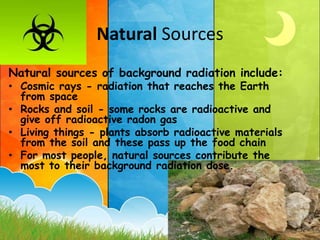
Natural sources of background radiation include: 
• Cosmic rays - radiation that reaches the Earth 
from space 
• Rocks and soil - some rocks are radioactive and 
give off radioactive radon gas 
• Living things - plants absorb radioactive materials 
from the soil and these pass up the food chain 
• For most people, natural sources contribute the 
most to their background radiation dose.
Artificial Radiation 
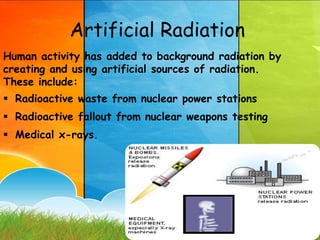
Human activity has added to background radiation by 
creating and using artificial sources of radiation. 
These include: 
 Radioactive waste from nuclear power stations 
 Radioactive fallout from nuclear weapons testing 
 Medical x-rays.
Internal radiation 
Internal radiation is background radiation due to 
radioactive sources present inside our bodies. 
Some of these are from naturally occurring 
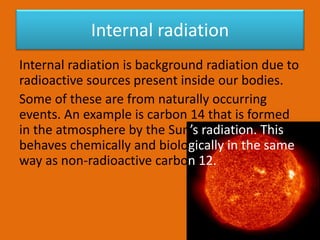
events. An example is carbon 14 that is formed 
in the atmosphere by the Sun’s radiation. This 
behaves chemically and biologically in the same 
way as non-radioactive carbon 12.
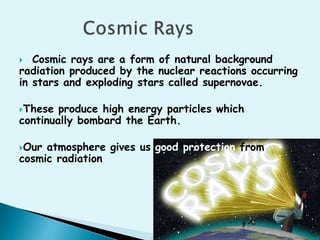
 Cosmic rays are a form of natural background 
radiation produced by the nuclear reactions occurring 
in stars and exploding stars called supernovae. 
These produce high energy particles which 
continually bombard the Earth. 
Our atmosphere gives us good protection from 
cosmic radiation
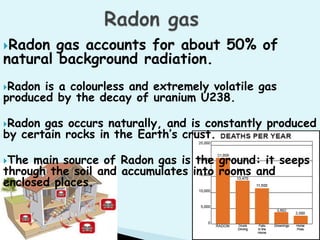
Radon gas accounts for about 50% of 
natural background radiation. 
Radon is a colourless and extremely volatile gas 
produced by the decay of uranium U238. 
Radon gas occurs naturally, and is constantly produced 
by certain rocks in the Earth’s crust. 
The main source of Radon gas is the ground: it seeps 
through the soil and accumulates into rooms and 
enclosed places.
Background Radiation

Background Radiation

  • 2.
    Background radiation •Background radiation is the present ionizing radiation that people on the planet Earth are exposed to, including natural and artificial sources.
  • 3.
    Natural Sources Naturalsources of background radiation include: • Cosmic rays - radiation that reaches the Earth from space • Rocks and soil - some rocks are radioactive and give off radioactive radon gas • Living things - plants absorb radioactive materials from the soil and these pass up the food chain • For most people, natural sources contribute the most to their background radiation dose.
  • 4.
    Artificial Radiation Humanactivity has added to background radiation by creating and using artificial sources of radiation. These include:  Radioactive waste from nuclear power stations  Radioactive fallout from nuclear weapons testing  Medical x-rays.
  • 5.
    Internal radiation Internalradiation is background radiation due to radioactive sources present inside our bodies. Some of these are from naturally occurring events. An example is carbon 14 that is formed in the atmosphere by the Sun’s radiation. This behaves chemically and biologically in the same way as non-radioactive carbon 12.
  • 8.
     Cosmic raysare a form of natural background radiation produced by the nuclear reactions occurring in stars and exploding stars called supernovae. These produce high energy particles which continually bombard the Earth. Our atmosphere gives us good protection from cosmic radiation
  • 9.
    Radon gas accountsfor about 50% of natural background radiation. Radon is a colourless and extremely volatile gas produced by the decay of uranium U238. Radon gas occurs naturally, and is constantly produced by certain rocks in the Earth’s crust. The main source of Radon gas is the ground: it seeps through the soil and accumulates into rooms and enclosed places.