
Radioactivity
- refers to the spontaneous
emission of particles or high-energy
electromagnetic radiation from the
nuclei of unstable atoms. This occurs
due to the disintegration of the atomic
nuclei.
Discovery of
Radioactivity
In 1898 a French scientist,

Antoine Henri Becquerel

discovered the ability for
uranium to create a picture
when exposed to light. Later, the
husband and wife team of Pierre
and Marie Curie studied and
coined the term 'radioactivity.'
Importance of
Radioactivity
Radioactivity has an importance mostly when it
comes to medicine, but is important for science in
general. In medicine, radiation is used as a way of
finding tumors within the body and then it is used to
destroy them. However, in the realm of science,
radiation can also be used to determine the age of the
earth as well as the universe, itself. Unfortunately, as
much as radiation can be helpful, in large amounts, it
can be harmful or deadly to all living matter.
Dangers of
Radioactivity

Radioactivity can damage cells; can
cause burns, diarrhea, vomiting, infertility,
migraine and death. A huge amount of
radioactivity can destroy many cells that the
body cannot replace immediately, because
after being inhaled or ingested, the particles
settle in certain organs and start damaging
the neighbouring cells.
Advantages and
Disadvantages of
Radioactivity

Radioactivity does have a medical advantage. It is
used for treatment of cancer patients to reduce or
deplete tumors. Another advantage is that it kills microbes
and permits carbon dating to take place. A disadvantage of
radioactivity is that using it as a medical treatment does
make the reproductive organs sterile. Over-exposure does
have negative affects on your health. A large dose that is
experienced all at one time can be fatal and is usually only
an issue in the event of an explosion.
Types of Radioactivity
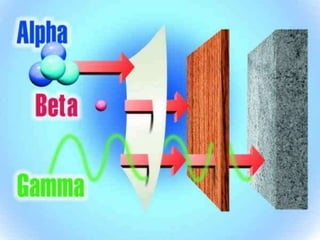
The types of radioactivity are alpha, beta,
and gamma, which are classified according to
the charge if the electromagnetic rays they
give off.
Alpha rays carry a positive charge, beta
rays carry a negative one, and gamma rays
are neutral.
Radioactivity
Radioactivity
Radioactivity

Radioactivity

  • 2.
    Radioactivity - refers tothe spontaneous emission of particles or high-energy electromagnetic radiation from the nuclei of unstable atoms. This occurs due to the disintegration of the atomic nuclei.
  • 3.
    Discovery of Radioactivity In 1898a French scientist, Antoine Henri Becquerel discovered the ability for uranium to create a picture when exposed to light. Later, the husband and wife team of Pierre and Marie Curie studied and coined the term 'radioactivity.'
  • 4.
    Importance of Radioactivity Radioactivity hasan importance mostly when it comes to medicine, but is important for science in general. In medicine, radiation is used as a way of finding tumors within the body and then it is used to destroy them. However, in the realm of science, radiation can also be used to determine the age of the earth as well as the universe, itself. Unfortunately, as much as radiation can be helpful, in large amounts, it can be harmful or deadly to all living matter.
  • 5.
    Dangers of Radioactivity Radioactivity candamage cells; can cause burns, diarrhea, vomiting, infertility, migraine and death. A huge amount of radioactivity can destroy many cells that the body cannot replace immediately, because after being inhaled or ingested, the particles settle in certain organs and start damaging the neighbouring cells.
  • 6.
    Advantages and Disadvantages of Radioactivity Radioactivitydoes have a medical advantage. It is used for treatment of cancer patients to reduce or deplete tumors. Another advantage is that it kills microbes and permits carbon dating to take place. A disadvantage of radioactivity is that using it as a medical treatment does make the reproductive organs sterile. Over-exposure does have negative affects on your health. A large dose that is experienced all at one time can be fatal and is usually only an issue in the event of an explosion.
  • 7.
    Types of Radioactivity Thetypes of radioactivity are alpha, beta, and gamma, which are classified according to the charge if the electromagnetic rays they give off. Alpha rays carry a positive charge, beta rays carry a negative one, and gamma rays are neutral.