Radioactivity and
 radioisotopes
A very brief history of the discovery of radioactivity
                      Dear Marie, do you remember those uranium compounds that glow when I
                    put them under sunlight? Well, guess what I found out last night as I put them
                    in my drawer… in the same drawer I had a key on top of a film plate. When I
                       developed the film the image of the key was impressed on it, although the
                     film was wrapped! These compounds must emit invisible rays that penetrate
                                 certain materials. I think I’ll call them Radioactivity.


 Henri Bequerel
  (1852-1908)
Don’t say more dear Professor! I have taken on the work you have passed on
to me and I have already discovered two new elements more radioactive than
 uranium, polonium and radium. To isolate 1 g of radium I had to buy a tonne
of pitchblende and separate the radium. The amazing thing is that the radium
           is about one million times more radioactive than uranium!                   Marie Curie
                                                                                       (1867-1934)

                     Hey guys, thank you for this stuff! Now that we know so much I can find out
                       the nature of this radioactivity pal! In fact, I have already discovered that
                     there are at least two kinds of radiation. I’ve called the first alpha. This gets
                      easily absorbed and it’s positively charged. The second is beta, it is more
                                          penetrative and has negative charge.

                  Ernest Rutherford (1871-1937)
What is radioactivity?
Radioactivity is the spontaneous emission of energy and
 particles due to the breaking down (disintegrating) of
 the nuclei of unstable atoms.


                                          Energy


                   Particles
What is radioactivity?
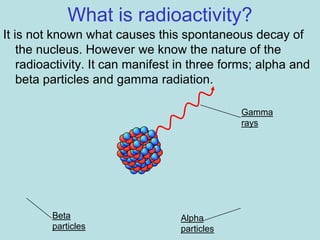
It is not known what causes this spontaneous decay of
    the nucleus. However we know the nature of the
    radioactivity. It can manifest in three forms; alpha and
    beta particles and gamma radiation.

                                              Gamma
                                              rays


         Beta                     Alpha
         particles                particles
What is radioactivity?
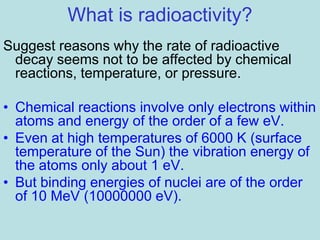
Suggest reasons why the rate of radioactive
 decay seems not to be affected by chemical
 reactions, temperature, or pressure.

• Chemical reactions involve only electrons within
  atoms and energy of the order of a few eV.
• Even at high temperatures of 6000 K (surface
  temperature of the Sun) the vibration energy of
  the atoms only about 1 eV.
• But binding energies of nuclei are of the order
  of 10 MeV (10000000 eV).
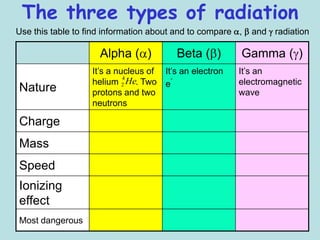
The three types of radiation
Use this table to find information about and to compare ,   and radiation

                     Alpha ( )          Beta ( )        Gamma ( )

Nature

Charge
Mass
Speed
Ionizing
effect
Most dangerous
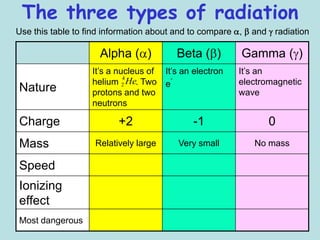
The three types of radiation
Use this table to find information about and to compare ,   and radiation

                     Alpha ( )          Beta ( )        Gamma ( )
                   It’s a nucleus of It’s an electron   It’s an
                            4
                   helium 2 He. Two e-                  electromagnetic
Nature             protons and two                      wave
                   neutrons

Charge
Mass
Speed
Ionizing
effect
Most dangerous
The three types of radiation
Use this table to find information about and to compare ,   and radiation

                     Alpha ( )          Beta ( )        Gamma ( )
                   It’s a nucleus of It’s an electron   It’s an
                            4
                   helium 2 He. Two e-                  electromagnetic
Nature             protons and two                      wave
                   neutrons

Charge                   +2                  -1                0
Mass
Speed
Ionizing
effect
Most dangerous
The three types of radiation
Use this table to find information about and to compare ,   and radiation

                     Alpha ( )          Beta ( )        Gamma ( )
                   It’s a nucleus of It’s an electron   It’s an
                            4
                   helium 2 He. Two e-                  electromagnetic
Nature             protons and two                      wave
                   neutrons

Charge                    +2                 -1                0
Mass                Relatively large     Very small         No mass

Speed
Ionizing
effect
Most dangerous
The three types of radiation
Use this table to find information about and to compare ,   and radiation

                     Alpha ( )          Beta ( )        Gamma ( )
                   It’s a nucleus of It’s an electron   It’s an
                            4
                   helium 2 He. Two e-                  electromagnetic
Nature             protons and two                      wave
                   neutrons

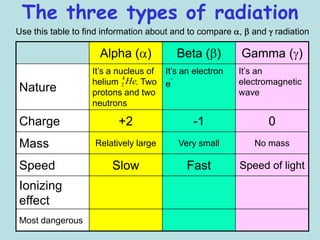
Charge                    +2                 -1                0
Mass                Relatively large     Very small         No mass

Speed                   Slow               Fast         Speed of light
Ionizing
effect
Most dangerous
The three types of radiation
Use this table to find information about and to compare ,    and radiation

                     Alpha ( )          Beta ( )        Gamma ( )
                   It’s a nucleus of It’s an electron   It’s an
                            4
                   helium 2 He. Two e-                  electromagnetic
Nature             protons and two                      wave
                   neutrons

Charge                    +2                 -1                 0
Mass                Relatively large     Very small          No mass

Speed                   Slow               Fast         Speed of light
Ionizing
                       Strong             Weak              Very weak
effect
Most dangerous
The three types of radiation
Use this table to find information about and to compare ,    and radiation

                     Alpha ( )           Beta ( )        Gamma ( )
                   It’s a nucleus of It’s an electron   It’s an
                            4
                   helium 2 He. Two e-                  electromagnetic
Nature             protons and two                      wave
                   neutrons

Charge                    +2                 -1                 0
Mass                Relatively large      Very small         No mass

Speed                   Slow                Fast        Speed of light
Ionizing
                       Strong              Weak             Very weak
effect
                   When source is      When source is When source is
Most dangerous
                   inside the body     outside the body outside the body

Alpha beta and_gamma

  • 1.
  • 2.
    A very briefhistory of the discovery of radioactivity Dear Marie, do you remember those uranium compounds that glow when I put them under sunlight? Well, guess what I found out last night as I put them in my drawer… in the same drawer I had a key on top of a film plate. When I developed the film the image of the key was impressed on it, although the film was wrapped! These compounds must emit invisible rays that penetrate certain materials. I think I’ll call them Radioactivity. Henri Bequerel (1852-1908) Don’t say more dear Professor! I have taken on the work you have passed on to me and I have already discovered two new elements more radioactive than uranium, polonium and radium. To isolate 1 g of radium I had to buy a tonne of pitchblende and separate the radium. The amazing thing is that the radium is about one million times more radioactive than uranium! Marie Curie (1867-1934) Hey guys, thank you for this stuff! Now that we know so much I can find out the nature of this radioactivity pal! In fact, I have already discovered that there are at least two kinds of radiation. I’ve called the first alpha. This gets easily absorbed and it’s positively charged. The second is beta, it is more penetrative and has negative charge. Ernest Rutherford (1871-1937)
  • 3.
    What is radioactivity? Radioactivityis the spontaneous emission of energy and particles due to the breaking down (disintegrating) of the nuclei of unstable atoms. Energy Particles
  • 4.
    What is radioactivity? Itis not known what causes this spontaneous decay of the nucleus. However we know the nature of the radioactivity. It can manifest in three forms; alpha and beta particles and gamma radiation. Gamma rays Beta Alpha particles particles
  • 5.
    What is radioactivity? Suggestreasons why the rate of radioactive decay seems not to be affected by chemical reactions, temperature, or pressure. • Chemical reactions involve only electrons within atoms and energy of the order of a few eV. • Even at high temperatures of 6000 K (surface temperature of the Sun) the vibration energy of the atoms only about 1 eV. • But binding energies of nuclei are of the order of 10 MeV (10000000 eV).
  • 6.
    The three typesof radiation Use this table to find information about and to compare , and radiation Alpha ( ) Beta ( ) Gamma ( ) Nature Charge Mass Speed Ionizing effect Most dangerous
  • 7.
    The three typesof radiation Use this table to find information about and to compare , and radiation Alpha ( ) Beta ( ) Gamma ( ) It’s a nucleus of It’s an electron It’s an 4 helium 2 He. Two e- electromagnetic Nature protons and two wave neutrons Charge Mass Speed Ionizing effect Most dangerous
  • 8.
    The three typesof radiation Use this table to find information about and to compare , and radiation Alpha ( ) Beta ( ) Gamma ( ) It’s a nucleus of It’s an electron It’s an 4 helium 2 He. Two e- electromagnetic Nature protons and two wave neutrons Charge +2 -1 0 Mass Speed Ionizing effect Most dangerous
  • 9.
    The three typesof radiation Use this table to find information about and to compare , and radiation Alpha ( ) Beta ( ) Gamma ( ) It’s a nucleus of It’s an electron It’s an 4 helium 2 He. Two e- electromagnetic Nature protons and two wave neutrons Charge +2 -1 0 Mass Relatively large Very small No mass Speed Ionizing effect Most dangerous
  • 10.
    The three typesof radiation Use this table to find information about and to compare , and radiation Alpha ( ) Beta ( ) Gamma ( ) It’s a nucleus of It’s an electron It’s an 4 helium 2 He. Two e- electromagnetic Nature protons and two wave neutrons Charge +2 -1 0 Mass Relatively large Very small No mass Speed Slow Fast Speed of light Ionizing effect Most dangerous
  • 11.
    The three typesof radiation Use this table to find information about and to compare , and radiation Alpha ( ) Beta ( ) Gamma ( ) It’s a nucleus of It’s an electron It’s an 4 helium 2 He. Two e- electromagnetic Nature protons and two wave neutrons Charge +2 -1 0 Mass Relatively large Very small No mass Speed Slow Fast Speed of light Ionizing Strong Weak Very weak effect Most dangerous
  • 12.
    The three typesof radiation Use this table to find information about and to compare , and radiation Alpha ( ) Beta ( ) Gamma ( ) It’s a nucleus of It’s an electron It’s an 4 helium 2 He. Two e- electromagnetic Nature protons and two wave neutrons Charge +2 -1 0 Mass Relatively large Very small No mass Speed Slow Fast Speed of light Ionizing Strong Weak Very weak effect When source is When source is When source is Most dangerous inside the body outside the body outside the body