Basics of Radiation NC Radiation Protection Section- DENR NC Health Physics Society
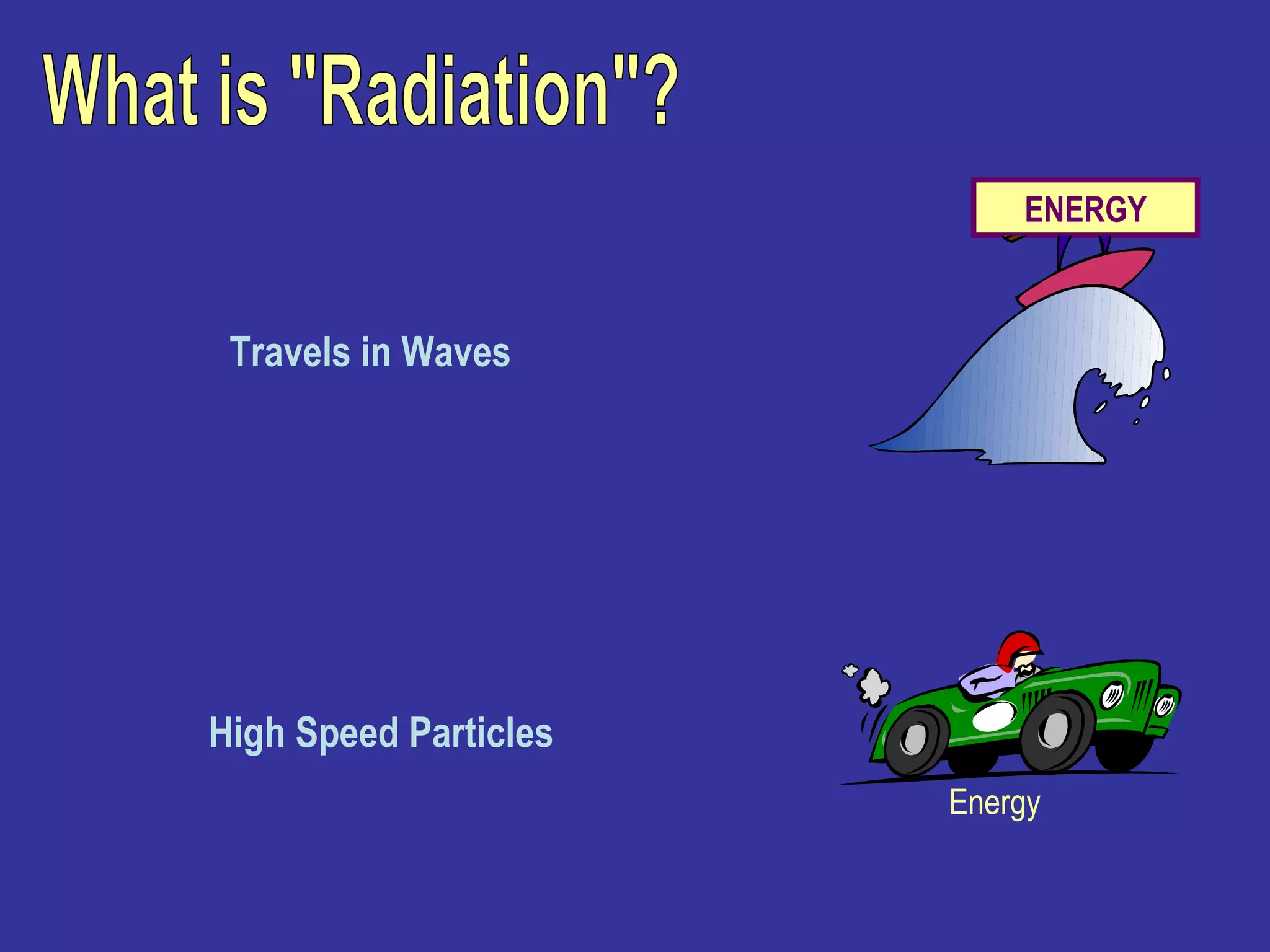
What is "Radiation"? Travels in Waves High Speed Particles ENERGY Energy
 
Ionizing ionizes [strips electrons from] atoms Basic Types of Radiation Non-Ionizing many other modes of interaction
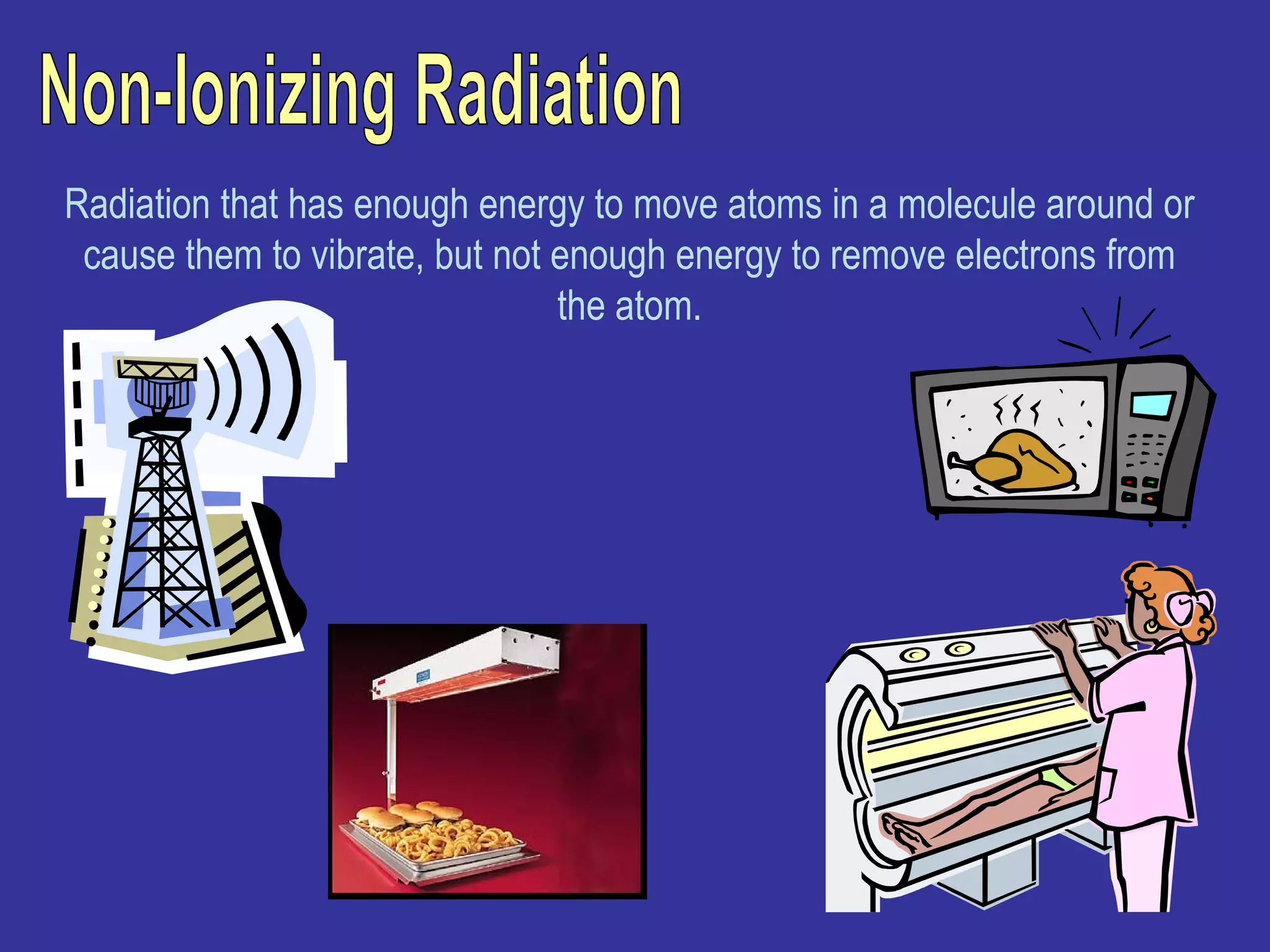
Non-Ionizing Radiation Radiation that has enough energy to move atoms in a molecule around or cause them to vibrate, but not enough energy to remove electrons from the atom.
Ionizing Radiation Ionization is the process in which a charged portion of a molecule (usually an electron) is given enough energy to break away from the atom.  This process results in the formation of two charged particles or ions: molecule with a net positive charge free electron with a negative charge   
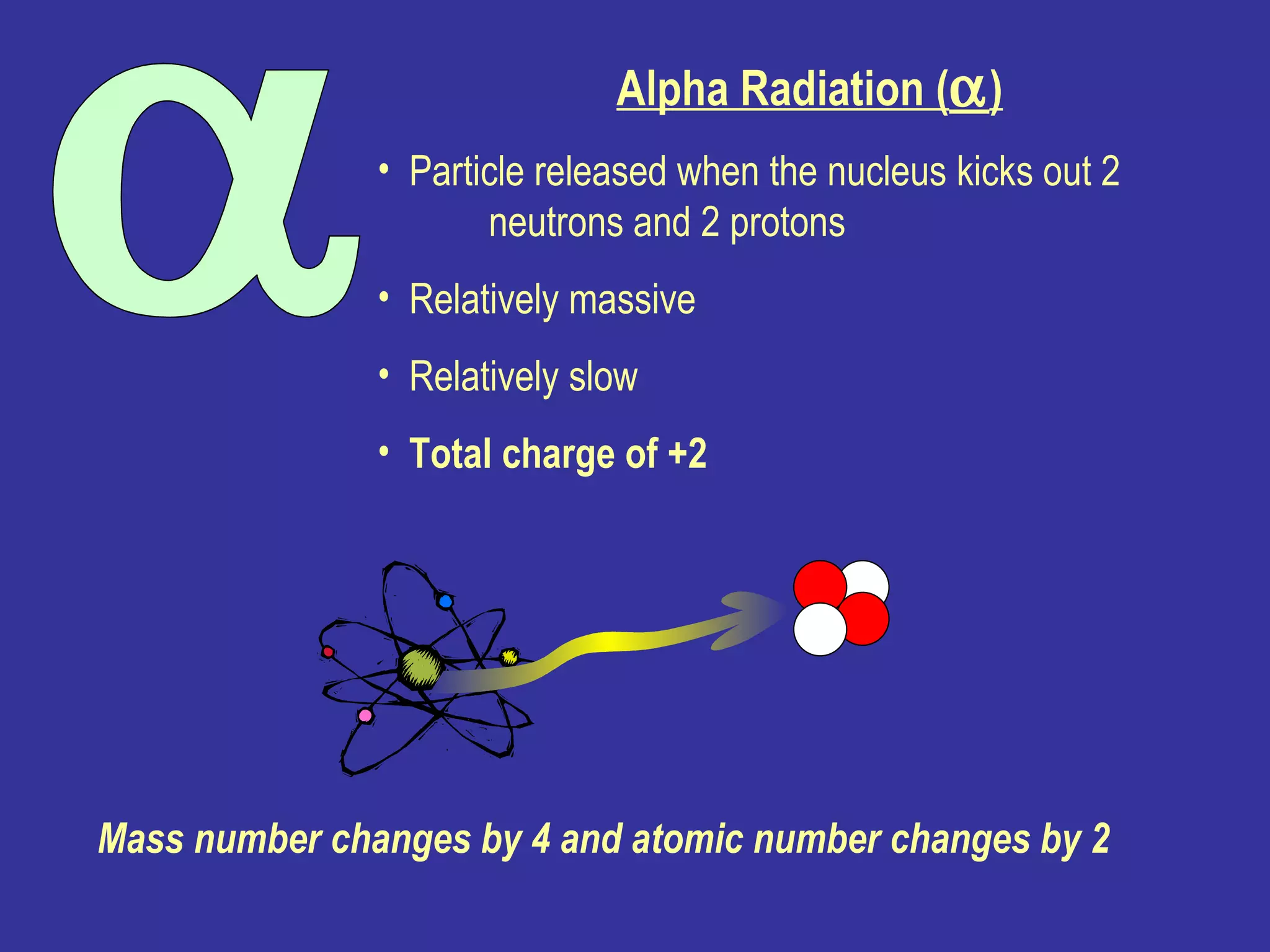
a Alpha Radiation (  ) Particle released when the nucleus kicks out 2  neutrons and 2 protons Relatively massive Relatively slow Total charge of +2 Mass number changes by 4 and atomic number changes by 2
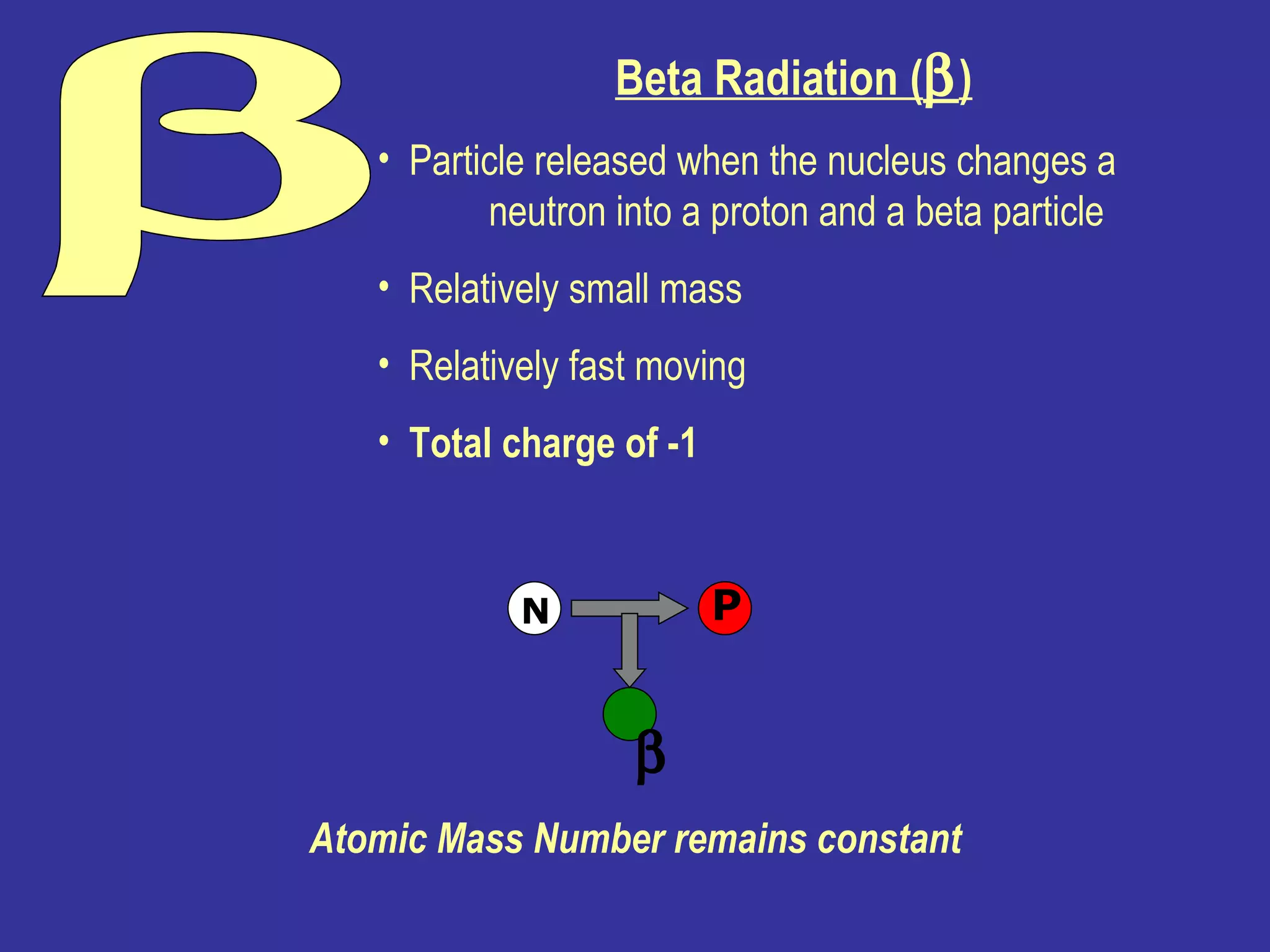
b Beta Radiation (  ) Particle released when the nucleus changes a  neutron into a proton and a beta particle Relatively small mass Relatively fast moving Total charge of -1 Atomic Mass Number remains constant  P N
g Gamma Radiation (  ) Pure energy.  Released from the nucleus when an alpha or a  beta is emitted No mass Speed of light No charge NO CHANGE
Courtesy of  David C Howell, Radiation Safety Officer-Wake Forest University-Baptist Medical Center
Radioactivity Property of some atoms to spontaneously give off energy as particles or rays Caused by instability in the atom’s nucleus or an excess of energy Radioactive atoms try to achieve stability by throwing off Protons or Neutrons, other particles, or by releasing excess energy in other forms
Stable Radioactive Decay Process
Half-life Time required for the disintegration of one-half of the radioactive atoms that are present in a given amount  Uranium-238 (In soil) 4.5 Billion years Potassium-40 (in soil and body) 1.3 Billion years Carbon-14 (In all living tissue) 5730 years Hydrogen-3 (in all water) 12 years Radium-226 (In soil - produces radon) 1600 years Radon-222 (in soil and air) 3.8 days Polonium-214 (radon progeny that decays in lungs) 164 microseconds
Radiation Units Dose = Rad/ Gray (Gy)  1Gy = 100 rads Dose Equivalent = Rem/ Sievert (Sv)  1Sv = 100 rem Exposure = Roentgen (R) Examples of Radiation Dose from Medical Radiation Exposures Chest X-ray: 8 mrem (0.08 mSv) Head CT scan: 111 mrem (1.11 mSv) Barium Enema: 406 mrem (4.06 mSv) Extremity X-ray: 1 mrem (0.01 mSv) Source: NCRP Report 100
Risk Dose (in addition to natural background radiation) Linear No-Threshold Risk Model
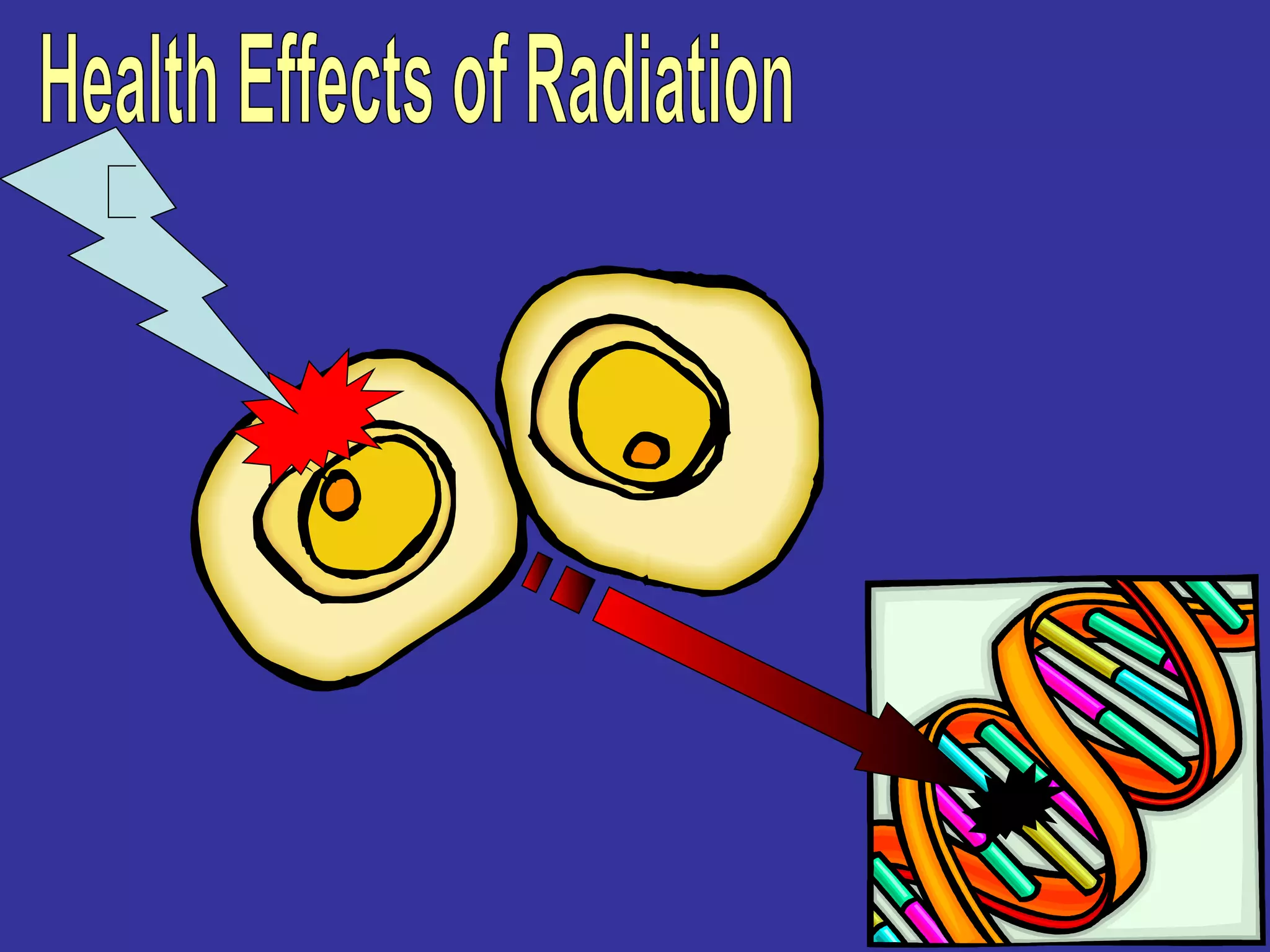
Health Effects of Radiation 
Cell Sensitivity Most sensitive cells: Rapidly dividing cells (Small intestines, bone marrow, hair, fetus) Least sensitive cells: Slowly dividing cells (brain, nerves)
Categories of Radiation Effects Acute Somatic Immediate effects to the organism receiving the dose Delayed Somatic Effects that appear years later to organism receiving the dose Genetic Effects that appear in offspring
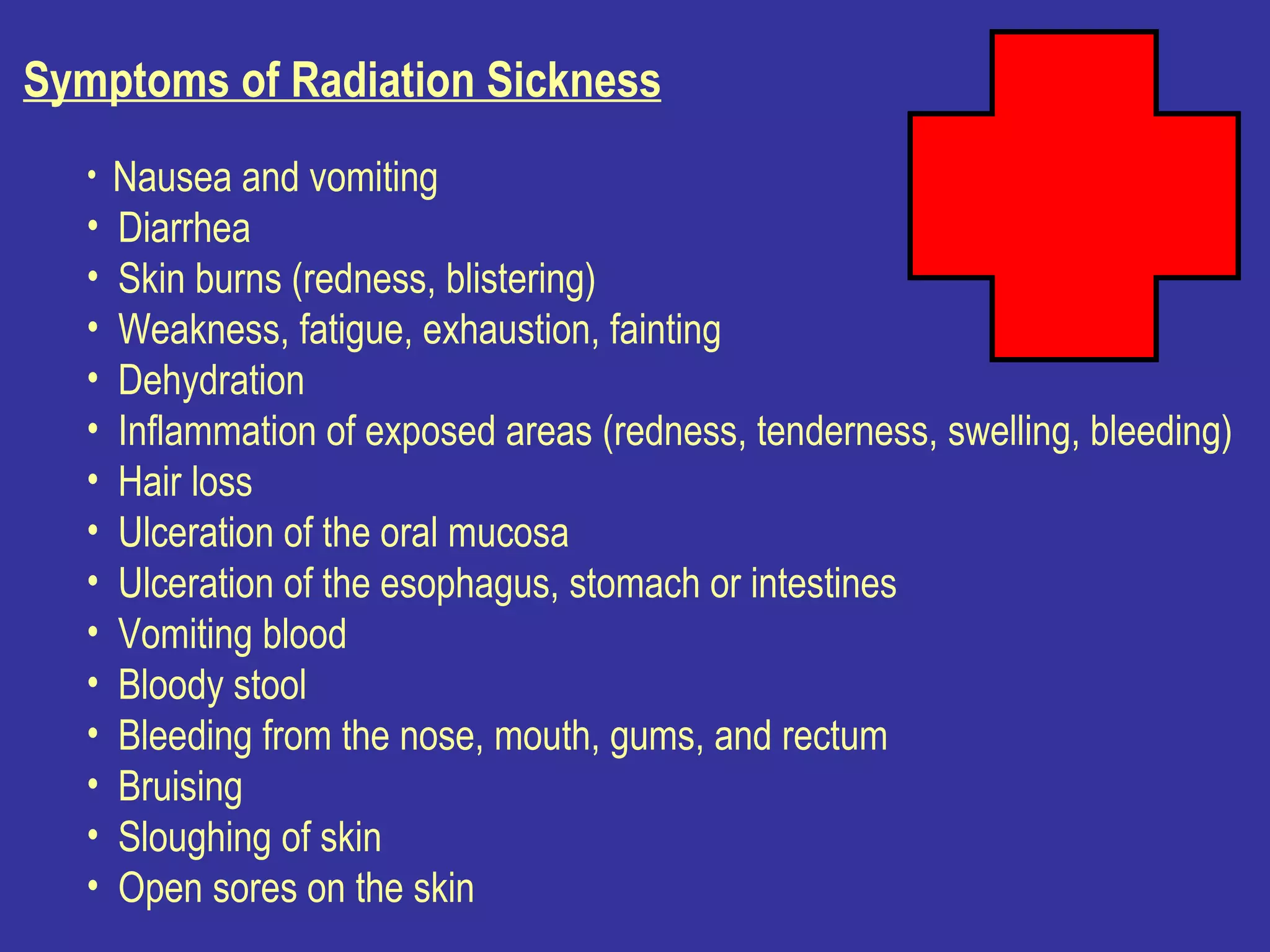
Symptoms of Radiation Sickness     Nausea and vomiting  Diarrhea  Skin burns (redness, blistering)  Weakness, fatigue, exhaustion, fainting  Dehydration  Inflammation of exposed areas (redness, tenderness, swelling, bleeding)  Hair loss  Ulceration of the oral mucosa  Ulceration of the esophagus, stomach or intestines  Vomiting blood  Bloody stool  Bleeding from the nose, mouth, gums, and rectum  Bruising  Sloughing of skin  Open sores on the skin
Radiation Effects 500 – 600 Skin Skin erythema 350 Testis Permanent sterility 300 – 500 Skin Temporary hair loss 300 GI Vomiting 250 – 600 Ovaries Permanent sterility 200 Skin Reversible skin effects 50 Bone Marrow Blood cell depression Dose (rad) Organ Health Effect
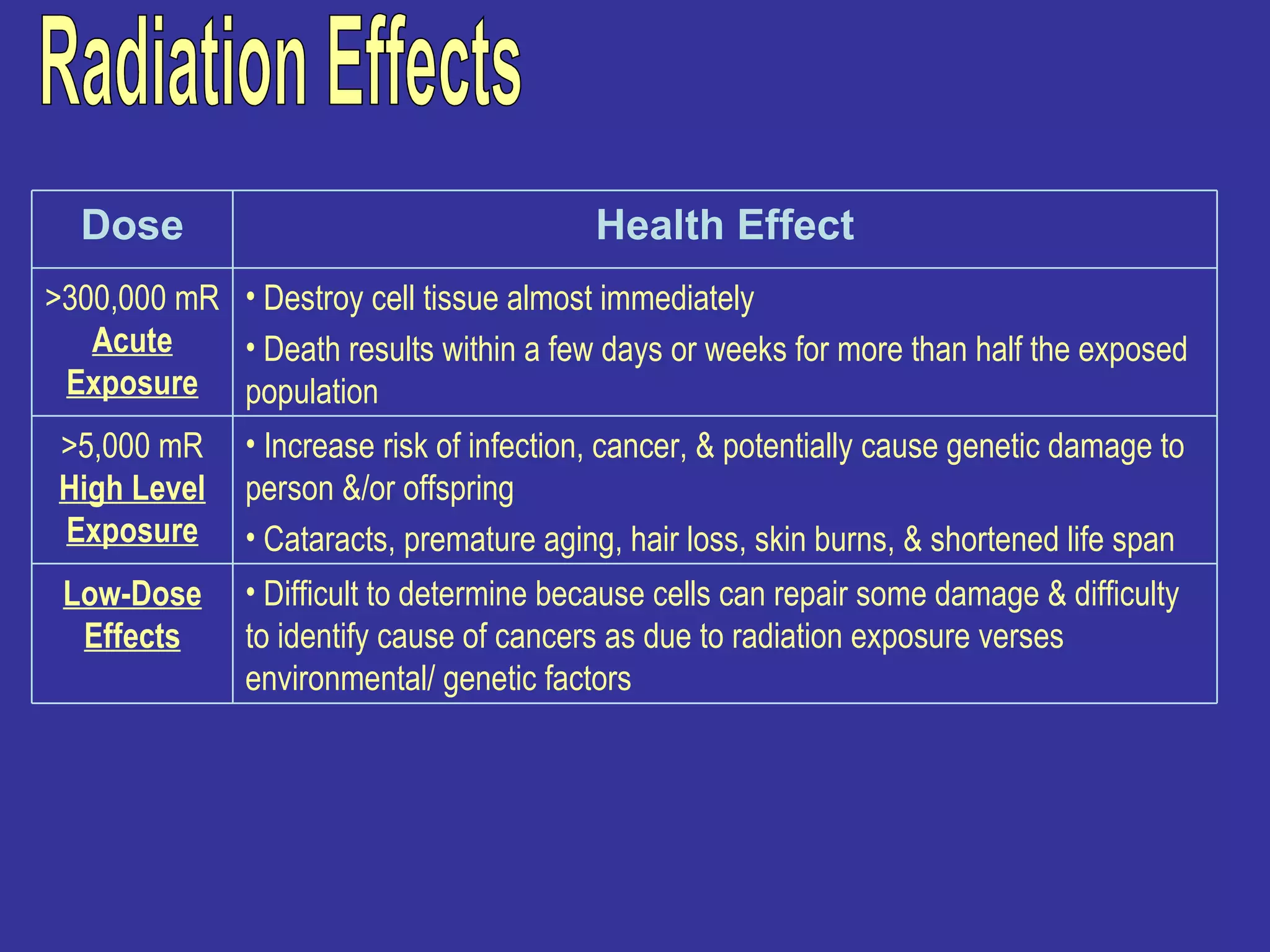
Radiation Effects Destroy cell tissue almost immediately Death results within a few days or weeks for more than half the exposed population >300,000 mR Acute Exposure Low-Dose Effects >5,000 mR High Level Exposure Dose Difficult to determine because cells can repair some damage & difficulty to identify cause of cancers as due to radiation exposure verses environmental/ genetic factors Increase risk of infection, cancer, & potentially cause genetic damage to person &/or offspring Cataracts, premature aging, hair loss, skin burns, & shortened life span Health Effect
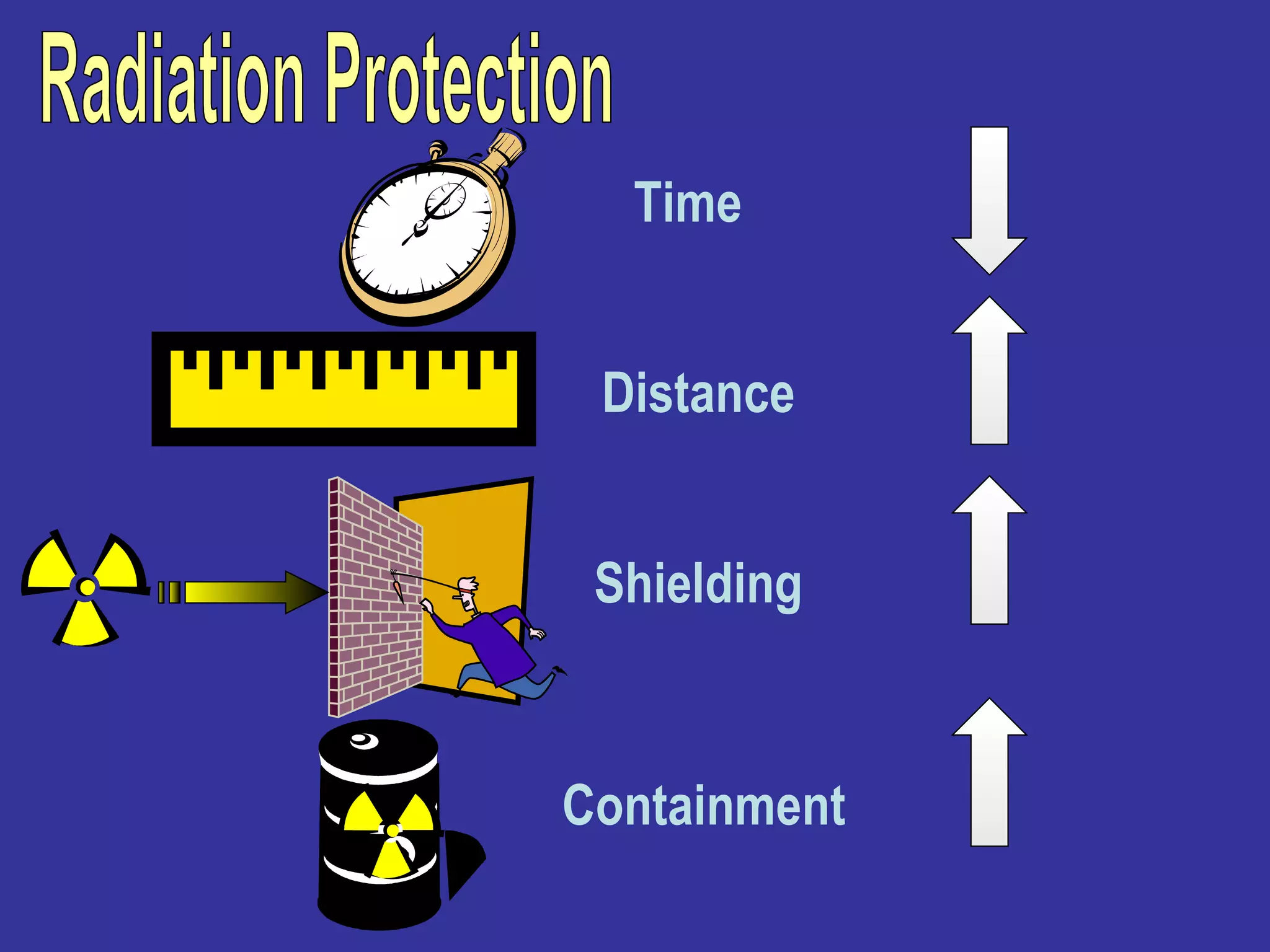
Radiation Protection Time Distance Shielding Containment
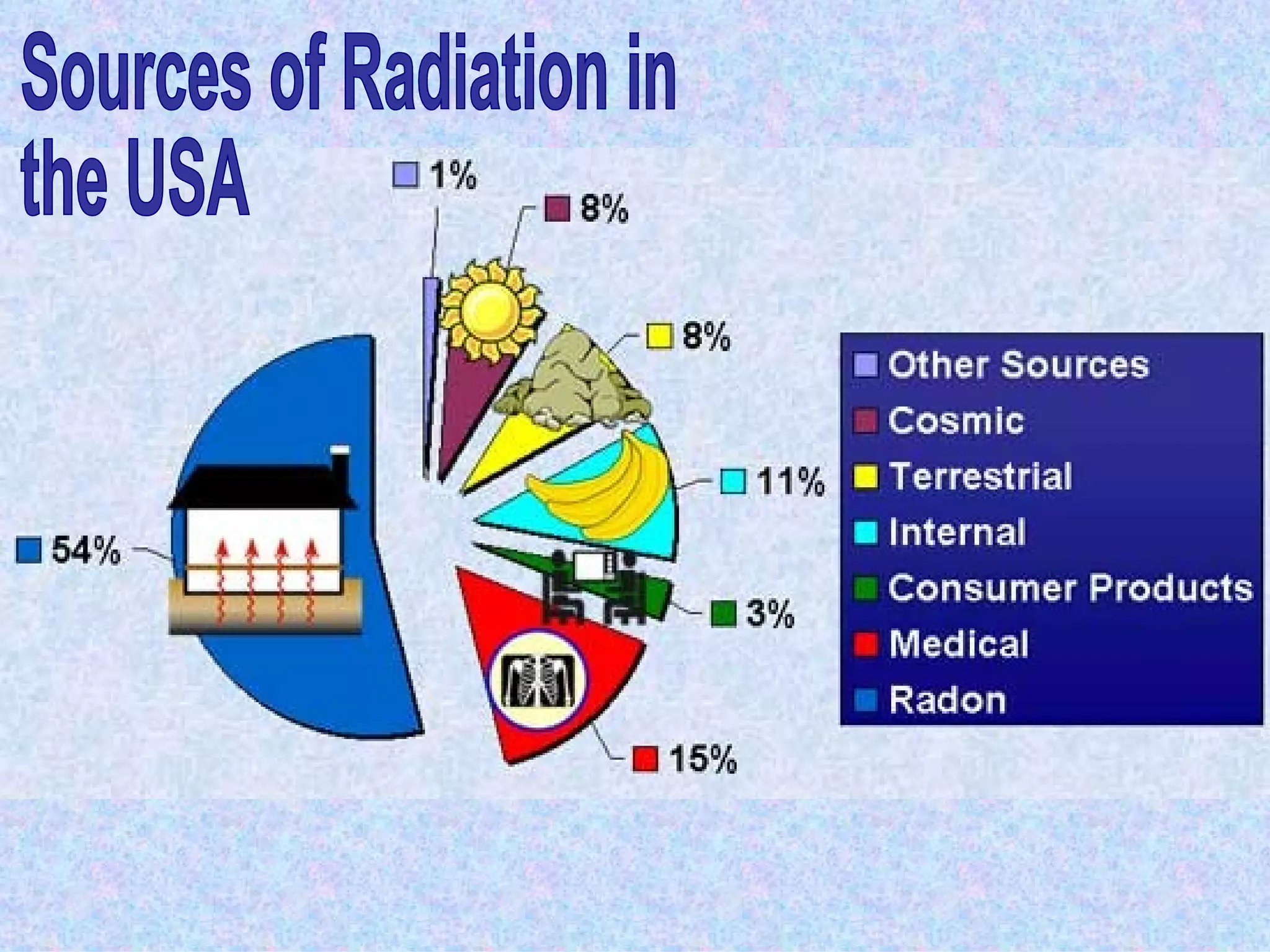
Sources of Radiation in the USA
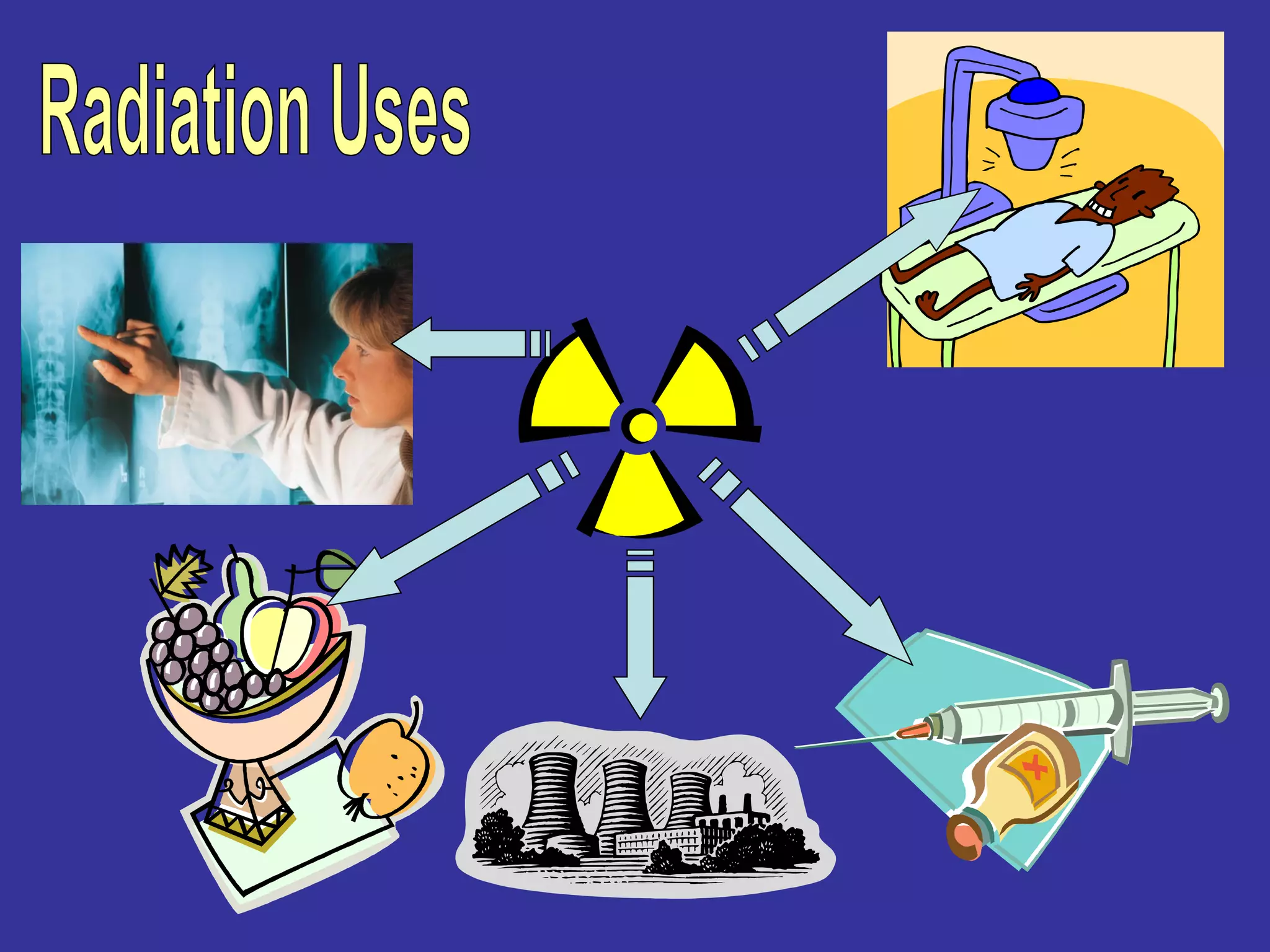
Radiation Uses
Industrial Use Well logging Test pipes & welds Control thickness of sheet products Cold sterilize plastics, pharmaceuticals,  cosmetics, & other heat sensitive products Security checks (luggage) Prove authenticity of old paintings Detect pollution
Food Irradiation Food treatment comparable to pasteurization Kills pests/microorganisms without food degradation Controls sprouting Does not make the food radioactive FDA Approved Must be labeled Good information about food irradiation: http://uw-food-irradiation.engr.wisc.edu/Facts.html
Safety and Security Smoke Detection Equipment Self-powered Lighting in Exit Signs Lighted Aircraft Instrumentation Pharmaceutical Detection Bomb/Weapons Detection Scanning and Surveillance Equipment Theft Deterrent Systems
Consumer Products Television sets accelerate electrons to make the picture on the screen and in the process produce a few low energy x-rays. Some more products or services: long lasting light bulbs, building materials, and luminous dials, among many others.
Eliminate dust from computer disks & audio & video tapes Sterilize baby powder, bandages, cosmetics, hair products, & contact lens solutions Control thickness of sheet products Attach a non-stick surface to pans Brighten porcelain in false teeth Consumer Products
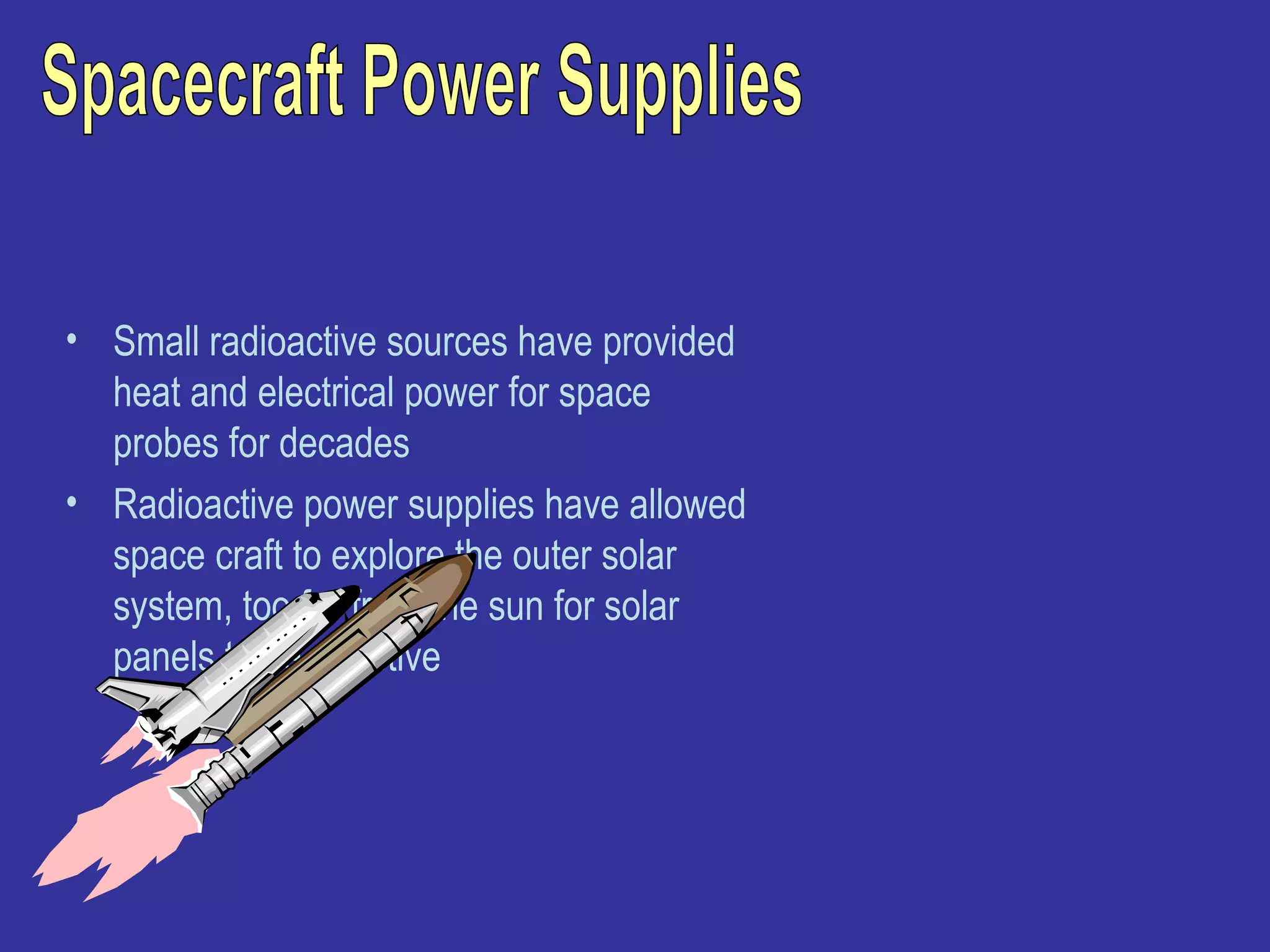
Spacecraft Power Supplies Small radioactive sources have provided heat and electrical power for space probes for decades Radioactive power supplies have allowed space craft to explore the outer solar system, too far from the sun for solar panels to be effective
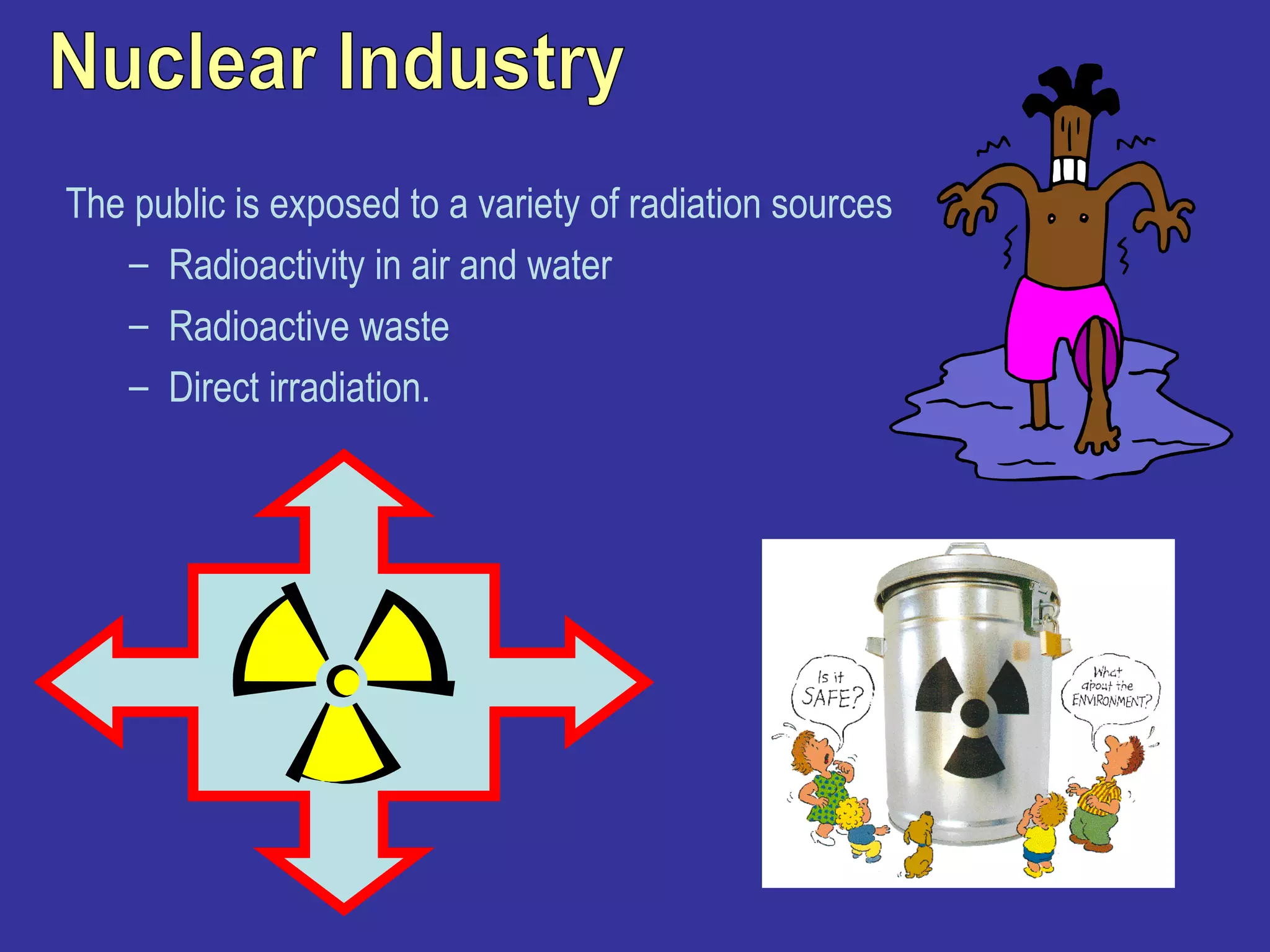
The public is exposed to a variety of radiation sources Radioactivity in air and water Radioactive waste Direct irradiation. Nuclear Industry
Nuclear Power
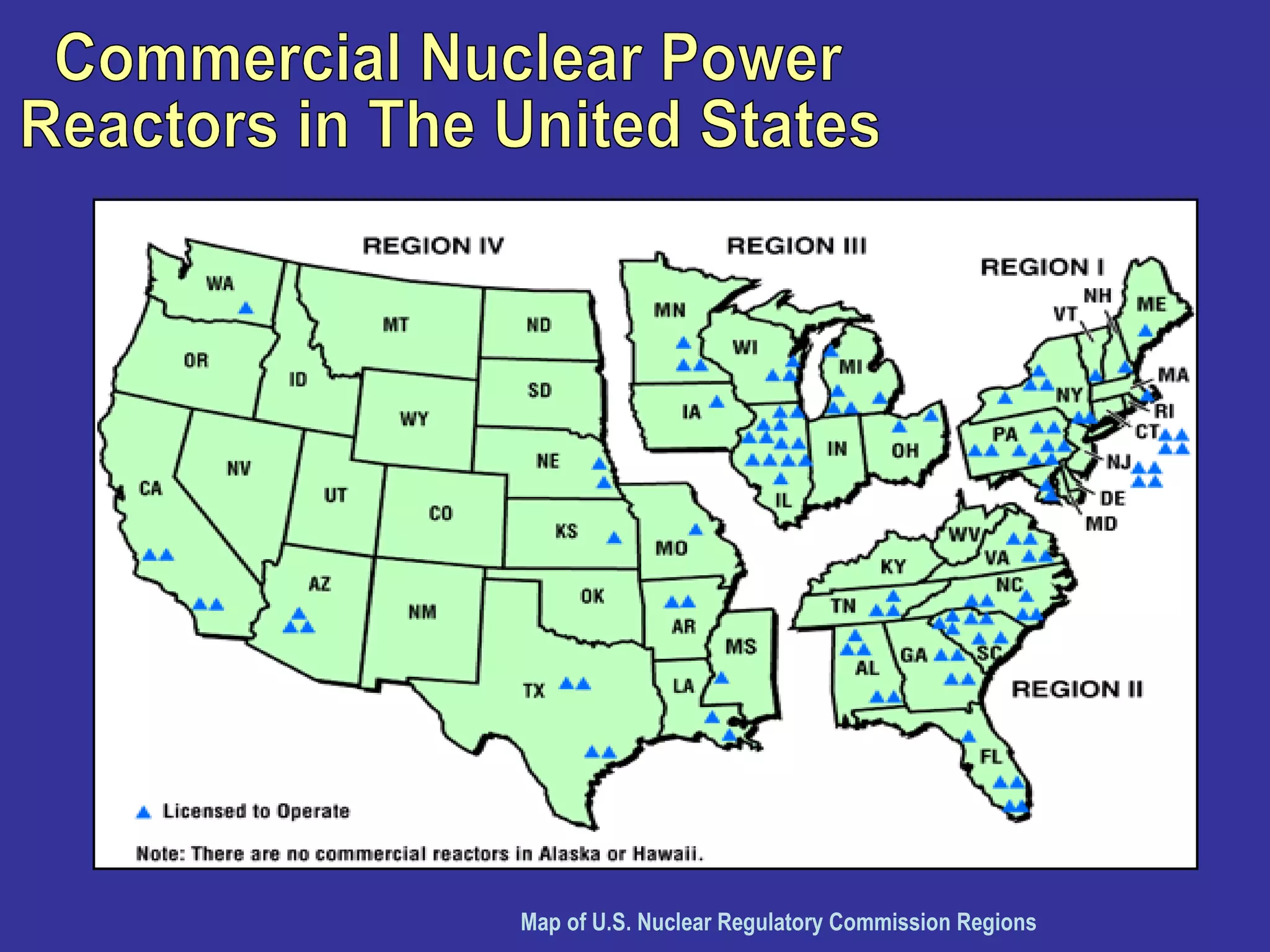
Map of U.S. Nuclear Regulatory Commission Regions Commercial Nuclear Power Reactors in The United States
X-radiation Radiographs Fluoroscopy CT scan Nuclear Medicine Diagnostic Uses Generally low doses Short-time exposures
Radiotherapy  (Direct radiation beam) Gamma rays Electron beams X-radiation Therapeutic Uses Brachytherapy  (Radiation from internally deposited radioactivity) Removable seeds (long half-life) Permanent seeds (short half-life) Generally high doses Short to long time exposures
Radioactivity remaining after atmospheric nuclear weapons testing Less than 0.01 mSv (1 mrem)/yr  Long-lived radionuclides: Cesium-137: 30 year half-life Mimics potassium - found in muscle Strontium-90: 29 year half-life Mimics calcium - found in bones Fallout Radiation Leukemia is among the greatest of afflictions that are passed on to the offspring of survivors  http://www.serendipity.li/more/atomic.html
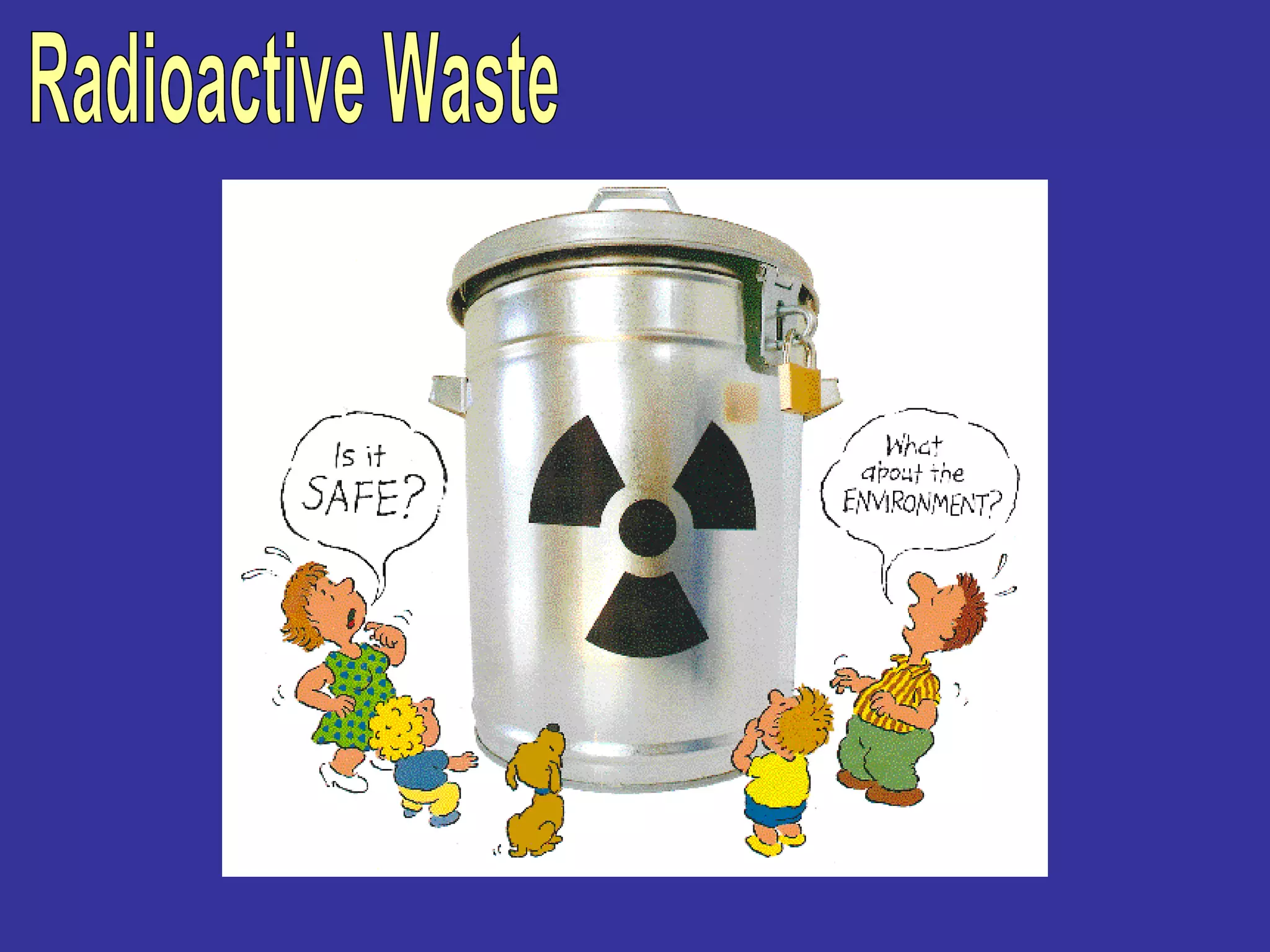
Radioactive Waste
Locations of Operating LLRW Facilities in the U.S. U.S. Ecology Facility Richland, WA Chem Nuclear Facility Barnwell, S.C. Envirocare Facility Clive, UT
Thank you for your attention Any Questions?

Basics Of Radiation

  • 1.
    Basics of RadiationNC Radiation Protection Section- DENR NC Health Physics Society
  • 2.
    What is "Radiation"?Travels in Waves High Speed Particles ENERGY Energy
  • 3.
  • 4.
    Ionizing ionizes [stripselectrons from] atoms Basic Types of Radiation Non-Ionizing many other modes of interaction
  • 5.
    Non-Ionizing Radiation Radiationthat has enough energy to move atoms in a molecule around or cause them to vibrate, but not enough energy to remove electrons from the atom.
  • 6.
    Ionizing Radiation Ionizationis the process in which a charged portion of a molecule (usually an electron) is given enough energy to break away from the atom. This process results in the formation of two charged particles or ions: molecule with a net positive charge free electron with a negative charge   
  • 7.
    a Alpha Radiation(  ) Particle released when the nucleus kicks out 2 neutrons and 2 protons Relatively massive Relatively slow Total charge of +2 Mass number changes by 4 and atomic number changes by 2
  • 8.
    b Beta Radiation(  ) Particle released when the nucleus changes a neutron into a proton and a beta particle Relatively small mass Relatively fast moving Total charge of -1 Atomic Mass Number remains constant  P N
  • 9.
    g Gamma Radiation(  ) Pure energy. Released from the nucleus when an alpha or a beta is emitted No mass Speed of light No charge NO CHANGE
  • 10.
    Courtesy of David C Howell, Radiation Safety Officer-Wake Forest University-Baptist Medical Center
  • 11.
    Radioactivity Property ofsome atoms to spontaneously give off energy as particles or rays Caused by instability in the atom’s nucleus or an excess of energy Radioactive atoms try to achieve stability by throwing off Protons or Neutrons, other particles, or by releasing excess energy in other forms
  • 12.
  • 13.
    Half-life Time requiredfor the disintegration of one-half of the radioactive atoms that are present in a given amount Uranium-238 (In soil) 4.5 Billion years Potassium-40 (in soil and body) 1.3 Billion years Carbon-14 (In all living tissue) 5730 years Hydrogen-3 (in all water) 12 years Radium-226 (In soil - produces radon) 1600 years Radon-222 (in soil and air) 3.8 days Polonium-214 (radon progeny that decays in lungs) 164 microseconds
  • 14.
    Radiation Units Dose= Rad/ Gray (Gy) 1Gy = 100 rads Dose Equivalent = Rem/ Sievert (Sv) 1Sv = 100 rem Exposure = Roentgen (R) Examples of Radiation Dose from Medical Radiation Exposures Chest X-ray: 8 mrem (0.08 mSv) Head CT scan: 111 mrem (1.11 mSv) Barium Enema: 406 mrem (4.06 mSv) Extremity X-ray: 1 mrem (0.01 mSv) Source: NCRP Report 100
  • 15.
    Risk Dose (inaddition to natural background radiation) Linear No-Threshold Risk Model
  • 16.
    Health Effects ofRadiation 
  • 17.
    Cell Sensitivity Mostsensitive cells: Rapidly dividing cells (Small intestines, bone marrow, hair, fetus) Least sensitive cells: Slowly dividing cells (brain, nerves)
  • 18.
    Categories of RadiationEffects Acute Somatic Immediate effects to the organism receiving the dose Delayed Somatic Effects that appear years later to organism receiving the dose Genetic Effects that appear in offspring
  • 19.
    Symptoms of RadiationSickness     Nausea and vomiting Diarrhea Skin burns (redness, blistering) Weakness, fatigue, exhaustion, fainting Dehydration Inflammation of exposed areas (redness, tenderness, swelling, bleeding) Hair loss Ulceration of the oral mucosa Ulceration of the esophagus, stomach or intestines Vomiting blood Bloody stool Bleeding from the nose, mouth, gums, and rectum Bruising Sloughing of skin Open sores on the skin
  • 20.
    Radiation Effects 500– 600 Skin Skin erythema 350 Testis Permanent sterility 300 – 500 Skin Temporary hair loss 300 GI Vomiting 250 – 600 Ovaries Permanent sterility 200 Skin Reversible skin effects 50 Bone Marrow Blood cell depression Dose (rad) Organ Health Effect
  • 21.
    Radiation Effects Destroycell tissue almost immediately Death results within a few days or weeks for more than half the exposed population >300,000 mR Acute Exposure Low-Dose Effects >5,000 mR High Level Exposure Dose Difficult to determine because cells can repair some damage & difficulty to identify cause of cancers as due to radiation exposure verses environmental/ genetic factors Increase risk of infection, cancer, & potentially cause genetic damage to person &/or offspring Cataracts, premature aging, hair loss, skin burns, & shortened life span Health Effect
  • 22.
    Radiation Protection TimeDistance Shielding Containment
  • 23.
  • 24.
  • 25.
    Industrial Use Welllogging Test pipes & welds Control thickness of sheet products Cold sterilize plastics, pharmaceuticals, cosmetics, & other heat sensitive products Security checks (luggage) Prove authenticity of old paintings Detect pollution
  • 26.
    Food Irradiation Foodtreatment comparable to pasteurization Kills pests/microorganisms without food degradation Controls sprouting Does not make the food radioactive FDA Approved Must be labeled Good information about food irradiation: http://uw-food-irradiation.engr.wisc.edu/Facts.html
  • 27.
    Safety and SecuritySmoke Detection Equipment Self-powered Lighting in Exit Signs Lighted Aircraft Instrumentation Pharmaceutical Detection Bomb/Weapons Detection Scanning and Surveillance Equipment Theft Deterrent Systems
  • 28.
    Consumer Products Televisionsets accelerate electrons to make the picture on the screen and in the process produce a few low energy x-rays. Some more products or services: long lasting light bulbs, building materials, and luminous dials, among many others.
  • 29.
    Eliminate dust fromcomputer disks & audio & video tapes Sterilize baby powder, bandages, cosmetics, hair products, & contact lens solutions Control thickness of sheet products Attach a non-stick surface to pans Brighten porcelain in false teeth Consumer Products
  • 30.
    Spacecraft Power SuppliesSmall radioactive sources have provided heat and electrical power for space probes for decades Radioactive power supplies have allowed space craft to explore the outer solar system, too far from the sun for solar panels to be effective
  • 31.
    The public isexposed to a variety of radiation sources Radioactivity in air and water Radioactive waste Direct irradiation. Nuclear Industry
  • 32.
  • 33.
    Map of U.S.Nuclear Regulatory Commission Regions Commercial Nuclear Power Reactors in The United States
  • 34.
    X-radiation Radiographs FluoroscopyCT scan Nuclear Medicine Diagnostic Uses Generally low doses Short-time exposures
  • 35.
    Radiotherapy (Directradiation beam) Gamma rays Electron beams X-radiation Therapeutic Uses Brachytherapy (Radiation from internally deposited radioactivity) Removable seeds (long half-life) Permanent seeds (short half-life) Generally high doses Short to long time exposures
  • 36.
    Radioactivity remaining afteratmospheric nuclear weapons testing Less than 0.01 mSv (1 mrem)/yr Long-lived radionuclides: Cesium-137: 30 year half-life Mimics potassium - found in muscle Strontium-90: 29 year half-life Mimics calcium - found in bones Fallout Radiation Leukemia is among the greatest of afflictions that are passed on to the offspring of survivors http://www.serendipity.li/more/atomic.html
  • 37.
  • 38.
    Locations of OperatingLLRW Facilities in the U.S. U.S. Ecology Facility Richland, WA Chem Nuclear Facility Barnwell, S.C. Envirocare Facility Clive, UT
  • 39.
    Thank you foryour attention Any Questions?