Nuclear Science Merit
Badge
Howard Matis - hsmatis@lbl.gov 1
Nuclear Science Merit Badge
Howard Matis
Lawrence Berkeley National Laboratory
Nuclear Science Merit Badge Howard Matis - hsmatis@lbl.gov 2
Radiation gives Superhuman Powers to
Spiderman
Nuclear Science Merit Badge Howard Matis - hsmatis@lbl.gov 3
Radiation gives Superhuman Powers to
The Hulk
Nuclear Science Merit Badge Howard Matis - hsmatis@lbl.gov 4
Chernobyl
Nuclear Science Merit Badge Howard Matis - hsmatis@lbl.gov 5
Radiation is
 Plot device for fiction
 Scary
 Deadly
 Life saving
 Misunderstood
 Useful
Nuclear Science Merit Badge Howard Matis - hsmatis@lbl.gov 6
Radiation Hazard Symbol
The symbol is placed on a placard with the
word CAUTION or DANGER or GRAVE
DANGER centered about it. Under the
symbol is the information addressing the
types of hazards.
Examples are:
Radiation Area
High Radiation Area
Airborne
Radioactivity Area
Contaminated Area
Radioactive
Materials Area
R
1.5R
5R
60°
60°
Nuclear Science Merit Badge Howard Matis - hsmatis@lbl.gov 7
Radiation is Energy
 The energy is given off by unstable (radioactive)
atoms and some machines.
We will be focusing on ionizing radiation and its health effects.
Nuclear Science Merit Badge Howard Matis - hsmatis@lbl.gov 8
Atoms Building Blocks of Matter
 All matter is made up of
atoms
 The nucleus is in center
 almost all of the mass
 Electrons go around
 At this scale, electrons
are at the edge of town
Nuclear Science Merit Badge Howard Matis - hsmatis@lbl.gov 9
What is a Nucleus?
 Quarks determine if proton
or neutron
 Neutrons
 Protons
 Protons determine chemical
properties
 Ratio of neutrons to protons
make a nucleus stable or
unstable
Nuclear Science Merit Badge Howard Matis - hsmatis@lbl.gov 10
Isotopes
•Many elements have nuclei with
the same number of protons
•same name
•same chemistry
•but different numbers of
neutrons
•different masses
Nuclear Science Merit Badge Howard Matis - hsmatis@lbl.gov 11
Examples - Isotopes
•Uranium-238 (238U)
92 protons, 146 neutrons, mass 238
•Uranium-235 (235U)
92 protons, 143 neutrons, mass 235
•Hydrogen (1H)
1 proton, 0 neutrons, mass 1
•Deuterium (2D)
1 proton, 1 neutron, mass 2
•Tritium (3
1T)
1 proton, 2 neutrons, mass 3
•Helium (4He) (a-particle)
2 protons, 2 neutrons, mass 4
•Helium-3 (3He)
2 protons, 1 neutron, mass 3
Nuclear Science Merit Badge Howard Matis - hsmatis@lbl.gov 12
Types of Radioactivity
•Each type of radiation is ionizing
•But different properties
•affect the hazards they pose
•the detection mechanism
•shielding
Six Common Types
Alpha Decay
Beta Decay
Gamma Decay
Fission
Fusion
Cosmic Rays
Nuclear Science Merit Badge Howard Matis - hsmatis@lbl.gov 13
How Does it Decay?
 Alpha - lose an alpha
particle (a - helium
nucleus)
 Beta - emit a beta
particle ( - electron or
anti-electron)
 Gamma - emit a gamma
( or photon or light
particle)
Nuclear Science Merit Badge Howard Matis - hsmatis@lbl.gov 14
Alpha Decay
 Alpha particle or helium nucleus
emitted
 Nucleus changes mass by four
units and charge by two units
 Common for heavy elements
 Changes chemical properties
 Alpha particle easily stopped
 4 x nucleon mass
 +2 Charge
 Big
Nuclear Science Merit Badge Howard Matis - hsmatis@lbl.gov 15
Beta Decay
 Beta minus - neutron converts to
electron and anti-neutrino
 Beta plus - proton converts to a
anti-electron and neutrino
 Nucleus changes charge but not
mass number
 Changes chemical properties
 Radiation moderately penetrating
 +1 charge
 Small electron
Nuclear Science Merit Badge Howard Matis - hsmatis@lbl.gov 16
Gamma Decay
 Nucleus changes energy
level
 Emits gamma ray or
photon
 Nucleus stays the same
 No change in chemical
properties
 Very penetrating
 Almost no size
 Neutral
Nuclear Science Merit Badge Howard Matis - hsmatis@lbl.gov 17
Absorption of Radiation
a++
0
-
0

1
n
Alpha
Beta
Gamma and X-rays
Neutron
Paper Plastic Lead Concrete
Nuclear Science Merit Badge Howard Matis - hsmatis@lbl.gov 18
Fission
The heavy parent nucleus
fissions …
… into two lighter (radioactive) fission fragment nuclei plus
some left over neutrons
Sometimes a very heavy
nucleus will fall apart
before it can emit an
alpha particle.
Fission can release an enormous amount of energy and is
utilized in power plants and fission bombs (A-bomb).
Nuclear Science Merit Badge Howard Matis - hsmatis@lbl.gov 19
Fusion
 When two nuclei collide and
stick together
 Process that powers the sun
and stars
 All life arises from it
 Not usually found in every
day experience on Earth
 Component of the H-bomb
Nuclear Science Merit Badge Howard Matis - hsmatis@lbl.gov 20
How Unstable Is It?
 The “Half-life” describes how quickly Radioactive Material
decays away with time.
It is the time required for half of the unstable atoms to decay.
 Some Examples:
 Some natural isotopes (like uranium and thorium) have half-lives that
are billions of years
 Since Earth is about 5 billion years old, short lived naturally produced
isotopes gone
 Most medical isotopes (like 99mTc) last only a few days
Nuclear Science Merit
Badge
Howard Matis - hsmatis@lbl.gov 21
Half-Life Experiment
Guess the number I am thinking
from 1 to 4
Nuclear Science Merit Badge Howard Matis - hsmatis@lbl.gov 22
Some Isotopes & Their Half Lives
ISOTOPE HALF-
LIFE
APPLICATIONS
238U – Uranium billions
of years
Natural uranium is comprised of several different isotopes.
When enriched in the isotope of 235U, it’s used to power
nuclear reactor or nuclear weapons.
14C – Carbon 5730 y Found in nature from cosmic interactions, used to “carbon
date” items and as radiolabel for detection of tumors.
137Ce – Cesium 30.2 y Blood irradiators, tumor treatment through external
exposure. Also used for industrial radiography.
3H – Tritium 12.3 y Labeling biological tracers.
192Ir – Iridium 74 d Implants or "seeds" for treatment of cancer. Also used for
industrial radiography.
99Mo –
Molybdenum
66 h Parent for 99mTc generator.
99mTc –
Technetium
6 h Brain, heart, liver (gastroenterology), lungs, bones, thyroid,
and kidney imaging, regional cerebral blood flow, etc.
Nuclear Science Merit Badge Howard Matis - hsmatis@lbl.gov 23
How do we Measure the Amount of
Radiation?
Nuclear Science Merit Badge Howard Matis - hsmatis@lbl.gov 24
Radiation Quantities and Units
Radioactivity
Qty: Activity
Unit: Curie (Bequerel)
1 Ci = 1000 mCi
1 Bq = 1 disintegration/sec
1 Ci = 3.7  1010 Bq
Radiation Risk
Qty: Dose Equivalent
Unit: rem (Sievert)
1 rem = 1000 mrem
1 Sv=100 rem
Radiation Absorbed Dose
Qty: Dose
Unit: rad (Gray)
1 rad = 1000 mrad
1 rad = 100 erg/gram
1 Gy =100 rad
Nuclear Science Merit Badge Howard Matis - hsmatis@lbl.gov 25
Convert from Curies to Rad
 Curie is the number of decays/s
 1 Curie = 3.7  1010 decays/s (exactly)
 Rad is the absorbed dose or physical dose
 Amount of energy deposited in unit mass
 human tissue or other media
 1 Rad = 100 erg/g
 Often use gray
 1 J/kg
 1 gray = 100 rad
Nuclear Science Merit Badge Howard Matis - hsmatis@lbl.gov 26
Need Biological Dose – REM
rad  Q = rem
Q
Gamma x-ray 1
Beta 1
Neutron 3-20
Alpha 20
•To convert from rad to rem multiply
by appropriate value of Q
•Q is the Quality Factor
•Q reflects the damage
Nuclear Science Merit
Badge
Howard Matis - hsmatis@lbl.gov 27
Radiation and Health
Does radiation affect you?
Nuclear Science Merit Badge Howard Matis - hsmatis@lbl.gov 28
Ionizing Radiation can Damage DNA
Ionizing radiation has
the ability to ionize*
atoms and molecules,
possibly altering
structure and function.
* ionize = produce
positive and negative
electrical charge
Nuclear Science Merit Badge Howard Matis - hsmatis@lbl.gov 29
Alpha Radiation Is Only a Hazard When Inside
Your Body (Internal Hazard)
Your skin will stop it
can’t penetrate skin internal hazard
stopped by paper
found in soil, radon
and other
radioactive
materials
Nuclear Science Merit Badge Howard Matis - hsmatis@lbl.gov 30
Beta Radiation Is a Skin, Eye and Internal
Hazard
skin, eye and internal hazard
stopped by plastic
found in natural food, air and water
Nuclear Science Merit Badge Howard Matis - hsmatis@lbl.gov 31
X-ray and Gamma Radiation Are Penetrating
Radiation and an External Hazard
stopped by lead
naturally present in soil
and cosmic radiation
found in
medical uses
Nuclear Science Merit Badge Howard Matis - hsmatis@lbl.gov 32
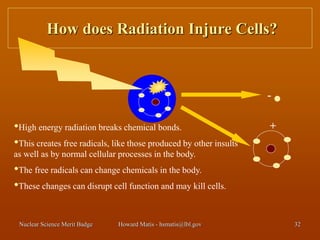
How does Radiation Injure Cells?
•High energy radiation breaks chemical bonds.
•This creates free radicals, like those produced by other insults
as well as by normal cellular processes in the body.
•The free radicals can change chemicals in the body.
•These changes can disrupt cell function and may kill cells.
+
-
Nuclear Science Merit Badge Howard Matis - hsmatis@lbl.gov 33
Types of Exposure & Health Effects
 Acute Dose - Deterministic
 Large radiation dose in a short period of time
 Large doses may result in observable health effects
 Early: Nausea & vomiting
 Hair loss, fatigue, & medical complications
 Burns and wounds heal slowly
 Examples: medical exposures and
accidental exposure to sealed sources
 Chronic Dose - Stochastic
 Radiation dose received over a long period of time
 Body more easily repairs damage from chronic doses
 Does not usually result in observable effects
 Examples: Background Radiation and
Internal Deposition Inhalation
Nuclear Science Merit Badge Howard Matis - hsmatis@lbl.gov 34
At HIGH Doses, We KNOW Radiation
Causes Harm
 High Dose effects seen in
 Radium dial painters
 Early radiologists
 Atomic bomb survivors
 Populations near Chernobyl
 Medical treatments
 Criticality Accidents
 Cancer
 Leukemia (A-bomb data)
 Thyroid (Chernobyl data)
 Bone and other solid cancers (A-bomb data)
 Birth defects (A-bomb data)
 Genetic effects (only animal data)
.
Nuclear Science Merit Badge Howard Matis - hsmatis@lbl.gov 35
Effects of ACUTE (Deterministic)
Exposures
Dose (rads*) Effects
25-50
First sign of physical effects
(drop in white blood cell count)
100
Threshold for vomiting
(within a few hours of exposure)
320 - 360
~ 50% die within 60 days
(with minimal supportive care)
480 - 540
~50 % die within 60 days
(with supportive medical care)
1,000 ~ 100% die within 30 days
* For common external exposures 1 rad ~ 1 rem = 1,000 mrem
Nuclear Science Merit Badge Howard Matis - hsmatis@lbl.gov 36
At LOW Doses, We PRESUME Radiation Causes
Harm
 No physical effects have been observed
The Bad News: Radiation is a carcinogen
and a mutagen
The Good News: Radiation is a very weak
carcinogen and mutagen!
Very Small DOSE = Very Small RISK
Nuclear Science Merit Badge Howard Matis - hsmatis@lbl.gov 37
Sources of Radiation
 Average
radiation
exposure in the
United States
 360 mrem or
 0.360 rem
 Very location
dependent
Nuclear Science Merit Badge Howard Matis - hsmatis@lbl.gov 38
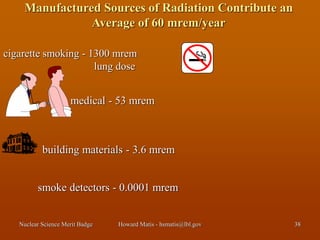
Manufactured Sources of Radiation Contribute an
Average of 60 mrem/year
cigarette smoking - 1300 mrem
lung dose
building materials - 3.6 mrem
smoke detectors - 0.0001 mrem
medical - 53 mrem
Nuclear Science Merit Badge Howard Matis - hsmatis@lbl.gov 39
Risks in Perspective
1 in 1 million chance of fatality
 40 tablespoon peanut butter (aflotoxin)
 2 days in New York City (air quality)
 3 mrem radiation (cancer)
 1 mile on motorcycle (collision)
 300 miles in car (collision)
 10 charbroiled steaks
 Smoking 1 cigarette
Nuclear Science Merit Badge Howard Matis - hsmatis@lbl.gov 40
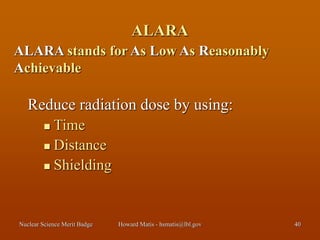
ALARA
Reduce radiation dose by using:
 Time
 Distance
 Shielding
ALARA stands for As Low As Reasonably
Achievable
Nuclear Science Merit Badge Howard Matis - hsmatis@lbl.gov 41
Reduce Time
Spend as short as time as necessary
to complete the task
Nuclear Science Merit
Badge
Howard Matis - hsmatis@lbl.gov 42
Activity
Demonstrate Time – (t)
Nuclear Science Merit Badge Howard Matis - hsmatis@lbl.gov 43
Increase Distance
Twice the distance = ¼ of the dose
Nuclear Science Merit
Badge
Howard Matis - hsmatis@lbl.gov 44
Activity
Demonstrate Distance – (d)
Nuclear Science Merit Badge Howard Matis - hsmatis@lbl.gov 45
Use Shielding
Nuclear Science Merit
Badge
Howard Matis - hsmatis@lbl.gov 46
Activity
Demonstrate Shielding – (s)
Nuclear Science Merit Badge Howard Matis - hsmatis@lbl.gov 47
Reactors Glow in the Dark
 Reactor core emits
electrons
 Electrons move faster
than the speed of light
in water
 At that speed they emit
blue light
 Cherenkov Radiation
 Similar to sonic boom
or wake of a boat
Nuclear Science Merit Badge Howard Matis - hsmatis@lbl.gov 48
Can You Glow in the Dark?
 Ingest a very hot radiation
source
 Beta needed
 Short half life
 Do not swallow
 Unless your midriff is
exposed
 Or inject source into your
blood
 Don’t be in direct light
 Usually too faint for sunlight
 Try it for Halloween?
Nuclear Science Merit Badge Howard Matis - hsmatis@lbl.gov 49
Summary
 Radiation is part
 Our natural environment
 Technology
 Health effects
 Known for high doses
 Unknown for low
 You deal with it
regularly
Nuclear Science Merit
Badge
Howard Matis - hsmatis@lbl.gov 50
The End

BSA.ppt

  • 1.
    Nuclear Science Merit Badge HowardMatis - hsmatis@lbl.gov 1 Nuclear Science Merit Badge Howard Matis Lawrence Berkeley National Laboratory
  • 2.
    Nuclear Science MeritBadge Howard Matis - hsmatis@lbl.gov 2 Radiation gives Superhuman Powers to Spiderman
  • 3.
    Nuclear Science MeritBadge Howard Matis - hsmatis@lbl.gov 3 Radiation gives Superhuman Powers to The Hulk
  • 4.
    Nuclear Science MeritBadge Howard Matis - hsmatis@lbl.gov 4 Chernobyl
  • 5.
    Nuclear Science MeritBadge Howard Matis - hsmatis@lbl.gov 5 Radiation is  Plot device for fiction  Scary  Deadly  Life saving  Misunderstood  Useful
  • 6.
    Nuclear Science MeritBadge Howard Matis - hsmatis@lbl.gov 6 Radiation Hazard Symbol The symbol is placed on a placard with the word CAUTION or DANGER or GRAVE DANGER centered about it. Under the symbol is the information addressing the types of hazards. Examples are: Radiation Area High Radiation Area Airborne Radioactivity Area Contaminated Area Radioactive Materials Area R 1.5R 5R 60° 60°
  • 7.
    Nuclear Science MeritBadge Howard Matis - hsmatis@lbl.gov 7 Radiation is Energy  The energy is given off by unstable (radioactive) atoms and some machines. We will be focusing on ionizing radiation and its health effects.
  • 8.
    Nuclear Science MeritBadge Howard Matis - hsmatis@lbl.gov 8 Atoms Building Blocks of Matter  All matter is made up of atoms  The nucleus is in center  almost all of the mass  Electrons go around  At this scale, electrons are at the edge of town
  • 9.
    Nuclear Science MeritBadge Howard Matis - hsmatis@lbl.gov 9 What is a Nucleus?  Quarks determine if proton or neutron  Neutrons  Protons  Protons determine chemical properties  Ratio of neutrons to protons make a nucleus stable or unstable
  • 10.
    Nuclear Science MeritBadge Howard Matis - hsmatis@lbl.gov 10 Isotopes •Many elements have nuclei with the same number of protons •same name •same chemistry •but different numbers of neutrons •different masses
  • 11.
    Nuclear Science MeritBadge Howard Matis - hsmatis@lbl.gov 11 Examples - Isotopes •Uranium-238 (238U) 92 protons, 146 neutrons, mass 238 •Uranium-235 (235U) 92 protons, 143 neutrons, mass 235 •Hydrogen (1H) 1 proton, 0 neutrons, mass 1 •Deuterium (2D) 1 proton, 1 neutron, mass 2 •Tritium (3 1T) 1 proton, 2 neutrons, mass 3 •Helium (4He) (a-particle) 2 protons, 2 neutrons, mass 4 •Helium-3 (3He) 2 protons, 1 neutron, mass 3
  • 12.
    Nuclear Science MeritBadge Howard Matis - hsmatis@lbl.gov 12 Types of Radioactivity •Each type of radiation is ionizing •But different properties •affect the hazards they pose •the detection mechanism •shielding Six Common Types Alpha Decay Beta Decay Gamma Decay Fission Fusion Cosmic Rays
  • 13.
    Nuclear Science MeritBadge Howard Matis - hsmatis@lbl.gov 13 How Does it Decay?  Alpha - lose an alpha particle (a - helium nucleus)  Beta - emit a beta particle ( - electron or anti-electron)  Gamma - emit a gamma ( or photon or light particle)
  • 14.
    Nuclear Science MeritBadge Howard Matis - hsmatis@lbl.gov 14 Alpha Decay  Alpha particle or helium nucleus emitted  Nucleus changes mass by four units and charge by two units  Common for heavy elements  Changes chemical properties  Alpha particle easily stopped  4 x nucleon mass  +2 Charge  Big
  • 15.
    Nuclear Science MeritBadge Howard Matis - hsmatis@lbl.gov 15 Beta Decay  Beta minus - neutron converts to electron and anti-neutrino  Beta plus - proton converts to a anti-electron and neutrino  Nucleus changes charge but not mass number  Changes chemical properties  Radiation moderately penetrating  +1 charge  Small electron
  • 16.
    Nuclear Science MeritBadge Howard Matis - hsmatis@lbl.gov 16 Gamma Decay  Nucleus changes energy level  Emits gamma ray or photon  Nucleus stays the same  No change in chemical properties  Very penetrating  Almost no size  Neutral
  • 17.
    Nuclear Science MeritBadge Howard Matis - hsmatis@lbl.gov 17 Absorption of Radiation a++ 0 - 0  1 n Alpha Beta Gamma and X-rays Neutron Paper Plastic Lead Concrete
  • 18.
    Nuclear Science MeritBadge Howard Matis - hsmatis@lbl.gov 18 Fission The heavy parent nucleus fissions … … into two lighter (radioactive) fission fragment nuclei plus some left over neutrons Sometimes a very heavy nucleus will fall apart before it can emit an alpha particle. Fission can release an enormous amount of energy and is utilized in power plants and fission bombs (A-bomb).
  • 19.
    Nuclear Science MeritBadge Howard Matis - hsmatis@lbl.gov 19 Fusion  When two nuclei collide and stick together  Process that powers the sun and stars  All life arises from it  Not usually found in every day experience on Earth  Component of the H-bomb
  • 20.
    Nuclear Science MeritBadge Howard Matis - hsmatis@lbl.gov 20 How Unstable Is It?  The “Half-life” describes how quickly Radioactive Material decays away with time. It is the time required for half of the unstable atoms to decay.  Some Examples:  Some natural isotopes (like uranium and thorium) have half-lives that are billions of years  Since Earth is about 5 billion years old, short lived naturally produced isotopes gone  Most medical isotopes (like 99mTc) last only a few days
  • 21.
    Nuclear Science Merit Badge HowardMatis - hsmatis@lbl.gov 21 Half-Life Experiment Guess the number I am thinking from 1 to 4
  • 22.
    Nuclear Science MeritBadge Howard Matis - hsmatis@lbl.gov 22 Some Isotopes & Their Half Lives ISOTOPE HALF- LIFE APPLICATIONS 238U – Uranium billions of years Natural uranium is comprised of several different isotopes. When enriched in the isotope of 235U, it’s used to power nuclear reactor or nuclear weapons. 14C – Carbon 5730 y Found in nature from cosmic interactions, used to “carbon date” items and as radiolabel for detection of tumors. 137Ce – Cesium 30.2 y Blood irradiators, tumor treatment through external exposure. Also used for industrial radiography. 3H – Tritium 12.3 y Labeling biological tracers. 192Ir – Iridium 74 d Implants or "seeds" for treatment of cancer. Also used for industrial radiography. 99Mo – Molybdenum 66 h Parent for 99mTc generator. 99mTc – Technetium 6 h Brain, heart, liver (gastroenterology), lungs, bones, thyroid, and kidney imaging, regional cerebral blood flow, etc.
  • 23.
    Nuclear Science MeritBadge Howard Matis - hsmatis@lbl.gov 23 How do we Measure the Amount of Radiation?
  • 24.
    Nuclear Science MeritBadge Howard Matis - hsmatis@lbl.gov 24 Radiation Quantities and Units Radioactivity Qty: Activity Unit: Curie (Bequerel) 1 Ci = 1000 mCi 1 Bq = 1 disintegration/sec 1 Ci = 3.7  1010 Bq Radiation Risk Qty: Dose Equivalent Unit: rem (Sievert) 1 rem = 1000 mrem 1 Sv=100 rem Radiation Absorbed Dose Qty: Dose Unit: rad (Gray) 1 rad = 1000 mrad 1 rad = 100 erg/gram 1 Gy =100 rad
  • 25.
    Nuclear Science MeritBadge Howard Matis - hsmatis@lbl.gov 25 Convert from Curies to Rad  Curie is the number of decays/s  1 Curie = 3.7  1010 decays/s (exactly)  Rad is the absorbed dose or physical dose  Amount of energy deposited in unit mass  human tissue or other media  1 Rad = 100 erg/g  Often use gray  1 J/kg  1 gray = 100 rad
  • 26.
    Nuclear Science MeritBadge Howard Matis - hsmatis@lbl.gov 26 Need Biological Dose – REM rad  Q = rem Q Gamma x-ray 1 Beta 1 Neutron 3-20 Alpha 20 •To convert from rad to rem multiply by appropriate value of Q •Q is the Quality Factor •Q reflects the damage
  • 27.
    Nuclear Science Merit Badge HowardMatis - hsmatis@lbl.gov 27 Radiation and Health Does radiation affect you?
  • 28.
    Nuclear Science MeritBadge Howard Matis - hsmatis@lbl.gov 28 Ionizing Radiation can Damage DNA Ionizing radiation has the ability to ionize* atoms and molecules, possibly altering structure and function. * ionize = produce positive and negative electrical charge
  • 29.
    Nuclear Science MeritBadge Howard Matis - hsmatis@lbl.gov 29 Alpha Radiation Is Only a Hazard When Inside Your Body (Internal Hazard) Your skin will stop it can’t penetrate skin internal hazard stopped by paper found in soil, radon and other radioactive materials
  • 30.
    Nuclear Science MeritBadge Howard Matis - hsmatis@lbl.gov 30 Beta Radiation Is a Skin, Eye and Internal Hazard skin, eye and internal hazard stopped by plastic found in natural food, air and water
  • 31.
    Nuclear Science MeritBadge Howard Matis - hsmatis@lbl.gov 31 X-ray and Gamma Radiation Are Penetrating Radiation and an External Hazard stopped by lead naturally present in soil and cosmic radiation found in medical uses
  • 32.
    Nuclear Science MeritBadge Howard Matis - hsmatis@lbl.gov 32 How does Radiation Injure Cells? •High energy radiation breaks chemical bonds. •This creates free radicals, like those produced by other insults as well as by normal cellular processes in the body. •The free radicals can change chemicals in the body. •These changes can disrupt cell function and may kill cells. + -
  • 33.
    Nuclear Science MeritBadge Howard Matis - hsmatis@lbl.gov 33 Types of Exposure & Health Effects  Acute Dose - Deterministic  Large radiation dose in a short period of time  Large doses may result in observable health effects  Early: Nausea & vomiting  Hair loss, fatigue, & medical complications  Burns and wounds heal slowly  Examples: medical exposures and accidental exposure to sealed sources  Chronic Dose - Stochastic  Radiation dose received over a long period of time  Body more easily repairs damage from chronic doses  Does not usually result in observable effects  Examples: Background Radiation and Internal Deposition Inhalation
  • 34.
    Nuclear Science MeritBadge Howard Matis - hsmatis@lbl.gov 34 At HIGH Doses, We KNOW Radiation Causes Harm  High Dose effects seen in  Radium dial painters  Early radiologists  Atomic bomb survivors  Populations near Chernobyl  Medical treatments  Criticality Accidents  Cancer  Leukemia (A-bomb data)  Thyroid (Chernobyl data)  Bone and other solid cancers (A-bomb data)  Birth defects (A-bomb data)  Genetic effects (only animal data) .
  • 35.
    Nuclear Science MeritBadge Howard Matis - hsmatis@lbl.gov 35 Effects of ACUTE (Deterministic) Exposures Dose (rads*) Effects 25-50 First sign of physical effects (drop in white blood cell count) 100 Threshold for vomiting (within a few hours of exposure) 320 - 360 ~ 50% die within 60 days (with minimal supportive care) 480 - 540 ~50 % die within 60 days (with supportive medical care) 1,000 ~ 100% die within 30 days * For common external exposures 1 rad ~ 1 rem = 1,000 mrem
  • 36.
    Nuclear Science MeritBadge Howard Matis - hsmatis@lbl.gov 36 At LOW Doses, We PRESUME Radiation Causes Harm  No physical effects have been observed The Bad News: Radiation is a carcinogen and a mutagen The Good News: Radiation is a very weak carcinogen and mutagen! Very Small DOSE = Very Small RISK
  • 37.
    Nuclear Science MeritBadge Howard Matis - hsmatis@lbl.gov 37 Sources of Radiation  Average radiation exposure in the United States  360 mrem or  0.360 rem  Very location dependent
  • 38.
    Nuclear Science MeritBadge Howard Matis - hsmatis@lbl.gov 38 Manufactured Sources of Radiation Contribute an Average of 60 mrem/year cigarette smoking - 1300 mrem lung dose building materials - 3.6 mrem smoke detectors - 0.0001 mrem medical - 53 mrem
  • 39.
    Nuclear Science MeritBadge Howard Matis - hsmatis@lbl.gov 39 Risks in Perspective 1 in 1 million chance of fatality  40 tablespoon peanut butter (aflotoxin)  2 days in New York City (air quality)  3 mrem radiation (cancer)  1 mile on motorcycle (collision)  300 miles in car (collision)  10 charbroiled steaks  Smoking 1 cigarette
  • 40.
    Nuclear Science MeritBadge Howard Matis - hsmatis@lbl.gov 40 ALARA Reduce radiation dose by using:  Time  Distance  Shielding ALARA stands for As Low As Reasonably Achievable
  • 41.
    Nuclear Science MeritBadge Howard Matis - hsmatis@lbl.gov 41 Reduce Time Spend as short as time as necessary to complete the task
  • 42.
    Nuclear Science Merit Badge HowardMatis - hsmatis@lbl.gov 42 Activity Demonstrate Time – (t)
  • 43.
    Nuclear Science MeritBadge Howard Matis - hsmatis@lbl.gov 43 Increase Distance Twice the distance = ¼ of the dose
  • 44.
    Nuclear Science Merit Badge HowardMatis - hsmatis@lbl.gov 44 Activity Demonstrate Distance – (d)
  • 45.
    Nuclear Science MeritBadge Howard Matis - hsmatis@lbl.gov 45 Use Shielding
  • 46.
    Nuclear Science Merit Badge HowardMatis - hsmatis@lbl.gov 46 Activity Demonstrate Shielding – (s)
  • 47.
    Nuclear Science MeritBadge Howard Matis - hsmatis@lbl.gov 47 Reactors Glow in the Dark  Reactor core emits electrons  Electrons move faster than the speed of light in water  At that speed they emit blue light  Cherenkov Radiation  Similar to sonic boom or wake of a boat
  • 48.
    Nuclear Science MeritBadge Howard Matis - hsmatis@lbl.gov 48 Can You Glow in the Dark?  Ingest a very hot radiation source  Beta needed  Short half life  Do not swallow  Unless your midriff is exposed  Or inject source into your blood  Don’t be in direct light  Usually too faint for sunlight  Try it for Halloween?
  • 49.
    Nuclear Science MeritBadge Howard Matis - hsmatis@lbl.gov 49 Summary  Radiation is part  Our natural environment  Technology  Health effects  Known for high doses  Unknown for low  You deal with it regularly
  • 50.
    Nuclear Science Merit Badge HowardMatis - hsmatis@lbl.gov 50 The End