A Presentation by:
Deep Shah
Ionizing radiation
Subject: Environment & Disaster Management
What is Radiation?
 Energy emitted from a source is generally referred to as radiation.
 Examples include
 Heat or light from the sun
 Microwaves from an oven
 X rays from an X-ray tube
 Gamma rays from radioactive elements
Ionizing Radiation
 Ionizing radiation is radiation with enough energy so that during an interaction with
an atom, it can remove tightly bound electrons from the orbit of an atom,
causing the atom to become charged or ionized.
 Here we are concerned with only one type of radiation, ionizing radiation, which
occurs in two forms - waves or particles.
 Here are forms of electromagnetic radiation. These differ only in frequency and
wave length.
 Heat waves
 Radio-waves
 Infrared light
 Visible light
 Ultraviolet light
 X rays
 Gamma rays
Radioactive Decay
 Many nuclei are radioactive. This means they are unstable, and will
eventually decay by emitting a particle, transforming the nucleus into
another nucleus, or into a lower energy state. A chain of decays takes place
until a stable nucleus is reached.
 particle decay refers to the transformation of a fundamental particle into
other fundamental particles. This type of decay is strange, because the end
products are not pieces of the starting particle, but totally new particles.
Decay particle
 There are three common types of radioactive decay,
 Alpha
 Beta
 Gamma
 The difference between them is the particle emitted
by the nucleus during the decay process.
Alpha Particle
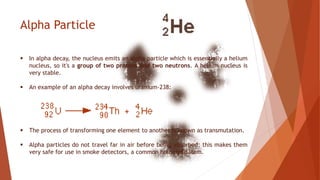
 In alpha decay, the nucleus emits an alpha particle which is essentially a helium
nucleus, so it's a group of two protons and two neutrons. A helium nucleus is
very stable.
 An example of an alpha decay involves uranium-238:
 The process of transforming one element to another is known as transmutation.
 Alpha particles do not travel far in air before being absorbed; this makes them
very safe for use in smoke detectors, a common household item.
Beta Particle
 A beta particle is often an electron, but can also be a positron, a positively-
charged particle that is the anti-matter equivalent of the electron.
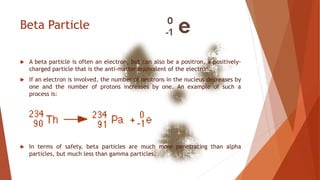
 If an electron is involved, the number of neutrons in the nucleus decreases by
one and the number of protons increases by one. An example of such a
process is:
 In terms of safety, beta particles are much more penetrating than alpha
particles, but much less than gamma particles.
Gamma particle
 Gamma rays is electromagnetic radiation similar to light.
 Gamma decay does not change the mass or charge of the atom from which it
originates.
 Gamma is often emitted along with alpha or beta particle ejection.
 Gamma radiation can be stopped by LEAD.
X - Rays
 X-radiation (composed of X-rays) is a form of electromagnetic radiation.
 Most X-rays have a wavelength ranging from 0.01 to 10 nanometer,
corresponding to frequencies in the range 3×10¹⁶ Hz to 3×10¹⁹ Hz and
energies in the range 100 eV to 100 keV.
 X-ray wavelengths are shorter than those of UV rays and typically longer
than those of gamma rays.
 There is no universal consensus for a definition distinguishing between X-rays
and gamma rays.
 One common practice is to distinguish between the two types of radiation
based on their source: X-rays are emitted by electrons, while gamma rays
are emitted by the atomic nucleus.
Ionizing radiation hazard symbol
 X-ray photons carry enough energy to ionize atoms and disrupt molecular
bonds. This makes it a type of ionizing radiation, and therefore harmful to
living tissue.
 A very high radiation dose over a short amount of time causes radiation
sickness, while lower doses can give an increased risk of radiation-induced
cancer.
 In medical imaging this increased cancer risk is generally greatly outweighed
by the benefits of the examination.
Medical Uses
 The ionizing capability of X-rays can be utilized in cancer treatment to kill
malignant cells using radiation therapy. It is also used for material
characterization using X-ray spectroscopy.
 Hard X-rays can traverse relatively thick objects without being much absorbed
or scattered.
 Radiotherapy
 The use of X-rays as a treatment is known as radiation therapy and is
largely used for the management of cancer; it requires higher radiation
doses than those received for imaging alone.
 X-rays beams are used for treating skin cancers using lower energy x-ray
beams while higher energy beams are used for treating cancers within the
body such as brain, lung, prostate and breast.
Thank You

Ionizing Radiation

  • 1.
    A Presentation by: DeepShah Ionizing radiation Subject: Environment & Disaster Management
  • 2.
    What is Radiation? Energy emitted from a source is generally referred to as radiation.  Examples include  Heat or light from the sun  Microwaves from an oven  X rays from an X-ray tube  Gamma rays from radioactive elements
  • 3.
    Ionizing Radiation  Ionizingradiation is radiation with enough energy so that during an interaction with an atom, it can remove tightly bound electrons from the orbit of an atom, causing the atom to become charged or ionized.  Here we are concerned with only one type of radiation, ionizing radiation, which occurs in two forms - waves or particles.  Here are forms of electromagnetic radiation. These differ only in frequency and wave length.  Heat waves  Radio-waves  Infrared light  Visible light  Ultraviolet light  X rays  Gamma rays
  • 4.
    Radioactive Decay  Manynuclei are radioactive. This means they are unstable, and will eventually decay by emitting a particle, transforming the nucleus into another nucleus, or into a lower energy state. A chain of decays takes place until a stable nucleus is reached.  particle decay refers to the transformation of a fundamental particle into other fundamental particles. This type of decay is strange, because the end products are not pieces of the starting particle, but totally new particles.
  • 5.
    Decay particle  Thereare three common types of radioactive decay,  Alpha  Beta  Gamma  The difference between them is the particle emitted by the nucleus during the decay process.
  • 6.
    Alpha Particle  Inalpha decay, the nucleus emits an alpha particle which is essentially a helium nucleus, so it's a group of two protons and two neutrons. A helium nucleus is very stable.  An example of an alpha decay involves uranium-238:  The process of transforming one element to another is known as transmutation.  Alpha particles do not travel far in air before being absorbed; this makes them very safe for use in smoke detectors, a common household item.
  • 7.
    Beta Particle  Abeta particle is often an electron, but can also be a positron, a positively- charged particle that is the anti-matter equivalent of the electron.  If an electron is involved, the number of neutrons in the nucleus decreases by one and the number of protons increases by one. An example of such a process is:  In terms of safety, beta particles are much more penetrating than alpha particles, but much less than gamma particles.
  • 8.
    Gamma particle  Gammarays is electromagnetic radiation similar to light.  Gamma decay does not change the mass or charge of the atom from which it originates.  Gamma is often emitted along with alpha or beta particle ejection.  Gamma radiation can be stopped by LEAD.
  • 9.
    X - Rays X-radiation (composed of X-rays) is a form of electromagnetic radiation.  Most X-rays have a wavelength ranging from 0.01 to 10 nanometer, corresponding to frequencies in the range 3×10¹⁶ Hz to 3×10¹⁹ Hz and energies in the range 100 eV to 100 keV.  X-ray wavelengths are shorter than those of UV rays and typically longer than those of gamma rays.  There is no universal consensus for a definition distinguishing between X-rays and gamma rays.  One common practice is to distinguish between the two types of radiation based on their source: X-rays are emitted by electrons, while gamma rays are emitted by the atomic nucleus.
  • 10.
    Ionizing radiation hazardsymbol  X-ray photons carry enough energy to ionize atoms and disrupt molecular bonds. This makes it a type of ionizing radiation, and therefore harmful to living tissue.  A very high radiation dose over a short amount of time causes radiation sickness, while lower doses can give an increased risk of radiation-induced cancer.  In medical imaging this increased cancer risk is generally greatly outweighed by the benefits of the examination.
  • 11.
    Medical Uses  Theionizing capability of X-rays can be utilized in cancer treatment to kill malignant cells using radiation therapy. It is also used for material characterization using X-ray spectroscopy.  Hard X-rays can traverse relatively thick objects without being much absorbed or scattered.  Radiotherapy  The use of X-rays as a treatment is known as radiation therapy and is largely used for the management of cancer; it requires higher radiation doses than those received for imaging alone.  X-rays beams are used for treating skin cancers using lower energy x-ray beams while higher energy beams are used for treating cancers within the body such as brain, lung, prostate and breast.
  • 12.