Gazi Zahirul Islam, Assistant Professor, Department of CSE, Daffodil International University, Dhaka
1
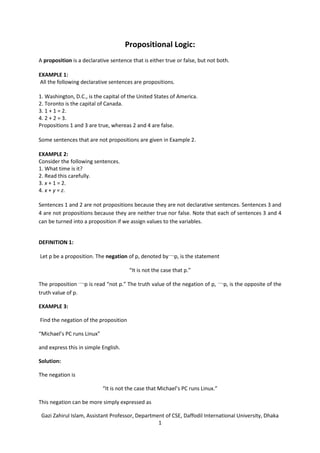
Propositional Logic:
A proposition is a declarative sentence that is either true or false, but not both.
EXAMPLE 1:
All the following declarative sentences are propositions.
1. Washington, D.C., is the capital of the United States of America.
2. Toronto is the capital of Canada.
3. 1 + 1 = 2.
4. 2 + 2 = 3.
Propositions 1 and 3 are true, whereas 2 and 4 are false.
Some sentences that are not propositions are given in Example 2.
EXAMPLE 2:
Consider the following sentences.
1. What time is it?
2. Read this carefully.
3. x + 1 = 2.
4. x + y = z.
Sentences 1 and 2 are not propositions because they are not declarative sentences. Sentences 3 and
4 are not propositions because they are neither true nor false. Note that each of sentences 3 and 4
can be turned into a proposition if we assign values to the variables.
DEFINITION 1:
Let p be a proposition. The negation of p, denoted by¬p, is the statement
“It is not the case that p.”
The proposition ¬p is read “not p.” The truth value of the negation of p, ¬p, is the opposite of the
truth value of p.
EXAMPLE 3:
Find the negation of the proposition
“Michael’s PC runs Linux”
and express this in simple English.
Solution:
The negation is
“It is not the case that Michael’s PC runs Linux.”
This negation can be more simply expressed as
Gazi Zahirul Islam, Assistant Professor, Department of CSE, Daffodil International University, Dhaka
2
“Michael’s PC does not run Linux.”
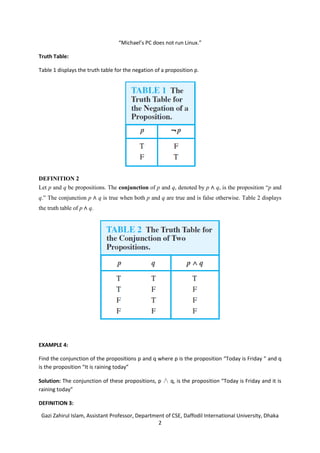
Truth Table:
Table 1 displays the truth table for the negation of a proposition p.
DEFINITION 2
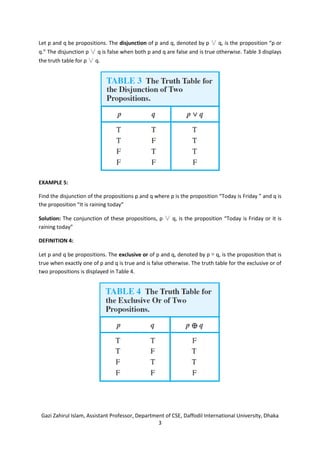
Let p and q be propositions. The conjunction of p and q, denoted by p ∧ q, is the proposition “p and
q.” The conjunction p ∧ q is true when both p and q are true and is false otherwise. Table 2 displays
the truth table of p ∧ q.
EXAMPLE 4:
Find the conjunction of the propositions p and q where p is the proposition “Today is Friday ” and q
is the proposition “It is raining today”
Solution: The conjunction of these propositions, p ∧ q, is the proposition “Today is Friday and it is
raining today”
DEFINITION 3:
Gazi Zahirul Islam, Assistant Professor, Department of CSE, Daffodil International University, Dhaka
3
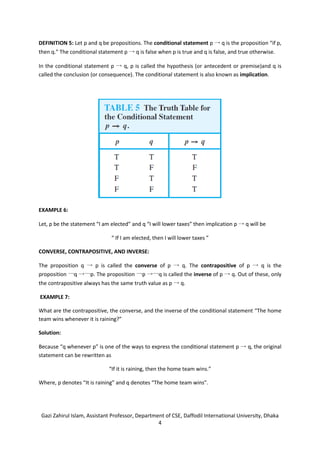
Let p and q be propositions. The disjunction of p and q, denoted by p ∨ q, is the proposition “p or
q.” The disjunction p ∨ q is false when both p and q are false and is true otherwise. Table 3 displays
the truth table for p ∨ q.
EXAMPLE 5:
Find the disjunction of the propositions p and q where p is the proposition “Today is Friday ” and q is
the proposition “It is raining today”
Solution: The conjunction of these propositions, p ∨ q, is the proposition “Today is Friday or it is
raining today”
DEFINITION 4:
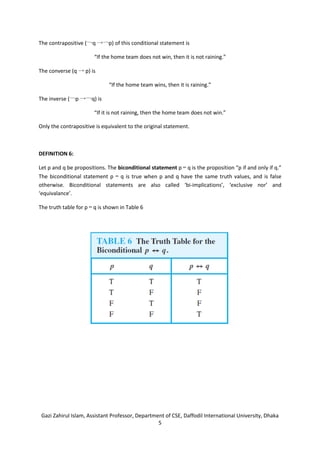
Let p and q be propositions. The exclusive or of p and q, denoted by p ⊕ q, is the proposition that is
true when exactly one of p and q is true and is false otherwise. The truth table for the exclusive or of
two propositions is displayed in Table 4.
Gazi Zahirul Islam, Assistant Professor, Department of CSE, Daffodil International University, Dhaka
4
DEFINITION 5: Let p and q be propositions. The conditional statement p → q is the proposition “if p,
then q.” The conditional statement p → q is false when p is true and q is false, and true otherwise.
In the conditional statement p → q, p is called the hypothesis (or antecedent or premise)and q is
called the conclusion (or consequence). The conditional statement is also known as implication.
EXAMPLE 6:
Let, p be the statement “I am elected” and q “I will lower taxes” then implication p → q will be
“ If I am elected, then I will lower taxes ”
CONVERSE, CONTRAPOSITIVE, AND INVERSE:
The proposition q → p is called the converse of p → q. The contrapositive of p → q is the
proposition ¬q →¬p. The proposition ¬p →¬q is called the inverse of p → q. Out of these, only
the contrapositive always has the same truth value as p → q.
EXAMPLE 7:
What are the contrapositive, the converse, and the inverse of the conditional statement “The home
team wins whenever it is raining?”
Solution:
Because “q whenever p” is one of the ways to express the conditional statement p → q, the original
statement can be rewritten as
“If it is raining, then the home team wins.”
Where, p denotes “It is raining” and q denotes “The home team wins”.
Gazi Zahirul Islam, Assistant Professor, Department of CSE, Daffodil International University, Dhaka
5
The contrapositive (¬q →¬p) of this conditional statement is
“If the home team does not win, then it is not raining.”
The converse (q → p) is
“If the home team wins, then it is raining.”
The inverse (¬p →¬q) is
“If it is not raining, then the home team does not win.”
Only the contrapositive is equivalent to the original statement.
DEFINITION 6:
Let p and q be propositions. The biconditional statement p ↔ q is the proposition “p if and only if q.”
The biconditional statement p ↔ q is true when p and q have the same truth values, and is false
otherwise. Biconditional statements are also called ‘bi-implications’, ‘exclusive nor’ and
‘equivalance’.
The truth table for p ↔ q is shown in Table 6
Gazi Zahirul Islam, Assistant Professor, Department of CSE, Daffodil International University, Dhaka
6
Propositional Equivalences
DEFINITION 1: A compound proposition that is always true is called a tautology. A compound
proposition that is always false is called a contradiction. A compound proposition that is neither a
tautology nor a contradiction is called a contingency.
Example 1 illustrates these types of compound propositions.
EXAMPLE 1:
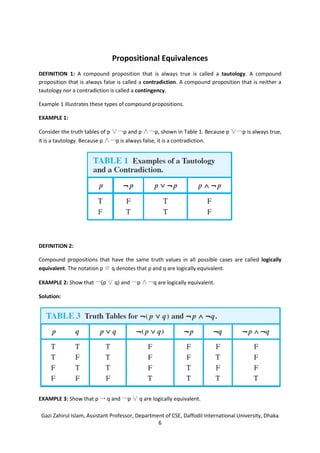
Consider the truth tables of p ∨¬p and p ∧¬p, shown in Table 1. Because p ∨¬p is always true,
it is a tautology. Because p ∧¬p is always false, it is a contradiction.
DEFINITION 2:
Compound propositions that have the same truth values in all possible cases are called logically
equivalent. The notation p ≡ q denotes that p and q are logically equivalent.
EXAMPLE 2: Show that ¬(p ∨ q) and ¬p ∧¬q are logically equivalent.
Solution:
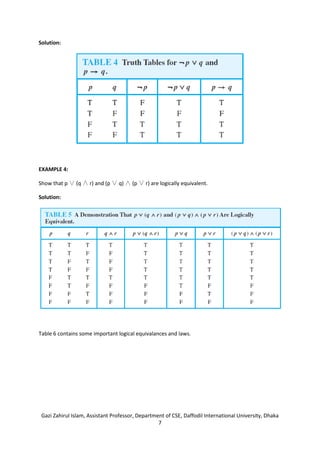
EXAMPLE 3: Show that p → q and ¬p ∨ q are logically equivalent.
Gazi Zahirul Islam, Assistant Professor, Department of CSE, Daffodil International University, Dhaka
7
Solution:
EXAMPLE 4:
Show that p ∨ (q ∧ r) and (p ∨ q) ∧ (p ∨ r) are logically equivalent.
Solution:
Table 6 contains some important logical equivalances and laws.
Gazi Zahirul Islam, Assistant Professor, Department of CSE, Daffodil International University, Dhaka
8
EXAMPLE 5: Show that ¬(p ∨ (¬p ∧ q)) and ¬p ∧¬q are logically equivalent by developing a
series of logical equivalences.
Solution:
¬(p ∨ (¬p ∧ q))
≡ ¬p ∧¬(¬p ∧ q) by the second De Morgan law
≡ ¬p ∧ [¬(¬p)∨¬q] by the first De Morgan law
≡ ¬p ∧ (p ∨¬q) by the double negation law
≡ (¬p ∧ p) ∨ (¬p ∧¬q) by the second distributive law
Gazi Zahirul Islam, Assistant Professor, Department of CSE, Daffodil International University, Dhaka
9
≡ F ∨ (¬p ∧¬q) because ¬p ∧ p ≡ F
≡ (¬p ∧¬q) ∨ F by the commutative law for disjunction
≡ ¬p ∧¬q by the identity law for F
Consequently ¬(p ∨ (¬p ∧ q)) and ¬p ∧¬q are logically equivalent.
EXAMPLE 6:
Show that (p ∧ q) → (p ∨ q) is a tautology.
Solution:
(p ∧ q) → (p ∨ q)
≡ ¬(p ∧ q) ∨ (p ∨ q)
≡ (¬p ∨¬q) ∨ (p ∨ q) by the first De Morgan law
≡ (¬p ∨ p) ∨ (¬q ∨ q) by the associative and commutative laws for disjunction
≡ T ∨ T by the commutative law for disjunction
≡ T by the domination law
Gazi Zahirul Islam, Assistant Professor, Department of CSE, Daffodil International University, Dhaka
10
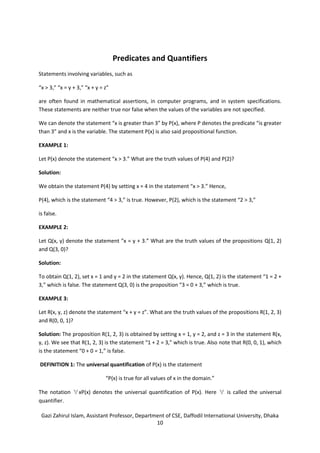
Predicates and Quantifiers
Statements involving variables, such as
“x > 3,” “x = y + 3,” “x + y = z”
are often found in mathematical assertions, in computer programs, and in system specifications.
These statements are neither true nor false when the values of the variables are not specified.
We can denote the statement “x is greater than 3” by P(x), where P denotes the predicate “is greater
than 3” and x is the variable. The statement P(x) is also said propositional function.
EXAMPLE 1:
Let P(x) denote the statement “x > 3.” What are the truth values of P(4) and P(2)?
Solution:
We obtain the statement P(4) by setting x = 4 in the statement “x > 3.” Hence,
P(4), which is the statement “4 > 3,” is true. However, P(2), which is the statement “2 > 3,”
is false.
EXAMPLE 2:
Let Q(x, y) denote the statement “x = y + 3.” What are the truth values of the propositions Q(1, 2)
and Q(3, 0)?
Solution:
To obtain Q(1, 2), set x = 1 and y = 2 in the statement Q(x, y). Hence, Q(1, 2) is the statement “1 = 2 +
3,” which is false. The statement Q(3, 0) is the proposition “3 = 0 + 3,” which is true.
EXAMPLE 3:
Let R(x, y, z) denote the statement “x + y = z”. What are the truth values of the propositions R(1, 2, 3)
and R(0, 0, 1)?
Solution: The proposition R(1, 2, 3) is obtained by setting x = 1, y = 2, and z = 3 in the statement R(x,
y, z). We see that R(1, 2, 3) is the statement “1 + 2 = 3,” which is true. Also note that R(0, 0, 1), which
is the statement “0 + 0 = 1,” is false.
DEFINITION 1: The universal quantification of P(x) is the statement
“P(x) is true for all values of x in the domain.”
The notation ∀xP(x) denotes the universal quantification of P(x). Here ∀ is called the universal
quantifier.
Gazi Zahirul Islam, Assistant Professor, Department of CSE, Daffodil International University, Dhaka
11
EXAMPLE 4: Let P(x) be the statement “x + 1 > x.” What is the truth value of the quantification
∀xP(x), where the universe of discourse (domain)consists of all real numbers?
Solution: Because P(x) is true for all real numbers x, the quantification
∀xP(x)
is true.
EXAMPLE 5:
Let Q(x) be the statement “x < 2.” What is the truth value of the quantification ∀xQ(x), where the
domain consists of all real numbers?
Solution:
Q(x) is not true for every real number x, because, for instance, Q(3) is false. Thus
∀xQ(x)
is false.
EXAMPLE 6: What is the truth value of ∀xP(x), where P(x) is the statement “x2
< 10” and the
universe of discourse consists of the positive integers not exceeding 4?
Solution:
Since P(4), which is the statement “42
< 10,” is false,
it follows that ∀xP(x) is false.
EXAMPLE 7:
What is the truth value of ∀x(x2
≥ x) if the domain consists of all real numbers? What is the truth
value of this statement if the domain consists of all integers?
Solution:
The universal quantification ∀x(x2
≥ x) is false, where the domain consists of all real numbers. For
example,
Consequently, x2
≥ x if and only if x ≤ 0 or x ≥ 1. Therefore, if the domain consists of the integers,
∀x(x2
≥ x) is true, because there are no integers x with 0 < x < 1.
DEFINITION 2:
The existential quantification of P(x) is the proposition
“There exists an element x in the universe of discourse such that P(x) is true.”
Gazi Zahirul Islam, Assistant Professor, Department of CSE, Daffodil International University, Dhaka
12
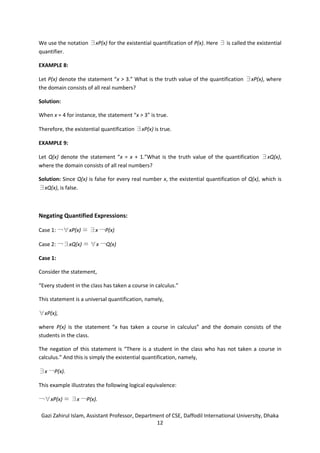
We use the notation ∃xP(x) for the existential quantification of P(x). Here ∃ is called the existential
quantifier.
EXAMPLE 8:
Let P(x) denote the statement “x > 3.” What is the truth value of the quantification ∃xP(x), where
the domain consists of all real numbers?
Solution:
When x = 4 for instance, the statement “x > 3” is true.
Therefore, the existential quantification ∃xP(x) is true.
EXAMPLE 9:
Let Q(x) denote the statement “x = x + 1.”What is the truth value of the quantification ∃xQ(x),
where the domain consists of all real numbers?
Solution: Since Q(x) is false for every real number x, the existential quantification of Q(x), which is
∃xQ(x), is false.
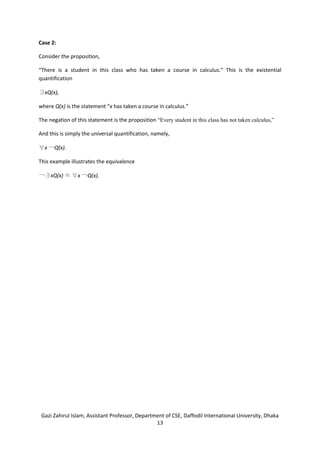
Negating Quantified Expressions:
Case 1: ¬∀xP(x) ≡ ∃x ¬P(x)
Case 2: ¬∃xQ(x) ≡ ∀x ¬Q(x)
Case 1:
Consider the statement,
“Every student in the class has taken a course in calculus.”
This statement is a universal quantification, namely,
∀xP(x),
where P(x) is the statement “x has taken a course in calculus” and the domain consists of the
students in the class.
The negation of this statement is “There is a student in the class who has not taken a course in
calculus.” And this is simply the existential quantification, namely,
∃x ¬P(x).
This example illustrates the following logical equivalence:
¬∀xP(x) ≡ ∃x ¬P(x).
Gazi Zahirul Islam, Assistant Professor, Department of CSE, Daffodil International University, Dhaka
13
Case 2:
Consider the proposition,
“There is a student in this class who has taken a course in calculus.” This is the existential
quantification
∃xQ(x),
where Q(x) is the statement “x has taken a course in calculus.”
The negation of this statement is the proposition “Every student in this class has not taken calculus,”
And this is simply the universal quantification, namely,
∀x ¬Q(x).
This example illustrates the equivalence
¬∃xQ(x) ≡ ∀x ¬Q(x).

Propositional logic

  • 1.
    Gazi Zahirul Islam,Assistant Professor, Department of CSE, Daffodil International University, Dhaka 1 Propositional Logic: A proposition is a declarative sentence that is either true or false, but not both. EXAMPLE 1: All the following declarative sentences are propositions. 1. Washington, D.C., is the capital of the United States of America. 2. Toronto is the capital of Canada. 3. 1 + 1 = 2. 4. 2 + 2 = 3. Propositions 1 and 3 are true, whereas 2 and 4 are false. Some sentences that are not propositions are given in Example 2. EXAMPLE 2: Consider the following sentences. 1. What time is it? 2. Read this carefully. 3. x + 1 = 2. 4. x + y = z. Sentences 1 and 2 are not propositions because they are not declarative sentences. Sentences 3 and 4 are not propositions because they are neither true nor false. Note that each of sentences 3 and 4 can be turned into a proposition if we assign values to the variables. DEFINITION 1: Let p be a proposition. The negation of p, denoted by¬p, is the statement “It is not the case that p.” The proposition ¬p is read “not p.” The truth value of the negation of p, ¬p, is the opposite of the truth value of p. EXAMPLE 3: Find the negation of the proposition “Michael’s PC runs Linux” and express this in simple English. Solution: The negation is “It is not the case that Michael’s PC runs Linux.” This negation can be more simply expressed as
  • 2.
    Gazi Zahirul Islam,Assistant Professor, Department of CSE, Daffodil International University, Dhaka 2 “Michael’s PC does not run Linux.” Truth Table: Table 1 displays the truth table for the negation of a proposition p. DEFINITION 2 Let p and q be propositions. The conjunction of p and q, denoted by p ∧ q, is the proposition “p and q.” The conjunction p ∧ q is true when both p and q are true and is false otherwise. Table 2 displays the truth table of p ∧ q. EXAMPLE 4: Find the conjunction of the propositions p and q where p is the proposition “Today is Friday ” and q is the proposition “It is raining today” Solution: The conjunction of these propositions, p ∧ q, is the proposition “Today is Friday and it is raining today” DEFINITION 3:
  • 3.
    Gazi Zahirul Islam,Assistant Professor, Department of CSE, Daffodil International University, Dhaka 3 Let p and q be propositions. The disjunction of p and q, denoted by p ∨ q, is the proposition “p or q.” The disjunction p ∨ q is false when both p and q are false and is true otherwise. Table 3 displays the truth table for p ∨ q. EXAMPLE 5: Find the disjunction of the propositions p and q where p is the proposition “Today is Friday ” and q is the proposition “It is raining today” Solution: The conjunction of these propositions, p ∨ q, is the proposition “Today is Friday or it is raining today” DEFINITION 4: Let p and q be propositions. The exclusive or of p and q, denoted by p ⊕ q, is the proposition that is true when exactly one of p and q is true and is false otherwise. The truth table for the exclusive or of two propositions is displayed in Table 4.
  • 4.
    Gazi Zahirul Islam,Assistant Professor, Department of CSE, Daffodil International University, Dhaka 4 DEFINITION 5: Let p and q be propositions. The conditional statement p → q is the proposition “if p, then q.” The conditional statement p → q is false when p is true and q is false, and true otherwise. In the conditional statement p → q, p is called the hypothesis (or antecedent or premise)and q is called the conclusion (or consequence). The conditional statement is also known as implication. EXAMPLE 6: Let, p be the statement “I am elected” and q “I will lower taxes” then implication p → q will be “ If I am elected, then I will lower taxes ” CONVERSE, CONTRAPOSITIVE, AND INVERSE: The proposition q → p is called the converse of p → q. The contrapositive of p → q is the proposition ¬q →¬p. The proposition ¬p →¬q is called the inverse of p → q. Out of these, only the contrapositive always has the same truth value as p → q. EXAMPLE 7: What are the contrapositive, the converse, and the inverse of the conditional statement “The home team wins whenever it is raining?” Solution: Because “q whenever p” is one of the ways to express the conditional statement p → q, the original statement can be rewritten as “If it is raining, then the home team wins.” Where, p denotes “It is raining” and q denotes “The home team wins”.
  • 5.
    Gazi Zahirul Islam,Assistant Professor, Department of CSE, Daffodil International University, Dhaka 5 The contrapositive (¬q →¬p) of this conditional statement is “If the home team does not win, then it is not raining.” The converse (q → p) is “If the home team wins, then it is raining.” The inverse (¬p →¬q) is “If it is not raining, then the home team does not win.” Only the contrapositive is equivalent to the original statement. DEFINITION 6: Let p and q be propositions. The biconditional statement p ↔ q is the proposition “p if and only if q.” The biconditional statement p ↔ q is true when p and q have the same truth values, and is false otherwise. Biconditional statements are also called ‘bi-implications’, ‘exclusive nor’ and ‘equivalance’. The truth table for p ↔ q is shown in Table 6
  • 6.
    Gazi Zahirul Islam,Assistant Professor, Department of CSE, Daffodil International University, Dhaka 6 Propositional Equivalences DEFINITION 1: A compound proposition that is always true is called a tautology. A compound proposition that is always false is called a contradiction. A compound proposition that is neither a tautology nor a contradiction is called a contingency. Example 1 illustrates these types of compound propositions. EXAMPLE 1: Consider the truth tables of p ∨¬p and p ∧¬p, shown in Table 1. Because p ∨¬p is always true, it is a tautology. Because p ∧¬p is always false, it is a contradiction. DEFINITION 2: Compound propositions that have the same truth values in all possible cases are called logically equivalent. The notation p ≡ q denotes that p and q are logically equivalent. EXAMPLE 2: Show that ¬(p ∨ q) and ¬p ∧¬q are logically equivalent. Solution: EXAMPLE 3: Show that p → q and ¬p ∨ q are logically equivalent.
  • 7.
    Gazi Zahirul Islam,Assistant Professor, Department of CSE, Daffodil International University, Dhaka 7 Solution: EXAMPLE 4: Show that p ∨ (q ∧ r) and (p ∨ q) ∧ (p ∨ r) are logically equivalent. Solution: Table 6 contains some important logical equivalances and laws.
  • 8.
    Gazi Zahirul Islam,Assistant Professor, Department of CSE, Daffodil International University, Dhaka 8 EXAMPLE 5: Show that ¬(p ∨ (¬p ∧ q)) and ¬p ∧¬q are logically equivalent by developing a series of logical equivalences. Solution: ¬(p ∨ (¬p ∧ q)) ≡ ¬p ∧¬(¬p ∧ q) by the second De Morgan law ≡ ¬p ∧ [¬(¬p)∨¬q] by the first De Morgan law ≡ ¬p ∧ (p ∨¬q) by the double negation law ≡ (¬p ∧ p) ∨ (¬p ∧¬q) by the second distributive law
  • 9.
    Gazi Zahirul Islam,Assistant Professor, Department of CSE, Daffodil International University, Dhaka 9 ≡ F ∨ (¬p ∧¬q) because ¬p ∧ p ≡ F ≡ (¬p ∧¬q) ∨ F by the commutative law for disjunction ≡ ¬p ∧¬q by the identity law for F Consequently ¬(p ∨ (¬p ∧ q)) and ¬p ∧¬q are logically equivalent. EXAMPLE 6: Show that (p ∧ q) → (p ∨ q) is a tautology. Solution: (p ∧ q) → (p ∨ q) ≡ ¬(p ∧ q) ∨ (p ∨ q) ≡ (¬p ∨¬q) ∨ (p ∨ q) by the first De Morgan law ≡ (¬p ∨ p) ∨ (¬q ∨ q) by the associative and commutative laws for disjunction ≡ T ∨ T by the commutative law for disjunction ≡ T by the domination law
  • 10.
    Gazi Zahirul Islam,Assistant Professor, Department of CSE, Daffodil International University, Dhaka 10 Predicates and Quantifiers Statements involving variables, such as “x > 3,” “x = y + 3,” “x + y = z” are often found in mathematical assertions, in computer programs, and in system specifications. These statements are neither true nor false when the values of the variables are not specified. We can denote the statement “x is greater than 3” by P(x), where P denotes the predicate “is greater than 3” and x is the variable. The statement P(x) is also said propositional function. EXAMPLE 1: Let P(x) denote the statement “x > 3.” What are the truth values of P(4) and P(2)? Solution: We obtain the statement P(4) by setting x = 4 in the statement “x > 3.” Hence, P(4), which is the statement “4 > 3,” is true. However, P(2), which is the statement “2 > 3,” is false. EXAMPLE 2: Let Q(x, y) denote the statement “x = y + 3.” What are the truth values of the propositions Q(1, 2) and Q(3, 0)? Solution: To obtain Q(1, 2), set x = 1 and y = 2 in the statement Q(x, y). Hence, Q(1, 2) is the statement “1 = 2 + 3,” which is false. The statement Q(3, 0) is the proposition “3 = 0 + 3,” which is true. EXAMPLE 3: Let R(x, y, z) denote the statement “x + y = z”. What are the truth values of the propositions R(1, 2, 3) and R(0, 0, 1)? Solution: The proposition R(1, 2, 3) is obtained by setting x = 1, y = 2, and z = 3 in the statement R(x, y, z). We see that R(1, 2, 3) is the statement “1 + 2 = 3,” which is true. Also note that R(0, 0, 1), which is the statement “0 + 0 = 1,” is false. DEFINITION 1: The universal quantification of P(x) is the statement “P(x) is true for all values of x in the domain.” The notation ∀xP(x) denotes the universal quantification of P(x). Here ∀ is called the universal quantifier.
  • 11.
    Gazi Zahirul Islam,Assistant Professor, Department of CSE, Daffodil International University, Dhaka 11 EXAMPLE 4: Let P(x) be the statement “x + 1 > x.” What is the truth value of the quantification ∀xP(x), where the universe of discourse (domain)consists of all real numbers? Solution: Because P(x) is true for all real numbers x, the quantification ∀xP(x) is true. EXAMPLE 5: Let Q(x) be the statement “x < 2.” What is the truth value of the quantification ∀xQ(x), where the domain consists of all real numbers? Solution: Q(x) is not true for every real number x, because, for instance, Q(3) is false. Thus ∀xQ(x) is false. EXAMPLE 6: What is the truth value of ∀xP(x), where P(x) is the statement “x2 < 10” and the universe of discourse consists of the positive integers not exceeding 4? Solution: Since P(4), which is the statement “42 < 10,” is false, it follows that ∀xP(x) is false. EXAMPLE 7: What is the truth value of ∀x(x2 ≥ x) if the domain consists of all real numbers? What is the truth value of this statement if the domain consists of all integers? Solution: The universal quantification ∀x(x2 ≥ x) is false, where the domain consists of all real numbers. For example, Consequently, x2 ≥ x if and only if x ≤ 0 or x ≥ 1. Therefore, if the domain consists of the integers, ∀x(x2 ≥ x) is true, because there are no integers x with 0 < x < 1. DEFINITION 2: The existential quantification of P(x) is the proposition “There exists an element x in the universe of discourse such that P(x) is true.”
  • 12.
    Gazi Zahirul Islam,Assistant Professor, Department of CSE, Daffodil International University, Dhaka 12 We use the notation ∃xP(x) for the existential quantification of P(x). Here ∃ is called the existential quantifier. EXAMPLE 8: Let P(x) denote the statement “x > 3.” What is the truth value of the quantification ∃xP(x), where the domain consists of all real numbers? Solution: When x = 4 for instance, the statement “x > 3” is true. Therefore, the existential quantification ∃xP(x) is true. EXAMPLE 9: Let Q(x) denote the statement “x = x + 1.”What is the truth value of the quantification ∃xQ(x), where the domain consists of all real numbers? Solution: Since Q(x) is false for every real number x, the existential quantification of Q(x), which is ∃xQ(x), is false. Negating Quantified Expressions: Case 1: ¬∀xP(x) ≡ ∃x ¬P(x) Case 2: ¬∃xQ(x) ≡ ∀x ¬Q(x) Case 1: Consider the statement, “Every student in the class has taken a course in calculus.” This statement is a universal quantification, namely, ∀xP(x), where P(x) is the statement “x has taken a course in calculus” and the domain consists of the students in the class. The negation of this statement is “There is a student in the class who has not taken a course in calculus.” And this is simply the existential quantification, namely, ∃x ¬P(x). This example illustrates the following logical equivalence: ¬∀xP(x) ≡ ∃x ¬P(x).
  • 13.
    Gazi Zahirul Islam,Assistant Professor, Department of CSE, Daffodil International University, Dhaka 13 Case 2: Consider the proposition, “There is a student in this class who has taken a course in calculus.” This is the existential quantification ∃xQ(x), where Q(x) is the statement “x has taken a course in calculus.” The negation of this statement is the proposition “Every student in this class has not taken calculus,” And this is simply the universal quantification, namely, ∀x ¬Q(x). This example illustrates the equivalence ¬∃xQ(x) ≡ ∀x ¬Q(x).