
McGraw-Hill ©The McGraw-Hill Companies, Inc., 2004
SONET
McGraw-Hill ©The McGraw-Hill Companies, Inc., 2004
TopicsTopics
SONET Devices
SONET Frame
Frame Transmission
Synchronous Transport Signals
STS-1
Virtual Tributaries
Higher-Rate Service
McGraw-Hill ©The McGraw-Hill Companies, Inc., 2004
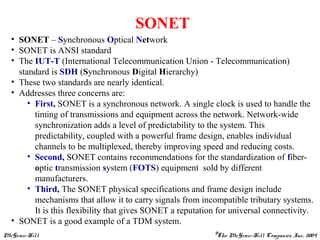
SONET
• SONET – Synchronous Optical Network
• SONET is ANSI standard
• The IUT-T (International Telecommunication Union - Telecommunication)
standard is SDH (Synchronous Digital Hierarchy)
• These two standards are nearly identical.
• Addresses three concerns are:
• First, SONET is a synchronous network. A single clock is used to handle the
timing of transmissions and equipment across the network. Network-wide
synchronization adds a level of predictability to the system. This
predictability, coupled with a powerful frame design, enables individual
channels to be multiplexed, thereby improving speed and reducing costs.
• Second, SONET contains recommendations for the standardization of fiber-
optic transmission system (FOTS) equipment sold by different
manufacturers.
• Third, The SONET physical specifications and frame design include
mechanisms that allow it to carry signals from incompatible tributary systems.
It is this flexibility that gives SONET a reputation for universal connectivity.
• SONET is a good example of a TDM system.
McGraw-Hill ©The McGraw-Hill Companies, Inc., 2004
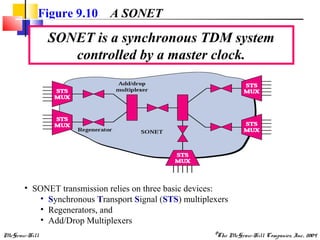
Figure 9.10 A SONET
• SONET transmission relies on three basic devices:
• Synchronous Transport Signal (STS) multiplexers
• Regenerators, and
• Add/Drop Multiplexers
SONET is a synchronous TDM system
controlled by a master clock.
McGraw-Hill ©The McGraw-Hill Companies, Inc., 2004
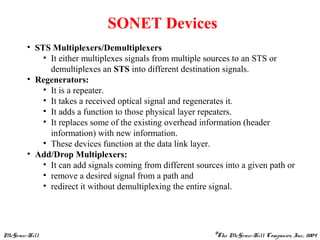
SONET Devices
• STS Multiplexers/Demultiplexers
• It either multiplexes signals from multiple sources to an STS or
demultiplexes an STS into different destination signals.
• Regenerators:
• It is a repeater.
• It takes a received optical signal and regenerates it.
• It adds a function to those physical layer repeaters.
• It replaces some of the existing overhead information (header
information) with new information.
• These devices function at the data link layer.
• Add/Drop Multiplexers:
• It can add signals coming from different sources into a given path or
• remove a desired signal from a path and
• redirect it without demultiplexing the entire signal.
McGraw-Hill ©The McGraw-Hill Companies, Inc., 2004
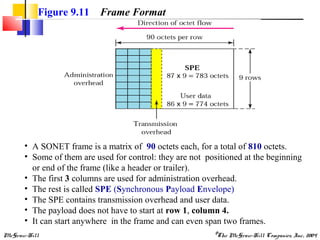
Figure 9.11 Frame Format
• A SONET frame is a matrix of 90 octets each, for a total of 810 octets.
• Some of them are used for control: they are not positioned at the beginning
or end of the frame (like a header or trailer).
• The first 3 columns are used for administration overhead.
• The rest is called SPE (Synchronous Payload Envelope)
• The SPE contains transmission overhead and user data.
• The payload does not have to start at row 1, column 4.
• It can start anywhere in the frame and can even span two frames.
McGraw-Hill ©The McGraw-Hill Companies, Inc., 2004
Frame Transmission and STS
• Frame Transmission
• SONET frames are transmitted one after another without any gap in
between, even if there are no real data.
• Empty frames carry dummy data.
• A sequence of frames looks like a sequence of bits.
• The first 2 bytes of each frame is called the alignment bytes define the
beginning of each frame.
• The 3rd
byte is the frame identification
• STS
• STS is Synchronous Transport Signal
• It defines a hierarchy of signaling levels.
• There are 9 levels and they are STS-1, STS-3, STS-9, STS-12, STS-18,
STS-24, STS-36, STS-48 and STS-192 .
• Each STS level supports a certain data rate, specified in Mbps.
• The physical links defined to carry each level of STS are called OCs
(Optical Carriers).
• OC levels describe the conceptual and physical specifications of the links
to support each level of signaling.
McGraw-Hill ©The McGraw-Hill Companies, Inc., 2004
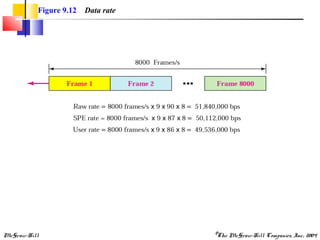
Figure 9.12 Data rate
McGraw-Hill ©The McGraw-Hill Companies, Inc., 2004
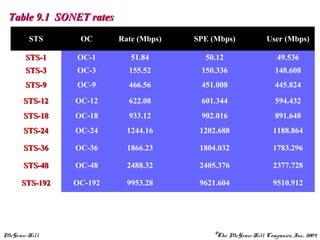
Table 9.1 SONET ratesTable 9.1 SONET rates
STS OC Rate (Mbps) SPE (Mbps) User (Mbps)
STS-1STS-1 OC-1 51.84 50.12 49.536
STS-3STS-3 OC-3 155.52 150.336 148.608
STS-9STS-9 OC-9 466.56 451.008 445.824
STS-12STS-12 OC-12 622.08 601.344 594.432
STS-18STS-18 OC-18 933.12 902.016 891.648
STS-24STS-24 OC-24 1244.16 1202.688 1188.864
STS-36STS-36 OC-36 1866.23 1804.032 1783.296
STS-48STS-48 OC-48 2488.32 2405.376 2377.728
STS-192STS-192 OC-192 9953.28 9621.604 9510.912
McGraw-Hill ©The McGraw-Hill Companies, Inc., 2004
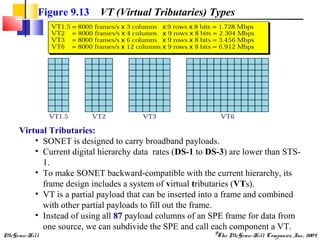
Figure 9.13 VT (Virtual Tributaries) Types
Virtual Tributaries:
• SONET is designed to carry broadband payloads.
• Current digital hierarchy data rates (DS-1 to DS-3) are lower than STS-
1.
• To make SONET backward-compatible with the current hierarchy, its
frame design includes a system of virtual tributaries (VTs).
• VT is a partial payload that can be inserted into a frame and combined
with other partial payloads to fill out the frame.
• Instead of using all 87 payload columns of an SPE frame for data from
one source, we can subdivide the SPE and call each component a VT.
McGraw-Hill ©The McGraw-Hill Companies, Inc., 2004
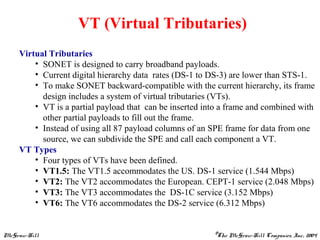
VT (Virtual Tributaries)
Virtual Tributaries
• SONET is designed to carry broadband payloads.
• Current digital hierarchy data rates (DS-1 to DS-3) are lower than STS-1.
• To make SONET backward-compatible with the current hierarchy, its frame
design includes a system of virtual tributaries (VTs).
• VT is a partial payload that can be inserted into a frame and combined with
other partial payloads to fill out the frame.
• Instead of using all 87 payload columns of an SPE frame for data from one
source, we can subdivide the SPE and call each component a VT.
VT Types
• Four types of VTs have been defined.
• VT1.5: The VT1.5 accommodates the US. DS-1 service (1.544 Mbps)
• VT2: The VT2 accommodates the European. CEPT-1 service (2.048 Mbps)
• VT3: The VT3 accommodates the DS-1C service (3.152 Mbps)
• VT6: The VT6 accommodates the DS-2 service (6.312 Mbps)
McGraw-Hill ©The McGraw-Hill Companies, Inc., 2004
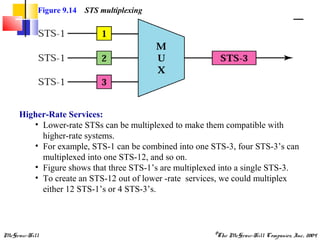
Figure 9.14 STS multiplexing
Higher-Rate Services:
• Lower-rate STSs can be multiplexed to make them compatible with
higher-rate systems.
• For example, STS-1 can be combined into one STS-3, four STS-3’s can
multiplexed into one STS-12, and so on.
• Figure shows that three STS-1’s are multiplexed into a single STS-3.
• To create an STS-12 out of lower -rate services, we could multiplex
either 12 STS-1’s or 4 STS-3’s.
McGraw-Hill ©The McGraw-Hill Companies, Inc., 2004
Quiz Contents
•SONET
•Addresses of the SONET Standard
•SONET Devices
•SONET Frame Format
•Frame Transmission and STS
•Data Rate
•SONET Rates
•VT and VT Types
•STS multiplexing

Sonet

  • 1.
    McGraw-Hill ©The McGraw-HillCompanies, Inc., 2004 SONET
  • 2.
    McGraw-Hill ©The McGraw-HillCompanies, Inc., 2004 TopicsTopics SONET Devices SONET Frame Frame Transmission Synchronous Transport Signals STS-1 Virtual Tributaries Higher-Rate Service
  • 3.
    McGraw-Hill ©The McGraw-HillCompanies, Inc., 2004 SONET • SONET – Synchronous Optical Network • SONET is ANSI standard • The IUT-T (International Telecommunication Union - Telecommunication) standard is SDH (Synchronous Digital Hierarchy) • These two standards are nearly identical. • Addresses three concerns are: • First, SONET is a synchronous network. A single clock is used to handle the timing of transmissions and equipment across the network. Network-wide synchronization adds a level of predictability to the system. This predictability, coupled with a powerful frame design, enables individual channels to be multiplexed, thereby improving speed and reducing costs. • Second, SONET contains recommendations for the standardization of fiber- optic transmission system (FOTS) equipment sold by different manufacturers. • Third, The SONET physical specifications and frame design include mechanisms that allow it to carry signals from incompatible tributary systems. It is this flexibility that gives SONET a reputation for universal connectivity. • SONET is a good example of a TDM system.
  • 4.
    McGraw-Hill ©The McGraw-HillCompanies, Inc., 2004 Figure 9.10 A SONET • SONET transmission relies on three basic devices: • Synchronous Transport Signal (STS) multiplexers • Regenerators, and • Add/Drop Multiplexers SONET is a synchronous TDM system controlled by a master clock.
  • 5.
    McGraw-Hill ©The McGraw-HillCompanies, Inc., 2004 SONET Devices • STS Multiplexers/Demultiplexers • It either multiplexes signals from multiple sources to an STS or demultiplexes an STS into different destination signals. • Regenerators: • It is a repeater. • It takes a received optical signal and regenerates it. • It adds a function to those physical layer repeaters. • It replaces some of the existing overhead information (header information) with new information. • These devices function at the data link layer. • Add/Drop Multiplexers: • It can add signals coming from different sources into a given path or • remove a desired signal from a path and • redirect it without demultiplexing the entire signal.
  • 6.
    McGraw-Hill ©The McGraw-HillCompanies, Inc., 2004 Figure 9.11 Frame Format • A SONET frame is a matrix of 90 octets each, for a total of 810 octets. • Some of them are used for control: they are not positioned at the beginning or end of the frame (like a header or trailer). • The first 3 columns are used for administration overhead. • The rest is called SPE (Synchronous Payload Envelope) • The SPE contains transmission overhead and user data. • The payload does not have to start at row 1, column 4. • It can start anywhere in the frame and can even span two frames.
  • 7.
    McGraw-Hill ©The McGraw-HillCompanies, Inc., 2004 Frame Transmission and STS • Frame Transmission • SONET frames are transmitted one after another without any gap in between, even if there are no real data. • Empty frames carry dummy data. • A sequence of frames looks like a sequence of bits. • The first 2 bytes of each frame is called the alignment bytes define the beginning of each frame. • The 3rd byte is the frame identification • STS • STS is Synchronous Transport Signal • It defines a hierarchy of signaling levels. • There are 9 levels and they are STS-1, STS-3, STS-9, STS-12, STS-18, STS-24, STS-36, STS-48 and STS-192 . • Each STS level supports a certain data rate, specified in Mbps. • The physical links defined to carry each level of STS are called OCs (Optical Carriers). • OC levels describe the conceptual and physical specifications of the links to support each level of signaling.
  • 8.
    McGraw-Hill ©The McGraw-HillCompanies, Inc., 2004 Figure 9.12 Data rate
  • 9.
    McGraw-Hill ©The McGraw-HillCompanies, Inc., 2004 Table 9.1 SONET ratesTable 9.1 SONET rates STS OC Rate (Mbps) SPE (Mbps) User (Mbps) STS-1STS-1 OC-1 51.84 50.12 49.536 STS-3STS-3 OC-3 155.52 150.336 148.608 STS-9STS-9 OC-9 466.56 451.008 445.824 STS-12STS-12 OC-12 622.08 601.344 594.432 STS-18STS-18 OC-18 933.12 902.016 891.648 STS-24STS-24 OC-24 1244.16 1202.688 1188.864 STS-36STS-36 OC-36 1866.23 1804.032 1783.296 STS-48STS-48 OC-48 2488.32 2405.376 2377.728 STS-192STS-192 OC-192 9953.28 9621.604 9510.912
  • 10.
    McGraw-Hill ©The McGraw-HillCompanies, Inc., 2004 Figure 9.13 VT (Virtual Tributaries) Types Virtual Tributaries: • SONET is designed to carry broadband payloads. • Current digital hierarchy data rates (DS-1 to DS-3) are lower than STS- 1. • To make SONET backward-compatible with the current hierarchy, its frame design includes a system of virtual tributaries (VTs). • VT is a partial payload that can be inserted into a frame and combined with other partial payloads to fill out the frame. • Instead of using all 87 payload columns of an SPE frame for data from one source, we can subdivide the SPE and call each component a VT.
  • 11.
    McGraw-Hill ©The McGraw-HillCompanies, Inc., 2004 VT (Virtual Tributaries) Virtual Tributaries • SONET is designed to carry broadband payloads. • Current digital hierarchy data rates (DS-1 to DS-3) are lower than STS-1. • To make SONET backward-compatible with the current hierarchy, its frame design includes a system of virtual tributaries (VTs). • VT is a partial payload that can be inserted into a frame and combined with other partial payloads to fill out the frame. • Instead of using all 87 payload columns of an SPE frame for data from one source, we can subdivide the SPE and call each component a VT. VT Types • Four types of VTs have been defined. • VT1.5: The VT1.5 accommodates the US. DS-1 service (1.544 Mbps) • VT2: The VT2 accommodates the European. CEPT-1 service (2.048 Mbps) • VT3: The VT3 accommodates the DS-1C service (3.152 Mbps) • VT6: The VT6 accommodates the DS-2 service (6.312 Mbps)
  • 12.
    McGraw-Hill ©The McGraw-HillCompanies, Inc., 2004 Figure 9.14 STS multiplexing Higher-Rate Services: • Lower-rate STSs can be multiplexed to make them compatible with higher-rate systems. • For example, STS-1 can be combined into one STS-3, four STS-3’s can multiplexed into one STS-12, and so on. • Figure shows that three STS-1’s are multiplexed into a single STS-3. • To create an STS-12 out of lower -rate services, we could multiplex either 12 STS-1’s or 4 STS-3’s.
  • 13.
    McGraw-Hill ©The McGraw-HillCompanies, Inc., 2004 Quiz Contents •SONET •Addresses of the SONET Standard •SONET Devices •SONET Frame Format •Frame Transmission and STS •Data Rate •SONET Rates •VT and VT Types •STS multiplexing