Nuclear Chemistry and
 Radioactive Decay
     By Christa Ross
     OECS 110 A70
      Final Project
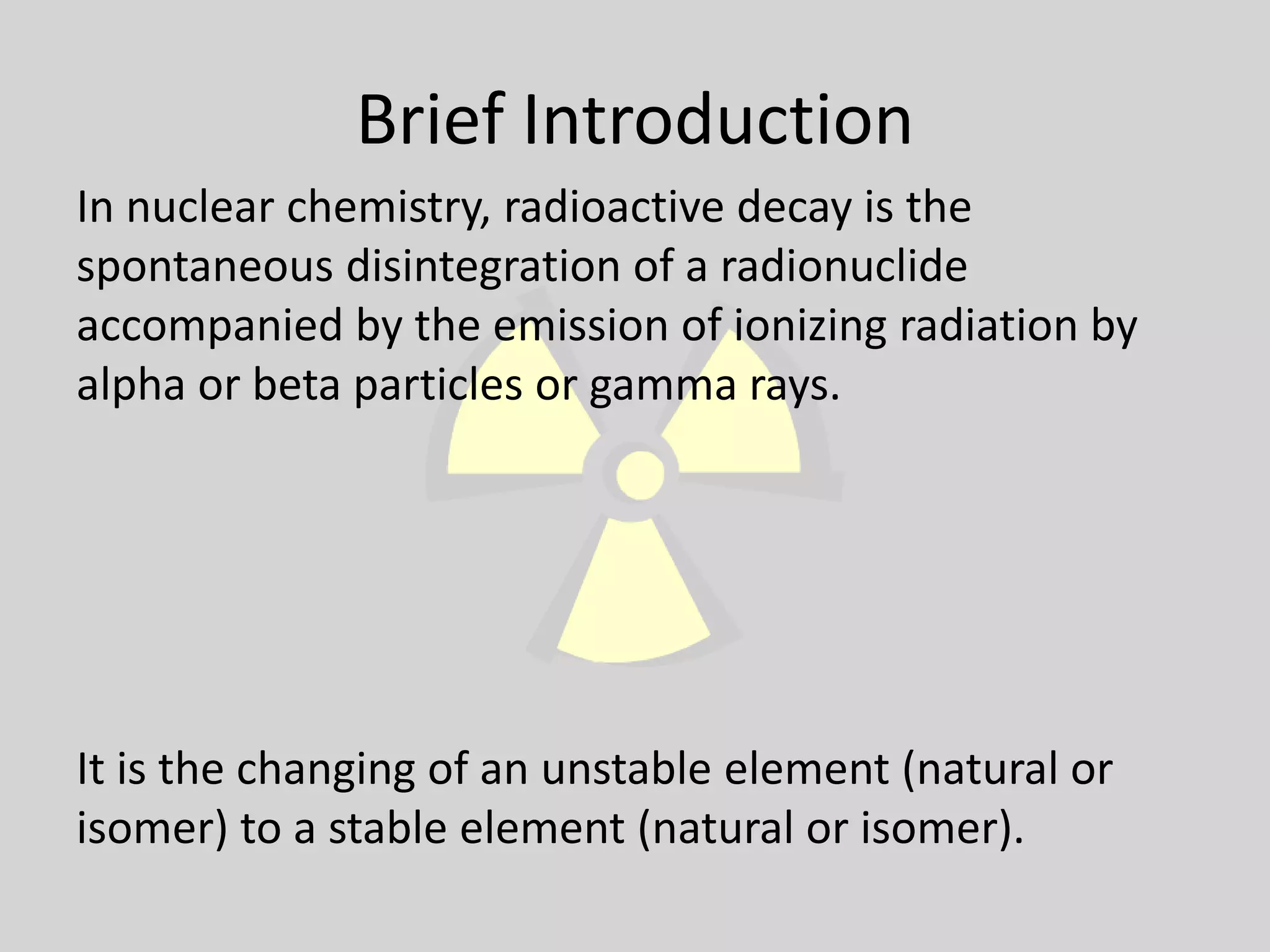
Brief Introduction
In nuclear chemistry, radioactive decay is the
spontaneous disintegration of a radionuclide
accompanied by the emission of ionizing radiation by
alpha or beta particles or gamma rays.


It is the changing of an unstable element (natural or
isomer) to a stable element (natural or isomer).
Notation
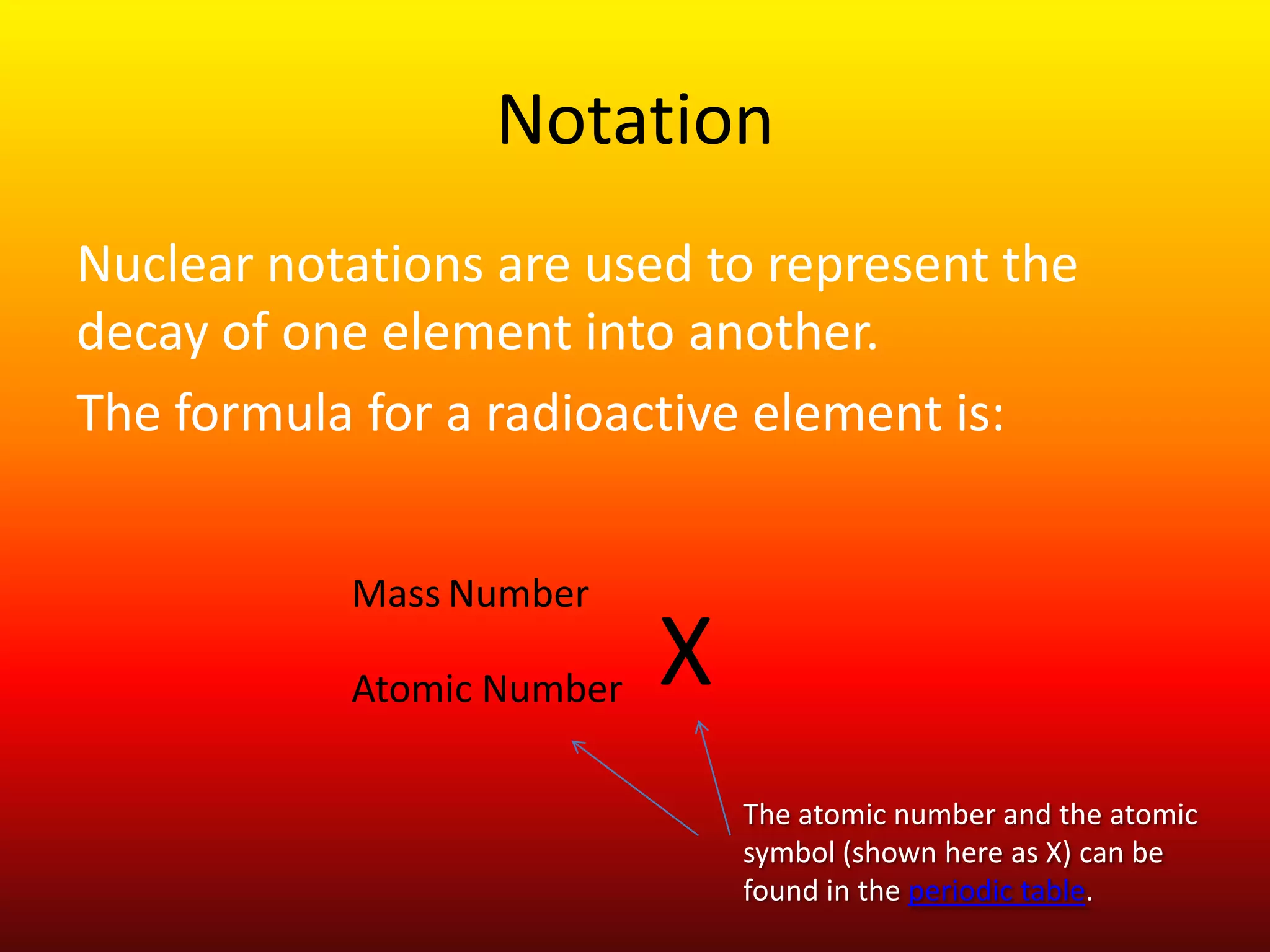
Nuclear notations are used to represent the
decay of one element into another.
The formula for a radioactive element is:


           Mass Number

           Atomic Number   X
                               The atomic number and the atomic
                               symbol (shown here as X) can be
                               found in the periodic table.
Alpha Decay
Alpha decay (α) occurs when the nucleus has
too many protons, causing excessive repulsion.
A Helium nucleus is emitted, stabilizing the
nucleus.


                         263        259          4
                               Sg         Rf +       He
                         106        104          2
                                                          This can also be
This is the new atomic number                             written as: 4
and can be found in the periodic                                             α
                                                                       2
table.
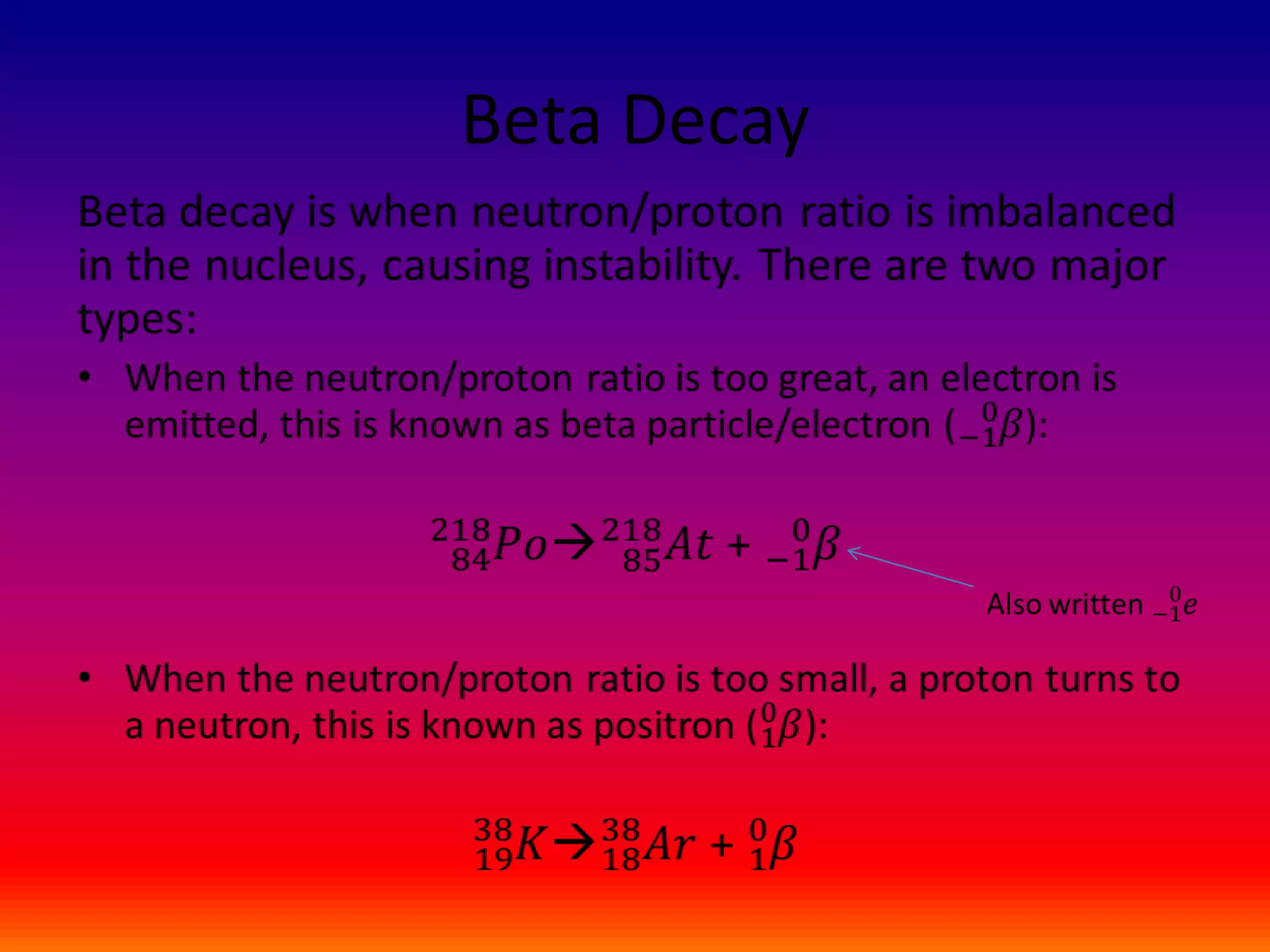
Beta Decay
Gamma Decay
Conclusion
Radioactive decay is an important topic in
nuclear chemistry. It helps to understand
everything from X-rays to Nuclear Energy.


For further information on this interesting topic,
visit the Three Types of Radioactive Decay
Webpage or go here for an awesome song.
Resources
“Periodic Table.” (2012). Retrieved 9 May 2012 from http://www.ptable.com/

“Radioactive Decay.” (2012). Retrieved 5 May 2012 from
   http://chemed.chem.purdue.edu/genchem/topicreview/bp/ch23/modes.
   php#beta

“Three Types of Radioactive Decay.” (2012). Retrieved 6 May 2012 from
   http://library.thinkquest.org/3471/radiation_types_body.html

Tro, Nivaldo. Principles of Chemistry: A Molecular Approach (1st ed.).
   Upper Saddle River: Prentice Hall, 2009. Print.

Nuclear chemistry and radioactive decay

  • 1.
    Nuclear Chemistry and Radioactive Decay By Christa Ross OECS 110 A70 Final Project
  • 2.
    Brief Introduction In nuclearchemistry, radioactive decay is the spontaneous disintegration of a radionuclide accompanied by the emission of ionizing radiation by alpha or beta particles or gamma rays. It is the changing of an unstable element (natural or isomer) to a stable element (natural or isomer).
  • 3.
    Notation Nuclear notations areused to represent the decay of one element into another. The formula for a radioactive element is: Mass Number Atomic Number X The atomic number and the atomic symbol (shown here as X) can be found in the periodic table.
  • 4.
    Alpha Decay Alpha decay(α) occurs when the nucleus has too many protons, causing excessive repulsion. A Helium nucleus is emitted, stabilizing the nucleus. 263 259 4 Sg Rf + He 106 104 2 This can also be This is the new atomic number written as: 4 and can be found in the periodic α 2 table.
  • 5.
  • 6.
  • 7.
    Conclusion Radioactive decay isan important topic in nuclear chemistry. It helps to understand everything from X-rays to Nuclear Energy. For further information on this interesting topic, visit the Three Types of Radioactive Decay Webpage or go here for an awesome song.
  • 8.
    Resources “Periodic Table.” (2012).Retrieved 9 May 2012 from http://www.ptable.com/ “Radioactive Decay.” (2012). Retrieved 5 May 2012 from http://chemed.chem.purdue.edu/genchem/topicreview/bp/ch23/modes. php#beta “Three Types of Radioactive Decay.” (2012). Retrieved 6 May 2012 from http://library.thinkquest.org/3471/radiation_types_body.html Tro, Nivaldo. Principles of Chemistry: A Molecular Approach (1st ed.). Upper Saddle River: Prentice Hall, 2009. Print.