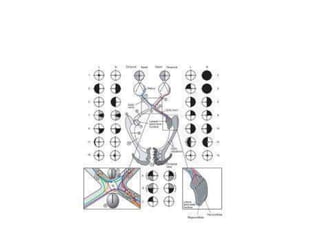
Pupillary pathway & Field Defects
Dr. K. Srikanth MS;D.O;DNB;
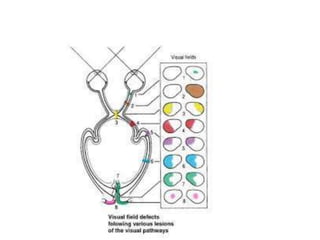
Monocular blindness
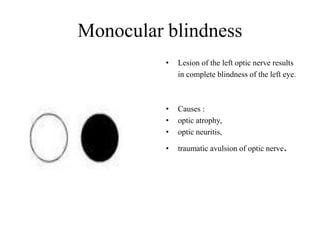
• Lesion of the left optic nerve results
in complete blindness of the left eye.
• Causes :
• optic atrophy,
• optic neuritis,
• traumatic avulsion of optic nerve.
Bitemporal hemianopsia
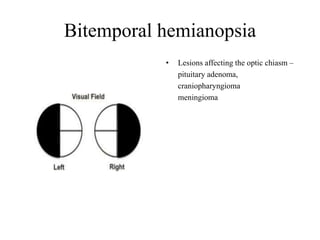
• Lesions affecting the optic chiasm –
pituitary adenoma,
craniopharyngioma
meningioma
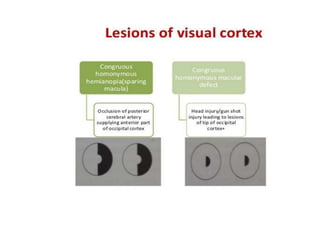
Homonymous Hemianopia
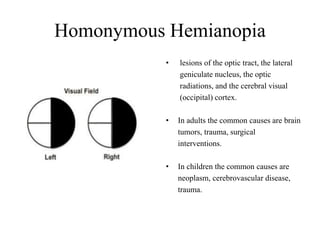
• lesions of the optic tract, the lateral
geniculate nucleus, the optic
radiations, and the cerebral visual
(occipital) cortex.
• In adults the common causes are brain
tumors, trauma, surgical
interventions.
• In children the common causes are
neoplasm, cerebrovascular disease,
trauma.
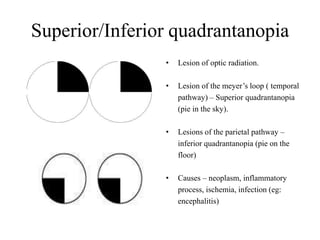
Superior/Inferior quadrantanopia
• Lesion of optic radiation.
• Lesion of the meyer’s loop ( temporal
pathway) – Superior quadrantanopia
(pie in the sky).
• Lesions of the parietal pathway –
inferior quadrantanopia (pie on the
floor)
• Causes – neoplasm, inflammatory
process, ischemia, infection (eg:
encephalitis)
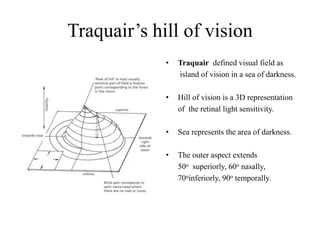
Traquair’s hill of vision
• Traquair defined visual field as
island of vision in a sea of darkness.
• Hill of vision is a 3D representation
of the retinal light sensitivity.
• Sea represents the area of darkness.
• The outer aspect extends
50o superiorly, 60o nasally,
70oinferiorly, 90o temporally.
Perimetry
• Perimetry is the measurement of visual functions of the eye
at topographically defined loci in the visual field.
• Usually each eye is tested separately, however when both eyes
are tested together it is binocular field of vision.
• Types of perimetry – kinetic, static, suprathreshold, threshold
Kinetic perimetry
• It is a 2D assessment of boundary of hill of vision
• Moving stimulus of known intensity ( luminance ) is presented
from non seeing area to a seeing area until it is perceived.
• Stimulus is moved at a steady speed
• Point of perception is recorded on a chart
• Goldmann perimeter most commonly used.
Static perimetry
• Location of stimulus remains fixed.
• The intensity of stimulus is increased until it is seen by the
subject or decreased until it is no longer seen.
• Most commonly used automated perimeter is the Humphrey
Field Analyzer (HFA)
• Others – Henson, Dicon & Octopus
Important questions
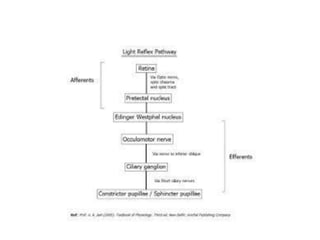
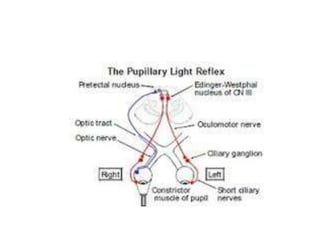
• Draw dig. of pupillary light reflex?
• Enumerate any 4 field defects of the visual pathway?
• What are the causes of monocular blindness?
• What are the causes of homonymous hemianopia?
• What are the causes of bitemporal hemianopsia?
• What are the causes of quadrantanopia?
• What are the field defects seen in case of a lesion in the visual
cortex and their causes?
Pupillary pathway & field defects dr.k.srikanth-25.05.16

Pupillary pathway & field defects dr.k.srikanth-25.05.16

  • 1.
    Pupillary pathway &Field Defects Dr. K. Srikanth MS;D.O;DNB;
  • 6.
    Monocular blindness • Lesionof the left optic nerve results in complete blindness of the left eye. • Causes : • optic atrophy, • optic neuritis, • traumatic avulsion of optic nerve.
  • 7.
    Bitemporal hemianopsia • Lesionsaffecting the optic chiasm – pituitary adenoma, craniopharyngioma meningioma
  • 8.
    Homonymous Hemianopia • lesionsof the optic tract, the lateral geniculate nucleus, the optic radiations, and the cerebral visual (occipital) cortex. • In adults the common causes are brain tumors, trauma, surgical interventions. • In children the common causes are neoplasm, cerebrovascular disease, trauma.
  • 9.
    Superior/Inferior quadrantanopia • Lesionof optic radiation. • Lesion of the meyer’s loop ( temporal pathway) – Superior quadrantanopia (pie in the sky). • Lesions of the parietal pathway – inferior quadrantanopia (pie on the floor) • Causes – neoplasm, inflammatory process, ischemia, infection (eg: encephalitis)
  • 11.
    Traquair’s hill ofvision • Traquair defined visual field as island of vision in a sea of darkness. • Hill of vision is a 3D representation of the retinal light sensitivity. • Sea represents the area of darkness. • The outer aspect extends 50o superiorly, 60o nasally, 70oinferiorly, 90o temporally.
  • 12.
    Perimetry • Perimetry isthe measurement of visual functions of the eye at topographically defined loci in the visual field. • Usually each eye is tested separately, however when both eyes are tested together it is binocular field of vision. • Types of perimetry – kinetic, static, suprathreshold, threshold
  • 13.
    Kinetic perimetry • Itis a 2D assessment of boundary of hill of vision • Moving stimulus of known intensity ( luminance ) is presented from non seeing area to a seeing area until it is perceived. • Stimulus is moved at a steady speed • Point of perception is recorded on a chart • Goldmann perimeter most commonly used.
  • 14.
    Static perimetry • Locationof stimulus remains fixed. • The intensity of stimulus is increased until it is seen by the subject or decreased until it is no longer seen. • Most commonly used automated perimeter is the Humphrey Field Analyzer (HFA) • Others – Henson, Dicon & Octopus
  • 15.
    Important questions • Drawdig. of pupillary light reflex? • Enumerate any 4 field defects of the visual pathway? • What are the causes of monocular blindness? • What are the causes of homonymous hemianopia? • What are the causes of bitemporal hemianopsia? • What are the causes of quadrantanopia? • What are the field defects seen in case of a lesion in the visual cortex and their causes?