Presentation on PROPTOSIS
Sharanya Rajan
Definition
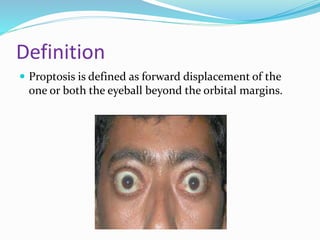
 Proptosis is defined as forward displacement of the
one or both the eyeball beyond the orbital margins.
 Among adults, the usual distance from the lateral
orbital rim to the corneal apex is approximately 16
mm-21 mm.
 Proptosis-
 1.protrusion more than 22mm
 beyond the orbital rim.
 2.An asymmetry of more than 2 mm
 between the eyes.
How is it different from exopthalmos
 the word exophthalmos for those cases of proptosis
secondary to endocrinological dysfunction
 Therefore the dictum is-non–endocrine mediated
globe protrusion will be referred to as proptosis and
exophthalmos will be reserved for protrusion
secondary to endocrinopathies
Classification of proptosis
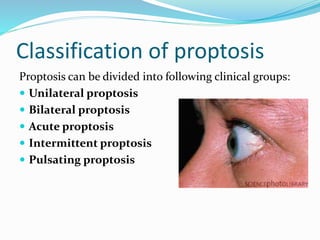
Proptosis can be divided into following clinical groups:
 Unilateral proptosis
 Bilateral proptosis
 Acute proptosis
 Intermittent proptosis
 Pulsating proptosis
ETIOLOGY
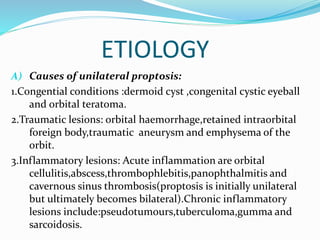
A) Causes of unilateral proptosis:
1.Congential conditions :dermoid cyst ,congenital cystic eyeball
and orbital teratoma.
2.Traumatic lesions: orbital haemorrhage,retained intraorbital
foreign body,traumatic aneurysm and emphysema of the
orbit.
3.Inflammatory lesions: Acute inflammation are orbital
cellulitis,abscess,thrombophlebitis,panophthalmitis and
cavernous sinus thrombosis(proptosis is initially unilateral
but ultimately becomes bilateral).Chronic inflammatory
lesions include:pseudotumours,tuberculoma,gumma and
sarcoidosis.
4.Circulatory disturbances and vascular lesions.These
are:angioneurotic oedema,orbital varix and
aneurysms.
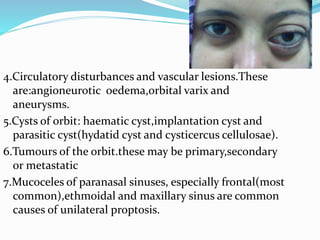
5.Cysts of orbit: haematic cyst,implantation cyst and
parasitic cyst(hydatid cyst and cysticercus cellulosae).
6.Tumours of the orbit.these may be primary,secondary
or metastatic
7.Mucoceles of paranasal sinuses, especially frontal(most
common),ethmoidal and maxillary sinus are common
causes of unilateral proptosis.
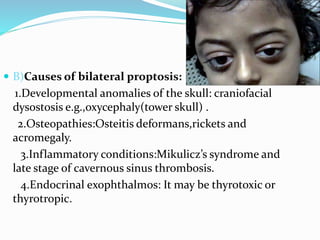
 B)Causes of bilateral proptosis:
1.Developmental anomalies of the skull: craniofacial
dysostosis e.g.,oxycephaly(tower skull) .
2.Osteopathies:Osteitis deformans,rickets and
acromegaly.
3.Inflammatory conditions:Mikulicz’s syndrome and
late stage of cavernous sinus thrombosis.
4.Endocrinal exophthalmos: It may be thyrotoxic or
thyrotropic.
5.Tumours:Symmetrical lymphoma or lymph sarcoma,
secondaries from
neuroblastoma,nephroblastoma,Ewing’s sarcoma and
leukaemic infiltration.
6.Systemic diseases: Histiocytosis,systemic
amyloidosis,xanthomatosis and Wegener’s
granulomatosis.
 C) Causes of acute proptosis: orbital emphysema, fracture of
the medial orbital wall, orbital haemorrhage and rupture of
ethmoidal mucocele.
 D) Causes of intermittent proptosis: orbital varix, periodic
orbital oedema, recurrent orbital haemorrhage and highly
vascular tumours.
 E) Causes of pulsating proptosis: 1) It is caused by pulsating
vascular lesions such as caroticocavernous fistula and saccular
aneurysm of ophthalmic artery.
2) Pulsating proptosis can also occur due to transmitted
cerebral pulsations in conditions associated with deficient
orbital roof. These include congenital meningocele or
meningoencephalocele, neurofibromatosis and traumatic or
operative hiatus.
Picture of acute proptosis
Acute proptosis with periorbital oedema,
chemosis and dilated episclearl vessels.
Picture of Intermittent proptosis
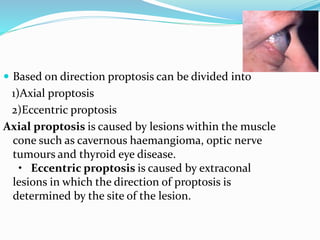
 Based on direction proptosis can be divided into
1)Axial proptosis
2)Eccentric proptosis
Axial proptosis is caused by lesions within the muscle
cone such as cavernous haemangioma, optic nerve
tumours and thyroid eye disease.
• Eccentric proptosis is caused by extraconal
lesions in which the direction of proptosis is
determined by the site of the lesion.
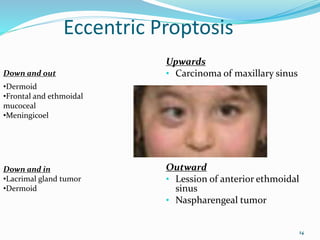
Eccentric Proptosis
14
Upwards
• Carcinoma of maxillary sinus
Outward
• Lession of anterior ethmoidal
sinus
• Naspharengeal tumor
•Dermoid
•Frontal and ethmoidal
mucoceal
•Meningicoel
Down and out
Down and in
•Lacrimal gland tumor
•Dermoid
Measurement of proptosis
 Exophthalmometry
It measures protrusion of apex of cornea from outer
orbital margin (with eyes looking straight
ahead).Normal values vary between 10 and 21 mm
and are symmetrical in both eyes. A difference of
more than 2mm between two eyes is considered
significant
 The simplest instrument to measure proptosis is
1. Luedde’s exophthalmometer
2. Hertel’s exophthalmometer is the most
commonly used instrument.
A Helter exophthalmometer in use
Luedde’s exophthalmometer
3. CT Scan-Brain, orbit
4. MRI Brain
Proptosis

Proptosis

  • 1.
  • 2.
    Definition  Proptosis isdefined as forward displacement of the one or both the eyeball beyond the orbital margins.
  • 3.
     Among adults,the usual distance from the lateral orbital rim to the corneal apex is approximately 16 mm-21 mm.  Proptosis-  1.protrusion more than 22mm  beyond the orbital rim.  2.An asymmetry of more than 2 mm  between the eyes.
  • 4.
    How is itdifferent from exopthalmos  the word exophthalmos for those cases of proptosis secondary to endocrinological dysfunction  Therefore the dictum is-non–endocrine mediated globe protrusion will be referred to as proptosis and exophthalmos will be reserved for protrusion secondary to endocrinopathies
  • 5.
    Classification of proptosis Proptosiscan be divided into following clinical groups:  Unilateral proptosis  Bilateral proptosis  Acute proptosis  Intermittent proptosis  Pulsating proptosis
  • 6.
    ETIOLOGY A) Causes ofunilateral proptosis: 1.Congential conditions :dermoid cyst ,congenital cystic eyeball and orbital teratoma. 2.Traumatic lesions: orbital haemorrhage,retained intraorbital foreign body,traumatic aneurysm and emphysema of the orbit. 3.Inflammatory lesions: Acute inflammation are orbital cellulitis,abscess,thrombophlebitis,panophthalmitis and cavernous sinus thrombosis(proptosis is initially unilateral but ultimately becomes bilateral).Chronic inflammatory lesions include:pseudotumours,tuberculoma,gumma and sarcoidosis.
  • 7.
    4.Circulatory disturbances andvascular lesions.These are:angioneurotic oedema,orbital varix and aneurysms. 5.Cysts of orbit: haematic cyst,implantation cyst and parasitic cyst(hydatid cyst and cysticercus cellulosae). 6.Tumours of the orbit.these may be primary,secondary or metastatic 7.Mucoceles of paranasal sinuses, especially frontal(most common),ethmoidal and maxillary sinus are common causes of unilateral proptosis.
  • 8.
     B)Causes ofbilateral proptosis: 1.Developmental anomalies of the skull: craniofacial dysostosis e.g.,oxycephaly(tower skull) . 2.Osteopathies:Osteitis deformans,rickets and acromegaly. 3.Inflammatory conditions:Mikulicz’s syndrome and late stage of cavernous sinus thrombosis. 4.Endocrinal exophthalmos: It may be thyrotoxic or thyrotropic.
  • 9.
    5.Tumours:Symmetrical lymphoma orlymph sarcoma, secondaries from neuroblastoma,nephroblastoma,Ewing’s sarcoma and leukaemic infiltration. 6.Systemic diseases: Histiocytosis,systemic amyloidosis,xanthomatosis and Wegener’s granulomatosis.
  • 10.
     C) Causesof acute proptosis: orbital emphysema, fracture of the medial orbital wall, orbital haemorrhage and rupture of ethmoidal mucocele.  D) Causes of intermittent proptosis: orbital varix, periodic orbital oedema, recurrent orbital haemorrhage and highly vascular tumours.  E) Causes of pulsating proptosis: 1) It is caused by pulsating vascular lesions such as caroticocavernous fistula and saccular aneurysm of ophthalmic artery. 2) Pulsating proptosis can also occur due to transmitted cerebral pulsations in conditions associated with deficient orbital roof. These include congenital meningocele or meningoencephalocele, neurofibromatosis and traumatic or operative hiatus.
  • 11.
    Picture of acuteproptosis Acute proptosis with periorbital oedema, chemosis and dilated episclearl vessels.
  • 12.
  • 13.
     Based ondirection proptosis can be divided into 1)Axial proptosis 2)Eccentric proptosis Axial proptosis is caused by lesions within the muscle cone such as cavernous haemangioma, optic nerve tumours and thyroid eye disease. • Eccentric proptosis is caused by extraconal lesions in which the direction of proptosis is determined by the site of the lesion.
  • 14.
    Eccentric Proptosis 14 Upwards • Carcinomaof maxillary sinus Outward • Lession of anterior ethmoidal sinus • Naspharengeal tumor •Dermoid •Frontal and ethmoidal mucoceal •Meningicoel Down and out Down and in •Lacrimal gland tumor •Dermoid
  • 15.
    Measurement of proptosis Exophthalmometry It measures protrusion of apex of cornea from outer orbital margin (with eyes looking straight ahead).Normal values vary between 10 and 21 mm and are symmetrical in both eyes. A difference of more than 2mm between two eyes is considered significant
  • 16.
     The simplestinstrument to measure proptosis is 1. Luedde’s exophthalmometer 2. Hertel’s exophthalmometer is the most commonly used instrument. A Helter exophthalmometer in use Luedde’s exophthalmometer
  • 17.
    3. CT Scan-Brain,orbit 4. MRI Brain