CHRONIC SUPPURATIVE
OTITIS MEDIA –
TUBOTYMPANIC DISEASE
DR.BINI MOHAN
OBJECTIVES:
At the end of this class, you should be able
to describe:
•Lining epithelium of the middle ear cleft
•Definition of CSOM
•Types of CSOM and clinical features of
Tubotympanic disease(TTD)
•Types of perforation.
•Investigations for CSOM-TTD
•Treatment of CSOM-TTD
RELEVANT ANATOMY
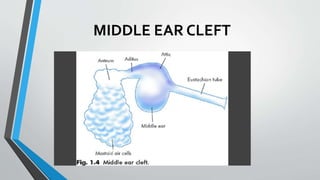
MIDDLE EAR CLEFT
LINING EPITHELIUM OF MIDDLE EAR
CLEFT
•Antero inferiorly – ciliated columnar epithelium
•Posteriorly – cuboidal type
•Epitympanum and mastoid air cells – flat
nonciliated epithelium (pavement epithelium)
Definition
•Chronic suppurative otitis media is a long
standing infection of a part or whole of the
middle ear cleft characterised by continuous
or intermittent discharge through a
persistent tympanic membrane perforation.
EPIDEMIOLOGY
•Incidence is higher in developing countries
•Predisposing factors : Poor socio-economic
status, poor nutrition, lack of health education
•Affects both sexes
•All age groups
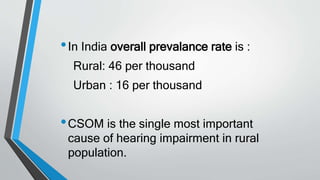
•In India overall prevalance rate is :
Rural: 46 per thousand
Urban : 16 per thousand
•CSOM is the single most important
cause of hearing impairment in rural
population.
TYPES OF CSOM
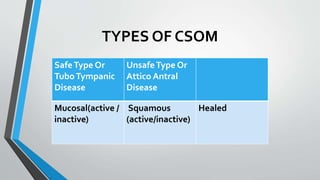
SafeType Or
TuboTympanic
Disease
UnsafeType Or
Attico Antral
Disease
Mucosal(active /
inactive)
Squamous
(active/inactive)
Healed
TUBOTYMPANIC DISEASE
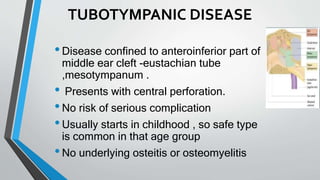
•Disease confined to anteroinferior part of
middle ear cleft -eustachian tube
,mesotympanum .
• Presents with central perforation.
•No risk of serious complication
•Usually starts in childhood , so safe type
is common in that age group
•No underlying osteitis or osteomyelitis
AETIOLOGY
1)Via tympanic membrane perforation
•Following A.S.O.M. or post-traumatic
(traumatic perforation)
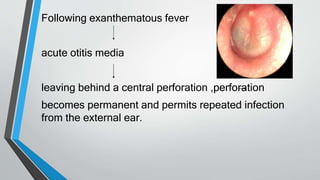
Following exanthematous fever
acute otitis media
leaving behind a central perforation ,perforation
becomes permanent and permits repeated infection
from the external ear.
•Middle ear mucosa is exposed to the
environment and gets sensitized to dust ,pollen
and other aeroallergens causing persistent
otorrhoea.
2 ) Via Eustachian tube
• Infection of tonsils, adenoids
,sinusitis, regurgitation of milk.
3)Allergy to ingestants such as milk
,eggs,fish,etc
BACTERIOLOGY
•Pseudomonas aeruginosa
•Proteus aerobic
•Escherichia.coli
•Staphylococcus Aureus
•Bacteroides fragilis
•Anaerobic streptococci anaerobic
Clinical Features
SYMPTOMS
•Ear discharge
•Hearing loss
•SIGNS:
Ear discharge: profuse, mucoid to mucopurulent
,odourless, non blood stained, constant or
intermittent
•Hearing Loss:
•Usually conductive (25-50 dB) but might
be normal in small, dry perforations.
•Round window shielding by ear
discharge leads to better hearing in acute
exacerbations.
ROUND WINDOW SHIELDING
EFFECT
•Patient hears better in the presence of
discharge rather than dry ear
• Effect is produced by discharge, by
maintaining phase differential
•In dry ear, sound waves strike both the Oval
and Round windows simultaneously, thus
cancelling each other’s effect with no
movement of perilymph, and thus, no
hearing.
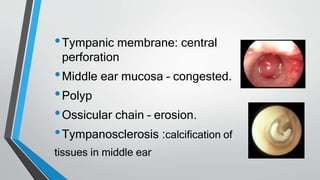
•Tympanic membrane: central
perforation
•Middle ear mucosa – congested.
•Polyp
•Ossicular chain – erosion.
•Tympanosclerosis :calcification of
tissues in middle ear
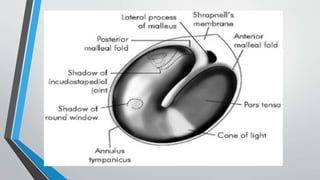
Perforations of Pars Tensa in CSOM TT
LAYERS OFTYMPANIC MEMBRANE
• Outer epithelial layer : continuous with skin .
• Middle fibrous layer : which encloses the handle of
malleus and has three types of fibres –radial, circular and
parabolic.
• Inner mucosal layer :continuous with the mucosa of the
middle ear
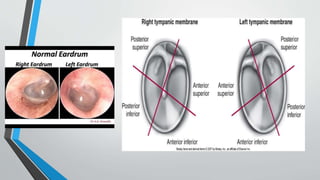
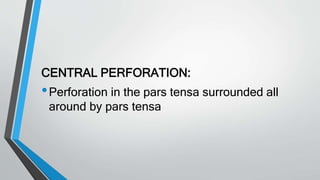
CENTRAL PERFORATION:
•Perforation in the pars tensa surrounded all
around by pars tensa
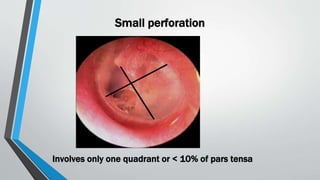
Involves only one quadrant or < 10% of pars tensa
Small perforation
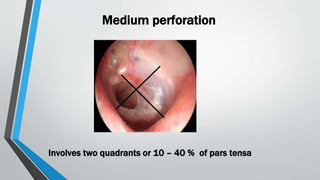
Medium perforation
Involves two quadrants or 10 – 40 % of pars tensa
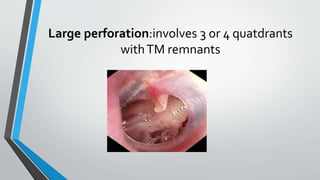
Large perforation:involves 3 or 4 quatdrants
withTM remnants
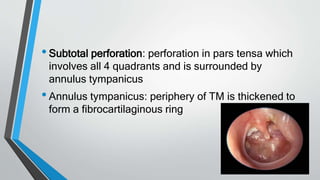
•Subtotal perforation: perforation in pars tensa which
involves all 4 quadrants and is surrounded by
annulus tympanicus
•Annulus tympanicus: periphery of TM is thickened to
form a fibrocartilaginous ring
•Total perforation :perforation in the pars tensa
which involves all 4 quadrants with destruction
annulus tympanicous
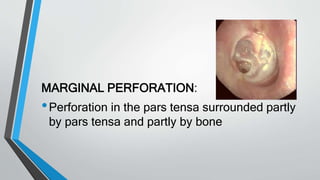
MARGINAL PERFORATION:
•Perforation in the pars tensa surrounded partly
by pars tensa and partly by bone
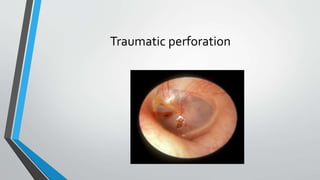
Traumatic perforation
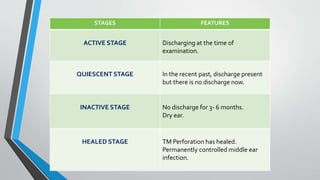
STAGES FEATURES
ACTIVE STAGE Discharging at the time of
examination.
QUIESCENT STAGE In the recent past, discharge present
but there is no discharge now.
INACTIVE STAGE No discharge for 3- 6 months.
Dry ear.
HEALED STAGE TM Perforation has healed.
Permanently controlled middle ear
infection.
Investigations
•Examination under microscope
• Ear discharge swab: for culture
sensitivity
•Pure tone audiometry
•X-ray mastoid
Treatment of CSOM Tubo-tympanic
Disease
•Short term goals :
Elimination of infection
Control of otorrhoea
•Long term goals :-
Improvement of hearing
Eventual healing of TM
Non-surgical Treatment
•Precautions
•Aural toilet
•Antibiotics : Systemic & Topical
•Antihistamines : Systemic & Topical
•Nasal decongestants : Systemic & Topical
•Treatment of respiratory infection & allergy
Precautions
•Encourage breast feeding with child’s
head raised. Avoid bottle feeding
•Avoid forceful nose blowing
•Plug E.A.C. with Vaseline smeared
cotton while bathing & avoid swimming
•Avoid putting oil , water or self-
cleaning of ear
• Done only for active stage
• Dry mopping with cotton swab
• Suction clearance: best method
• Gentle irrigation (wet mopping)
Aural Toilet
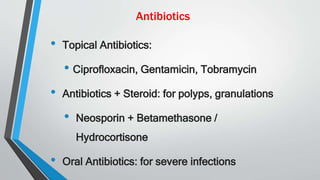
Antibiotics
• Topical Antibiotics:
• Ciprofloxacin, Gentamicin, Tobramycin
• Antibiotics + Steroid: for polyps, granulations
• Neosporin + Betamethasone /
Hydrocortisone
• Oral Antibiotics: for severe infections
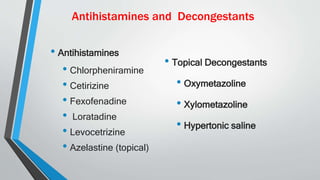
Antihistamines and Decongestants
• Antihistamines
• Chlorpheniramine
• Cetirizine
• Fexofenadine
• Loratadine
• Levocetrizine
• Azelastine (topical)
• Topical Decongestants
• Oxymetazoline
• Xylometazoline
• Hypertonic saline
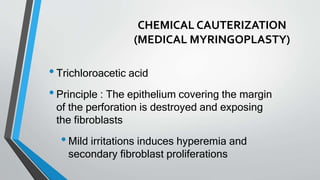
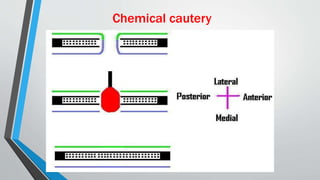
CHEMICAL CAUTERIZATION
(MEDICAL MYRINGOPLASTY)
•Trichloroacetic acid
•Principle : The epithelium covering the margin
of the perforation is destroyed and exposing
the fibroblasts
•Mild irritations induces hyperemia and
secondary fibroblast proliferations
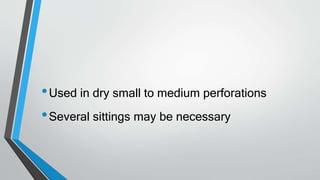
•Used in dry small to medium perforations
•Several sittings may be necessary
Chemical cautery
Surgical Treatment
•Indicated in inactive or quiescent stage
•Myringoplasty
•Tympanoplasty
•Indicated in active stage
•Cortical Mastoidectomy
•Aural polypectomy
Myringoplasty
Surgical closure of perforation of
pars tensa of Tympanic
membrane without ossicular
reconstruction
Aims
• Permanently stop ear discharge : make the ear dry and safe
• Improve hearing if ossicles are intact and mobile and there is
absence of sensori-neural deafness
• Prevention of ongoing complications like further hearing loss,
tympanosclerosis, adhesions, mucosal bands, vertigo
• Wearing of hearing aid
• Occupational: military, pilots
• Recreation: swimming, diving
MYRINGOPLASTY
•Prerequisites
•Dry ear
•Good cochlear reserve
•Normal ET function
•Predominantly conductive hearing loss
•No cholesteatoma
Contraindications
• Purulent ear discharge
• Otitis externa
• Respiratory allergy
• Age < 7 yr (Eustachian tube not fully developed)
• Only hearing ear
• Cholesteatoma
Methods
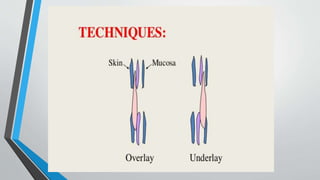
Techniques
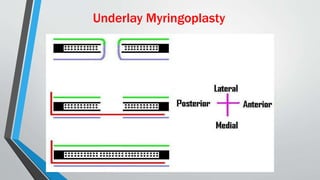
• Underlay: graft placed medial to fibrous annulus
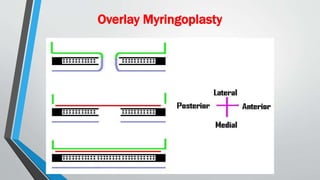
• Overlay: graft placed lateral to fibrous annulus
Grafts used
• Temporalis fascia, Tragal perichondrium, Vein graft,
Fascia lata, Dura mater
Overlay Myringoplasty
Underlay Myringoplasty
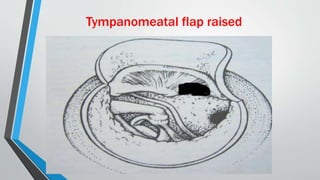
Steps of underlay
Myringoplasty
Tympanomeatal flap raised
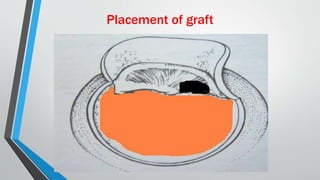
Placement of graft
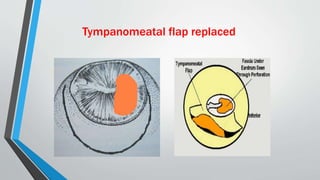
Tympanomeatal flap replaced
Why temporalis fascia?
•Basal metabolic rate lowest (best survival
rate)
•Easy to harvest
•Large size graft can be harvested
•Autograft, so no rejection
•Same thickness as normal tympanic
membrane
•Good resistance to infection
TYMPANOPLASTY
•An operation performed to eradicate disease in the
middle ear and to reconstruct the hearing
mechanisms with out mastoid surgery, with or
without TM grafting
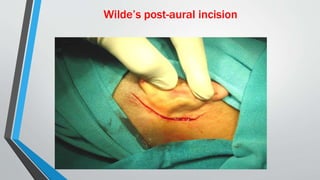
Wilde’s post-aural incision
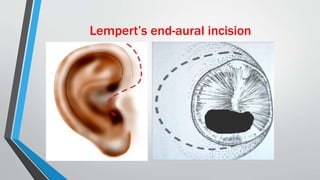
Lempert’s end-aural incision
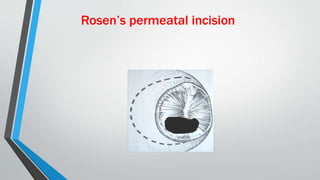
Rosen’s permeatal incision
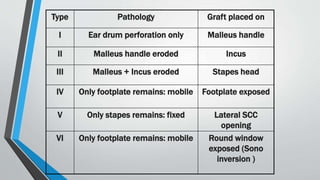
Tympanoplasty
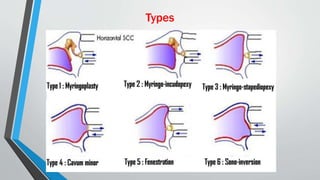
Types
Type Pathology Graft placed on
I Ear drum perforation only Malleus handle
II Malleus handle eroded Incus
III Malleus + Incus eroded Stapes head
IV Only footplate remains: mobile Footplate exposed
V Only stapes remains: fixed Lateral SCC
opening
VI Only footplate remains: mobile Round window
exposed (Sono
inversion )
Thank you

Csom.dr.bini,03.04.17